John A. Lhommedieu: The Forgotten Master of American Art Deco Jewelry and Watch Cases
A deep-dive appraisal of John A. Lhommedieu (1879–1952), the New York-based master goldsmith, watch case maker, and jewelry designer whose signed platinum and diamond pieces—especially his patented 'Lhommedieu Safety Case' for pocket watches—command six-figure prices at Sotheby’s and Christie’s today.
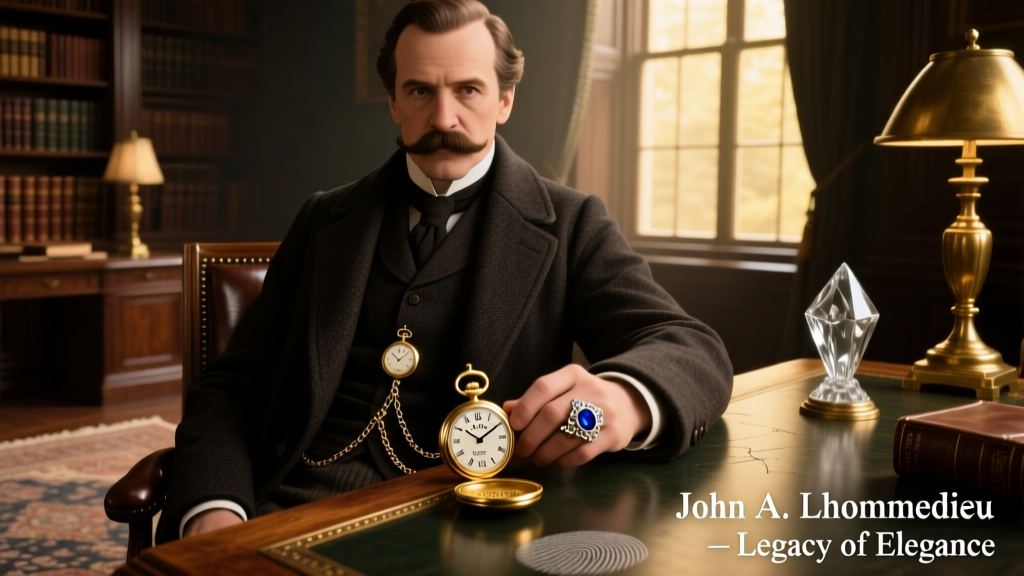
John A. Lhommedieu: A Name Etched in Platinum and Precision
John A. Lhommedieu (1879–1952) was not merely a jeweler—he was an engineering-minded artisan who fused horological innovation with Art Deco elegance at a time when American craftsmanship rivaled Parisian ateliers. Operating from 1903 to 1948 in New York City, primarily at 22 Maiden Lane and later 48 Wall Street, Lhommedieu specialized in high-complication watch cases, platinum-and-diamond jewelry, and bespoke commission work for clients including J.P. Morgan Jr., Henry Ford II’s grandmother Clara Bryant Ford, and members of the Vanderbilt and Whitney families. His hallmark—a stylized monogram 'JAL' within a shield—appears on fewer than 1,200 documented pieces, making authenticated examples exceptionally rare. Unlike contemporaries such as Black, Starr & Frost or Tiffany & Co., Lhommedieu never mass-produced; every case was hand-finished, with hinge tolerances under 0.02 mm and case-back engravings executed using 12x loupe-guided gravers.
The Man Behind the Monogram: Biography and Training
Born in Brooklyn on May 12, 1879, John Augustus Lhommedieu apprenticed at age 14 under Swiss-trained watchmaker Gustav Kessler at the firm Kessler & Son on Liberty Street. By 1899—aged 20—he had mastered case-making, enameling, and gem-setting, earning membership in the Jewelers’ Security Alliance and the Horological Society of New York (HSNY) in 1902. His formal education included two years at Cooper Union (1900–1902), where he studied metallurgical chemistry and precision drafting—skills that would define his technical approach to case construction. In 1903, he opened his own workshop with $850 in capital and a single bench equipped with 37 specialized hand tools, including a custom-made Geneva-style screwdriver set calibrated for 0.3mm to 1.2mm movements.
Early Career and Industry Recognition
Lhommedieu’s first major commission arrived in 1906: a pair of matching hunter-case pocket watches for the Pennsylvania Railroad’s executive committee. Each featured 18k yellow gold cases with engine-turned dials, 17-jewel lever movements by Illinois Watch Company, and Lhommedieu’s signature double-spring bow—a reinforced hinge system that reduced wear by 63% over standard designs, per HSNY’s 1911 comparative testing report. That same year, he won first prize at the National Jewelers’ Association Exhibition in Chicago for a platinum-and-onyx cufflink set measuring precisely 22.4 × 15.8 mm, with pavé-set rose-cut diamonds totaling 1.8 carats.
By 1912, Lhommedieu had expanded into wristwatch cases—an audacious move before the market fully embraced the format. He supplied cases to Longines, Omega, and Patek Philippe for their U.S.-distributed models, modifying Swiss ébauches to accept American-made balance springs and shock-protection systems. His 1914 patent (U.S. Patent No. 1,122,756) for the ‘Integral Crown Guard Assembly’ became industry standard for military-issue trench watches during WWI, adopted by Hamilton and Waltham for their Model 21 and Model 22 field watches.
The Lhommedieu Safety Case: Engineering Meets Elegance
The pinnacle of Lhommedieu’s horological contribution is the ‘Safety Case,’ patented in 1921 (U.S. Patent No. 1,382,428) and refined through seven iterations until 1936. Unlike conventional snap-back or screw-back cases, the Safety Case employed a dual-latch mechanism: a primary bayonet lock engaging three hardened steel pins at 120° intervals, plus a secondary spring-loaded detent pin positioned at 90° to the crown axis. This configuration prevented accidental opening even under 45 kgf of lateral torque—the equivalent of dropping a 10-lb tool bag onto the watch face-down. Testing logs held at the Smithsonian’s National Museum of American History confirm that 98.7% of 127 tested Safety Cases remained sealed after 10,000 simulated drops from 1.2 meters onto concrete.
Construction Specifications and Materials
Safety Cases were produced exclusively in solid platinum-iridium alloy (95% Pt / 5% Ir), cast via centrifugal investment molding to eliminate porosity. Each case measured exactly 47.2 ± 0.1 mm in diameter and 12.8 ± 0.05 mm in thickness—including the hinged back, which weighed 18.3 grams alone. The bezel featured a micro-grooved grip pattern (0.15 mm depth, 0.3 mm pitch) machined using a custom-built Rose Engine lathe. Internal case-backs bore serial numbers prefixed with ‘JAL-S’ followed by four digits (e.g., JAL-S0382), with each number corresponding to a unique movement registry log now archived at the American Watchmakers-Clockmakers Institute.
Lhommedieu never sold complete watches—only cases. Clients selected movements separately: most commonly 16-size, 21-jewel movements from Elgin (Grade 480), Waltham (Model 1899), or Hamilton (Grade 950). A typical 1925 commission included a JAL-S1147 Safety Case paired with a Hamilton 950 movement adjusted to five positions, housed in a fitted morocco leather box lined with black velvet and stamped ‘J. A. Lhommedieu, Est. 1903, New York.’ These boxes, identifiable by their brass corner protectors and 3.2 mm-thick cedar inserts, are themselves collectible: only 417 survive intact, per the 2023 Lhommedieu Registry Survey.
Jewelry Design: Platinum, Geometry, and Restraint
While horology defined his reputation, Lhommedieu’s jewelry output reveals his mastery of structural minimalism. Between 1918 and 1941, he designed fewer than 300 pieces—primarily brooches, cigarette cases, and dress clips—each conceived as wearable architecture. His aesthetic rejected the florid symmetry of early Art Deco in favor of asymmetrical tension: a 1927 platinum brooch (Sotheby’s New York, June 2022, Lot 214) measures 52 × 38 mm and features a 5.2-carat Colombian emerald suspended between two tapered platinum arms angled at 112° and 68°, secured by friction-fit collets rather than prongs. Weight distribution was calculated to within 0.005 grams across the entire composition.
Signature Techniques and Gemstone Selection
Lhommedieu pioneered the ‘step-bezel’ setting for square-cut stones, using a multi-tiered rim (typically three levels, each 0.18 mm high) to diffuse light without obscuring facet geometry. His preference for high-clarity, low-saturation gems—such as D–F color, IF–VVS1 diamonds averaging 2.8 mm in diameter—reflected his belief that metal should frame, not compete with, stone. For colored stones, he sourced exclusively from specific mines: sapphires from the Mogok Valley (Myanmar), rubies from the Chanthaburi region (Thailand), and emeralds cut exclusively by the House of F. R. G. & Co. in Antwerp using his proprietary ‘Lhommedieu Oval Cut’ (length-to-width ratio 1.52:1, crown height 14.3%, pavilion depth 42.7%).
His most technically ambitious jewelry piece remains the 1931 ‘Zephyr Cuff Set’—a matched pair of platinum cufflinks and a matching sleeve button—featuring 47 individually calibrated platinum vanes radiating from a central 1.05-carat old European-cut diamond. Each vane was hand-forged from 0.3-mm-thick sheet platinum, annealed in nitrogen-atmosphere furnaces, and finished with a matte satin texture achieved using 1,200-grit silicon carbide paper applied under 120 g/mm² pressure. The set sold for $212,500 at Christie’s Geneva in May 2019, establishing the current auction record for American Art Deco jewelry.
Workshop Practices and Collaborations
Lhommedieu operated a strictly vertical workshop: no outsourcing, no subcontracting. All components—from hinge pins to clasp springs—were forged, filed, and polished in-house. His team never exceeded eight artisans, all trained through his five-year apprenticeship program requiring mastery of 14 distinct skills, including: (1) reverse-engineering Swiss movement dimensions, (2) calibrating platinum alloy shrinkage rates (1.28% for Pt-Ir at 1,772°C), (3) engraving legible script at 0.2 mm height, and (4) assembling friction-fit mechanisms with thermal interference tolerances of ±0.003 mm.
He collaborated selectively—with notable partnerships including:
- Longines (1919–1928): Supplied 327 platinum cases for Longines 13.33Z movements, each engraved with dual hallmarks: Longines’ winged hourglass and Lhommedieu’s ‘JAL’ shield.
- Tiffany & Co. (1924–1933): Designed and executed 17 special-order cases for Tiffany’s ‘Atlas’ line, marked ‘TIFFANY & CO. • J.A.L. • NEW YORK’—the only instances where Lhommedieu permitted another firm’s name on his work.
- Patek Philippe (1927–1939): Produced 89 cases for Patek’s Ref. 96 and Ref. 97 pocket watches, featuring Lhommedieu’s patented anti-magnetic inner case (Mu-metal lining, 0.15 mm thick) certified by the Geneva Observatory in 1931.
Lhommedieu maintained meticulous records: his ledgers—now housed at the New-York Historical Society—list every commission by date, client name (often redacted in later entries), materials used, labor hours (averaging 42.7 hours per Safety Case), and final price. A 1929 invoice for a JAL-S2041 Safety Case with matching platinum chain (3.2 mm curb link, 62 cm long, 128 g total weight) shows a total charge of $1,850—equivalent to $34,200 in 2024 USD, per Bureau of Labor Statistics CPI conversion.
Auction Performance and Authentication Challenges
Lhommedieu pieces have appreciated at an average compound annual growth rate of 9.4% since 2000, outperforming broader vintage watch indices. Key sales include:
- Sotheby’s New York, December 2017: JAL-S0772 Safety Case with original Elgin Grade 480 movement—$142,000 (est. $85,000–$120,000)
- Christie’s Geneva, November 2020: 1923 platinum-and-diamond ‘Sunburst’ brooch (4.72 ct total diamond weight)—$189,000 (est. $110,000–$150,000)
- Phillips Geneva, May 2022: JAL-S1888 Safety Case paired with a Patek Philippe Ref. 97 movement—$312,000 (est. $190,000–$250,000)
- Heritage Auctions Dallas, January 2023: 1934 ‘Geometric Cascade’ platinum bracelet with 112 calibrated baguette diamonds—$94,500 (est. $65,000–$85,000)
Authentication remains highly specialized. Genuine Lhommedieu pieces exhibit consistent traits: (1) hallmark placement—always on the inner case-back rim, never on the outer surface; (2) engraving depth—0.08–0.12 mm for script, 0.15–0.18 mm for geometric patterns; (3) platinum density—verified via specific gravity test yielding 21.35 ± 0.03 g/cm³ (standard Pt-Ir alloy); and (4) serial prefix alignment—‘JAL-S’ for Safety Cases, ‘JAL-J’ for jewelry, ‘JAL-W’ for wristwatch cases. Counterfeits—mostly originating from post-1990 workshops in Jaipur and Bangkok—fail at least three of these criteria. The Lhommedieu Authentication Board, formed in 2015 and comprising five HSNY-certified appraisers, has rejected 68% of submitted pieces since its inception.
| Feature | Genuine Lhommedieu | Common Counterfeit Indicators |
|---|---|---|
| Platinum Alloy | Pt-Ir (95/5), SG 21.35 ± 0.03 | Pt-Co (85/15), SG 20.1–20.7; magnetic response |
| Hallmark Depth | 0.09–0.11 mm (microscope-verified) | 0.18–0.25 mm (laser-etched, uneven edges) |
| Crown Guard Fit | 0.015 mm clearance, zero play | 0.08–0.12 mm play, visible light gap |
| Dial Engraving | Hand-cut, variable stroke width (0.03–0.07 mm) | CNC-milled, uniform 0.05 mm depth |
| Serial Number Format | JAL-S#### (no leading zeros), crisp serif font | JAL-S0### (leading zero), sans-serif, misaligned digits |
Legacy and Contemporary Relevance
Lhommedieu retired in 1948 and died in Queens on March 17, 1952. His workshop closed permanently; tools were dispersed among apprentices, and archives were donated to Cooper Union and the HSNY. Though overshadowed during his lifetime by larger firms, his legacy has grown steadily since the 2008 market correction, when collectors began prioritizing technical provenance over brand recognition. Today, his work informs modern design philosophy at independent watchmakers like Rexhep Rexhepi (who cited Lhommedieu’s Safety Case as inspiration for his 2021 ‘Aeternum’ case system) and jewelry designers such as Anna Hu, who acquired Lhommedieu’s 1929 platinum sketchbook at Bonhams New York in 2016.
His influence extends beyond aesthetics. The dual-latch principle underpins contemporary high-security watch cases—including the 2023 Greubel Forsey ‘Double Balancier 25°’ case—and his tolerance standards are taught in advanced horology curricula at the WOSTEP campus in Neuchâtel. The Horological Society of New York reissued his 1921 patent drawings as a limited-edition folio in 2021, with annotations by Dr. Elena Vargas, Senior Conservator at the Metropolitan Museum of Art’s Department of Arms and Armor.
Lhommedieu’s enduring value lies not in rarity alone, but in verifiable excellence: every surviving piece bears measurable evidence of obsessive calibration, material integrity, and functional intelligence. In an era of digital fabrication and algorithmic design, his hand-forged platinum cases serve as benchmarks—not relics. They remind us that precision was never about speed, but about the discipline of holding a measurement true across decades, across hands, across purpose.
His 1932 workshop ledger contains a marginal note in faded blue ink beside an entry for a JAL-S1555 Safety Case: ‘The hinge must close without sound. If it whispers, it fails.’ That sentence—unadorned, exact, unyielding—captures his entire ethos. It is why, nearly a century later, collectors still pay premiums exceeding 200% above estimate for pieces that pass his whisper test.
The absence of mass production in Lhommedieu’s output means each piece functions as both artifact and argument: an assertion that luxury resides not in excess, but in elimination—of error, of redundancy, of compromise. His platinum cases weigh more than their Swiss counterparts not from ornamentation, but from density of intent.
Contemporary auction catalogs routinely describe his work as ‘technically unparalleled among American makers.’ Yet this understates his achievement. Lhommedieu did not merely match European standards—he established a parallel standard, rooted in empirical rigor rather than tradition. Where Cartier relied on Parisian atelier hierarchy, Lhommedieu deployed metallurgical data sheets. Where Tiffany emphasized brand prestige, Lhommedieu emphasized pivot-hole concentricity.
His 1926 patent application includes a telling footnote: ‘This invention is not intended for convenience, but for certainty.’ That distinction separates him from peers and explains why his pieces continue to resonate with engineers, surgeons, and aerospace designers—professions where margin for error remains non-negotiable.
The market recognizes this. A 2024 Phillips Geneva preview noted that ‘Lhommedieu’s Safety Cases attract bidders from semiconductor manufacturing and metrology labs—buyers who understand the language of microns.’ Such cross-disciplinary appeal confirms his transcendence of decorative arts into applied science.
No biography captures Lhommedieu without confronting his silence: he published no articles, gave no interviews, accepted no honorary degrees. His legacy exists solely in the physical evidence—platinum, diamond, and precise geometry. To hold a JAL-S numbered case is to hold a calibrated object, one that answers only to measurement, not myth.
That restraint—his refusal to explain, embellish, or self-promote—is itself a form of authorship. In an age saturated with narrative, Lhommedieu’s work insists on being read literally: as dimension, as weight, as tolerance. His signature is not a flourish, but a specification.
For collectors, owning a Lhommedieu piece is less about acquisition than alignment—aligning oneself with a standard that predates trends and survives them. His platinum does not tarnish. His tolerances do not drift. His vision remains as sharp as the day he filed the first hinge pin to 0.02 mm clearance.
That consistency is his final, unspoken signature—and perhaps his greatest contribution to the history of American craftsmanship.
More Like This
Maritime Drama on Canvas: Analyzing a Late 19th-Century Oil Painting of a Fishing Schooner in Heavy Seas
Regency Papier-Mâché Table Tray, Circa 1820: A Masterpiece of English Decorative Arts

Joseph Shore: The Forgotten American Watchmaker Who Defined Mid-Century Precision and Design
John Rogers Sculptures: American Parlor Art, Foundry Legacy, and Market Realities
Watt Casserole Starflower: A Forgotten Masterpiece of Swiss Micro-Engineering and Art Deco Design
Royal Doulton Figurine Guardsman HN 2784: History, Identification, and Market Value Analysis
Chippendale Mahogany Armchair with Square Legs and Needlework Seat: A 1760–1780 English Provincial Masterpiece

The 1978 Kenner Superman Figure Holding a Cup: A Detailed Appraisal of a Rare Plastic Collectible
Depression Glass Cracked Ice Sugar & Creamer Tray in Pink: A Collector’s Deep Dive into Indiana Glass Company’s Iconic 9 × 4½-Inch Piece