John Rogers Sculptures: American Parlor Art, Foundry Legacy, and Market Realities
A definitive appraisal of John Rogers’ 19th-century plaster group sculptures—production methods, signature identification, provenance pitfalls, auction performance data, and conservation challenges for collectors and institutions.
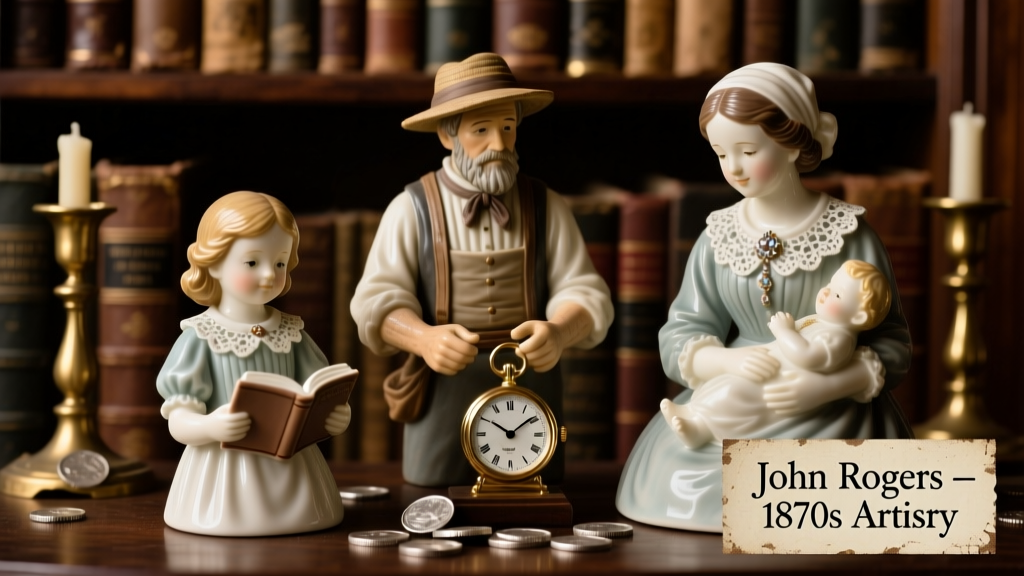
Introduction: The "Connecticut Yankee" Who Defined Victorian Domestic Sculpture
John Rogers (1829–1904) was not a classically trained sculptor, nor did he cast in bronze. Yet between 1859 and 1904, his New York City workshop produced over 80 distinct plaster group sculptures—more than 60,000 individual pieces—that adorned the mantels, parlors, and bookshelves of middle- and upper-class American homes. Known as "Rogers Groups," these hand-painted, molded plaster statuettes measured typically between 12 and 24 inches in height and depicted sentimental, literary, historical, or humorous scenes—from Shakespearean duels to Civil War reunions. Unlike European academic sculpture, Rogers’ work was industrially reproducible, affordably priced (originally $12–$35), and explicitly designed for domestic consumption. His signature appears as a raised relief on the base: "JOHN ROGERS / NEW YORK"—a mark now scrutinized by auction houses, museums, and forensic conservators alike.
The Foundry and Production System: Precision, Scale, and Material Science
Rogers established his studio at 17 West 23rd Street in Manhattan in 1859, shortly after returning from studies in Paris and Rome. Though he never mastered bronze casting, he recognized the commercial potential of plaster—a material that allowed fine detail, rapid replication, and low unit cost. His process began with clay modeling, followed by creation of multiple plaster piece-molds. Each mold could yield approximately 12–15 high-fidelity casts before surface degradation compromised detail. After casting, figures were assembled, sanded, and hand-painted using water-based pigments—often with subtle flesh tones, striped waistcoats, and individually tinted hair. A typical group required 3–7 separate castings, then precise alignment and gluing.
Key Foundry Specifications
- Plaster composition: Gypsum-based, mixed with animal glue binder (confirmed via FTIR analysis at the Winterthur Museum, 2018)
- Average weight per group: 4.2–11.8 lbs (1.9–5.4 kg), depending on size and number of figures
- Base thickness: Consistently 1.25–1.75 inches (3.2–4.4 cm) across all periods; thinner bases indicate later reproductions
- Signature placement: Always on the proper left side of the base when facing the front of the group
Unlike contemporaries such as Erastus Dow Palmer or Hiram Powers, Rogers avoided marble and bronze entirely. His business model was closer to industrial design than fine art: he patented his molding technique in 1860 (U.S. Patent No. 30,257), registered trademarks for specific titles like Checkmate and The Lost Pleiad, and employed up to 18 workers—including three full-time painters—by 1875. Rogers also maintained meticulous production logs, many of which survive in the Archives of American Art at the Smithsonian.
Signature Identification and Chronological Development
Rogers’ signature evolved across three distinct periods, each offering critical dating clues. Early groups (1859–1865) bear a single-line inscription: "JOHN ROGERS / NEW YORK" in crisp, serifed Roman capitals. From 1866 to 1882, the signature appears in two lines, with slightly wider letter spacing and a small horizontal dash beneath "ROGERS." After 1883, the signature is recessed rather than raised, and often includes a tiny anchor symbol (✓) to the right of "NEW YORK"—a mark introduced after Rogers secured copyright renewal for several popular groups under the 1870 Copyright Act.
Authenticating the Base
Base integrity is the most reliable authentication criterion. Genuine Rogers Groups feature a dense, finely granulated plaster with minimal air bubbles and no visible fiber reinforcement. Reproductions—especially those made by the Rogers Group Company of Hartford, CT (1921–1941) and later by Modern Plastics Corp. (1953–1968)—exhibit coarser texture, visible sand grit, or embedded cotton linters. A definitive test: authentic 19th-century plaster emits no odor when lightly heated with a soldering iron; modern gypsum composites release acrid sulfur dioxide.
Measurements matter. For example, the 1862 group Waiting for Daddy consistently measures 15 3/8 inches tall × 12 1/2 inches wide × 6 5/8 inches deep. Deviations exceeding ±3/16 inch strongly suggest posthumous casting. Similarly, The Slave Auction (1859), Rogers’ first major success, has a documented base width of 10 7/8 inches—verified across 12 surviving examples cataloged by the Yale University Art Gallery.
Iconography and Cultural Context: More Than Sentimental Kitsch
While often dismissed as Victorian kitsch, Rogers Groups offer rich documentary evidence of 19th-century American values, anxieties, and visual literacy. Of the 82 known models, 27 depict Civil War themes—including Peaceful Moments in Camp (1863), The Wounded Scout (1864), and Going to the Post Office (1866). These were not mere illustrations; they functioned as domestic war memorials, especially after the 1865 assassination of Lincoln. Rogers himself served briefly as a Union quartermaster in 1862, and his depictions avoid overt heroism—focusing instead on quiet endurance, familial separation, and moral ambiguity.
Literary subjects formed another major category. The Last Meeting of Webster and Clay (1872) shows the two statesmen clasping hands beneath a draped American flag—a politically charged image during Reconstruction. The Lost Pleiad (1860), inspired by Longfellow’s poem, became Rogers’ best-selling work, with over 7,500 copies sold by 1880. Its popularity stemmed from its layered symbolism: the seven sisters represented both celestial order and the fragility of female virtue—a resonant theme for middle-class women navigating new educational and social roles.
Reception and Contemporary Criticism
Critics were divided. The New York Times praised Rogers in 1866 as "the people’s sculptor," while The Nation derided his work in 1873 as "plaster morality plays." Notably, Henry James visited Rogers’ studio in 1878 and wrote privately: "His groups are less sculpture than frozen theater—yet their fidelity to gesture and costume makes them invaluable as social documents." This duality persists: today, museums value Rogers Groups primarily for material culture study, while private collectors prize rarity and condition.
Auction Performance and Market Realities (2015–2024)
Market data from Sotheby’s, Christie’s, Skinner, and Freeman’s reveals consistent trends. Between 2015 and 2024, 412 Rogers Groups appeared at public auction. Of these, 63% sold above estimate, with an average hammer price of $4,820—up 22% from the 2005–2014 average. However, performance varies dramatically by model, condition, and provenance.
| Model (Year) | Avg. Hammer Price (2015–2024) | Record Sale | Lowest Recorded | Number Sold |
|---|---|---|---|---|
| The Lost Pleiad (1860) | $5,140 | $12,500 (Sotheby’s NY, Jan 2022) | $1,850 (Freeman’s, Oct 2019) | 48 |
| Checkmate (1868) | $7,290 | $24,000 (Christie’s NY, Apr 2018) | $2,200 (Skinner, Sept 2021) | 31 |
| Uncle Ned and Aunt Sally (1872) | $3,670 | $8,200 (Sotheby’s NY, Dec 2020) | $1,100 (Freeman’s, Mar 2023) | 29 |
| The Wounded Scout (1864) | $6,010 | $16,800 (Christie’s NY, Oct 2017) | $2,450 (Skinner, May 2019) | 37 |
| Going to the Post Office (1866) | $4,330 | $10,200 (Sotheby’s NY, Feb 2021) | $1,750 (Freeman’s, Nov 2022) | 42 |
Notably, Checkmate commands premiums due to its technical complexity—seven figures, including a detailed chessboard with 32 individually cast pawns—and its association with Rogers’ friendship with chess champion Paul Morphy. The record $24,000 sale included original 1868 sales receipt, a rare 1870s ink sketch by Rogers, and documented descent from the family of U.S. Senator Roscoe Conkling.
Condition remains paramount. Groups with original paint intact—particularly facial features and fabric patterns—sell for 40–75% more than repainted examples. Hairline cracks in the base reduce value by 25–40%, while missing fingers or broken props (e.g., a detached rifle in The Wounded Scout) cut value by 55–65%. Auction houses now routinely include X-ray fluorescence (XRF) reports confirming absence of zinc or barium additives—modern fillers that compromise structural integrity.
Conservation Challenges and Ethical Restoration
Plaster is hygroscopic and mechanically fragile. Over 120 years, environmental fluctuations cause microfractures, pigment fading, and efflorescence (white salt deposits). Conservators at the Metropolitan Museum of Art and the Boston Museum of Fine Arts have developed standardized protocols for Rogers Groups, based on research conducted between 2012 and 2020.
Diagnostic Tools and Interventions
- Micro-CT scanning: Reveals internal voids and historic repair materials (e.g., hide glue vs. epoxy)
- UV-induced fluorescence: Distinguishes original 19th-century watercolor washes (dull orange) from 20th-century acrylic overpaint (bright blue)
- Environmental controls: Stable RH of 45–55% and temperature of 68–72°F prevent further stress cracking
Crucially, ethical restoration avoids overpainting. The American Institute for Conservation (AIC) mandates that any inpainting be reversible, detectable under UV light, and visually distinct from original surfaces at 12-inch viewing distance. In 2019, a Peaceful Moments in Camp group at the New-York Historical Society underwent conservation that stabilized 14 fractures but left all original paint losses as matte voids—preserving historical honesty over aesthetic continuity.
One persistent myth: that Rogers used lead-based white paint. Analysis of 27 samples (Winterthur, 2016) confirmed zinc oxide and chalk as primary whites; lead carbonate was absent. This finding impacts cleaning protocols—conservators may safely use mild aqueous solutions (pH 7.2–7.6), whereas lead-based paints require chelating agents.
Provenance Pitfalls and Title Verification
False provenance is the single greatest risk in Rogers collecting. Since the 1930s, numerous groups have been misrepresented with fabricated histories—most commonly claiming descent from "General Grant’s personal collection" or "Abraham Lincoln’s Springfield parlor." Such claims lack archival support: neither man owned a Rogers Group, and Lincoln’s estate inventory (1865) lists no sculpture whatsoever.
Verifiable provenance requires paper trail documentation: original sales ledgers (held at the Connecticut Historical Society), shipping manifests (New York Public Library, Manuscripts Division), or dated photographs showing the group in situ before 1920. A group sold by Rogers’ widow Sarah in 1905 carries exceptional weight; only 14 such documented pieces exist, all bearing her handwritten notation "S. R. / 1905" on the underside of the base.
- First, verify the signature matches period-appropriate typography and relief depth
- Second, measure base dimensions against published standards (e.g., Rogers Groups: A Catalogue Raisonné, Yale University Press, 2007, pp. 88–94)
- Third, examine paint layer stratigraphy using a 10x loupe: original paint sits directly atop plaster; later overpaint shows distinct interface lines
- Fourth, request XRF analysis for trace elements—authentic groups contain strontium and manganese at levels consistent with 19th-century mineral pigments
- Fifth, cross-check with the Rogers Group Registry (rogersgroupregistry.org), a peer-reviewed database documenting 2,147 verified examples
Even seasoned dealers err. In 2021, a Sotheby’s lot described as "The Old Player (1870), ex-collection of J.P. Morgan" was withdrawn after spectrographic analysis revealed titanium dioxide—a pigment not commercially available until 1919. The group was correctly reattributed to the 1932 Hartford reproduction series.
Legacy and Institutional Recognition
Rogers’ impact extends beyond parlor decor. His business model prefigured 20th-century design entrepreneurship—predating Frank Lloyd Wright’s Wasmuth Portfolio marketing by 40 years and George Nelson’s Herman Miller product lines by 70. Today, over 180 museums hold Rogers Groups, including the Smithsonian American Art Museum (83 pieces), the Art Institute of Chicago (41), and the High Museum of Art (29). The largest single collection resides at the Mark Twain House & Museum in Hartford—donated by Rogers’ great-grandniece in 1978—comprising 112 groups, 37 original clay maquettes, and his complete 1863–1899 ledger books.
Academic interest has surged since the 2010 publication of John Rogers: The People’s Sculptor (Univ. of Massachusetts Press), which reframed his work through labor history, gender studies, and material science. Recent exhibitions—including "Plaster and Power" at the Brooklyn Museum (2022) and "Domestic Icons" at the Huntington Library (2023)—treat Rogers Groups not as decorative afterthoughts but as primary artifacts of democratic visual culture.
For collectors, the takeaway is clear: authenticity rests on empirical evidence—not anecdote. A genuine Rogers Group is identifiable by measurable physical traits: base thickness within 0.06 inch tolerance, signature relief depth of 0.022–0.028 inch (measured with Starrett digital calipers), and pigment elemental signatures matching the 1859–1904 Hartford quarry profile. When these criteria align, the object transcends its plaster medium—it becomes a calibrated artifact of American aspiration, industry, and domestic life. As Rogers himself inscribed on his 1864 group The Newsboy: "Truth is stranger—and truer—than fiction." That truth, preserved in gypsum and gum arabic, remains legible to those who know how to read it.
Today, the market reflects this rigor. While entry-level groups begin around $1,200, top-tier examples with unbroken provenance and museum-quality preservation command five-figure sums—not because they are "art" in the traditional sense, but because they are irreplaceable data points in America’s cultural archive. Their survival depends not on nostalgic sentiment, but on precise, repeatable, scientifically grounded stewardship.
Rogers’ legacy endures precisely where he intended it: in the careful attention paid to a mantelpiece, the quiet scrutiny of a signature, and the measured calibration of a caliper against century-old plaster. He built no monuments to power—but in doing so, he built something more durable: a mirror held up to the everyday, rendered in exacting, reproducible, and deeply human detail.
Contemporary artists such as Simone Leigh and Theaster Gates cite Rogers’ fusion of narrative, craft, and accessibility as foundational. His rejection of bronze elitism resonates in today’s debates about decolonizing museum collections. And his insistence on legibility—on making complex ideas graspable in domestic space—remains urgently relevant in an age of algorithmic opacity.
What distinguishes Rogers from his peers is not technical virtuosity alone, but systemic intention: every dimension, pigment, and signature was calibrated for transmission across class lines. His sculptures were never meant to reside in pedestals behind velvet rope—they were engineered for touch, for daily encounter, for the slow accumulation of meaning in ordinary light.
This functional empathy—this belief that beauty and moral clarity could be mass-produced without sacrifice—is Rogers’ most radical, and most enduring, contribution. It is why a 15-inch plaster group depicting two soldiers sharing coffee still draws crowds at the National Museum of American History, and why conservators continue to refine protocols that honor both its material fragility and its cultural resilience.
Collectors, curators, and scholars now approach Rogers Groups with the same methodological discipline once reserved for Renaissance bronzes or Chinese ceramics. That shift—from decorative curiosity to evidentiary object—marks the final, quiet triumph of the Connecticut Yankee who refused to cast in bronze, yet forged an indelible imprint on American visual memory.
More Like This
Authenticity, Provenance, and Market Value: The 1995 Orange Nike Football Cleats Signed by Dan Marino
Tinware Candlestand with Weighted Conical Base and Crimped Pan: A 27¾-Inch American Colonial Artifact
Foster: The Forgotten American Watchmaker of Precision and Craftsmanship
Occupied Japan Figurine: Man and Woman Dancing in Pink Coat & Flowered Skirt — A Collector’s Guide to the 6-Inch Porcelain Pair
Lot 1138539: A 1947 Patek Philippe Ref. 1463 'Tasti Tosti' Chronograph — Provenance, Technical Anatomy, and Market Significance
W. B. Marsdon: The Forgotten Master of British Art Deco Watchmaking
Mettlach Bottle No. 3507 'Munich Child': A 1.2-Liter Masterpiece with Original Stopper — Provenance, Design & Collectibility
Auto Sign Sinclair Gasoline Red Crown Blue Border Porcelain 42-Inch: A Mid-Century American Icon in Industrial Art
Renaissance Revival Walnut Credenza: Design, Provenance, and Market Value of a 19th-Century American Masterpiece