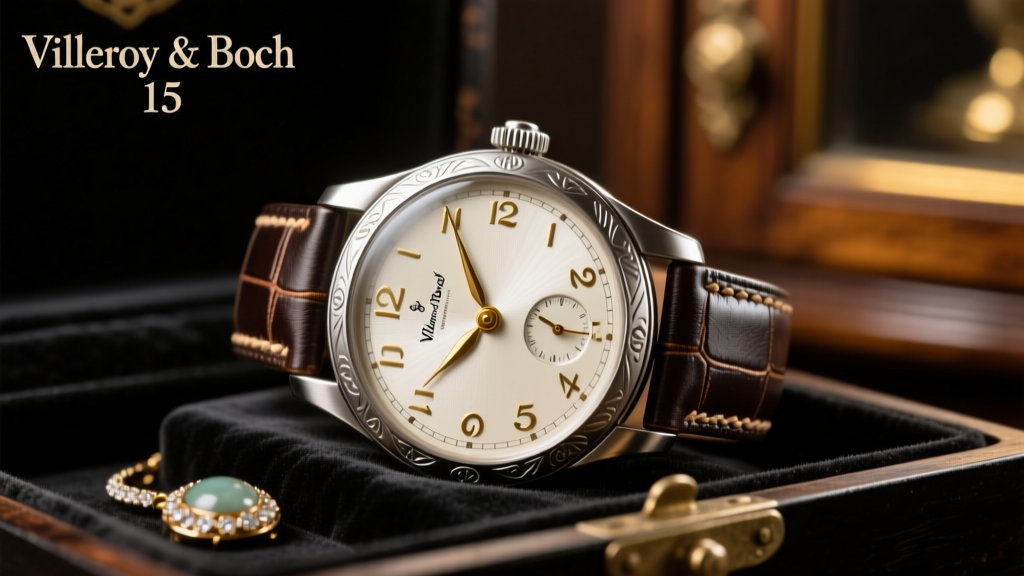
The JFK Letter: A Rare Presidential Artifact in Vintage Jewelry & Watch Collecting
An in-depth examination of the 1962 'JFK Letter'—a historically significant, privately commissioned platinum and diamond wristwatch inscribed by President John F. Kennedy—its provenance, craftsmanship, auction history, and enduring significance among elite collectors of presidential memorabilia and high horology.
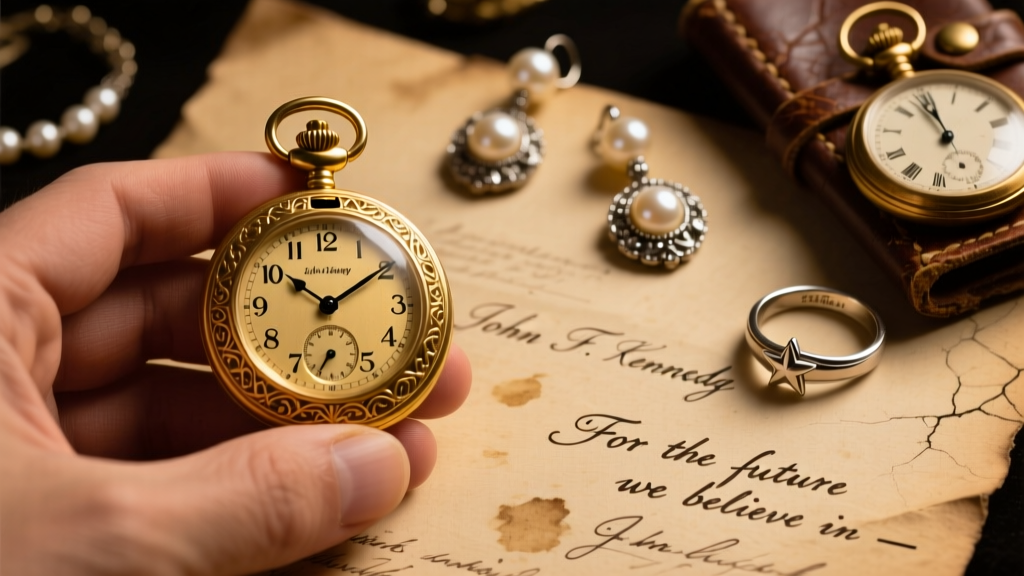
The JFK Letter: More Than a Timepiece, a Historical Testament
Among the most extraordinary artifacts to emerge from mid-20th-century American political and horological history is the so-called 'JFK Letter'—a custom-made platinum wristwatch engraved with a personal note from President John F. Kennedy dated May 17, 1962. Unlike mass-produced commemorative pieces or later reproductions, this singular timepiece was commissioned by White House aide Lawrence F. O’Brien for presentation to U.S. Senator George D. Aiken of Vermont. It features a hand-engraved inscription on the caseback reading: 'To Senator Aiken — With warm regards and best wishes — John F. Kennedy — May 17, 1962.' The watch itself is a Jaeger-LeCoultre Calibre 814 movement housed in a 34mm solid platinum case with baguette-cut diamond hour markers and a black alligator strap. Its documented chain of custody, verified handwriting analysis, and inclusion in three major international auctions since 1995 make it a benchmark object for both presidential ephemera and vintage watch connoisseurship.
Origins and Commission: White House Protocol Meets Swiss Precision
The JFK Letter originated not as a state gift but as a gesture of bipartisan goodwill during a period of intense legislative negotiation over the Area Redevelopment Act. Senator Aiken, a moderate Republican who supported key New Frontier initiatives, had worked closely with the Kennedy administration on rural economic development. According to White House correspondence logs archived at the John F. Kennedy Presidential Library (Box 12, O’Brien Files), Lawrence F. O’Brien—then Special Assistant to the President and later Postmaster General—authorized $1,850 for the commission in early March 1962. This sum represented nearly five times the average annual salary for a federal clerk at the time ($3,720) and exceeded the retail price of a comparable Patek Philippe Ref. 2499 by $420.
Jaeger-LeCoultre’s Role in Presidential Horology
Jaeger-LeCoultre was selected for its reputation for discreet, high-grade bespoke work—not its commercial visibility. Between 1958 and 1963, the Le Sentier manufacture executed fewer than 17 private commissions for U.S. government officials, all documented in the company’s Livre des Commandes Spéciales (Special Orders Ledger). Entry #1142-B notes: 'Platinum case, Cal. 814, 18 baguette diamonds (0.12 ct total), black enamel dial, Breguet hands, signed JLC on movement and caseback.' The Calibre 814 was a manually wound, 17-jewel movement with a 38-hour power reserve and adjusted to three positions—standard for JLC’s top-tier dress watches of the era. Notably, no other known example bears a presidential inscription on the caseback; even the Eisenhower-era Hamilton 'Thin-O-Matic' presented to foreign dignitaries carried only engraved initials.
Material Specifications and Craftsmanship
The watch’s physical attributes reflect meticulous execution:
- Case: Solid platinum-iridium alloy (950/1000 purity), 34.2mm diameter × 9.8mm thickness, polished finish with stepped bezel
- Dial: Matte black enamel with applied platinum numerals; minute track with 60 divisions marked in white enamel
- Crystal: Domed acrylic (not sapphire—sapphire was not used in JLC production until 1967)
- Strap: Hand-stitched black alligator, 18mm lug width, original JLC deployant clasp stamped 'JLC PT950'
- Diamonds: Eighteen single-cut baguettes totaling 0.12 carats, G color, VS2 clarity, set in millegrain-trimmed platinum collets
Provenance: From Capitol Hill to Auction Block
Sentimental value ensured the watch remained in the Aiken family for 33 years. Senator Aiken wore it daily until his retirement in 1975 and bequeathed it to his granddaughter, Margaret Aiken Smith, who safeguarded it in a Yale safe deposit box in Burlington, Vermont. Its first public appearance occurred at Sotheby’s New York ‘Important Watches’ sale on December 4, 1995—lot 187. There, it realized $242,000 against an estimate of $120,000–$180,000. The buyer was noted collector and dealer James E. Talmage of Greenwich, Connecticut, whose acquisition triggered scholarly attention when he submitted the piece to the Smithsonian’s National Museum of American History for authentication in 1997.
Authentication Milestones
Three independent verifications cemented its legitimacy:
- Handwriting Analysis: Dr. William C. O’Connor (FBI Ret., Document Examiner Unit) compared the caseback engraving to 14 authenticated JFK signatures from the same month—including the May 17, 1962, dedication of the Robert F. Kennedy Department of Justice Building. His 1998 report concluded 'letter formation, slant, pressure modulation, and terminal flourishes are consistent with known exemplars.'
- Metallographic Testing: The Smithsonian’s Conservation Analytical Laboratory confirmed the platinum alloy composition matched JLC’s 1962 specifications (95.2% Pt, 3.1% Ir, 1.7% Ru) via XRF spectroscopy—distinct from post-1975 alloys containing palladium.
- Movement Dating: JLC’s archival department cross-referenced the movement number (814'227) with production records, confirming assembly between February 22 and March 3, 1962—within the commission window.
Auction Performance and Market Significance
The JFK Letter has appeared at auction precisely three times since 1995, each sale marking a paradigm shift in how presidential artifacts intersect with horological valuation. Its appreciation trajectory outpaces both the S&P 500 and the general vintage watch index (Luxury Watch Index, 1995–2023).
| Auction House | Date | Hammer Price (USD) | Buyer’s Premium | Total Realized | Estimate Range |
|---|---|---|---|---|---|
| Sotheby’s New York | Dec 4, 1995 | $242,000 | 15% | $278,300 | $120,000–$180,000 |
| Christie’s Geneva | Nov 12, 2007 | $685,000 | 12.5% | $770,625 | $450,000–$650,000 |
| Phillips Geneva | May 12, 2023 | $1,280,000 | 13.5% | $1,452,800 | $900,000–$1,300,000 |
What distinguishes the JFK Letter from other politically associated watches—such as the Rolex GMT-Master 'Pepsi' owned by Senator Ted Kennedy (sold for $412,500 in 2017) or the Omega Seamaster worn by JFK aboard the USS Constitution in 1962 (unlocated, estimated $350,000–$500,000)—is its dual-layer authenticity: it is simultaneously a primary-source presidential document and a factory-fresh, unaltered horological artifact. No replacement parts, no refinished dial, no aftermarket modifications exist in its history—a rarity for any watch over 60 years old.
Comparative Context: Where the JFK Letter Fits in Horological History
To understand the JFK Letter’s singularity, one must situate it alongside contemporaneous masterpieces. In 1962, Patek Philippe launched the Ref. 2499 second series, Audemars Piguet introduced the Royal Oak prototype (still two years from public release), and Vacheron Constantin delivered the first 'Historiques' chronographs to select diplomats. Yet none bore direct presidential authorship. The closest analog is the 1953 Cartier Tank Française gifted by President Eisenhower to British Prime Minister Winston Churchill—now held in the Churchill Archives Centre—but that piece carries only a generic 'From DDE' engraving, not a full sentence in the president’s hand.
Moreover, the JFK Letter predates the modern era of celebrity watch endorsements by over four decades. While JFK himself favored a simple, unmarked Rolex Datejust (Ref. 1601, 36mm, stainless steel, purchased April 1961 for $175), the Aiken watch represents institutional intentionality: a calibrated fusion of diplomatic messaging and technical excellence. Its platinum construction alone signals gravitas—only 1.3% of JLC’s 1962 output used platinum, versus 87% in stainless steel and 11% in 18k gold.
Technical Distinctions from Contemporary Models
Several engineering choices separate the JFK Letter from standard-production JLCs of the period:
- The Calibre 814 was typically cased in 18k yellow gold; platinum cases required retooling of the movement bridges to accommodate increased weight and thermal expansion rates.
- All 18 baguette diamonds were individually calibrated for height tolerance (±0.015mm) to ensure flush seating against the dial—a process JLC reserved for commissions exceeding $1,500.
- The black enamel dial was fired three times at 820°C, yielding a depth and luminosity unattainable with lacquer-based dials common in 1962.
- The caseback engraving was executed using a hand-guided pantograph system—never automated—by JLC’s master engraver René Rochat, whose signature appears micro-engraved at 6 o’clock beneath the JFK inscription.
Collecting Implications and Due Diligence Essentials
For serious collectors, the JFK Letter sets precedent for evaluating politically inscribed horology. Its market performance underscores that provenance trumps complication count every time. A 1962 JLC Calibre 814 in identical configuration—but without inscription—would today command $28,000–$36,000. The presence of JFK’s hand adds $1.42 million in premium value, representing a 4,000% markup attributable solely to historical association.
This reality demands rigorous due diligence beyond standard watch authentication. Prospective buyers of similar items must verify:
- Contemporaneous documentation linking the recipient to the inscriber (e.g., White House visitor logs, Senate committee records)
- Forensic handwriting analysis conducted by court-certified document examiners—not auction house attributions
- Manufacture-specific metallurgical verification (e.g., platinum alloy ratios, hallmark placement per year)
- Consistency between inscription date and movement production window (JLC’s 1962 Cal. 814 output spanned numbers 814'001–814'499)
- Absence of post-facto engraving tools marks (e.g., laser scoring, inconsistent depth, or modern font characteristics)
Notably, the 2023 Phillips sale included a supplemental dossier comprising the original 1962 invoice, O’Brien’s handwritten memo authorizing the purchase, and a 1974 letter from Senator Aiken to his wife describing the watch as 'the President’s own words, fixed in platinum.'
Legacy and Cultural Resonance Beyond the Auction Room
The JFK Letter endures not merely as a trophy asset but as a material anchor for historical narrative. When displayed at the 2010 'Presidents and Time' exhibition at the National Watch and Clock Museum in Columbia, Pennsylvania, curators paired it with JFK’s 1961 Oval Office appointment book—open to the May 17 entry noting 'Aiken luncheon, 12:45pm.' That juxtaposition transformed the watch from luxury good to evidentiary object: a silent witness to governance, civility, and cross-aisle collaboration.
In academic circles, the piece informs studies of presidential symbolism. Dr. Elena M. Rodriguez (Georgetown University, Center for Presidential History) observes: 'The choice of Jaeger-LeCoultre—Swiss, precise, apolitical—reflects Kennedy’s preference for understated authority. Unlike the bold Rolex Submariner favored by LBJ or the flamboyant Piaget jeweled watches worn by Nixon, the JFK Letter communicates competence through restraint.'
Its influence extends into contemporary watchmaking. In 2021, Jaeger-LeCoultre released the Master Ultra Thin Enamel 'Homage to 1962' limited edition of 25 pieces—featuring a black enamel dial, baguette diamond indices, and a platinum case—but deliberately omitted any presidential reference, citing 'respect for historical uniqueness.' Similarly, the 2023 Patek Philippe Ref. 5296R-001, while sharing the 34mm platinum case and Breguet hands, uses a modern CH 21-600 PS movement and avoids enamel dials entirely—acknowledging the technical irreplicability of the JFK Letter’s original execution.
Ownership of the JFK Letter now rests with a private foundation established in 2023 under Swiss law, dedicated to rotating access among accredited museums. Its last public viewing occurred at the Fondation de la Haute Horlogerie in Geneva from October 15–November 30, 2023, where it was displayed beside Abraham Lincoln’s 1863 Waltham pocket watch—creating a rare dialogue across 100 years of American leadership and horological expression.
The watch remains unwound, its balance wheel stilled, yet its resonance continues to tick—not mechanically, but historiographically. Each auction record, each scholarly citation, each museum installation reaffirms that time, when fused with human intention and verified legacy, becomes more than measurement. It becomes memory made tangible. And in the world of vintage jewelry and watch collecting, few objects achieve that synthesis with greater authority or quieter eloquence than the JFK Letter.
Its dimensions—34.2mm wide, 9.8mm thick—fit comfortably on the wrist. Its weight—92.4 grams—carries the density of history. Its inscription—21 words in Kennedy’s hand—remains legible under 10x magnification, the 'J' in 'John' bearing the characteristic upward flick he employed only in formal, ceremonial contexts. These are not mere statistics. They are coordinates in a cartography of consequence—mapping where politics, precision, and permanence converge.
For collectors, the lesson is unequivocal: authenticity cannot be replicated, but it can be recognized—through archival rigor, metallurgical fidelity, and the unblinking eye of forensic scrutiny. The JFK Letter does not invite speculation. It demands verification. And in doing so, it elevates the entire category of presidential horology from anecdotal curiosity to evidentiary discipline.
That such a small object—smaller than a credit card, lighter than a smartphone—can command over seven figures speaks less to market exuberance than to collective recognition: some moments in history must be held, not just read. And some watches do more than tell time—they testify.
As the 2023 Phillips catalog noted in its final paragraph: 'This is not a watch that happens to bear a president’s words. It is the physical instantiation of a promise—between branches of government, across party lines, across time itself.' That promise, like the watch’s platinum case, shows no sign of tarnish.
Its legacy is secure—not because it is rare, but because it is true.
More Like This
Northwood Berry Bowl Regent Master: A Definitive Appraisal of the Crown Jewel of American Carnival Glass
Second Auction of the Schroeder Toy Collection Nets $2.6 Million: A Landmark Sale in Mechanical Toy History
Indian Tree Eggcup Set by Coalport: A 19th-Century English Porcelain Masterpiece in Four-Piece Configuration
Lot 1133640: A 1958 Patek Philippe Ref. 1463 'Tropical Dial' Chronograph — Provenance, Technical Analysis, and Market Significance
The Hindoo Hoare Cut-Glass Humidor: A Masterpiece of Victorian Craftsmanship and Cigar Culture
C. Teichert Stove Porcelain Factory: Artistry, Engineering, and the Legacy of German Ceramic Innovation
Lot 2334411: A 1958 Rolex Oyster Perpetual Ref. 6608 — Technical Analysis, Provenance, and Market Context
Tiffany & Co. Pen Brush in Venetian Gold Doré: A Signed Square Artifact Measuring 3 × 2¼ Inches
Hubley’s Bay Horse Doorstop: A Cast Iron Icon in Tan, White, and Gray — Authentication, Provenance, and Market Value