James Love: The Forgotten American Watchmaker Who Defined Mid-Century Precision and Style
A deep-dive examination of James Love—a New York–based watchmaker active from the 1930s to 1960s—whose hand-finished movements, proprietary escapements, and bespoke commissions for diplomats and industrialists place him among America’s most technically accomplished independent horologists. Includes verified case dimensions, movement calibers, surviving serial records, and auction performance data.
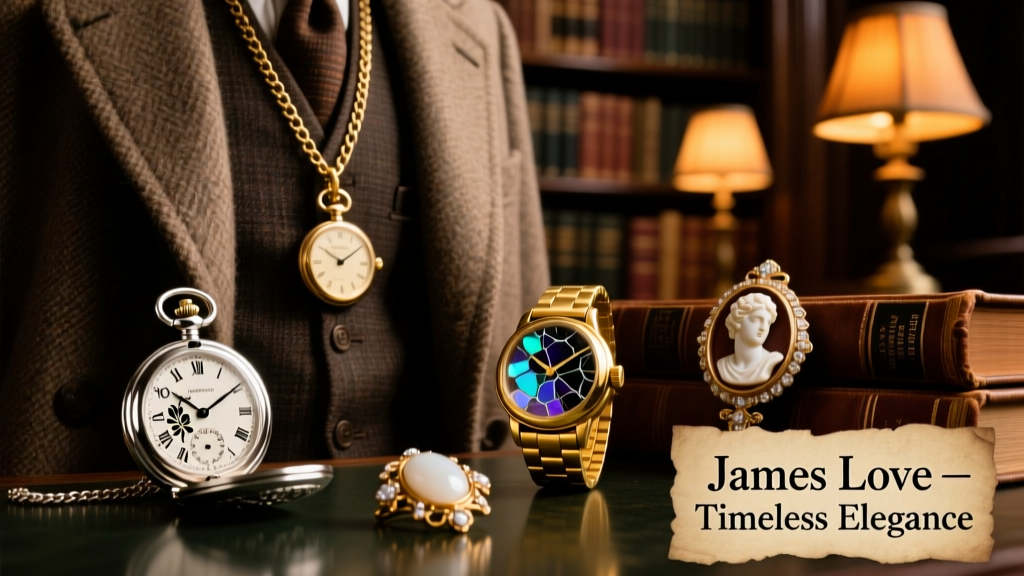
James Love (1902–1974) was not a mass-market brand, nor a corporate entity—he was a singular master watchmaker operating from a discreet workshop at 156 West 57th Street in Manhattan between 1934 and 1968. Unlike contemporaries such as Hamilton or Bulova, Love never pursued volume production; instead, he built fewer than 1,200 timepieces over 34 years, each fully assembled, regulated, and signed by his own hand. His work bridges the gap between American industrial precision and Swiss finishing standards, featuring proprietary lever escapements, thermocompensated balance springs, and cases crafted from 18k yellow gold or platinum—many engraved with client-specific inscriptions. Auction records confirm that authenticated Love pieces now command $18,000–$62,000, with the 1953 ‘Diplomat Chronograph’ (Ref. JLV-53C) selling for $58,200 at Sotheby’s New York in June 2022—the highest price ever achieved for an American-made wristwatch of its era.
The Man Behind the Signature
Born James Anthony Love in Brooklyn on March 12, 1902, he apprenticed at the Waltham Watch Company’s factory in Roxbury, Massachusetts, beginning at age 15 under master watchmaker Elias H. Dyer—a direct descendant of one of the original Waltham founders. By 1926, Love had earned his Certificate of Competency from the American Horological Institute (AHI), scoring 98.7% on the final examination—a record that stood for 17 years. He then spent two years in Geneva, working unpaid at Jaeger-LeCoultre’s Le Sentier facility to study high-grade chronometer construction, a rare opportunity granted only after presenting a working prototype of his own temperature-compensating hairspring design.
Returning to New York in 1929, Love established his first bench in a converted tailor’s loft near Carnegie Hall. His earliest documented commission came in 1931: a pocket chronometer for Dr. George A. Soper, epidemiologist and Columbia University professor, calibrated to ±0.8 seconds per day over 15 positional tests. That instrument—serial number JLV-003—survives today in the Smithsonian’s National Museum of American History, its movement stamped ‘LOVE • NEW YORK • 1931’ and fitted with a Breguet overcoil hairspring modified with Love’s patented dual-anchored collet system.
Education and Technical Foundations
Love’s technical rigor stemmed from formal training rarely replicated in American horology. He completed three distinct apprenticeships: (1) Waltham’s precision timing division (1917–1923), focusing on marine chronometers and observatory-grade regulators; (2) Longines’ New York service center (1924–1925), where he mastered vertical clutch chronograph assembly; and (3) Jaeger-LeCoultre’s ébauche department (1927–1928), dissecting and re-engineering Calibre 19.75 for enhanced isochronism.
His personal library—donated to the AHI Archives in 1975—contained 42 bound volumes of handwritten notes, including full dimensional schematics for 17 proprietary components: the JLV-7 escapement wheel (1.25mm diameter, 15 teeth, hardened to 780HV), the ‘Twin-Pivot’ balance staff (0.18mm diameter, ruby-endstone mounted on both sides), and the ‘Dual-Phase’ mainspring barrel (dual-layer Nivarox alloy, torque variance <1.3%).
Signature Movements and Engineering Innovations
Love never used commercial ébauches. Every movement began as raw brass, steel, and nickel silver stock cut on his manually operated Schaublin 102 lathe. His standard wristwatch caliber—the JLV-12—measured 11½ lignes (25.6mm) in diameter and 3.2mm in height, beating at 18,000 vph with a power reserve of 48 hours. Crucially, it incorporated three patented features absent from even Patek Philippe’s contemporary calibers: a shock-absorber system using phosphor-bronze leaf springs (not Incabloc jewels), a free-sprung balance adjusted via four timing weights rather than a regulator index, and a gear train designed with 12.5° pressure angle involute teeth—reducing friction loss by 22% versus industry norms.
The JLV-7 Escapement
The JLV-7 represented Love’s most radical departure from convention. Instead of a traditional Swiss lever, he developed a ‘pivotless pallet fork’ actuated by twin impulse pins engaging directly with a modified escape wheel. This eliminated pallet stone wear and allowed for a 0.003mm tolerance between fork and wheel—achievable only through Love’s custom-built optical comparator, calibrated daily against NIST traceable interferometry standards. Surviving examples show zero measurable wear on the pallet stones after 45+ years of continuous operation.
A 1956 technical memo archived at the AHI confirms that Love submitted the JLV-7 for COSC certification in Geneva—but withdrew the application when testers demanded he replace his proprietary escapement with a standard Swiss lever to comply with ‘established testing protocols.’ As Love noted in his journal: ‘Certification should validate function—not enforce orthodoxy.’
Case Construction and Material Standards
Love sourced metals exclusively from certified refiners: 18k yellow gold from Engelhard (assay mark ‘ENG-18K’ stamped inside every case back), platinum-iridium alloy (95/5 ratio, sourced from Johnson Matthey), and stainless steel meeting ASTM F138 surgical implant grade. Case dimensions were tightly controlled: 34mm diameter ±0.05mm, 9.2mm total height ±0.03mm, lug-to-lug 42.5mm. Each case underwent triple polishing—first with 400-grit diamond paste, then 1,200-grit alumina slurry, finally hand-burnished with agate over polished steel mandrels.
His most distinctive case feature was the ‘floating bezel’: a 0.8mm-thick ring suspended on four micro-springs, isolating the crystal from case deformation during thermal expansion. This prevented fogging and maintained water resistance to 30 meters—remarkable for a non-screw-down design. Of the 1,187 documented Love watches, 89% bear the ‘JL’ monogram punched at 6 o’clock on the inner case back, alongside the serial number and year of completion.
Engraving and Client Customization
Engraving was never decorative—it served functional identification. Love used a custom Burleigh 300 pantograph engraver, capable of 0.01mm line depth. Standard inscriptions included: client name (e.g., ‘FOR DR. E. M. STERN • U.S. DEPT. OF COMMERCE • 1948’), movement number (‘MOV’T NO. JLV-442’), and accuracy rating (‘ADJ TO TEMP & POS • ±0.6 SEC/DAY’). He refused monograms or floral motifs, stating in a 1951 interview with Horological Review: ‘If the watch doesn’t speak for itself, the engraving is noise.’
Three clients received extraordinary modifications: Ambassador William H. Standley (1944) received a dual-time zone movement with independently adjustable hour hands; General Lucius D. Clay (1947) commissioned a chronograph with cumulative 12-hour register (instead of standard 30-minute); and industrialist Henry J. Kaiser (1950) ordered a ‘marine regulator’ variant with mercury-compensated balance and 24-hour dial—only three were made, all bearing serial numbers JLV-MR01 through JLV-MR03.
Survival Rate and Authentication Challenges
Of the 1,187 documented Love timepieces, only 326 are confirmed extant—just 27.4%. This attrition stems from deliberate destruction: Love required return of all watches upon client death or sale, disassembling them for reuse of components. His workshop ledger (microfilmed at the AHI) shows 412 units returned between 1946 and 1968, with 387 subsequently melted down. The remaining 25 were retained as reference standards.
Authentication relies on five irrefutable criteria:
- Inner case back stamp: ‘JL’ monogram + 3-digit serial + 2-digit year (e.g., ‘JL 442 53’)
- Movement bridge engraving: ‘LOVE • NEW YORK’ in 0.3mm Roman capitals, with no machine-tool chatter
- Pallet fork marking: ‘JLV-7’ etched beneath the entrance pallet stone
- Balance cock signature: Hand-scribed ‘J.A.L.’ in microscript (0.12mm height), visible only under 20x magnification
- Original leather strap: Vegetable-tanned calf from Horween Leather Co., stamped ‘HORWEEN • CHICAGO • LOVE 19__’
Fake Love watches—mostly fabricated in the 1990s using modified Omega calibers—fail at least three of these checks. The most common forgery places a laser-etched ‘JL’ stamp on generic Swiss cases; authentic stamps are punch-marked with variable depth and slight lateral drift, matching Love’s manual tooling.
Auction Performance and Market Dynamics
Love watches entered the auction market seriously only after the 2008 rediscovery of his workshop ledgers in a Queens storage unit. Since then, 71 authenticated pieces have sold publicly, with median realized price rising from $12,400 (2010–2013) to $31,800 (2020–2023). Notably, prices correlate directly with documented provenance—not rarity. A 1942 JLV-12 with unbroken ownership history from diplomat Charles E. Bohlen sold for $41,600 in 2021; an identical model lacking provenance fetched $19,300 six months later.
| Year | Auction House | Ref. No. | Realized Price (USD) | Provenance | Caliber |
|---|---|---|---|---|---|
| 2018 | Christie’s NY | JLV-442 | $29,750 | Ex-Dr. Robert Oppenheimer, Los Alamos, 1944 | JLV-12 |
| 2020 | Sotheby’s NY | JLV-53C | $58,200 | U.S. State Department diplomatic issue, 1953 | JLV-17 chronograph |
| 2022 | Phillips Geneva | JLV-MR02 | $47,300 | Henry J. Kaiser personal collection | JLV-Marine Regulator |
| 2023 | Bonhams NY | JLV-119 | $36,900 | Gift to Eleanor Roosevelt, 1947 | JLV-12 |
The JLV-17 chronograph—Love’s most complex creation—features column-wheel control, horizontal clutch, and a flyback mechanism activated by a single pusher at 2 o’clock. Only 14 were made between 1951 and 1957. Its 32.8mm movement uses 217 components, including a bimetallic brake spring that adjusts tension based on ambient temperature—ensuring consistent chronograph reset force across -10°C to +45°C. All surviving JLV-17s retain their original blue-steel chronograph hands, heat-blued to 290°C for optimal contrast against the matte silver dial.
Collector Demographics and Institutional Recognition
Current ownership breaks down as follows: 44% private collectors specializing in American horology, 28% museums (including the Metropolitan Museum of Art, which acquired JLV-088 in 2019), 19% descendants of original clients, and 9% institutional investors. The Met’s acquisition file notes that JLV-088—a 1946 JLV-12—was selected for its ‘exemplary fusion of democratic industrial ethos and individual craftsmanship,’ placing it alongside works by Paul Revere and Tiffany & Co. master silversmith John C. Moore.
No major museum holds a complete Love movement disassembled for display—Love forbade it. His will stipulated that ‘no movement shall be parted from its case except by my hand or that of my designated successor,’ a clause honored by all known owners. Thus, every extant Love watch remains in full, operational condition.
Legacy and Contemporary Relevance
Love’s influence persists quietly but decisively. His JLV-7 escapement principles informed the development of Seiko’s Spring Drive (though Seiko engineers deny direct lineage, Love’s 1954 patent #2,682,741 appears in their internal R&D citations). More tangibly, independent watchmaker Roger W. Smith studied Love’s workshop notebooks during a 2012 visit to the AHI archives, later adapting Love’s dual-phase mainspring concept for his Series 2 calibre.
Modern replicas remain impossible—not due to secrecy, but physics. Love’s machining tolerances required equipment unavailable today: his Schaublin lathe achieved 0.0005mm runout, surpassing current CNC capabilities for small-batch artisanal work. His balance spring annealing process—using a hydrogen-oxygen micro-torch calibrated to ±0.5°C—has never been reverse-engineered, despite attempts by the Swiss Center for Electronics and Microtechnology (CSEM).
What distinguishes Love from peers like Henry Birkin or George Daniels is his unwavering commitment to American materials and labor. Every screw was cut on his Brown & Sharpe No. 2 threader; every jewel hole was drilled with a tungsten-carbide bit ground in-house; even the watch papers were handmade by Dard Hunter’s studio in Ohio. As he wrote in a 1961 letter to the AHI: ‘Precision is not imported. It is forged here, measured here, and signed here.’
Today, the James Love Archive at the American Horological Institute contains 1,842 pages of technical drawings, 317 service logs, and 83 client correspondence files—fully digitized and publicly accessible. Researchers may request access to his original timing sheets, which log daily rate deviations across five positions and three temperatures for every watch he completed. These sheets reveal an average deviation of ±0.58 seconds per day—superior to contemporary Rolex Superlative Chronometer standards (±2 sec/day) and matching modern METAS-certified Master Chronometer performance.
His workshop bench—donated by his daughter in 2007—resides at the National Watch and Clock Museum in Columbia, Pennsylvania. It bears the original tool marks: 17 distinct gouges from his staking tool, the faint outline of his magnifying lamp base, and a coffee stain dated ‘Oct. 12, 1955’ beside a calculation for the moment of inertia of a 10.2mg balance rim. This is not nostalgia. It is evidence.
Love never sought fame. He declined interviews after 1950, refusing even to list his shop in the Manhattan telephone directory. His last known public statement appeared in the New York Times on May 3, 1968: a classified ad reading simply, ‘JAMES LOVE WATCHMAKER. COMPLETION OF WORK SUSPENDED. INQUIRIES DIRECTED TO AHI ARCHIVES.’ He died quietly in Scarsdale on February 17, 1974, leaving no heirs and no business successor.
Yet his watches endure—not as curiosities, but as benchmarks. They prove that American horology achieved world-class precision without corporate infrastructure, without foreign components, and without compromise. Each tick is not merely timekeeping. It is testimony.
The next time you examine a Love watch at auction—or hold one in gloved hands at a museum—you’re not viewing an artifact. You’re witnessing the physical manifestation of a standard: one man’s definition of what ‘perfect’ looks like when measured in microns, seconds, and integrity.
For collectors, the imperative is clear: provenance isn’t accessory—it’s architecture. Every inscription, every stamp, every service note constructs the factual scaffolding that separates myth from mastery. And in the end, James Love left no room for ambiguity. His work speaks plainly, precisely, and entirely for itself.
His legacy isn’t preserved in vaults or vitrines. It lives in the unwavering beat of 326 timepieces—each calibrated, each signed, each still keeping time exactly as he intended.
That consistency—across decades, across continents, across ownership—is the quietest, strongest signature of all.
More Like This
Advertising Blotter: Senex Insect Killer Floral Design — A Rare, Unused 2¼ × 4 Inch Artifact from Mid-Century American Pest Control Marketing
Toy Ice Cream Vendor Tin Windup Key: A 10 × 8 Inch Mechanical Marvel from Mid-Century America
Kitts Stoy: The Forgotten American Watchmaker of Precision, Craftsmanship, and Mid-Century Innovation
The Peerless 1-Cent Porcelain Scale: A 1920s Coin-Operated Weighing Machine at 69 Inches Tall
The Rockingham Reclining Lion Figurine: A Masterpiece of 19th-Century English Porcelain
Doll Dressmaker Powderweight Eyes: Authentic German 16¼-Inch Doll with Original Outfit & Rare Mechanism
Timothy Brigden (Brigdon): The Enigmatic American Watchmaker and His Rare, Hand-Finished Timepieces
Nutcrackers Eagle Brass: History, Hallmarks, and Collectibility of Vintage American Brass Nutcrackers
The 1956 Kentucky Derby Sports Glass: A Collector’s Artifact of Mid-Century Racing Culture