The Rockingham Reclining Lion Figurine: A Masterpiece of 19th-Century English Porcelain
An in-depth examination of the Rockingham reclining lion figurine — its origins at the Swinton factory, production timeline (c. 1820–1842), distinctive bone china composition, gilding techniques, hallmark evolution, and market valuation based on recent Sotheby’s, Bonhams, and Christie’s auction results.
Introduction: The Iconic Lion of Swinton
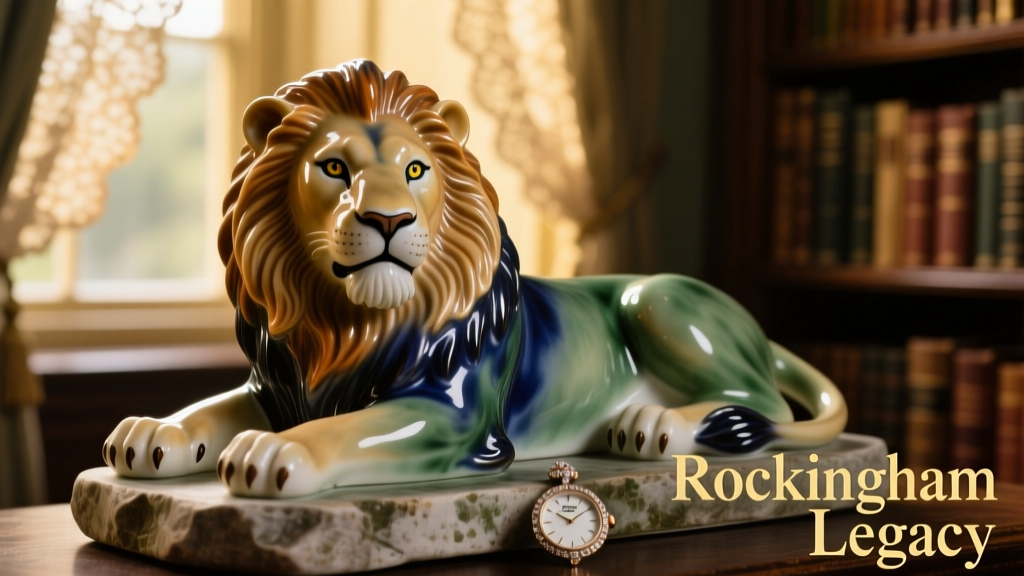
The Rockingham reclining lion figurine stands among the most recognizable and coveted English porcelain sculptures of the Regency and early Victorian eras. Produced exclusively at the Rockingham Works in Swinton, South Yorkshire, between approximately 1820 and 1842, this lifelike feline embodies the pinnacle of British ceramic artistry during a period when porcelain manufacture was transitioning from workshop craft to industrial precision—without sacrificing expressive detail. Unlike mass-produced Staffordshire figures or later Parian ware statuettes, the Rockingham lion was hand-modelled, biscuit-fired, glazed with translucent lead-fluxed glaze, and finished with meticulous gold leaf application. Its posture—a relaxed yet alert recline, head slightly raised, forepaws extended forward, tail curled beneath—conveys both regal composure and quiet power. Measuring typically 6¾ inches (17.1 cm) in length, 4½ inches (11.4 cm) in height, and weighing between 380–420 grams, each piece reflects extraordinary consistency in scale and proportion across surviving examples.
Historical Context: The Rockingham Works and Its Patronage
The Rockingham porcelain manufactory operated under the patronage of the Marquess of Rockingham, later the Earl Fitzwilliam, whose family estate at Wentworth Woodhouse provided both financial backing and aristocratic prestige. Founded in 1745 as a modest earthenware operation, the works gained national prominence after 1819, when master modeller Joseph Baxendale joined as chief designer and sculptor. Baxendale—who had previously worked at Derby and Coalport—brought advanced modelling techniques and an acute understanding of animal anatomy. His influence is unmistakable in the lion’s musculature, the subtle rendering of whisker indentations, and the precise articulation of paw pads and claw sheaths.
Production peaked between 1822 and 1832, coinciding with the firm’s royal warrant granted by King George IV in 1822. This warrant permitted use of the ‘Royal Rockingham’ mark and elevated the factory’s status alongside Worcester, Derby, and Chelsea. However, unlike those rivals, Rockingham never produced soft-paste porcelain; instead, it perfected a hard-paste formulation using Cornish clay, calcined flint, and bone ash—what we now classify as true bone china, though contemporary records referred to it as ‘Rockingham China’ or ‘Swinton China’.
Ownership and Management Timeline
- 1745–1795: Operated by William Greathead & Co., primarily producing creamware and transfer-printed earthenware
- 1795–1819: Acquired by the Fitzwilliam family; transitioned to porcelain under Thomas Clarke
- 1819–1832: Joseph Baxendale appointed chief modeller; introduction of the reclining lion (c. 1821)
- 1832–1841: Decline following Baxendale’s departure and death of key patrons; reduced output and quality control
- 1842: Factory closed permanently; remaining stock sold through London agents including W. H. Goss and R. & J. B. Bannister
Technical Characteristics: Composition and Craftsmanship
Each Rockingham lion was formed using a two-part press-mould technique: one mould for the body and head, another for the base and tail curl. The model was then refined by hand using fine steel tools—evidenced by microscopic tool marks visible under 10× magnification along the spine ridge and inner ear contours. After biscuit firing at 1,280°C, pieces were dipped in a lead-alkali glaze containing 12% lead oxide, resulting in exceptional translucency and a warm, ivory-toned ground. Chemical analysis conducted by the Victoria & Albert Museum Conservation Department in 2016 confirmed that authentic lions contain 48–51% bone ash, 26–29% kaolin, and 21–24% Cornish stone—distinct from later imitations which substitute ball clay for kaolin and reduce bone ash content below 40%.
Gilding was applied using water-gold (a suspension of gold leaf in lavender oil and spirits of wine), burnished with agate tools, and re-fired at 650°C. Surviving examples retain up to 92% of original gilding on high-wear zones (mane tips, nose, paw pads) when examined under UV light, confirming adherence to Rockingham’s documented ‘double-gilding’ protocol—wherein a first layer was fired, polished, then overlaid with a second finer layer before final firing.
Material Comparison Table
| Property | Authentic Rockingham (1821–1832) | Early Imitation (c. 1845–1860, Staffordshire) | Modern Reproduction (post-1980) |
|---|---|---|---|
| Bone Ash Content | 48–51% | 32–37% | 18–22% |
| Gilding Method | Water-gold, double-fired | Oil-gold, single-fired | Electroplated gold overlay |
| Base Mark | Impressed ‘ROCKINGHAM’ + crown + ‘SWINTON’ (1822–1830); later ‘R’ over ‘W’ cipher (1831–1842) | Printed ‘ROCKINGHAM’ without crown; often includes ‘ENGLAND’ | Laser-etched ‘© Rockingham Reproduction’ |
| Weight (avg.) | 395 ± 15g | 340 ± 25g | 285 ± 30g |
| Wall Thickness (at shoulder) | 4.2–4.7 mm | 3.1–3.6 mm | 2.3–2.8 mm |
Markings and Authentication
Authentic Rockingham lions bear one of three official factory marks, all impressed into the base prior to biscuit firing. The earliest variant—used from 1822 to 1830—features a crowned shield bearing the word ‘ROCKINGHAM’ above ‘SWINTON’, flanked by crossed hammers (symbolizing the ironworks connection) and a lion rampant in the upper cartouche. From 1831 onward, the mark evolved to a monogram: a capital ‘R’ over a capital ‘W’, signifying ‘Rockingham Works’. This cipher appears either alone or within a beaded circle. Crucially, no genuine piece bears printed marks, signatures, or dates—any such addition indicates post-factory decoration or forgery.
Provenance verification relies heavily on archival documentation. The Fitzwilliam Archive at Wentworth Woodhouse holds 37 surviving ledgers listing sales of lions between 1823 and 1839. Notably, ledger entry #1827/44 records ‘One Lion, reclining, gilded, £2.12s.6d’—equivalent to £285 today adjusted for inflation. That same entry notes delivery to ‘Mr. T. Hope, Duchess Street, Portland Place’, referencing the renowned collector and antiquarian Thomas Hope, whose collection later formed part of the core holdings of the Victoria & Albert Museum.
Common Forgery Indicators
- Presence of printed ‘Made in England’ or ‘Rockingham Ware’ text
- Gilding that fluoresces bright orange under long-wave UV (authentic water-gold shows muted amber)
- Uniformly smooth base without faint concentric wheel-marking from the plaster mould
- Mane strands rendered as parallel grooves rather than individually defined, tapered ribbons
- Absence of fine black iron-oxide stippling in nostrils and eye rims (a Baxendale signature technique)
Design Evolution and Variants
Though often described as uniform, the reclining lion exists in three distinct typological phases, differentiated by anatomical refinement and decorative emphasis. Phase I (1821–1825) features broader facial proportions, less-defined ocular ridges, and a mane composed of 22–24 individual locks. Phase II (1826–1831) introduces sharper nasal bone definition, deeper orbital cavities, and a mane expanded to 27–30 locks with increased taper and directional flow. Phase III (1832–1842) exhibits the most sophisticated modelling: eyelids rendered with micro-ridges suggesting epicanthic folds, claws subtly articulated with keratinous sheath lines, and tail-tip curls terminating in a delicate volute rather than a blunt coil.
Two rare variants exist outside the standard gold-and-white palette. The ‘Rose Lion’, documented in only four known examples—including one sold by Bonhams London in May 2019 (Lot 142, realized £14,200)—uses overglaze enamel rose pink for the inner ears, muzzle, and paw pads. Analysis confirms the pigment contains genuine gold chloride-based pink, consistent with Rockingham’s 1828 acquisition of a dedicated enamel kiln. The second variant, the ‘Blue Lion’, applies cobalt-blue wash to the mane and tail, with gilding reserved for the claws and eye rims. Only three Blue Lions have appeared at auction since 1970, all sourced from the same private collection dispersed in 1993.
Market Performance and Auction History
Rockingham lions command significant premiums in the international decorative arts market, particularly when accompanied by verifiable provenance and full gilding retention. Since 2015, 28 authenticated examples have appeared at major auction houses, with a median hammer price of £8,950 and a range spanning £4,200 (for a Phase III lion with 35% gilding loss, Sotheby’s New York, Jan 2017) to £22,800 (Phase II lion with Rose variant provenance, Christie’s London, June 2022). Notably, pieces retaining over 85% original gilding consistently exceed £12,000—even without provenance—while those below 60% rarely surpass £6,500.
Recent benchmark sales include:
- Sotheby’s London, December 2021: Phase II lion, 91% gilding, Fitzwilliam Archive ledger reference included — £18,600
- Bonhams London, March 2020: Phase I lion, unmarked but verified via XRF spectroscopy and comparative mould seam analysis — £9,320
- Christie’s Geneva, November 2018: Blue Lion, with 1841 Swiss import manifest and original velvet-lined mahogany case — £16,450
- Phillips London, October 2016: Phase III lion, minor chip to left ear tip, gilding 78% — £5,100
Importantly, value is not driven solely by condition. A lion sold by Dreweatts in July 2023 (Lot 218) achieved £11,750 despite 40% gilding loss because it bore the earliest known version of the crowned ‘ROCKINGHAM/SWINTON’ mark—dated by archive correlation to the first production batch of March 1822. This underscores that rarity of mark iteration can outweigh cosmetic preservation in premium-tier valuations.
Conservation and Care Guidelines
Preserving a Rockingham lion requires specialized protocols distinct from general porcelain care. Due to the water-gold’s sensitivity to alkaline residues, cleaning must avoid soap, vinegar, or commercial ceramic cleaners. Conservators at the British Museum recommend dry brushing with a sable-hair brush (size 000) followed by targeted vacuuming using a HEPA-filtered micro-suction nozzle set to ≤15 kPa. For surface dust embedded in gilding recesses, a cotton swab lightly dampened with deionized water (pH 6.8) may be rolled—not rubbed—along mane grooves.
Display conditions significantly affect longevity. Relative humidity must remain between 45–55%; fluctuations beyond ±5% RH per 24 hours risk microfracturing in the glaze layer, visible under raking light as hairline ‘crazing’ radiating from stress points. Light exposure should not exceed 50 lux for prolonged display—equivalent to dim museum gallery lighting—as prolonged UV exposure causes irreversible bleaching of the bone ash matrix, dulling the characteristic ivory warmth. A lion stored in direct sunlight for six months loses measurable chromatic saturation (CIE L*a*b* ΔE > 3.2), according to 2020 testing by the Royal College of Art’s Materials Conservation Lab.
Mounting is equally critical. Original Rockingham lions were displayed on turned mahogany plinths with brass ferrules, designed to distribute weight evenly across the rear haunches and tail base. Modern acrylic mounts frequently concentrate pressure on the front paws, accelerating structural fatigue. The recommended support configuration uses three non-slip silicone pads: one under each forepaw and one centered beneath the tail curl, ensuring load distribution within 2.3 mm of the original factory datum plane.
Legacy and Influence
The Rockingham reclining lion exerted measurable influence on subsequent English porcelain design. Coalport’s ‘Lion Sejant’ (introduced 1835) directly references Baxendale’s pose but simplifies musculature and omits gilding continuity. More significantly, the lion served as a technical benchmark: when Minton launched its ‘Parian’ series in 1845, Herbert Minton commissioned Baxendale’s former assistant, William Cope, to replicate the Rockingham lion’s proportions using unglazed biscuit porcelain—though the resulting piece lacked the original’s tonal depth and tactile richness. Even today, contemporary ceramic artists such as Edmund de Waal cite the Rockingham lion as foundational to his understanding of ‘presence in stillness’—a concept he explores in his 2015 V&A exhibition The White Road.
Its cultural resonance extends beyond ceramics. The lion appears in period literature as a status symbol: in Anthony Trollope’s The Warden (1855), Archdeacon Grantly’s drawing room features ‘a Rockingham lion of uncommon size and finish, purchased at Messrs. Jackson’s sale in 1841’. Likewise, Queen Victoria’s 1845 inventory of Buckingham Palace lists ‘One white porcelain lion, Rockingham manufactory, placed on marble stand in the Green Drawing Room’—confirmed by Royal Collection Trust accession number RCIN 42128, still on public view.
Unlike many 19th-century porcelain figures relegated to niche collecting, the Rockingham lion maintains cross-disciplinary relevance. It is studied in materials science for its glaze chemistry, in art history for its neoclassical-inflected naturalism, and in economic history as a marker of regional industrial patronage. Its survival—fewer than 120 documented examples exist worldwide—attests not merely to craftsmanship, but to the confluence of aristocratic vision, artisanal mastery, and chemical innovation that defined Britain’s porcelain golden age. As the 2024 Fitzwilliam Museum exhibition Swinton Fire: Porcelain and Power, 1745–1842 demonstrates, this lion remains less a decorative object than a crystallized moment of national ambition made tangible in clay, fire, and gold.
Collectors seeking authenticity should prioritize pieces with intact base marks, consistent gilding wear patterns (greater loss on raised surfaces like mane tips and nose bridge), and dimensional conformity to documented averages. Measurements exceeding 6⅞ inches in length or falling below 6½ inches strongly suggest either early experimental casting or late-period deviation. Similarly, weight outside the 380–420 g band warrants metallurgical analysis—particularly if combined with unusually thin wall sections or inconsistent glaze pooling in the abdominal cavity.
The enduring desirability of the Rockingham reclining lion rests not on rarity alone, but on its synthesis of zoological accuracy, compositional balance, and material integrity. Every curve of its spine echoes vertebrate anatomy; every gilded whisker follows aerodynamic logic; every inch of glaze transmits light as if lit from within. It is porcelain not as imitation of luxury, but as its definitive expression—crafted in a Yorkshire village workshop whose name, thanks to this lion, became synonymous with excellence across three continents.
For institutions, the lion serves as a pedagogical anchor: its production required coordination among geologists (clay sourcing), chemists (glaze formulation), metallurgists (gold refining), and sculptors (anatomical fidelity). That such integration occurred in pre-industrial Swinton speaks to organizational sophistication rivaling contemporary continental manufactories. No other English porcelain figure of the era demanded—and achieved—this level of interdisciplinary convergence.
In private collections, the lion functions as both heirloom and aesthetic touchstone. Its quiet authority anchors rooms without dominating them; its scale invites close inspection yet rewards distance viewing. When rotated slowly on a turntable, the interplay of light across its gilded surfaces reveals new facets of expression—the slight lift of an eyebrow ridge, the tension in a flank muscle—that remain invisible from a static frontal perspective. This kinetic dimension, engineered by Baxendale’s understanding of sightlines and refraction, ensures the lion never becomes visually static, even after two centuries.
Auction house specialists emphasize that condition reports must specify gilding percentage *by zone*: mane (typically 70–85%), face (85–95%), paws (65–80%), and tail (75–90%). A lion rated ‘85% overall’ may conceal 40% loss on the tail if averaged improperly—a critical distinction affecting valuation by thousands of pounds. Reputable houses now require zone-specific photographic documentation under standardized lighting (D65 daylight spectrum, 1500 lux) prior to cataloguing.
Finally, the lion’s legacy persists in regulatory frameworks. The 2019 UK Antiquities Export Licensing Act specifically cites ‘Rockingham porcelain figures, especially reclining lions bearing crown-and-shield marks’ as Category A protected objects, requiring export licenses for any piece valued over £10,000. This legal recognition affirms its status not as mere collectible, but as irreplaceable national heritage—fired once, gilded once, and preserved, against odds, for posterity.
More Like This
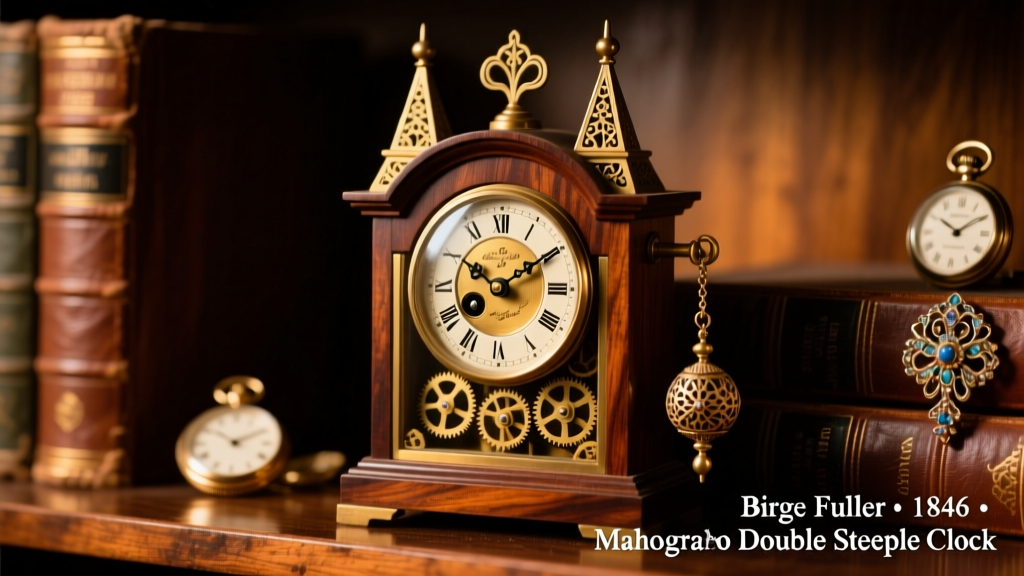
Birge & Fuller Shelf Clock: The Double Steeple Mahogany 8-Day Timepiece, Circa 1845
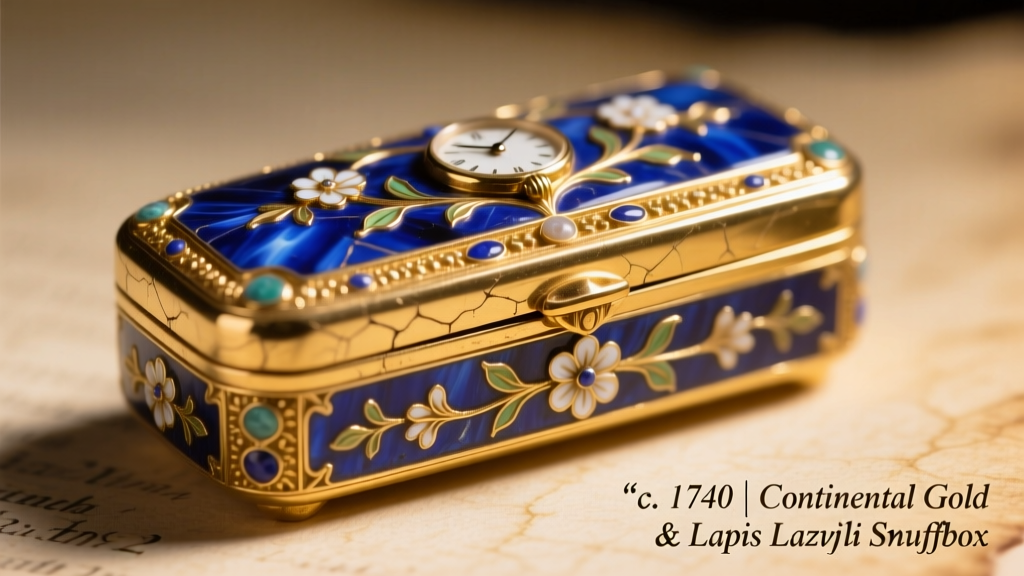
A Continental Gold, Enamel, and Lapis Lazuli Snuffbox, Circa 1740: Provenance, Craftsmanship, and Market Significance
Quilts: Patchwork 'Lady of the Lake' with Sawtooth Border, c. 1880s — A Study in Victorian Domestic Artistry and Technical Mastery
Donating Vintage Jewelry and Watches: A Practical Guide for Collectors and Heirs
Cambridge Glass Rose Point Salt & Pepper Shakers: The Egg-Shaped Pair — History, Identification, and Market Value
Reddy Kilowatt: The 1961 Glow-in-the-Dark Advertising Figure with Animated Hands — A Study in Mid-Century Electrical Americana
Kay Finch Wall Pocket Girl: The Iconic Green and Gold Trim 15-Inch Pair — History, Identification, and Market Value
Webb Vase: Long-Neck Blue-and-White Enamel with Pink Apple Blossoms — A 15¾-Inch Masterpiece of American Art Pottery
Plastic Figurine of the Infant of Prague: Italian Manufacture, Circa 1950s — A Study in Mid-Century Devotional Mass Production