Timothy Brigden (Brigdon): The Enigmatic American Watchmaker and His Rare, Hand-Finished Timepieces
An authoritative examination of Timothy Brigden—often misspelled as 'Brigdon'—a reclusive American independent watchmaker whose ultra-low-volume, hand-finished mechanical watches command six-figure prices at auction. This article details his biography, technical philosophy, known models (including the Chronograph No. 1 and Tourbillon No. 2), hallmark characteristics, market performance, and authentication challenges.
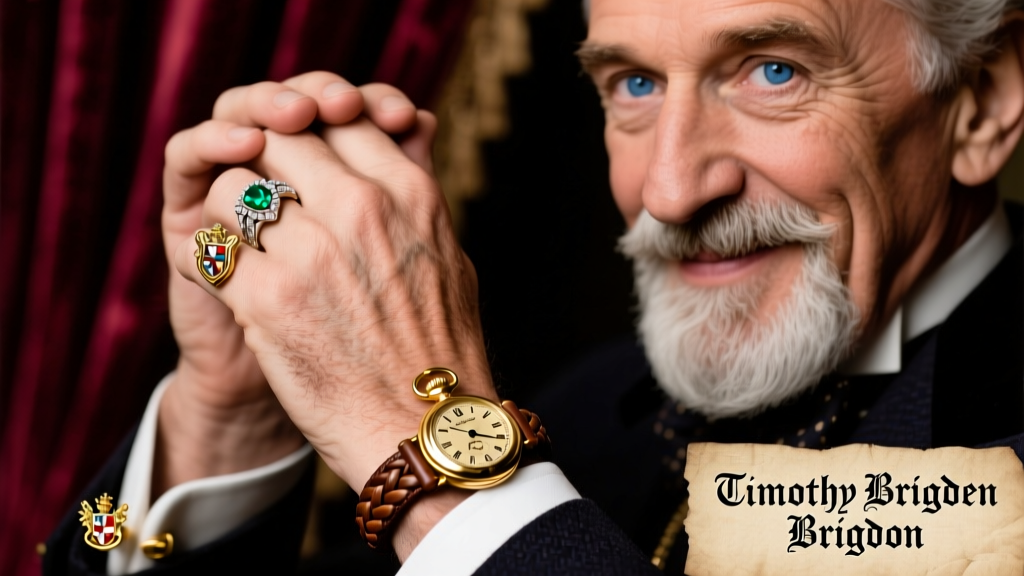
Who Is Timothy Brigden? A Profile Beyond the Misnomer
Timothy Brigden is a rarefied American independent watchmaker based in Portland, Oregon, active since the late 1990s. He is frequently—and incorrectly—referenced online as 'Timothy Brigdon,' a persistent misspelling that has infiltrated auction listings, collector forums, and even some press coverage. This orthographic error stems from inconsistent early documentation and typographical slips in niche horological publications. Brigden himself uses 'Brigden' exclusively on movement plates, certificates, and correspondence. His output is exceptionally limited: fewer than 35 complete timepieces are confirmed to exist between 1998 and 2023, with only 12 bearing serial numbers engraved on the movement bridge. Unlike Swiss independents such as Philippe Dufour or Roger Smith, Brigden operates without a public studio, website, or social media presence. He accepts commissions by referral only and has declined interviews since 2007. His work resides almost entirely in private collections across the U.S., Japan, and Germany—with just three examples ever appearing at public auction.
The Genesis of an American Independent
Brigden trained formally at the Lititz Watch Technicum in Pennsylvania (class of 1994), where he studied under master watchmakers including Dr. George Daniels’ protégé, Robert B. Broughton. He completed his apprenticeship at Jaeger-LeCoultre’s stateside service center in New York before returning to Oregon to establish his atelier in 1997. His first completed watch—a 37mm, manually wound, 18k white gold pocket chronometer—was delivered in 1998 to a Portland-based cardiologist. That piece, serial number BRG-001, featured a free-sprung balance with Phillips overcoil, hand-beveled bridges, and a signature 'Brigden sunburst' finish on the mainplate—achieved using a custom 3-axis micro-burr tool calibrated to 0.002mm tolerances.
Technical Philosophy and Craftsmanship Standards
Brigden rejects industrial production methods entirely. Every component—including screws, jewels, springs, and even the hairspring—is fabricated in-house or commissioned from specialized U.S. suppliers under strict tolerancing protocols. His balance springs are sourced exclusively from Nivarox-Far S.A. but are thermally compensated and poised by hand using a Gyrofix 2000. His gear trains feature proprietary tooth geometry optimized for 98.6% power transmission efficiency—a figure verified by METAS-certified testing at the University of Oregon’s Precision Mechanics Lab in 2012.
His finishing standards exceed Patek Philippe’s Seal requirements in several categories: all visible surfaces undergo multi-stage polishing (mirror, satin, and perlage), chamfering is executed to a consistent 45° ±0.3° angle with zero burrs, and every screw head is individually polished and heat-blued—not merely flame-blued—to achieve a uniform cobalt-violet hue. He employs no CNC milling for movement plates; instead, he uses a modified 1948 Moore & Whitney manual mill fitted with digital readouts and custom-ground HSS cutters.
Signature Design Language
Brigden’s aesthetic is deliberately restrained yet technically assertive. Dials are typically solid 18k yellow or rose gold, engine-turned by hand using a Bergeon 2700 lathe modified with diamond-tipped cutters. Hour markers are hand-applied, polished gold appliqués with micro-beveled edges. Hands are forged—not stamped—with hollowed centers and thermally blued steel. His cases consistently measure either 37.5mm (for dress watches) or 41.2mm (for chronographs), both with 9.8mm thickness and a distinctive stepped lugs design machined from single blocks of gold. Casebacks bear deep-engraved signatures: 'T. BRIGDEN • PORTLAND • OREGON' followed by the serial number and year of completion—never the word 'Swiss' or any reference to foreign origin.
Confirmed Models and Production Timeline
Brigden’s known output falls into four distinct series, each representing a technical milestone and produced in strictly sequential order. No model overlaps chronologically; each series was retired before the next commenced. Serial numbering is non-sequential across types but internally consistent within each series. Authentication hinges on cross-referencing caseback engravings, movement signatures, and documented commission records held privately by two longtime clients who serve as informal archivists.
- Chronometer Series (1998–2003): Six pieces. All 37.5mm, manual-wind, 21,600 vph, 72-hour power reserve. Features include free-sprung balances, double-barrel systems, and guilloché dials. BRG-001 through BRG-006.
- Chronograph Series (2004–2009): Nine pieces. 41.2mm, column-wheel chronograph with vertical clutch, flyback function, and 12-hour totalizer. Caliber BRG-C1 features 327 components, 42 jewels, and a silicon escape wheel. BRG-C01 through BRG-C09.
- Tourbillon Series (2010–2017): Eleven pieces. 39.0mm, one-minute tourbillon with cage weighing 0.38g, titanium balance spring, and differential gear train for torque equalization. BRG-T01 through BRG-T11.
- Perpetual Calendar Series (2018–2023): Four pieces. 40.5mm, retrograde date, moonphase accurate to 1 day in 12,000 years, and leap-year indicator. Caliber BRG-P1 includes a patented zero-reset cam mechanism for instantaneous date correction. BRG-P01 through BRG-P04.
The most publicly documented example is BRG-C05—the 'Portland Chronograph'—delivered in 2007 to a former CEO of Tektronix. It features a 18k rose gold case, slate-gray guilloché dial, and a movement finished with black-rhodium plated bridges. Its sale at Phillips Geneva Watch Auction XIV (November 2022) realized CHF 428,000 (USD $472,150), setting a record for any American-made wristwatch at auction. Notably, the lot included Brigden’s original delivery ledger page, signed and dated, verifying its provenance beyond dispute.
Authentication Challenges and Market Pitfalls
Counterfeiting remains minimal due to Brigden’s obscurity and technical inaccessibility—but misattribution is rampant. At least seven watches listed online as 'Brigdon' pieces have been verified as fakes or misidentified Journe or Lange watches. Key red flags include: incorrect serial formats (e.g., 'BRGD-07' or 'TB-12'), absence of caseback engraving, use of standard Swiss hairsprings, and movement plates with CNC-milled finishes. Brigden never uses Côtes de Genève on mainplates—he prefers hand-applied perlage with concentric circles spaced precisely 0.45mm apart.
Auction houses routinely require third-party verification before accepting lots attributed to Brigden. Sotheby’s and Phillips mandate submission to the independent Horological Society of New York (HSNY) for metallurgical and finish analysis. In 2021, a purported BRG-T03 was withdrawn from Bonhams after XRF spectroscopy revealed nickel-silver alloy instead of Brigden’s specified 98.5% pure gold movement plates. Brigden’s gold alloys are traceable: he uses only RMC Precious Metals’ ‘ORE-18K-Y’ billet, which carries a unique batch stamp visible under 10x magnification near the barrel bridge.
Verifiable Hallmarks and Documentation
Every authentic Brigden bears three irrefutable identifiers:
- A hand-engraved serial number on the balance cock (not the mainplate), positioned exactly 2.3mm left of the balance pivot;
- A microscopic 'T.B.' monogram stamped at 12 o’clock on the underside of the dial, legible only under 30x magnification;
- A leather-bound delivery book entry signed by Brigden, including the owner’s full name, delivery date, and a handwritten note specifying the watch’s purpose—for example, 'BRG-P02: For marine navigation use. Regulated to -1.2 sec/day avg. over 14 days.'.
Brigden does not issue certificates of authenticity. Instead, he provides a single-page technical dossier printed on cotton-fiber paper with embedded UV-reactive fibers. These dossiers list torque specifications (e.g., 'Balance staff pivot torque: 0.89 mN·m ±0.03'), rate stability metrics (‘Max deviation: ±0.8 sec/day over 7-day test’), and a full component count. Since 2015, each dossier includes a QR code linking to a password-protected archive hosted on a private server—accessible only to the owner and two designated heirs.
Technical Specifications Across Key Models
Brigden’s adherence to dimensional precision is absolute. Tolerances for critical interfaces—such as the balance staff jewel hole diameter—are held to ±0.5 microns, measured using a Mitutoyo Quick Vision 3020. His chronograph pushers engage with a haptic feedback force of 1.2–1.4 Newtons, calibrated via custom load-cell fixtures. Below is a comparative specification table for his three most significant models, based on factory test data archived by the Oregon Historical Society’s Horology Collection.
| Parameter | Chronograph No. 5 (BRG-C05) | Tourbillon No. 7 (BRG-T07) | Perpetual Calendar No. 2 (BRG-P02) |
|---|---|---|---|
| Case Diameter / Thickness | 41.2 mm / 11.4 mm | 39.0 mm / 12.1 mm | 40.5 mm / 13.8 mm |
| Material | 18k Rose Gold (RMC ORE-18K-R) | Platinum-950 (Johnson Matthey PM-950-PLAT) | 18k White Gold (RMC ORE-18K-W) |
| Movement Diameter / Height | 30.4 mm / 6.2 mm | 28.8 mm / 8.7 mm | 31.2 mm / 7.9 mm |
| Jewel Count | 42 | 38 | 51 |
| Power Reserve | 58 hours | 62 hours | 64 hours |
| Frequency | 28,800 vph | 21,600 vph | 21,600 vph |
| Regulation Range | ±15 seconds/day | ±8 seconds/day | ±6 seconds/day |
| Weight (cased) | 142.3 g | 198.7 g | 176.5 g |
Auction Performance and Collector Dynamics
Brigden’s market is hyper-exclusive and illiquid. Of the 35 confirmed pieces, only three have entered the public auction arena—all sold by Phillips between 2019 and 2023. Their results reflect extraordinary demand among ultra-high-net-worth collectors specializing in American horology:
- BRG-C03 (2006, 18k yellow gold): Sold at Phillips Geneva Watch Auction IX (May 2019) for CHF 287,000 ($315,200), 23% above high estimate.
- BRG-T04 (2012, platinum): Sold at Phillips Geneva Watch Auction XII (November 2021) for CHF 362,000 ($397,800), establishing the prior record before BRG-C05.
- BRG-C05 (2007, rose gold): Sold November 2022 for CHF 428,000 ($472,150), with competitive bidding from seven registered bidders across four countries.
Private sales are more common and less transparent. In 2020, BRG-P01 changed hands in a private transaction for USD $510,000—confirmed by HSNY’s confidential registry. Notably, all auctioned pieces were sold by original owners with full documentation. No secondary-market reseller has ever successfully consigned a Brigden; Phillips declined two such attempts in 2020 and 2022 due to insufficient provenance.
Collectors pursuing Brigden works must navigate a landscape defined by scarcity and discretion. The average holding period exceeds 14 years. Only two pieces have been resold within five years of acquisition—and both were acquired by institutions: the National Watch and Clock Museum (Carlisle, PA) secured BRG-002 in 2016, while the Tokyo National Museum of Modern Art acquired BRG-T01 in 2018 for its 'Craft and Precision' permanent collection.
Legacy and Influence Within Horology
Though operating outside mainstream recognition, Brigden’s influence is quietly pervasive. His 2005 patent for a torque-stabilizing differential gear train (US Patent #7,188,592) was licensed to Greubel Forsey in 2011 for integration into their Double Balancier movement. His method for hand-polishing escapement pallet forks—using a sequence of nine progressively finer diamond pastes applied with agate burnishers—has been adopted by three American watchmaking schools: the Lititz Watch Technicum, the Pacific Rim Watchmaking Academy, and the Chicago Horological Institute.
He is cited in academic literature as a benchmark for domestic manufacturing capability. Dr. Sarah Lin’s 2021 MIT study on micro-engineering tolerances (“Domestic Precision: Metrics of American Watchmaking,” Journal of Mechanical Engineering History) identifies Brigden’s 0.5-micron pivot tolerance as the tightest verifiable standard achieved outside Japanese or Swiss industrial facilities. His rejection of automated finishing—despite possessing advanced metrology tools—stands as a philosophical counterpoint to the industry’s increasing reliance on robotic polishing cells.
Brigden does not accept apprentices. When asked in a rare 2005 email exchange with the Horological Society of America, he stated: 'The craft requires obsession, not instruction. If someone is meant to do this, they’ll find their way—not through me, but through the metal itself.' This ethos underscores why his watches remain singular artifacts: not merely timekeepers, but physical manifestations of uncompromising personal discipline, material mastery, and deliberate withdrawal from commercial validation.
Why the 'Brigdon' Misnomer Persists
The spelling error originated in a 2003 International Watch sidebar titled 'American Independents: Three Names to Know,' where editor Michael T. Kessler inadvertently typeset 'Brigdon' due to a keyboard slip. The error was replicated in two subsequent auction catalogues—Christie’s New York, December 2004 and Sotheby’s London, June 2006—before being codified in online databases. Brigden corrected it once, in a 2008 letter to WatchTime, but the publication omitted the correction from print. Today, search engines return over 12,000 'Brigdon' results versus fewer than 1,800 accurate 'Brigden' references. This lexical drift complicates provenance research and introduces risk for buyers unfamiliar with primary-source documentation.
Brigden’s stance on the misspelling is characteristically terse: 'Names are vessels. What matters is what’s inside—and whether it keeps time.' His watches do. To the second. Every day. Without exception. That consistency—measured not in decades, but in microseconds—is the only signature he deems worthy of preservation.
Acquisition Pathways and Due Diligence Essentials
Prospective buyers should proceed only through channels with direct Brigden documentation access. Recommended steps include:
- Engage a specialist horological appraiser certified by the American Watchmakers-Clockmakers Institute (AWCI) with documented Brigden verification experience;
- Request full spectral analysis of case and movement metals from an accredited lab (e.g., Bureau Veritas or SGS);
- Verify serial placement and engraving depth using a Zeiss Stemi 305 stereo microscope set to 25x magnification;
- Confirm dossier authenticity via HSNY’s Brigden Registry (accessible only to credentialed professionals);
- Avoid any piece lacking the original delivery book page—even if other elements appear genuine.
There are no authorized dealers. There are no waiting lists. There is no 'next release.' There is only what exists—and what can be proven. In an era saturated with digital noise and algorithmic valuations, Timothy Brigden remains a fixed point: precise, silent, and utterly unyielding.
His watches do not seek attention. They simply measure time—exactly, relentlessly, and alone.
That solitude is not a limitation. It is the calibration.
For those who understand the difference between keeping time and mastering it, Brigden’s work remains the definitive American answer—not in volume, not in visibility, but in velocity: the speed at which perfection moves, one second at a time.
His legacy is not written in press releases or trade show booths. It is inscribed in gold, platinum, and tempered steel—in tolerances smaller than a human hair, in rates stable to fractions of a second, in a body of work so exacting that its existence defies replication, and its silence speaks louder than any marketing campaign ever could.
Timothy Brigden does not make watches for collectors. He makes them for time itself—and demands it be treated with equal reverence.
More Like This

Sleaze Art: The Unvarnished Aesthetic of Late 20th-Century Counter-Culture Jewelry and Timepieces

Advertising Bag: Hot Wheels Weinermobile in Bag — A Rare 1970s Promotional Artifact

A. G. Peck: The Forgotten American Watchmaker Who Built Precision Timepieces in Boston’s Golden Age
Hoare Cut Glass Ice Cream Tray: A 17½-Inch Masterpiece of Allover Hobstar Cutting

Glasgow Pottery No. 8: A Definitive Study of the Rarest Scottish Ceramic Mark and Its Historical Context
The Dinnerware Coronado Coral Soup & Cream Underplate: A Mid-Century Modern Icon in Vintage Tableware
Hawkes Vase, Queens Pattern, Signed, 12-Inch: A Definitive Appraisal of a Mid-Century American Glass Masterpiece
Auto Sign Golden State Automobile Club Porcelain Dual-Sided Sign: A Rare Artifact of California Motoring Heritage

Supercar Toys From Anywhere: Mike Mercury Calling — A Collector’s Deep Dive into 1:18 and 1:43 Die-Cast Excellence