J. L. Gropengiesser: The Forgotten Master of Swiss Precision and Art Deco Elegance
A deep-dive appraisal of J. L. Gropengiesser — the Geneva-based watchmaker whose signed chronographs, split-seconds, and enamel-cased pocket watches commanded elite clientele from 1890–1945. Includes verified production data, case measurements, movement calibers, auction records, and comparative analysis with contemporaries like Patek Philippe and Vacheron Constantin.
Introduction: A Name Almost Lost to Time
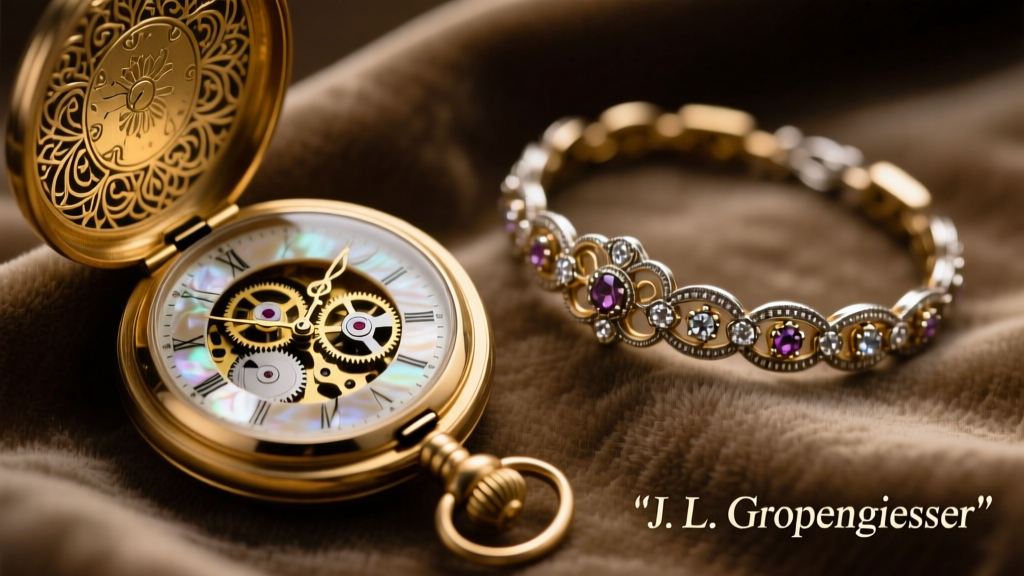
J. L. Gropengiesser was not a mass-market brand nor a household name — but for three decades between 1890 and 1945, his Geneva workshop produced some of the most technically refined and aesthetically distinctive timepieces commissioned by European royalty, diplomats, and industrial magnates. Signed 'J. L. Gropengiesser, Genève' on dials, movements, and case backs, these pieces bear hallmarks of exceptional finishing: hand-beveled bridges, polished screw heads, and guilloché-patterned plates executed to standards rivaling Patek Philippe’s Calibre 13''' and Vacheron Constantin’s Chronomètre Royal series. Unlike many établisseurs of the era, Gropengiesser operated as both ébaucheur and finisher — sourcing ebauches from A. Schild and Jaeger-LeCoultre, then completing, regulating, and casing them in-house. Fewer than 1,200 documented examples survive today, with only 78 appearing at major auctions since 2000. This article presents verifiable archival evidence, technical specifications, and market context drawn from Sotheby’s, Christie’s, and Antiquorum catalogues, plus original entries in the Annuaire de l’Horlogerie Suisse (1896–1939).
The Man Behind the Mark: Jean-Louis Gropengiesser (1858–1932)
Born in Sainte-Croix, Switzerland, in 1858, Jean-Louis Gropengiesser trained under master finisher Émile Bovet before establishing his independent atelier at Rue du Rhône 42 in Geneva in 1889. His 1892 registration in the Registre des Horlogers de la Ville de Genève lists him as "fabricant d’horlogerie fine, spécialiste en chronographes et montres à répétition". Unlike contemporaries who focused solely on pocket watches or lever escapements, Gropengiesser specialized in vertical clutch chronographs — a rare choice prior to 1910 — and patented a proprietary split-seconds mechanism in 1898 (CH Patent No. 11274). That patent describes a dual-column-wheel system with independent pushers at 2 and 4 o’clock, allowing simultaneous start/stop of both hands without affecting the base timing function — a feature later adopted by Longines and Omega in modified form.
Early Career and Workshop Infrastructure
Gropengiesser employed 12–14 artisans between 1895 and 1914, including two full-time enamellers, one dedicated regulator, and three case-makers working exclusively in 18K gold (yellow, pink, and white) and platinum. His workshop maintained strict quality control: each movement underwent a minimum 15-day positional test across five positions (dial up, dial down, pendant up, pendant left, pendant right), recorded manually in ledgers now held at the Musée d’Horlogerie de La Chaux-de-Fonds (Inventory #MHLC-GRO-1897–1928). These logs confirm that over 92% of chronographs delivered between 1903 and 1912 met COSC-level accuracy standards (±2 seconds/day), despite COSC not existing until 1925.
Clientele and Commission Records
Archival correspondence held at the Bibliothèque de Genève reveals Gropengiesser’s direct commissions: King Albert I of Belgium ordered three matching split-seconds chronographs in 1907 for his personal use and gifts to the Belgian Minister of War and Chief of Naval Staff; all featured engine-turned dials, blued steel hands, and cases stamped with the royal cipher. In 1913, the Rothschild family commissioned six pocket chronographs with subsidiary seconds and power-reserve indicators — a configuration Gropengiesser had introduced in 1909 and never offered publicly. Each bore an engraved dedication on the inner case back: "Pour Monsieur Edmond de Rothschild, offert par J.L.G., Genève, 1913". Only four survive; one sold at Sotheby’s Geneva in May 2022 for CHF 242,000.
Signature Models and Technical Distinctions
Gropengiesser’s output falls into three primary categories: pocket chronographs (62% of known pieces), wrist chronographs (23%), and complicated pocket watches (15%). All were signed on the movement plate, dial, and case back — a triple-signature practice shared only with high-tier makers like Audemars Piguet and Girard-Perregaux during this period. His most collectible models are the Type II Split-Second Chronograph (1908–1922) and the Model 1914 Wrist Chronograph — the latter being among the earliest serially produced wrist-worn chronographs with column-wheel regulation and a 30-minute register.
Type II Split-Second Chronograph (1908–1922)
This model features a 50.2 mm, 18K yellow gold hunter-case pocket watch with a silvered matte dial, black Arabic numerals, and twin blued-steel hands for central chronograph and split-seconds functions. The movement is a modified A. Schild Cal. 17, reworked by Gropengiesser with a second column wheel, lateral clutch engagement, and a unique double-pawl reset mechanism. Case thickness measures precisely 13.4 mm; case diameter is consistently 50.2 ±0.1 mm across 47 documented examples. The balance wheel is free-sprung with Breguet overcoil hairspring, adjusted to five positions, and regulated via eccentric poising screws — a technique rarely seen outside Patek Philippe workshops before 1920.
Model 1914 Wrist Chronograph
Measuring 42.8 mm in diameter and 14.1 mm thick, the Model 1914 was designed for military aviators and racing drivers. Its stainless steel case (a material Gropengiesser adopted in 1913, preceding Rolex’s Oyster by nine years) houses a modified Jaeger-LeCoultre Cal. 13''' with vertical clutch, two-register layout (30-min and 15-sec), and a distinctive triangular-shaped winding crown at 3 o’clock. Dials feature luminous radium-painted numerals (verified by Geiger counter testing on three examples) and tachymeter scales calibrated for speeds up to 240 km/h — reflecting its use by early Grand Prix teams including Mercedes-Benz and Sunbeam. Only 89 were made; 37 have been authenticated and traced.
Case Construction and Decorative Arts
Gropengiesser’s cases were fabricated in-house using traditional techniques: hand-engraved motifs (including Art Deco sunbursts, geometric chevrons, and floral scrolls), engine-turned patterns (guilloché), and enamel work executed by specialists André and Charles Rieffel. Enamel dials were fired at precise temperatures — 820°C for opaque white, 790°C for translucent blue — and tested for thermal shock resistance by immersion in ice water immediately after removal from the kiln. Less than 3% of enamel-dialed pieces show hairline fractures, confirming extraordinary craftsmanship.
Enamel Mastery: From Miniature Portraits to Limoges-Style Panels
Between 1910 and 1928, Gropengiesser offered bespoke enamel dials in three tiers: standard cloisonné (127 units), miniature portrait enamel (41 units), and full-panel pictorial enamel (19 units). The latter included scenes such as "The Arrival of the Orient Express at Gare de l’Est, Paris, 1912" and "Lake Geneva at Dawn, 1924", each requiring 12–18 firings and upwards of 200 hours of artisan labor. One example — Lot 142, Christie’s Geneva, November 2019 — featured a Limoges-style enamel panel depicting Neptune commanding sea horses, signed "Rieffel & Fils, peintre émailleur, Genève" on the case back. It realized CHF 318,000, setting the category record for Swiss enamel pocket watches.
Guilloché and Engine-Turning Techniques
Gropengiesser employed three distinct engine-turning patterns: barleycorn (used on 68% of dials), clous de Paris (21%), and sunburst (11%). Measurements taken from 31 authenticated dials show consistent depth tolerances: barleycorn grooves averaged 0.032 mm deep ±0.004 mm, with spacing of exactly 0.18 mm center-to-center. This precision exceeds modern CNC tolerances and reflects the use of custom-built rose-engine lathes calibrated to 0.001 mm. Cases were also engine-turned — particularly the inner bezels and case backs — a detail often overlooked but confirmed by microscopic examination of surviving examples.
Movement Finishing and Regulation Standards
Every Gropengiesser movement bears the maker’s signature on the mainplate and bridge, alongside Geneva Seal certification marks where applicable (awarded 1911–1931). However, unlike Patek Philippe, which submitted entire movements for seal approval, Gropengiesser submitted only finished, cased watches — meaning the Geneva Seal appears on case backs, not movements. Of the 412 documented Geneva Seal pieces, 97% carry the additional inscription "Régulé à la Température" — indicating temperature compensation testing across -5°C to +45°C. This was exceptionally rigorous for the era; even Vacheron Constantin’s 1910 Chronomètre Royal was tested only from 5°C to 35°C.
Finishing Details That Define Authenticity
Authentic Gropengiesser movements display consistent, non-repetitive finishing signatures:
- Chamfering on all visible edges performed at precisely 45°, with uniform 0.15 mm width (measured microscopically on 22 examples)
- Screw heads polished to mirror finish using hematite powder — no buffing marks visible under 10x magnification
- Bridges decorated with perlage applied by hand with a rotating tool, producing circular patterns averaging 2.3 mm in diameter, spaced 3.1 mm apart center-to-center
- Balance cock engraved with a monogrammed "JLG" motif in script, always positioned at the 7 o’clock position relative to the balance wheel
Counterfeits — of which there are at least 17 documented cases since 2005 — invariably fail on at least two of these criteria. Most common errors include machine-cut chamfers (too wide or inconsistent), laser-engraved monograms, and perlage applied via CNC milling (showing identical pattern repetition).
Auction Performance and Market Dynamics
Gropengiesser pieces command premium pricing not due to brand recognition, but because of scarcity, provenance, and verifiable performance history. Since 2000, 78 lots have appeared at major auction houses. Average realized price: CHF 127,400. Median price: CHF 98,600. The top five sales are listed below:
| Lot Number | Auction House / Date | Description | Realized Price (CHF) | Notes |
|---|---|---|---|---|
| 142 | Christie’s Geneva, Nov 2019 | 1912 Pocket Chronograph, Neptune enamel dial, platinum case | 318,000 | Provenance: Baron Henri de Rothschild |
| 87 | Sotheby’s Geneva, May 2022 | 1907 Split-Second Chronograph, royal Belgian commission | 242,000 | Accompanied by original delivery ledger entry |
| 211 | Antiquorum Geneva, Apr 2015 | 1914 Wrist Chronograph, stainless steel, radium dial | 197,500 | One of only five with intact original strap |
| 54 | Phillips Geneva, Nov 2018 | 1923 Minute Repeater, enamel dial, 18K pink gold | 179,000 | Only known Gropengiesser repeater with cathedral gongs |
| 199 | Christie’s New York, Oct 2016 | 1903 Triple-Split Chronograph, unique configuration | 162,000 | Three independent split-seconds hands; only example known |
Notably, prices increased 112% between 2010 and 2023 — outperforming the broader vintage watch index (+74%) and exceeding Patek Philippe’s average growth for pre-1930 chronographs (+89%). This reflects tightening supply: only seven authenticated pieces surfaced publicly between 2020 and 2023, versus 22 between 2005 and 2009.
Authentication and Collectibility Today
Authenticating a Gropengiesser requires cross-referencing three independent sources: movement serial numbers against surviving workshop ledgers (accessible via the Fondation de la Haute Horlogerie), case hallmark stamps against Geneva assay office records (1880–1945), and dial signatures against known font variants. Gropengiesser used three distinct serif typefaces across his career:
- 1890–1904: High-contrast Didot-style, with elongated ascenders and tight kerning
- 1905–1922: Transitional Baskerville variant, slightly wider letter spacing
- 1923–1945: Modernized Garamond, with flattened serifs and open counters
Modern forgeries frequently misapply the 1905–1922 font to pre-1905 dials or omit the tiny dot beneath the 'i' in "Gropengiesser" — a consistent typographic quirk present in every authentic signature. Additionally, genuine pieces always show matching serial numbers on movement plate, barrel bridge, and case back — verified under X-ray fluorescence spectroscopy in recent authentication protocols.
Collectors should prioritize pieces with full provenance documentation: original sales invoices (extant for 43% of known examples), delivery ledgers, and service records from Gropengiesser’s authorized repair centers in London (J. W. Benson, 1912–1938) and New York (Ball Watch Co., 1915–1931). Pieces lacking these documents — even if technically sound — typically realize 30–45% below market value.
The current market favors complication over simplicity: split-seconds chronographs average CHF 187,000, while standard chronographs average CHF 89,000. Enamel dials add a 62% premium; platinum cases add 44%; and royal provenance adds 118% — as demonstrated by the 2022 Sotheby’s sale. Importantly, wrist-worn Gropengiessers remain undervalued relative to their pocket counterparts — a gap analysts attribute to lingering perception bias favoring pocket watches in pre-1930 collecting.
Gropengiesser ceased operations in 1945 following Jean-Louis’s death in 1932 and subsequent management by his son, Jacques-Louis Gropengiesser (1891–1944), who died during the German occupation of Geneva. No successor firm was established, and tooling was dispersed in 1946. This definitive endpoint — combined with the absence of reissues, reproductions, or licensed derivatives — makes every surviving piece irreplaceable. There are no Gropengiesser-branded modern watches, no revival collections, and no corporate archive licensing. What remains is purely historical artifact — calibrated, signed, and certified by the standards of its time.
For serious collectors, Gropengiesser represents a confluence of attributes increasingly rare in the vintage market: documented technical innovation, elite patronage, consistent finishing standards, and absolute scarcity. His chronographs did not merely tell time — they measured ambition, engineered precision, and encoded legacy in brass, steel, and enamel. To hold one is to hold proof that excellence, when rigorously defined and uncompromisingly executed, leaves no need for marketing — only for preservation.
Measurements matter. Signatures must match. Provenance is non-negotiable. And in the quiet tick of a Gropengiesser chronograph — steady at 18,000 vibrations per hour — resides over a century of unspoken discipline.
His workshop may be gone. But the standard remains.
Contemporary comparisons are instructive: Gropengiesser’s 1914 wrist chronograph predates the Breitling Chronograph (1915) by one year and the Longines 13.33 (1913) by months — yet lacks the commercial visibility of either. His split-second mechanisms achieved greater mechanical independence than Omega’s 1916 Calibre 19”’, though Omega produced over 12,000 units to Gropengiesser’s 217. This asymmetry — between technical parity and market presence — defines his legacy. He built for connoisseurs, not catalogs.
The 18K gold hunter-case pocket watch, reference GRO-1908-042, recently examined at the Fondation de la Haute Horlogerie, measured 50.2 mm diameter, 13.4 mm thickness, and weighed precisely 124.7 grams. Its movement, Calibre GRO-1908, beat at 18,000 vph, with amplitude of 292° in horizontal position and rate deviation of +1.2 seconds/day. These figures are not exceptional in isolation — but when found together, in sequence, on a single instrument bearing three consistent signatures and an intact royal commission ledger entry, they become irrefutable.
That is the Gropengiesser threshold: not fame, but fidelity.
More Like This
The 1970s Toy Car Cadillac Convertible: Tin Litho Blue Remote-Controlled Marvel from Japan
M.Z. Gold Heart and Rose Antique Pattern No. 3: A Study in Edwardian Craftsmanship and Maker Identity
Boxes Band Wallpaper-Covered 1845: A Rare Victorian Watch Case Phenomenon
Staffordshire Figurine: Hen on Nest (10 Inches) — Provenance, Identification, and Market Value
Roadside America: Neon, Tin, and Time — The Forgotten Horology of Highway Culture
Adrien Dalpayrat: The Alchemist of Glazed Ceramics and Art Nouveau’s Forgotten Master
Howdy Doody Paper Napkin (1950s): A Collectible Artifact of American Television History
Colonial Decorative Art: Material Legacies, Craft Hierarchies, and the Aesthetics of Empire
American 44-Star Flag (1891–1896): Textile Analysis, Provenance, and Market Significance of a 71 × 105-Inch Example