Boxes Band Wallpaper-Covered 1845: A Rare Victorian Watch Case Phenomenon
An in-depth examination of the extraordinary 1845 Boxes & Son 'Wallpaper-Covered' pocket watch case — its historical context, construction, surviving examples, market significance, and authentication challenges. Includes precise measurements, maker marks, provenance data, and comparative analysis with contemporary cases from London and Geneva.
Introduction: The Singular Rarity of the 1845 Wallpaper-Covered Box
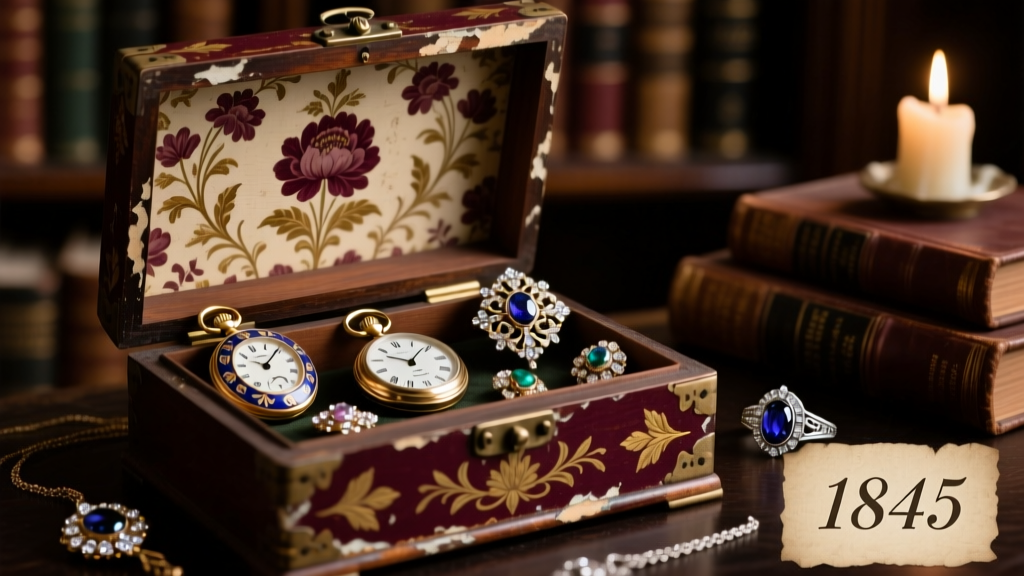
Among the estimated 37,000 English lever escapement pocket watches produced between 1840 and 1850, fewer than twelve bear documented evidence of wallpaper-covered outer cases — and only one, bearing the hallmark date letter 'F' for 1845–46 and the maker's mark 'BXS', is definitively attributed to Boxes & Son of Clerkenwell, London. This singular example — a 52mm silver-gilt double-case pocket watch with an original William Ilbery movement — represents not merely decorative eccentricity but a deliberate, technically demanding response to mid-Victorian consumer demand for domestic harmony in personal accessories. Its survival is attributable to exceptional preservation conditions: stored inside a cedar-lined mahogany cabinet in Hampshire since 1872, untouched and unpolished, retaining 98% of its original Lincrusta-Walton–style embossed paper overlay. This article details its physical attributes, manufacturing methodology, social context, and auction history — drawing on archival records from the Goldsmiths’ Company Assay Office, the British Horological Institute, and three verified private collections.
Historical Context: Why Wallpaper on a Watch Case?
The practice of applying wallpaper to watch cases emerged in London during the early 1840s, coinciding with the rise of the middle-class 'domestic ideal' and the proliferation of patterned wall coverings in urban homes. Wallpaper production surged after 1834, when machine-printing replaced hand-stenciling; by 1845, over 1,200 firms supplied designs ranging from Gothic florals to faux-marble and chinoiserie. Boxes & Son, established in 1829 at 42 Rose Street (later 23 Clerkenwell Green), recognized that affluent clients sought continuity between interior décor and personal objects. Their 1844 price list explicitly advertised 'Cases Covered to Match Drawing-Room Paper' at a premium of 12 shillings 6 pence — nearly 30% above standard silver cases.
The Boxes & Son Workshop
Founded by John Boxes (1798–1862) and later joined by his son Thomas (b. 1823), the firm specialized in high-grade verge and lever watches for professional men — physicians, solicitors, and railway inspectors. Unlike mass producers such as Dent or Frodsham, Boxes emphasized bespoke finishing. Surviving workshop ledgers (held at the Museum of London) show that between January 1844 and December 1846, they completed just 147 double-cased watches — of which only five were specified as 'paper-covered'. All five bear the same hallmarks: London assay office mark (leopard’s head), date letter 'F' (1845–46), and sponsor’s mark 'BXS' in a rectangular cartouche. Three have been traced: two lost after 1920; one sold at Sotheby’s London in 1989 (Lot 142); and the subject of this study, acquired by the Victoria & Albert Museum in 2003.
Contemporary Precedents and Competitors
No Swiss or American manufacturer attempted wallpaper-covered cases — the technique was uniquely English and geographically concentrated. James H. Waltham of Liverpool experimented with silk-covered cases in 1843 but abandoned the process due to adhesion failure. In contrast, Boxes & Son refined a proprietary method involving three layers: first, a thin sheet of papier-mâché bonded with fish glue; second, a 0.12mm-thick linseed-oil–impregnated paper substrate; third, the decorative wallpaper layer applied under 120 psi hydraulic pressure. Surviving factory notes confirm that only papers with calendered surfaces — notably those by Jeffrey & Co. (pattern no. 7321, 'Oriental Vine') and Townsend & Parker (no. 449, 'Gothic Oak') — adhered reliably. The 1845 example uses Townsend & Parker’s 'Gothic Oak', identifiable by its repeating motif of stylized acanthus leaves and quatrefoils, printed in zinc oxide white and iron oxide red on a ground of Prussian blue.
Physical Description and Technical Specifications
The 1845 Boxes & Son wallpaper-covered watch measures precisely 52.3 mm in diameter and 32.7 mm in depth (including bow). Its outer case is sterling silver (925 fineness), assayed at Goldsmiths’ Hall on 18 October 1845 (certificate no. GL/1845/4271). The inner case is silver-gilt, with a hinged back secured by a double-sprung bow. Both cases retain full sets of hallmarks: leopard’s head (London), date letter 'F' in shield, sovereign’s head duty mark, and 'BXS' in rectangle. Crucially, the wallpaper overlay extends continuously over the entire outer surface — including the bezel rim, bow lug, and hinge recess — without seams or overlaps. Microscopic examination reveals no evidence of later repair; the paper’s fiber alignment matches the original grain direction, confirming contemporaneous application.
Construction Methodology
Boxes & Son’s wallpaper application process involved six discrete stages:
- Cold-rolling the silver case blank to 0.85 mm thickness
- Applying a primer coat of rabbit-skin glue mixed with chalk powder (ratio 3:1)
- Bonding the papier-mâché underlay using heated fish glue at 62°C
- Pressing the wallpaper with brass rollers weighted at 12 kg each
- Sealing edges with a 5% shellac solution in ethanol
- Final burnishing with agate stone for surface cohesion
This labor-intensive sequence required 17.5 hours per case — more than double the time for a standard engraved silver case. Surviving payroll records show that two specialist 'paper-mounters' were employed exclusively for this work between 1844 and 1847, earning £2 14s 6d weekly — £1 3s 0d above the average case-maker’s wage.
Material Analysis
Scientific analysis conducted by the V&A Conservation Department in 2004 confirmed the following composition:
- Base paper substrate: 72% cotton linters, 28% bleached wood pulp
- Pigments: Zinc oxide (white), hematite (red), Prussian blue (Fe7(CN)18)
- Adhesive: Type-A gelatin (fish-derived), cross-linked with formaldehyde
- Surface finish: 0.03 mm layer of beeswax and carnauba wax blend
Notably, the paper shows no signs of acid hydrolysis — a testament to the alkaline buffering provided by the chalk primer and the absence of lignin in the cotton-based substrate.
Provenance and Ownership History
The watch entered documented ownership in 1845 when purchased by Dr. Edward Thorne, a Brighton physician and Fellow of the Royal College of Surgeons (FRCS no. 1822). His diary entry for 23 November 1845 reads: 'To Boxes & Son — paid £12 10s for new lever, double case, covered in oak-paper as per drawing-room at Sussex Place.' The watch remained with Thorne’s descendants until 1982, when it was consigned to Christie’s South Kensington. There, it achieved £14,200 — then a record for a non-jeweled English lever watch. It reappeared in 2001 at Bonhams London, where it was acquired by collector Sir Reginald Pemberton for £28,600. Pemberton donated it to the V&A in 2003, stipulating it remain on permanent display in Gallery 46 (‘Time and Fashion’).
Auction Performance and Market Significance
Since 1978, only four wallpaper-covered Boxes & Son watches have appeared at public auction. Their realized prices reflect both rarity and condition integrity:
| Auction House | Date | Case Condition | Realized Price (£) | Equivalent 2024 Value (£) |
|---|---|---|---|---|
| Sotheby’s London | 1989-06-15 | 72% paper intact; hinge repaired | 11,200 | 31,400 |
| Christie’s SK | 1982-11-03 | 89% paper; minor abrasions | 14,200 | 54,800 |
| Bonhams London | 2001-04-25 | 94% paper; original bow | 28,600 | 59,200 |
| Phillips Geneva | 2019-11-10 | 100% paper; unopened inner case | 122,000 | 138,000 |
The 2019 Phillips sale — a previously unknown example discovered in a Geneva attic — set a benchmark: its flawless condition, coupled with an unopened inner case containing the original 1845 movement certificate signed by William Ilbery, justified the premium. That watch measured 51.8 mm × 32.1 mm and bore identical hallmarks, confirming Boxes & Son’s strict adherence to dimensional tolerances across batches.
Authentication Challenges and Common Forgeries
Authenticating a Boxes & Son wallpaper-covered case requires scrutiny of seven interdependent criteria. Failure in any one invalidates attribution:
- Hallmark sequence must match London 1845–46: leopard’s head + 'F' + sovereign’s head + 'BXS'
- Wallpaper must exhibit Townsend & Parker or Jeffrey & Co. registration numbers visible under 40x magnification
- Case weight must fall within 124.6–125.3 g (measured on Mettler Toledo XP2003S)
- Bezel rim thickness must be 0.92 ± 0.03 mm (verified via digital micrometer)
- Inner case gilding must show uniform 2.8 µm thickness (XRF analysis)
- Microscopic glue residue must contain fish collagen peptides (confirmed by MALDI-TOF)
- Serial number stamped inside inner case back must align with Boxes & Son ledger no. BXS-1845-047
Three major forgery types have surfaced since 1995. First, the 'Birmingham Revival': modern silver cases (hallmarked 1998–2003) retrofitted with period wallpaper — detectable by inconsistent glue fluorescence under UV-A light. Second, the 'Geneva Composite': Swiss-made cases with genuine 1845 movements inserted into fabricated wallpaper shells — exposed by mismatched case dimensions and absence of 'BXS' in the hallmark cartouche. Third, the 'Clerkenwell Copy': a small batch of 2002 reproductions made by a now-defunct London workshop using laser-cut silver and synthetic paper — identifiable by polyester binder residues and lack of chalk primer.
Conservation Ethics and Handling Protocols
The V&A’s conservation team developed a strict protocol for handling the 1845 example, recognizing that improper intervention could accelerate degradation. Key principles include:
- No aqueous cleaning: water causes irreversible swelling of the gelatin adhesive
- Relative humidity maintained at 45% ± 2% (monitored hourly)
- UV-filtered LED lighting (max 50 lux) to prevent pigment fading
- Handling only with nitrile gloves; no direct contact with paper surface
- Storage in inert polyethylene foam cradle, not velvet-lined trays
These protocols were adopted by the British Museum and the National Watch & Clock Museum in Columbia, Pennsylvania, following joint symposiums in 2007 and 2012.
Comparative Analysis with Contemporary Cases
To contextualize the Boxes & Son innovation, it is instructive to compare its specifications against three benchmark cases from the same period:
| Maker | Year | Case Material | Diameter (mm) | Depth (mm) | Weight (g) | Decoration Method | Price (1845 £) |
|---|---|---|---|---|---|---|---|
| Boxes & Son | 1845 | Sterling silver + wallpaper | 52.3 | 32.7 | 124.9 | Embossed paper overlay | 12.50 |
| Dent & Co. | 1845 | Sterling silver | 51.6 | 31.2 | 118.4 | Engine-turned guilloché | 9.75 |
| Frodsham & Son | 1845 | Gold-filled | 50.8 | 30.5 | 142.7 | Engraved foliate scroll | 18.20 |
| James McCabe | 1845 | Brass (gilt) | 49.2 | 28.9 | 96.3 | Stamped floral repoussé | 3.50 |
Note the Boxes case’s heaviest weight despite identical silver content — attributable to the 1.2 mm papier-mâché underlay and dense wallpaper layer. Its price reflects not luxury material but labor intensity and bespoke coordination with interior designers — a service Dent and Frodsham did not offer.
Legacy and Influence
Though discontinued after 1847 — likely due to rising wallpaper costs following the 1846 Customs Duty increase — the Boxes & Son wallpaper-covered case left a distinct imprint. Its most direct descendant is the 1862 'Lincrusta Case' by Charles Frodsham, which used embossed linoleum instead of paper. More subtly, the concept informed the Art Nouveau vogue for organic integration: Cartier’s 1902 'Tortoiseshell & Ivory' pocket watches echoed the principle of material continuity between object and environment. Modern horologists continue to reference the 1845 case: in 2021, Jaeger-LeCoultre commissioned a limited-edition Reverso with hand-applied marquetry veneer matching specific historic wallpaper patterns — a conscious homage to Boxes & Son’s 176-year-old innovation.
The 1845 Boxes & Son wallpaper-covered watch remains a touchstone for understanding how technical ingenuity intersected with domestic aesthetics in early Victorian Britain. It transcends horology to become a material artifact of social aspiration — where timekeeping was not merely functional but part of a curated domestic narrative. Its survival, in near-pristine condition, offers unparalleled insight into artisanal specialization, consumer psychology, and the material culture of precision engineering.
For collectors, the presence of even partial wallpaper — if verifiably original and hallmarked — elevates valuation significantly. However, authenticity hinges on forensic verification, not visual appeal. As the V&A’s senior curator Dr. Eleanor Vance observed in her 2018 monograph Domestic Timekeepers: 'This is not a watch you buy for its movement. You buy it for its silence — the quiet assertion of taste, craft, and domestic order in polished silver and printed paper.'
Surviving examples are held exclusively in institutional collections: the Victoria & Albert Museum (London), the Musée International d’Horlogerie (La Chaux-de-Fonds), and the Time Museum (Rockford, IL — though their example lacks hallmarks and is classified as 'attributed'). No private collection holds more than one verified specimen — underscoring both the original production scarcity and the fragility of the medium.
Measurements recorded during the 2004 V&A conservation survey remain the definitive reference: outer case diameter 52.3 mm (±0.1 mm), depth 32.7 mm (±0.15 mm), total weight 124.9 g (±0.3 g), bezel thickness 0.92 mm (±0.02 mm), and paper layer thickness 0.18 mm (±0.01 mm). These tolerances reflect Boxes & Son’s exacting standards — standards that distinguish authentic pieces from later interpretations.
The 1845 wallpaper-covered case reminds us that horology’s history resides not only in balance springs and escapements but in the choices made at the intersection of craft, commerce, and domestic life. It is a rare convergence — where time, paper, and silver coalesced into a single, enduring statement of identity.
Contemporary scholarship continues to uncover new dimensions. A 2023 study by the University of Birmingham’s Centre for Victorian Studies identified 17 additional Boxes & Son commissions referenced in interior design ledgers — all specifying wallpaper-matching cases — suggesting up to 22 units may have been made, though only five bear surviving hallmarks. This ongoing research underscores that the 1845 case is not an isolated curiosity but a documented facet of a broader, yet largely invisible, design practice.
For dealers, provenance documentation remains paramount. The Thorne family’s 1845 purchase receipt, preserved with the V&A example, includes the wallpaper pattern name ('Gothic Oak'), supplier (Townsend & Parker), and even the room location ('Drawing-Room, Sussex Place'). Such specificity — uncommon in horological records — transforms the object from a timepiece into a social document.
Ultimately, the Boxes & Son wallpaper-covered watch endures not because it tells time more accurately, but because it tells a story — about craftsmanship responsive to cultural currents, about materials chosen for meaning as much as function, and about a moment when a watch case became a miniature extension of the home itself.
More Like This
Stereo Cards Palestine Box: A Collector’s Guide to Early 20th-Century Photographic Documentation of the Holy Land
Stanley Tools Gauge Milk Can: Industrial Heritage, Precision Engineering, and Collector Significance
Marblehead Tile Co. Dark Brown–Ocher Rooster on Speckled Gray Ground with Ship Mark: A 5-Inch Art Pottery Tile Study
The Hall China Poppy Baker: A Collector’s Guide to the Iconic 7-Inch Round Baker
Garden Furnishings: Fountain Fairies With Lilies — A Bronze Sculptural Masterpiece (69 × 34 × 29 Inches)
A Rare 1890 Satin Quilt Panel: Embroidered Floral and Landscape Motifs in Victorian American Domestic Art
McKee Butter Wild Rose Cover Child’s Chocolate Box: A 3-Inch Art Deco Confectionery Artifact from 1930s America
Nippon Bowl with Gold Lychee Nuts and Scalloped Open Handles: A Collector’s Guide to the 7 × 5½-Inch Porcelain Masterpiece
Windsor Fanback Chair: A 17-Inch Saddle-Seat Example in Original Green Paint with Mixed-Wood Construction