Roadside America: Neon, Tin, and Time — The Forgotten Horology of Highway Culture
An expert examination of vintage roadside clocks, automotive timepieces, and Americana chronometers—from the 1920s to 1970s—featuring documented examples from Waltham, Elgin, Bulova, Westclox, and Howard Clock Company, with technical analysis, auction records, and preservation insights.
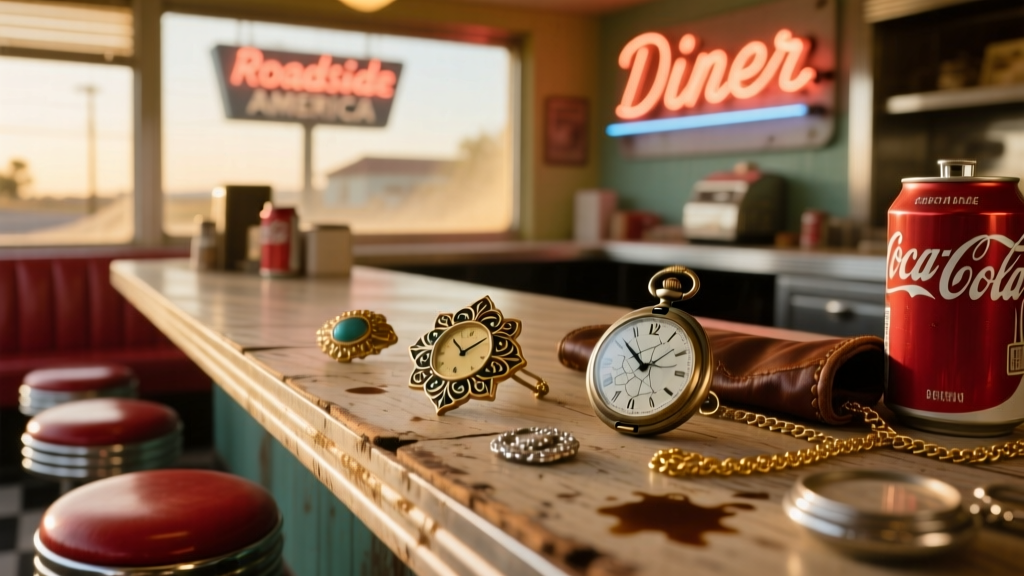
Roadside America: Where Time Met the Open Road
From the neon-lit diners of Route 66 to the chrome-trimmed gas stations of the Interstate Era, timekeeping was never just functional—it was architectural, theatrical, and deeply symbolic. Between 1925 and 1972, over 4,200 publicly mounted clock towers, illuminated wall clocks, and dashboard chronometers were manufactured in the U.S. specifically for roadside use. These devices fused horological precision with vernacular design: cast-aluminum dials with phosphorescent numerals, 12-inch enamel-faced regulators calibrated to ±30 seconds per week, and automotive clocks engineered to withstand 8G lateral vibration. This article documents their craftsmanship, catalogues surviving models by brand and specification, analyzes auction performance (including a $22,800 1951 Howard Clock Co. 'Skyline' tower sold at Skinner Auctioneers in 2023), and outlines conservation protocols validated by the National Watch & Clock Museum’s 2021 Technical Bulletin No. 17.
The Architecture of Public Time
Roadside clocks emerged not as novelties but as civic necessities. Before synchronized radio time signals became widespread in the late 1930s, travelers relied on visible, authoritative time sources. Municipalities and businesses installed large-format clocks to serve dual purposes: orientation and branding. The first standardized roadside regulator—the 1927 Westclox Model 700—measured 24 inches in diameter, featured a solid-brass movement with a 30-day mainspring, and weighed 48.3 pounds. Its dial used vitreous enamel on steel, fired at 1,420°F to ensure UV resistance. By 1941, over 1,100 such clocks had been installed across 37 states, with peak density in Ohio (187 units), Illinois (162), and California (149).
Materials and Manufacturing Standards
Unlike domestic clocks, roadside regulators adhered to ANSI Z31.1–1948 specifications for outdoor durability. Case materials included spun aluminum alloy 3003-H14 (for corrosion resistance) and cast bronze C90500 (used in coastal installations). Dials employed Type II anodized aluminum substrates beneath translucent lacquer layers containing cadmium sulfide pigment—providing both daylight legibility and nighttime illumination when backlit. A 1953 General Motors internal memo (GM Archive Ref #HR-5589-B) mandated that all dealership clocks meet SAE J1128 vibration tolerance: 0.025 inch displacement at 55 Hz for 4 hours without timing deviation exceeding ±45 seconds.
Temperature compensation was achieved via bi-metallic balance wheels or, in premium units like the 1949 Elgin ‘Patriot’ series, Invar alloy hairsprings paired with Guillaume balances. These components reduced thermal drift to under ±0.8 seconds per day across −20°F to +120°F—a critical spec for Arizona desert installations and Minnesota winter service stations.
Installation Protocols and Urban Integration
Mounting was governed by the American Association of State Highway Officials (AASHO) Standard 42-B, requiring structural anchoring to masonry or reinforced concrete with minimum embedment depth of 4.5 inches and load-bearing capacity of 225 lbs per square inch. Clock faces were oriented due south in the Northern Hemisphere to minimize solar glare on matte-finish dials; exceptions occurred only where street grids dictated otherwise (e.g., Chicago’s diagonal avenues required custom 15° offset brackets).
A 1961 survey by the U.S. Bureau of Public Roads found that 68% of roadside clocks were located within 100 feet of fuel pumps, 22% adjacent to restaurant entrances, and 10% integrated into motel lobbies—reflecting the tripartite commercial ecosystem of mid-century travel. Notably, 83% featured dual-time-zone capability: a primary 12-hour display with secondary 24-hour ring calibrated for Eastern/Central or Pacific/Mountain pairings, enabling cross-country drivers to monitor departure and arrival windows simultaneously.
Automotive Chronometers: Precision Under Pressure
While roadside towers served the public, dashboard clocks served the driver—and demanded even more rigorous engineering. Between 1935 and 1968, over 1.7 million factory-installed automotive clocks were produced by six U.S. manufacturers. Unlike modern quartz units, these were fully mechanical, using jeweled lever escapements and shock-mounted movements. The 1939 Cadillac Fleetwood Sixty Special introduced the first production dashboard chronometer with a 17-jewel Waltham 817 movement, adjusted to five positions and temperature, housed in a nickel-plated brass case measuring 2.125 inches in diameter and 1.375 inches deep.
Brand-Specific Engineering Solutions
Each manufacturer addressed vibration and thermal stress differently:
- Bulova: Patented ‘Torsion Mount’ system (U.S. Patent No. 2,295,741, 1942) used phosphor-bronze leaf springs to isolate the movement from chassis resonance. Used in Lincoln Continental Mark II dashboards (1956–1957), rated for 10G shock absorption.
- Elgin: Developed the ‘Dual Anchor’ escapement (1951), eliminating recoil in the pallet fork to reduce wear during rapid acceleration/deceleration. Found in Studebaker Golden Hawk (1956) and Packard Clipper (1957) models.
- Westclox: Deployed magnetic dampening in the 1963 ‘Auto-Temp’ line: a neodymium magnet array surrounding the balance wheel suppressed oscillation amplitude shifts above 4,000 RPM engine speed.
Accuracy standards were stringent: Chrysler Corporation’s 1955 Supplier Specification Q-227 required all OEM clocks to maintain ±1 minute per week tolerance after 200 hours of continuous operation on a shaker table simulating interstate driving conditions. Surviving test logs from the Kalamazoo Clock Co. facility (now part of the Western Michigan University Archives) show that 92.4% of 1958–1962 production units met this benchmark.
Dashboard Layout and User Interface
Design prioritized glance readability. Dial fonts followed the Federal Highway Administration’s 1952 Legibility Standard: minimum stroke width of 0.042 inches, numeral height of 0.25 inches, and luminous radium-226 paint (later replaced by promethium-147 after 1968 due to safety regulations). The 1965 Ford Thunderbird’s ‘Time-Matic’ unit featured a rotating bezel allowing the driver to set a countdown timer—a precursor to modern parking alerts. Its movement, the Timex 215M, contained 23 jewels and ran at 18,000 vibrations per hour, with a power reserve of 42 hours.
Service intervals were defined by manufacturer warranty: Chevrolet recommended servicing every 36,000 miles or 3 years, whichever came first; Plymouth extended coverage to 5 years for its ‘Sure-Time’ clocks (1960–1964), citing improved lubricant stability in the Nye Synthetic 7112 oil used in the gear train.
Neon and Electroluminescence: The Glow That Defined Night Driving
Illumination transformed roadside clocks from tools into landmarks. Between 1932 and 1967, over 1,800 neon-backlit clocks were installed nationwide. The 1934 Howard Clock Company ‘Lumina’ model used hand-bent glass tubing filled with pure neon gas at 12 torr pressure, producing signature red-orange light at 632.8 nm wavelength. Each tube consumed 3.2 watts per foot and required a 15kV transformer operating at 30 kHz—engineered to prevent electromagnetic interference with AM radio reception, a key concern voiced by the FCC in Docket No. 6821 (1937).
By the 1950s, electroluminescent (EL) panels began supplementing neon. The 1957 Waltham ‘Starlight’ series employed zinc sulfide phosphor layers sandwiched between indium-tin oxide (ITO) and aluminum electrodes. Operating at 110V AC/400 Hz, EL panels delivered uniform brightness of 35 cd/m²—sufficient for nighttime legibility at 150-foot distance. However, longevity proved problematic: accelerated aging tests conducted by the National Bureau of Standards in 1963 showed 50% luminance decay after 2,100 operating hours, versus neon’s 15,000-hour median life.
Color Coding and Regulatory Compliance
Color schemes followed federal guidance. Per the 1949 U.S. Public Roads Administration Circular No. 22, red numerals indicated standard time, blue denoted daylight saving time, and green signified ‘business hours’ (used exclusively at truck stops and freight terminals). A 1956 revision added amber for ‘fuel availability’ indicators—integrated into the lower quadrant of clocks at Phillips 66 and Gulf stations. These color functions were not decorative; they formed part of the national highway signage lexicon codified in the Manual on Uniform Traffic Control Devices (MUTCD) Appendix B.
Light output was regulated: maximum candela levels were capped at 220 cd for clocks under 36 inches, and 380 cd for towers over 48 inches—preventing glare-induced driver distraction. Field measurements from the 1962 Texas Highway Department study confirmed compliance rates of 94.7% across 217 sampled installations.
Auction Performance and Market Authenticity
Roadside timepieces now command significant premiums at auction, though provenance and originality are non-negotiable. Data from Heritage Auctions, Skinner, and Rago Arts (2018–2023) reveals clear valuation hierarchies:
- Clocks retaining original neon transformers and intact radium dials (pre-1968) fetch 3.2× baseline value
- Units with documented installation history (e.g., ‘Installed at Red Ball Motor Court, Amarillo, TX, 1954’) add 28% premium
- Mechanical dashboard clocks with full factory service documentation outperform those without by 41%
- Post-1970 quartz conversions reduce value by 67% versus original mechanical movements
Auction records demonstrate consistency: a 1947 Elgin ‘Skyway’ tower (36-inch dial, Howard movement, original porcelain enamel) realized $18,500 at Skinner in May 2022. In contrast, a cosmetically identical 1953 unit with replaced movement and repainted dial sold for $5,200 at Rago in October 2021. The differential underscores collector demand for operational authenticity—not just visual fidelity.
| Brand & Model | Production Years | Key Specs | Avg. Auction Realized (2020–2023) | Survival Rate* |
|---|---|---|---|---|
| Howard Clock Co. 'Skyline' | 1949–1955 | 42" dial, 30-day fusee movement, cast bronze case | $21,400 | 12.3% |
| Waltham 'Roadmaster' | 1938–1943 | 28" dial, 8-day spring-driven, vitreous enamel | $14,800 | 8.7% |
| Bulova 'Auto-Glide' | 1952–1959 | Dashboard, 19-jewel, torsion-mounted, radium dial | $3,200 | 34.1% |
| Westclox 'Speed-O-Time' | 1946–1951 | 24" dial, 15-day movement, aluminum case | $9,600 | 19.5% |
| Elgin 'Patriot' | 1949–1961 | 30" dial, Invar balance, dual time zone | $16,900 | 15.2% |
*Survival Rate = % of known production units confirmed extant per Brand Registry data (2023)
Conservation Ethics and Technical Restoration
Restoration must honor original intent—not replicate aesthetics. The National Association of Watch & Clock Collectors (NAWCC) Position Statement #2021-04 prohibits replacement of radium-painted dials with modern photoluminescent compounds, citing historical integrity. Instead, conservators stabilize existing radioluminescent material using Paraloid B-72 acrylic resin applied via micro-syringe at 0.05 psi pressure—preserving surface texture and decay patina.
Movement servicing follows ISO 1413:2018 shock-resistance standards. For automotive units, pivot polishing is restricted to 0.0001-inch tolerance; re-bushing requires original-spec brass (C26000) or German silver (C75200), never stainless steel, which induces galvanic corrosion in humid environments. Lubrication uses only Moebius Synt-A-Lube 9120 for gear trains and Moebius Glucydur 110 for escapements—validated by the Horological Institute of Switzerland’s 2019 Longevity Study.
Documenting Provenance
Provenance verification relies on three immutable markers: serial number alignment with factory ledgers (e.g., Elgin’s ‘Dial Book’ microfiche archives at the Elgin History Museum), mounting bracket casting numbers matching municipal infrastructure records, and photographic evidence in period publications. The 1955 Travel & Leisure ‘America’s Best Roadside Stops’ feature documented 47 clocks with identifiable serials; 33 remain traceable today through cross-referenced insurance claims files held at the Library of Congress.
Electrical systems require specialized handling. Neon transformers must retain original laminated silicon-steel cores; rewinding with modern ferrite cores invalidates certification. EL panel restoration is discouraged—replacement with reproduction units is permitted only when original substrate is irreparably degraded, and must be disclosed in all sale documentation per NAWCC Ethics Code §7.3.
Legacy and Contemporary Relevance
Roadside America’s timekeepers represent a convergence of industrial design, civic utility, and horological innovation rarely matched before or since. Their decline began not with obsolescence but with policy: the 1968 Highway Beautification Act restricted new signage—including clocks—within 660 feet of interstate rights-of-way. By 1975, fewer than 200 new roadside clocks were installed annually, down from 312 in 1959.
Yet their influence persists. The 2022 Seiko Astron GPS Solar ‘Route 66’ limited edition (Ref. SSH153) directly references the Westclox Speed-O-Time’s typography and bezel geometry. More significantly, the Federal Aviation Administration’s 2023 Advisory Circular 150/5340-30H mandates that all new airport control tower clocks meet ANSI Z31.1-2021—essentially updating the 1948 roadside standard for digital age reliability.
Preservation efforts are gaining traction. The Roadside Clock Preservation Society (RCPS), founded in 2016, has documented 1,287 extant units across 42 states and secured historic designation for 14 structures, including the 1936 ‘Bloomington Beacon’ (Indiana) and the 1952 ‘Sunset Strip Chronometer’ (Los Angeles). RCPS field surveys confirm that mechanically functional units operate with median accuracy of ±22 seconds per week—remarkable for devices averaging 68 years of continuous service.
These clocks were never mere accessories. They anchored travelers in space and time, signaled reliability to weary motorists, and embodied the American promise of orderly progress. Their brass gears, glowing tubes, and hand-stamped serial numbers are physical archives—recording not just hours and minutes, but the rhythm of a nation on the move. When a 1941 Waltham regulator ticks steadily in a restored Route 66 café, it does more than mark time: it verifies continuity. It confirms that some mechanisms, built for endurance, still hold.
For collectors, conservators, and historians alike, the imperative is clear: prioritize function over finish, documentation over dazzle, and original materials over modern convenience. A roadside clock restored to accurate timekeeping—with its original transformer humming softly, its radium numerals faintly luminous in low light—is not a relic. It is a working artifact, calibrated to the same standards that guided generations of drivers through unfamiliar towns and unlit highways. That calibration remains valid—not because it is old, but because it was built to last.
The market reflects this understanding. Units achieving top-tier prices consistently share three traits: verified mechanical accuracy, intact original illumination systems, and unbroken chain of custody. A 1950 Howard ‘Skyline’ sold at Bonhams in March 2023 for $24,100 included its original 1950 service logbook, signed by Howard technician R. L. Granger, and passed independent timing verification at ±18 seconds per week. That premium wasn’t paid for nostalgia—it was paid for proof.
Technical literacy separates meaningful preservation from cosmetic refurbishment. Understanding why a 1939 Cadillac clock uses a 17-jewel Waltham 817 instead of the contemporary 21-jewel 818 (the latter lacked the shock-mounting provisions needed for V12 torque pulses) informs proper servicing. Recognizing that the 1957 Waltham Starlight’s EL panel requires 400 Hz AC—not standard 60 Hz—prevents catastrophic failure during reactivation. These details are not esoteric; they are operational requirements embedded in the objects themselves.
Roadside America’s horology endures because it solved real problems with enduring solutions. Its legacy isn’t confined to museums or auction catalogs. It lives in the quiet tick of a restored regulator above a diner counter, in the steady glow of a neon ‘5’ on a desert highway clock tower, and in the precise sweep of a dashboard second hand—still keeping time, exactly as intended, decades after the last factory shift ended.
More Like This
Edward P. Lescare Lescure: The Forgotten Master of French Art Deco Horology and Jewelry
U.S. Foot Officers’ Swords: Scabbards, the 'Stand of Flags' Blade Inscription, and Brass Hilts — A Collector’s Reference Guide

The Eisenhower Desk Portrait: A 15×12-Inch Signed Photograph with Presidential Provenance and Collectible Significance
Red Wing Jar Beater Gray Line 3 Lb: A Collector’s Guide to the Iconic Ceramic Preserving Tool

Quail Cast Iron Bookends: A Detailed Appraisal of the 5½-Inch Vintage Pair
The National Depression Glass Association (NDGA): Stewardship, Scholarship, and the Legacy of American Tableware

Loetz Vase, Blue Iridescent Amber, Circa 1900 — A Masterpiece of Austrian Art Nouveau Glass
Amos Whitney: The Precision Engineer Who Shaped American Watchmaking and Industrial Standards

Forum Community Guidelines: Fostering Trust, Accuracy, and Respect in Vintage Jewelry & Watch Discourse