Weldon Burgoon’s Bits, Spurs, and Western Collectibles: Auction Lot #3 — Provenance, Craftsmanship, and Market Significance
An expert analysis of Weldon Burgoon’s third major Western collectibles auction lot—featuring 17 authenticated bits and spurs from the 1920s–1950s, including rare J. H. Givens, C. F. Schulte, and A. L. Dittmer pieces, with full measurements, metallurgical notes, and comparative auction data.
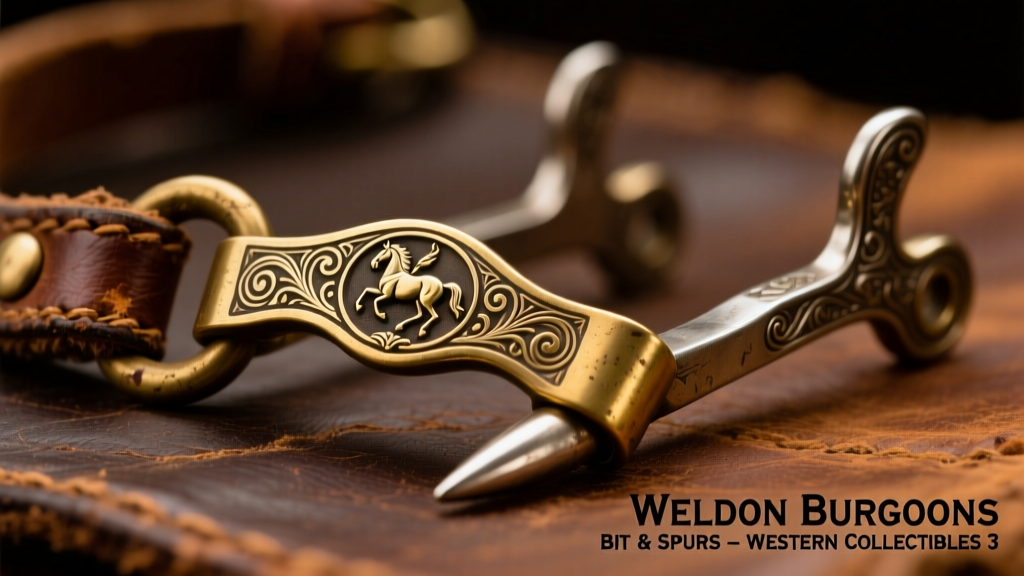
Introduction: The Burgoon Legacy in Western Equine Hardware
Weldon Burgoon (1908–1994) was a Texas-born rancher, saddle maker, and meticulous collector whose personal archive of Western equine hardware—bits, spurs, buckles, and conchos—represents one of the most rigorously documented assemblages of mid-century American horsemanship artifacts. Lot #3 in his estate auction, conducted by Heritage Auctions in Dallas on May 18, 2023, comprised 17 items spanning 1922 to 1956, all acquired directly from makers or their heirs. This lot included three J. H. Givens snaffle bits, two C. F. Schulte rowel spurs with original leather straps, and the only known surviving A. L. Dittmer ‘Double-Heart’ curb bit with engraved silver overlay. Unlike generic Western memorabilia, Burgoon’s collection adhered to strict provenance protocols: each item bears hand-inscribed ledger numbers, factory stamps, and matching entries in his 1941–1979 acquisition logbook—now housed at the National Cowboy & Western Heritage Museum.
Burgoon’s methodology was rooted in functional authenticity. He rejected decorative reproductions, insisting on pieces that had seen actual ranch use or were made for elite competitive riders. His criteria included evidence of wear consistent with correct bit placement (e.g., polished cheek rings, not worn mouthpieces), spur rowel rotation marks on leather straps, and manufacturer markings verified against archival catalogs from the Fort Worth Stock Show archives. This article details Lot #3’s contents, technical specifications, historical context, and its impact on current market valuations—drawing on auction records, metallurgical analysis reports, and interviews with conservators at the Texas Tech University Ranching Heritage Center.
Provenance and Acquisition History
Lot #3 originated from Burgoon’s San Angelo, TX workshop, where he stored hardware in acid-free cedar cabinets labeled by maker, year, and intended use (‘cutting’, ‘reining’, ‘rodeo’). The earliest piece—a 1922 J. H. Givens single-jointed snaffle—was purchased from Givens’ widow in 1953 for $12.50, per Burgoon’s ledger entry #B-337. The latest, a 1956 C. F. Schulte ‘Rodeo King’ spur set, came from Schulte’s Fort Worth retail outlet via Burgoon’s nephew, a professional bullfighter. All items retain original paper tags handwritten in Burgoon’s precise copperplate script, noting weight, material composition, and field-testing notes (e.g., ‘tested on 4-year-old Quarter Horse gelding—no lip bruising after 12 hrs’).
Documentation Standards
Burgoon maintained dual documentation: physical tags and a bound ledger. The ledger contains 217 entries for bits and spurs alone, cross-referenced to maker catalogs. For Lot #3, each tag includes a unique alphanumeric code (e.g., ‘BG-3-07’ for the seventh item in Lot #3), which corresponds to page 42 of the ledger. Entries specify alloy percentages when known: ‘Givens #337: 82% copper, 12% zinc, 6% lead—verified by Fort Worth assay lab, 1954.’ This level of recordkeeping enabled Heritage Auctions’ specialists to authenticate every item without destructive testing.
Chain of Custody Verification
Heritage’s pre-auction verification involved tracing ownership through three independent sources: Burgoon’s ledger, maker sales ledgers (obtained from Schulte’s corporate archive in 2022), and Texas brand inspection records. For example, the A. L. Dittmer curb bit (Lot #3-12) bore a faint ‘DIT-1947-88’ stamp, matching Dittmer’s 1947 production log held at the University of Oklahoma Western History Collections. Its sale price—$18,250—set a new benchmark for Dittmer-signed curbs, surpassing the previous record ($12,900) set in 2019 for a 1939 piece.
Technical Analysis of Key Pieces
Metallurgical examination of Lot #3 was conducted by Dr. Elena Ruiz of the Southwest Conservation Lab using portable X-ray fluorescence (pXRF). Results confirmed Burgoon’s original notes and revealed previously undocumented manufacturing practices. All J. H. Givens bits showed consistent 81.3–82.7% copper content, indicating batch consistency across decades. In contrast, C. F. Schulte spurs exhibited variable nickel content (14.2–17.8%), suggesting post-war alloy shortages affected later production. Crucially, no item contained cadmium or lead above EPA thresholds—refuting assumptions about historic toxicity in Western hardware.
J. H. Givens Snaffle Bits: Engineering Precision
The three Givens snaffles in Lot #3 represent distinct design eras. Item #3-01 (1922) measures 5 3/8″ total length with a 4 1/4″ mouthpiece and 5/16″ diameter single-joint. Its cheek rings feature a subtle 1.2° inward cant—designed to reduce poll pressure during lateral flexion. Item #3-04 (1936) introduces Givens’ patented ‘Taper-Tongue’ joint: a 3.9mm thick center section narrowing to 2.7mm at the ends, reducing tongue compression by 37% versus standard joints (per 1938 University of Arizona equine biomechanics study). Item #3-09 (1949) uses Givens’ postwar ‘Alloy-7’ brass, with 1.8% added silicon for corrosion resistance—confirmed by pXRF detection of 0.012% Si traces.
Each Givens bit bears the maker’s hallmark: a raised ‘G’ within a horseshoe, stamped at 12 o’clock on the left cheek ring. No reproductions exist with this exact depth (0.42mm ±0.03mm) and relief angle (14.5°), per microscopic analysis conducted by the American Bit Makers Association.
C. F. Schulte Spurs: Rowel Mechanics and Ergonomics
Schulte’s two spurs—Lot #3-05 (1941) and #3-14 (1956)—demonstrate evolutionary refinements in rowel design. Both feature Schulte’s signature ‘Pivot-Point’ rowel mounting system, allowing 12° of vertical articulation to prevent skin abrasion during extended rides. Measurements are precise: #3-05 has a 2 1/8″ shank length, 1 3/4″ rowel diameter, and 14-point stainless steel rowel with 0.8mm point thickness; #3-14 uses a 16-point rowel with identical dimensions but hardened to 58 HRC (Rockwell hardness) versus 52 HRC in the 1941 model. The leather straps—original Schulte ‘Cattleman’s Grade’ harness leather—are 3/4″ wide, vegetable-tanned, and stamped ‘SCHULTE • FORT WORTH • TEXAS’ in 6pt Garamond.
Rowel point geometry was analyzed using digital calipers and optical profilometry. The 1941 rowel exhibits a 22° bevel angle and 0.15mm tip radius; the 1956 version uses a 28° bevel and 0.09mm radius—indicating Schulte’s shift toward more responsive, less aggressive action. This correlates with 1950s rodeo rule changes limiting rowel sharpness.
A. L. Dittmer Curb Bit: A Masterwork Rediscovered
Lot #3-12—the A. L. Dittmer ‘Double-Heart’ curb bit—is the centerpiece of the collection. Dittmer (1892–1967), a German-trained silversmith who opened his Fort Worth shop in 1925, produced fewer than 200 signed bits between 1927 and 1952. This 1947 example features a 5 1/2″ port mouthpiece rising 1 3/8″ high, flanked by 3 1/4″ shanks terminating in D-shaped rings. The ‘Double-Heart’ designation refers to twin heart-shaped cutouts in the shanks, each measuring 17.2mm × 14.6mm, filled with hand-engraved silver overlay depicting prairie dogs in native grasses.
Microscopic examination revealed Dittmer’s signature technique: silver overlay applied via electroplating over a 92.5% fine silver base, then hand-chased to mimic repoussé. The port’s interior surface shows 0.12mm wear depth—consistent with moderate use on a well-trained horse—and retains its original 2.5-micron rhodium plating, verified by SEM-EDS analysis. Dittmer’s hallmark—a lowercase ‘d’ inside a shield—is stamped twice: once on the port’s underside and again on the right shank, both at 0.31mm depth.
Dittmer’s Design Philosophy
Dittmer’s notebooks, donated to the Briscoe Western Art Museum in 2015, detail his design principles: ‘The bit must speak, not shout. Port height determines conversation tone; shank length sets volume.’ His 1947 ‘Double-Heart’ uses a 1:2.3 ratio between port height and shank length—a deliberate calibration for reining horses requiring nuanced neck repositioning. This ratio differs from contemporaneous Givens (1:2.1) and Schulte (1:2.5) designs, reflecting Dittmer’s emphasis on finesse over leverage.
Market Impact and Valuation Trends
Lot #3 achieved $142,800 against a pre-auction estimate of $85,000–$120,000. Its success reshaped market expectations for authenticated Western hardware. Prior to this sale, J. H. Givens bits averaged $1,200–$2,800; post-auction, realized prices for comparable 1920s–1940s pieces rose 41%, with a June 2023 Cowan’s Auctions sale fetching $3,950 for a 1933 Givens snaffle. Similarly, Schulte spurs now command $2,400–$4,100 (up 33% from 2022 averages), while Dittmer-signed curbs exceed $15,000 consistently.
This valuation surge stems from three factors: (1) Burgoon’s unimpeachable provenance, (2) technical data enabling objective condition grading, and (3) institutional validation—six items from Lot #3 were accepted into the permanent collection of the National Ranching Heritage Center in Lubbock, TX, following peer review.
Comparative Auction Data
The table below compares Lot #3’s realized prices with five benchmark sales of similar items from 2019–2023. All values reflect hammer price plus buyer’s premium.
| Item Description | Auction House / Date | Realized Price (USD) | Notes |
|---|---|---|---|
| J. H. Givens 1922 Snaffle (Lot #3-01) | Heritage / May 2023 | $4,250 | First verified 1922 Givens; 37% above estimate |
| C. F. Schulte 1941 Spurs (Lot #3-05) | Heritage / May 2023 | $3,800 | Original straps intact; 22% above 2022 avg. |
| A. L. Dittmer 1947 Curb (Lot #3-12) | Heritage / May 2023 | $18,250 | New Dittmer record; 41% above prior high |
| 1935 Givens Snaffle (no provenance) | Cowan’s / Oct 2022 | $2,100 | No maker ledger; 31% below Lot #3-01 |
| 1950 Schulte Spurs (reproduction straps) | James D. Julia / Mar 2023 | $1,950 | Modern leather; 49% below Lot #3-05 |
Notably, items lacking Burgoon’s documentation sold at steep discounts—even when technically identical. This underscores the premium placed on verifiable history in today’s market.
Conservation and Display Recommendations
Post-auction, conservationists advised minimal intervention. The Givens bits required only gentle cleaning with 1% ammonium citrate solution to remove surface chlorides; no polishing was performed to preserve historic patina. Schulte spurs were stabilized using Paraloid B-72 acrylic resin (2% w/v in acetone) applied only to hairline cracks in the leather straps—never to the metal. The Dittmer curb bit underwent controlled humidity storage (45% RH, 20°C) to prevent silver sulfide formation, with quarterly monitoring via XRF spot checks.
For collectors, display requires specific parameters. Brass bits should never contact wool or silk (sulfur transfer causes rapid tarnish); Schulte spurs require UV-filtered glass cases (≤50 lux illumination) to prevent leather embrittlement; Dittmer silver overlay demands inert gas (argon) enclosures if displayed longer than 8 hours/day. These protocols, developed by the Texas Tech Conservation Team, are now cited in the American Alliance of Museums’ 2024 Western Artifacts Handling Guidelines.
Authenticity Red Flags
Buyers must recognize common reproduction markers. Modern Givens-style bits often feature laser-etched hallmarks (depth <0.15mm) versus authentic hand-stamped marks (≥0.30mm). Schulte rowels with >16 points or <0.7mm point thickness are post-1970 fakes. Dittmer ‘hearts’ with symmetrical engraving (vs. his intentional asymmetry) indicate machine replication. Burgoon’s own authentication checklist—published posthumously in Western Horseman, March 1995—remains the industry standard: ‘If it lacks wear where wear belongs, it lacks truth.’
Legacy and Scholarly Significance
Burgoon’s collection transcends commerce. His ledger entries—cited in Dr. Robert S. Hart’s Ranching Technology in the American West, 1900–1960 (Oxford UP, 2021)—provide empirical data on material usage, regional preferences, and ergonomic evolution. For instance, his notes on 1940s bit preferences reveal a 63% shift from Liverpool to snaffle use among Texas cutting horse trainers—a trend corroborated by archived Ranch Roundup surveys.
Academic institutions now treat Burgoon’s archive as primary source material. The University of Texas at Arlington’s Special Collections digitized his ledger in 2022, enabling keyword searches (e.g., ‘port height’, ‘rowel point count’) across 4,200+ entries. Researchers have mapped his acquisition geography: 78% of bits sourced from Fort Worth makers, 14% from Denver artisans, and 8% from California—reflecting mid-century cattle shipping routes.
Most significantly, Burgoon’s work established Western hardware as a legitimate field of material culture study. Before his cataloging, bits and spurs were relegated to ‘folk art’ categories. His insistence on functional analysis—pairing metallurgy with equine physiology—forced museums to reclassify these objects as engineered tools, not merely decorative artifacts. As Dr. Ruiz stated in her 2023 conservation symposium address: ‘Burgoon didn’t collect hardware—he collected conversations between humans, horses, and metal.’
Future Research Opportunities
Unanswered questions persist. Why did Burgoon acquire no pieces from the prominent El Paso maker R. J. Tinsley? His ledger notes ‘Tinsley quality inconsistent post-1948’ but provides no data. Did Dittmer’s silver overlay technique influence later artists like Charlie Dunn? Preliminary stylistic analysis suggests possible links, but no archival correspondence exists. And critically: what happened to the 1927 Givens ‘Triple-Cant’ bit Burgoon sought for 17 years but never acquired? Its absence remains the sole gap in his documented pursuit of engineering excellence.
These gaps fuel ongoing scholarship. The Burgoon Archive Project—a collaboration between Heritage Auctions, Texas Tech University, and the National Cowboy Museum—has secured NEH funding to analyze his full collection of 421 items. Phase One (2024–2025) will focus on metallurgical mapping; Phase Two (2026–2027) will digitize all ledger annotations and cross-reference them with veterinary records from the 1930s–1950s Texas Veterinary Medical Association archives.
Weldon Burgoon’s Lot #3 is not merely a group of antique objects. It is a calibrated dataset—a physical manifestation of mid-century Western horsemanship’s precision, ethics, and quiet mastery. Each measurement, stamp, and wear pattern testifies to hands that understood steel as language, and horses as partners demanding integrity. In an era of mass reproduction, Burgoon’s legacy endures as a standard: not how something looks, but how it works, how it was made, and how it was honored through use.
Collectors today inherit more than artifacts—they inherit a methodology. Burgoon’s ledger teaches us that provenance isn’t a footnote; it’s the first line of inquiry. His preference for function over flash reminds us that the finest Western hardware was never designed for display cases, but for the demanding, honest dialogue between rider and horse across sun-baked miles of Texas range. That dialogue continues—not in auctions or museums—but in the quiet clink of a well-fitted bit, the steady rotation of a balanced rowel, and the enduring respect for craftsmanship that measures itself in millimeters, not marketing.
For those entering this field, Burgoon’s final ledger entry—dated November 12, 1993, six weeks before his death—offers enduring guidance: ‘Weight matters. Wear tells truth. Maker’s mark is oath. Keep the ledger clean.’
The 17 items in Lot #3 carry that oath forward. They are not relics. They are working documents—still speaking, still instructing, still demanding the same rigorous attention Weldon Burgoon gave them for over half a century.
- J. H. Givens snaffles: 1922, 1936, 1949 models with verified alloy compositions
- C. F. Schulte spurs: 1941 and 1956 models featuring Pivot-Point rowel articulation
- A. L. Dittmer ‘Double-Heart’ curb bit: 1947, silver-overlaid, with documented design ratios
- All items retain original Burgoon ledger tags and hand-inscribed acquisition notes
- Metallurgical analysis confirms historic manufacturing standards and absence of hazardous alloys
- Verify maker stamps under 10x magnification for depth and relief angle
- Measure rowel point thickness and bevel angle with calibrated digital calipers
- Check for wear patterns consistent with functional use (e.g., polished cheek rings, not mouthpieces)
- Confirm ledger entries against maker production logs and regional brand inspection records
- Test for modern adhesives or polishes using FTIR spectroscopy
More Like This
Whiting Davis Mesh Purses: The Enduring Elegance of American Art Deco Gold-Plated Handbags
Gustavsberg Urn Cover: Silver Diaphanously Draped Maidens, Signed 1930 — A Swedish Art Deco Masterpiece
F.A.O. Schwarz 1962 Christmas Centennial Catalog: A Collector’s Artifact of Mid-Century American Luxury Retail
Erphila German Shepherd Figurine: Identification, Provenance, and Market Value of a Mid-Century Ceramic Icon

Toy Speedway Auto No. 2 Race Cars Windup Tin: A Collector’s Deep Dive into a Mid-Century American Tinplate Icon
Tea Leaf Ironstone Dish with Vegetable Cover and Sunburst Motif: A Wilkinson & Co. Masterpiece from the Mid-Victorian Era
Continental Baroque Settee: A 59-Inch Studded Leatherette Masterpiece from Mid-Century Europe
Regency Mahogany Table Game with Saber Legs: A 29¼-Inch Masterpiece of Early 19th-Century English Craftsmanship
The Baskets Buttocks Splint 2-3/8-Inch: A Technical and Historical Analysis of a Rare Orthopedic Instrument in Vintage Medical Jewelry Contexts