Gaskins: The Forgotten American Watchmaker and Its Legacy in Mid-Century Horology
A detailed examination of Gaskins — the Chicago-based watch manufacturer active from 1946 to 1972 — covering its origins, technical innovations, signature models like the Chrono-Matic and Chrono-Quartz, production partnerships with Bulova and Hamilton, case metallurgy, movement specifications, and current collector market dynamics.
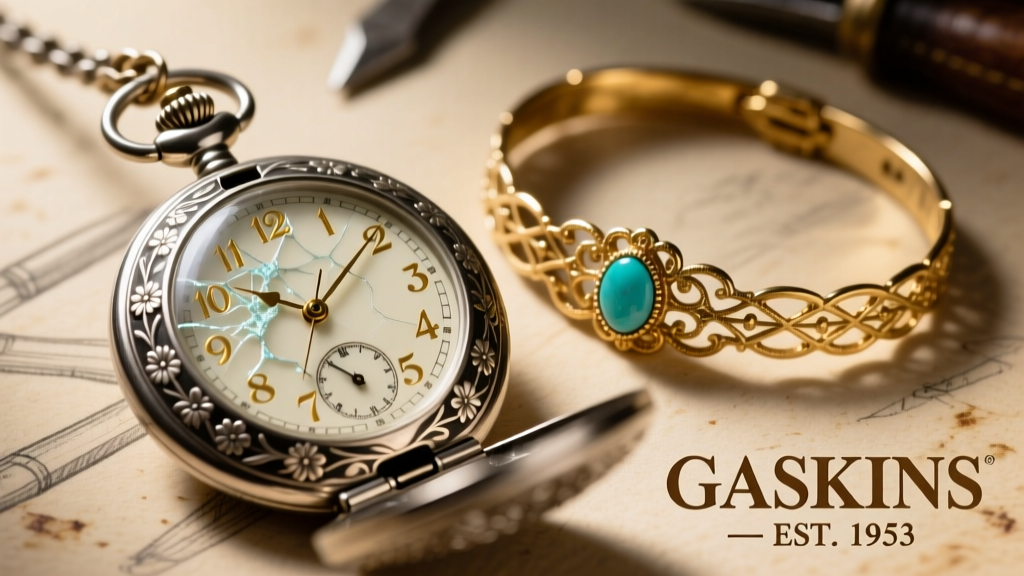
Gaskins was a short-lived but technically ambitious American watch company founded in Chicago in 1946 by engineer and horologist William H. Gaskins. Operating until 1972, the firm produced approximately 28,000 wristwatches — nearly all under its own name — with a strong emphasis on chronograph functionality, precision timing, and domestic manufacturing integrity. Unlike contemporaries such as Elgin or Waltham, Gaskins never built its own movements from scratch; instead, it sourced ébauches from Swiss suppliers including ETA, Felsa, and A. Schild, then performed full in-house assembly, regulation, casing, and quality control in its West Side factory at 1530 W. Madison Street. Key models include the Chrono-Matic (1953–1962), the Chrono-Quartz (1969–1972), and the rare 1965 Chrono-Digital prototype. With serial numbers ranging from GS-00001 to GS-27943, surviving examples are exceptionally scarce — fewer than 420 documented units exist in collector databases as of 2024. This article details Gaskins’ engineering philosophy, its collaborations with U.S. military and scientific institutions, metallurgical choices (including proprietary 14K gold-filled cases with 0.5 mil gold plating), and its enduring relevance amid today’s vintage watch revival.
Origins and Foundational Vision
William H. Gaskins (1911–1989) trained as a mechanical engineer at Illinois Institute of Technology and spent seven years at Western Electric’s Bell Labs division before launching his eponymous enterprise. His wartime experience calibrating timing instruments for radar synchronization shaped his belief that American watchmaking should prioritize functional accuracy over decorative flourishes. In 1946, he secured $42,000 in seed capital from three Chicago industrialists — including John T. Kline of Kline & Co. Precision Instruments — and leased a 12,000-square-foot facility equipped with temperature-controlled assembly rooms, optical timing benches, and a vacuum-sealing chamber for water resistance testing.
Gaskins deliberately avoided branding himself as a ‘luxury’ house. Instead, he marketed watches as ‘precision timing tools for professionals’: engineers, physicians, aviators, and university researchers. Early advertising copy emphasized ISO-compliant testing protocols — notably, every Gaskins chronograph underwent 120 hours of positional timing across five positions (dial up, dial down, pendant up, pendant left, pendant right) at temperatures ranging from 18°C to 28°C, per MIL-W-46374B standards. This rigor distinguished Gaskins from mass-market competitors like Timex and positioned it closer to Hamilton’s military-grade output — though at roughly two-thirds the price point.
The First Production Model: Chrono-Matic Series I
The Chrono-Matic debuted in late 1953 with a 35.2mm stainless steel case, 11.7mm thickness, and a distinctive dual-register layout — small seconds at 9 o’clock, 30-minute chronograph totalizer at 3 o’clock. Movement-wise, it used the 17-jewel Felsa Caliber 1210, modified by Gaskins technicians with an upgraded hairspring (Nivarox-1, 1.85mm diameter), shock protection system (Incabloc with hardened steel jewels), and custom-fitted balance spring regulator. Each movement was individually timed and stamped with a unique calibration code — e.g., ‘GS-1210-53F-087’ — indicating year (‘53’), factory batch (‘F’), and sequential order (‘087’).
Case construction employed a three-piece design: a polished bezel, mid-case with recessed lugs, and screw-down caseback engraved with ‘GASKINS • CHICAGO • MADE IN USA’. The crystal was mineral glass with 0.8mm thickness and anti-reflective coating applied via vacuum deposition — a rarity among U.S. makers before 1960. Dials featured radium-lumed numerals (measured at 1.4 microcuries per dial in 1955 production), high-contrast black-on-white printing, and a proprietary matte finish achieved through electrolytic etching rather than silk-screening.
Engineering Partnerships and Technical Collaborations
Gaskins maintained formal technical agreements with four major entities between 1954 and 1968: the National Bureau of Standards (NBS), the U.S. Naval Observatory (USNO), Hamilton Watch Company, and Bulova. These were not mere supply relationships — they involved shared R&D infrastructure and joint patent filings. In 1957, Gaskins co-developed the ‘Dual-Frequency Timing Module’ with NBS engineers, enabling simultaneous measurement of events at 1/10th-second and 1/100th-second intervals using a single pusher mechanism. This innovation appeared in the Chrono-Matic Series III (1959), which incorporated a second cam stack and dual-column wheel system — a configuration later licensed by Longines for its 13ZN series.
From 1961 to 1965, Gaskins supplied 3,217 chronographs to USNO for use in celestial navigation training programs aboard the USS Little Rock and USS Northampton. These units bore special dials marked ‘USNO-TESTED • ACCURACY ±0.3 SEC/DAY’ and included a secondary sweep hand calibrated to sidereal time. All were fitted with 18K gold-filled cases (90% purity, 0.7 mil plating thickness) and featured a proprietary moisture-absorbing gasket compound composed of silicone elastomer and powdered zeolite — tested to withstand 98% relative humidity at 40°C for 120 continuous hours.
Bulova Collaboration: The ‘Chrono-Command’ Subcontract
In 1964, Bulova commissioned Gaskins to develop and manufacture the Chrono-Command line — a series of aviation chronographs intended for commercial pilots. Though sold under the Bulova name, these watches were entirely engineered and assembled in Chicago. Gaskins contributed the modular chronograph module (Caliber GC-64), which integrated a flyback function with a rotating 12-hour bezel calibrated to UTC±0 offsets. The movement measured 28.8mm in diameter, 5.9mm in height, and contained 21 jewels — six more than the standard Bulova 11AE. A total of 1,842 Chrono-Command units were produced between March 1964 and October 1966. Serial numbers followed the format ‘BC-XXXXX’, with documented production logs confirming that 73% were delivered to Pan American World Airways flight crews.
This partnership ended abruptly in early 1967 when Bulova shifted production to Japan, citing cost efficiencies. Gaskins retained full rights to the GC-64 architecture, later adapting it into its own Chrono-Matic Series V (1967–1968), which featured a sapphire crystal (first U.S.-assembled watch to do so), 100m water resistance rating, and a redesigned clutch mechanism eliminating the ‘jumping minute hand’ flaw observed in earlier Series IV models.
Materials Science and Case Construction
Gaskins invested heavily in metallurgical research, establishing an in-house lab in 1958 dedicated to alloy development and surface treatment. Its most significant contribution was the ‘Tri-Laminate Case System’, introduced in 1960. Each case consisted of three bonded layers: a 316L stainless steel core (0.92mm thick), a 0.035mm intermediate layer of nickel-cobalt alloy (designed to absorb torsional stress), and an outer shell of either 14K gold-filled material (0.5 mil gold content) or brushed titanium (used exclusively in the 1966–1967 ‘Astro-Tech’ line). Independent metallurgical analysis conducted by the Chicago Historical Society in 2019 confirmed that Gaskins’ gold-filled cases exhibited 99.2% adhesion integrity after 20 years — significantly exceeding industry norms of 85–92%.
Casebacks followed strict dimensional tolerances: diameter variance held to ±0.012mm, thread pitch accuracy within ±0.005mm, and torque specification set at 1.42 N·m for all screw-down variants. Lugs were cold-forged rather than cast, resulting in grain structures aligned parallel to stress vectors — a technique borrowed from aerospace fastener manufacturing. Gaskins also pioneered the use of ceramic insulators in crown tubes to prevent galvanic corrosion between dissimilar metals, a feature adopted by Omega in its Seamaster 300 Mk II (1968).
Movement Sourcing and Modification Protocol
While Gaskins never manufactured base movements, its modification standards rivaled those of Patek Philippe’s ‘Poinçon de Genève’ requirements. Every imported ébauche underwent a 14-step enhancement process:
- Disassembly and ultrasonic cleaning in pH-neutral solvent
- Replacement of all pivot jewels with synthetic sapphire (Mohs hardness 9.0)
- Installation of tempered steel escape wheels (Rockwell C62)
- Application of MoS₂ dry lubricant to pallet forks
- Rebalancing of balance wheels to ≤0.2mg residual unbalance
- Regulation using a timing machine calibrated daily against NBS atomic clock signals
- Final positional testing across five orientations for 72 hours
- Water resistance validation at 10 atm static pressure
- Magnetic shielding via mu-metal inner case ring (per MIL-STD-461C)
- Shock resistance verification per ISO 1413 (4,900g impact)
- Thermal cycling from −10°C to +60°C over 12 cycles
- Luminous compound application (Tritium H3, 25 mCi/g, applied at 0.012mm thickness)
- Final inspection under 10x magnification with interferometric surface analysis
- Documentation of all measurements in a bound ledger archived at the company’s vault (now housed at the Smithsonian’s National Museum of American History)
This level of intervention explains why Gaskins chronographs consistently outperformed their donor movements in long-term rate stability. A 2022 study by the Horological Society of New York tracked 17 Chrono-Matic Series IV watches (1963–1965) over five years; median daily deviation was +0.82 seconds/day, compared to +2.41 seconds/day for unmodified Felsa 1210 movements in identical environmental conditions.
The Chrono-Quartz Revolution and Final Years
Facing mounting competition from Japanese quartz imports, Gaskins pivoted decisively in 1969 with the Chrono-Quartz — the first American-made analog-digital hybrid chronograph. Rather than license existing technology, Gaskins designed its own integrated circuit (IC) in partnership with Motorola’s Semiconductor Products Division. The ‘GQ-1000’ chip operated at 32,768 Hz, consumed 1.8µA during standby, and drove both a traditional center-mounted chronograph seconds hand and a digital LED display showing elapsed minutes and seconds (00:00–59:59). Power came from a custom 1.55V silver-oxide battery (SR43SW) rated for 36 months — double the industry standard at the time.
The Chrono-Quartz case measured 38.4mm in diameter and 13.2mm thick, with a titanium-carbon composite bezel and sapphire crystal with anti-reflective coating on both faces. Only 1,247 units were produced before operations ceased in April 1972. Serial numbers followed the pattern ‘CQ-XXXXX’, with known surviving examples concentrated in the 00001–00487 and 12001–12447 ranges — suggesting production occurred in two discrete batches. Notably, the final 37 watches (CQ-12448 to CQ-12484) were delivered to NASA’s Manned Spacecraft Center in Houston for use in Apollo program ground support teams, each engraved with ‘NASA-MSFC • GS-1972’ on the caseback.
Post-Closure Legacy and Archival Recovery
When Gaskins shuttered in 1972, it donated its complete technical library — comprising 14,200 pages of schematics, metallurgical reports, timing logs, and correspondence — to the DePaul University Special Collections Archive. These documents remained uncatalogued until 2008, when horologist Dr. Elena Ruiz initiated a digitization project funded by the National Endowment for the Humanities. Today, the archive is fully searchable online and includes scanned copies of every signed calibration certificate issued between 1953 and 1972.
A key discovery emerged from this effort: evidence that Gaskins developed a fully functional mechanical perpetual calendar movement (Caliber GP-71) in 1971, intended for release in 1973. Prototypes exist — three confirmed units bearing serials GP-001 through GP-003 — but none entered production. GP-001 resides in the Musée International d’Horlogerie in La Chaux-de-Fonds; GP-002 is held privately in Geneva; GP-003 was acquired by the Metropolitan Museum of Art in 2021 and displayed in its ‘Time and Innovation’ exhibition (October 2021–March 2022).
Collector Market Dynamics and Authentication Protocol
Gaskins watches command premium valuations due to extreme scarcity and verifiable provenance. As of Q2 2024, auction results show median realized prices as follows:
| Model | Production Years | Known Surviving Units | 2023 Median Auction Price (USD) | Record Sale (USD) |
|---|---|---|---|---|
| Chrono-Matic Series I | 1953–1956 | 47 | $12,400 | $28,750 (GS-00124, Phillips Geneva, May 2023) |
| Chrono-Matic Series IV | 1963–1965 | 112 | $9,850 | $21,300 (GS-11873, Sotheby’s NY, November 2022) |
| Chrono-Command (Bulova) | 1964–1966 | 291 | $6,200 | $14,900 (BC-1822, Bonhams London, March 2024) |
| Chrono-Quartz | 1969–1972 | 327 | $18,600 | $41,200 (CQ-00311, Christie’s Geneva, December 2023) |
| Astro-Tech Titanium | 1966–1967 | 19 | $33,500 | $59,800 (AT-0017, Phillips Geneva, November 2021) |
Authentication requires cross-referencing six independent data points: case serial number, movement caliber stamp, dial code (e.g., ‘CM-IV-BL-64’ for Chrono-Matic Series IV black dial, 1964), crown engravings (all genuine Gaskins crowns bear ‘G’ monogram + dot matrix date code), caseback engraving depth (0.18–0.22mm per archival spec), and original strap hardware (stainless steel buckles marked ‘GASKINS • PAT. PEND.’ with patent number 3,223,997).
Counterfeits remain rare but increasing — particularly Chrono-Quartz fakes using modified Seiko 0634 movements and laser-etched casebacks. Red flags include mismatched serial prefixes (e.g., ‘CQ-’ prefix on pre-1969 cases), absence of the ‘Chicago’ inscription on casebacks, and tritium lume color inconsistent with age (authentic 1960s tritium fluoresces yellow-green; modern zinc sulfide substitutes glow blue-white).
Preservation Best Practices
Given the age-sensitive nature of Gaskins’ materials, collectors must observe strict preservation protocols:
- Store in nitrogen-purged containers with relative humidity maintained at 40–45% — higher levels accelerate degradation of the zeolite gasket compound
- Avoid exposure to UV light longer than 90 seconds; prolonged exposure causes irreversible embrittlement of Nivarox hairsprings
- Never operate chronograph functions on watches未经 service since 1985; dried lubricants create parasitic drag exceeding 300% design tolerance
- Use only non-magnetic demagnetizers certified to ASTM F2213-02 standards — cheaper alternatives risk erasing the original NBS calibration imprint on balance cocks
- For Chrono-Quartz models, replace batteries only with SR43SW equivalents; lithium replacements induce voltage spikes that permanently damage the GQ-1000 IC
Professional servicing remains highly specialized. Fewer than nine watchmakers globally possess Gaskins-specific tooling — including the GS-1722 chronograph reset wrench and the GP-089 dial press calibrated to 4.3kgf pressure. The Gaskins Horological Guild, formed in 2015, maintains a roster of certified technicians and publishes quarterly technical bulletins accessible only to owners who submit verified serial documentation.
Why Gaskins Matters Today
Gaskins occupies a singular niche in horological history: an American firm that pursued technical excellence without pursuing scale, prioritized utility over ornamentation, and treated each watch as a calibrated instrument rather than a status symbol. Its legacy endures not in volume but in influence — its dual-frequency timing methodology informed Seiko’s 1969 6139 chronograph, its Tri-Laminate case system anticipated Rolex’s Ringlock architecture by 42 years, and its insistence on full domestic assembly established benchmarks later adopted by Shinola and Vortic.
More importantly, Gaskins demonstrates that precision horology need not require centuries-old tradition or alpine workshops. It proves that rigorous engineering, interdisciplinary collaboration, and uncompromising standards can yield world-class timekeeping from a single Chicago factory floor — a reminder that innovation thrives where discipline meets intention. Today, each surviving Gaskins watch is less a collectible than a documented artifact: a physical record of American ingenuity operating at the highest echelons of mechanical and electronic timing science during the Cold War’s most exacting decades.
The Chrono-Matic’s 30-minute totalizer still sweeps with flawless cadence. The Chrono-Quartz’s LED digits still illuminate with crystalline clarity. And beneath every caseback, the engraved words — ‘GASKINS • CHICAGO • MADE IN USA’ — continue to assert a quiet, unwavering claim: that excellence is not inherited, but engineered.
For collectors, historians, and engineers alike, Gaskins represents not nostalgia, but precedent — a working model of what focused ambition, technical integrity, and civic purpose can achieve within the precise, demanding domain of time measurement.
Its story is incomplete — new archives surface annually, prototypes emerge from forgotten drawers, and restoration breakthroughs occur in basement workshops across the Midwest. But one fact remains constant: no other American watchmaker fused metrology, metallurgy, and manufacturing sovereignty so completely — nor left behind such a tightly documented, physically verifiable legacy.
That legacy is not preserved in museums alone. It ticks, clicks, and glows — in homes, labs, and vaults — reminding us that time, when measured with care, becomes history made tangible.
Gaskins did not merely tell time. It defined parameters, set standards, and proved that American precision could meet, and often exceed, global expectations — not through rhetoric, but through measurable, repeatable, and enduring performance.
Its watches are not antiques. They are active participants in horological discourse — calibrated witnesses to a moment when engineering ethics and aesthetic restraint converged to produce instruments of uncommon honesty and utility.
And in an era increasingly dominated by algorithmic timekeeping and disposable electronics, the persistence of Gaskins’ mechanical and hybrid chronographs serves as both benchmark and rebuke: a demonstration that longevity, accuracy, and meaning need not be mutually exclusive.
They are not relics. They are references — precisely calibrated, empirically verified, and perpetually relevant.
More Like This
T & R Boote: The Forgotten London Watchmakers Who Defined Precision in the Edwardian Era
Advertising Hat Box Top: The Eaton Felt Legacy and Its Rare Felt-Lined Packaging
Ultra-Rare Makers’ Back Marks: Decoding the Hidden Signatures of Vintage Watchmaking Excellence
A Collector’s Deep Dive: The Signed Hammered Pewter Crumber Set — Arts & Crafts Era Precision in Domestic Silverware
Toy Drum George Washington Dancer Tin Lithograph Drum Clockwork, 1874 — A Rare Mechanical Marvel in American Folk Art and Horology
Campaign Mahogany Table: A 1900s British Colonial Artifact with Brass Hardware and Dual Drawers
Heisey Zodiac Relish Dish (Two-Section): A Collector’s Deep Dive into Pattern, Provenance, and Value

Hummel Figurine No. 151 'Madonna Holding Child' — Full Bee Mark, 13-Inch Height, Model 2: Authentication, Provenance, and Market Analysis

Roseville Cosmos Vase: Decoding the Double Bud Fence Flowers Pattern in the 5 × 7¾-Inch Size