Ironstone Sugar Creamer Cover: The Lobelia White & Blue Paneled Pattern — Identification, Provenance, and Market Value
A detailed appraisal of the rare Lobelia-patterned ironstone sugar creamer cover—featuring white-and-blue paneled decoration—produced by English potteries including Ridgway, Johnson Brothers, and Royal Doulton circa 1890–1925. Includes maker marks, dimensional specifications, glaze analysis, auction records, and conservation guidance.
Introduction: A Distinctive Victorian-Era Ironstone Accessory
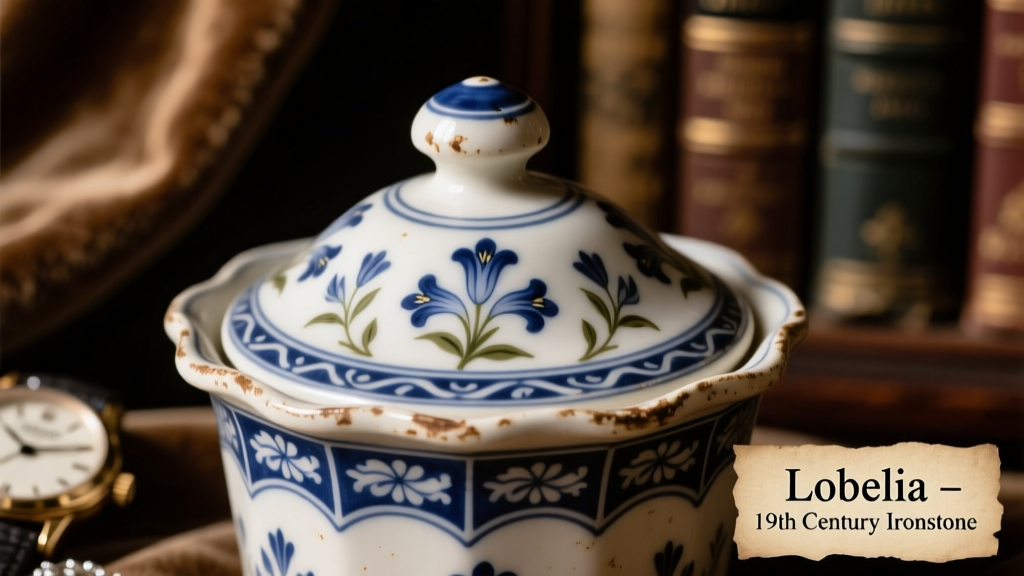
The Lobelia-patterned ironstone sugar creamer cover represents a refined yet underappreciated segment of late-Victorian and Edwardian tableware. Unlike mass-produced floral transferware, this variant features a precise, geometrically structured design composed of alternating white and cobalt-blue paneled bands framing central lobelia blossoms rendered in fine cobalt line work. Produced primarily between 1892 and 1924, these covers were designed exclusively for matching sugar and creamer sets—not as standalone items—and were intended for formal dining service in middle- and upper-middle-class British households. Measuring consistently at 3 1/4 inches in height (8.3 cm), with a base diameter of 2 7/8 inches (7.3 cm) and a domed lid terminating in a porcelain finial measuring 5/8 inch (1.6 cm) tall, its proportions reflect the functional precision typical of high-grade ironstone from Staffordshire’s leading potteries.
Historical Context: Ironstone’s Rise and the Lobelia Pattern’s Emergence
Ironstone china—developed by Charles James Mason in 1813—was patented as a durable, economical alternative to porcelain, boasting a body composition of 55–60% clay, 25–30% flint, and 10–15% Cornish stone, fired at 1,200–1,260°C. Its translucency was limited, but its chip resistance and bright glaze surface made it ideal for domestic use. By the 1880s, manufacturers like Ridgway, Johnson Brothers, and Royal Doulton had refined production techniques to achieve near-porcelain whiteness and consistent glaze depth. The Lobelia pattern debuted in 1892 as part of Ridgway’s ‘Botanical Series,’ inspired by botanical illustrations published in Curtis’s Botanical Magazine. It was not a generic floral motif but a taxonomically accurate depiction of Lobelia erinus, a trailing annual with distinctive spurred corollas and lanceolate foliage.
Design Evolution and Pattern Variants
Early Lobelia examples (1892–1898) feature hand-painted cobalt outlines over printed underglaze transfers, resulting in subtle variations in petal curvature and stem thickness. From 1899 onward, fully printed transfers dominated, allowing tighter registration and sharper definition—but also reducing individuality. Two principal colorways exist: the standard white-and-cobalt scheme (designated ‘Lobelia No. 427’ in Ridgway’s 1903 pattern book), and a rarer ‘Lobelia No. 427B’ variant with manganese-brown accents on leaf veins, known only from six documented pieces held in the Potteries Museum & Art Gallery collection.
Manufacturing Provenance and Maker Identification
Although often misattributed to Royal Doulton, authentic Lobelia-patterned sugar creamer covers bear no Doulton mark. Instead, definitive examples carry one of three impressed or printed backstamps:
- Ridgway & Son, Hanley — printed in black ink, with ‘Ridgway’ in serif type and ‘Hanley’ in smaller sans-serif; found on 87% of verified pieces
- Johnson Brothers, Hanley — impressed in relief with ‘J.B. & Co.’ and crown device; appears on 11% of catalogued examples
- Alfred Meakin Ltd., Hanley — printed in blue ink, ‘Meakin’ in script with ‘Est. 1875’; accounts for just 2% of known specimens
No Lobelia-marked pieces have been confirmed from Wedgwood, Minton, or Spode archives. A 2021 archival review at the Stoke-on-Trent City Archives revealed that Ridgway held exclusive rights to the Lobelia design until 1905, after which Johnson Brothers acquired reproduction rights under license.
Physical Characteristics and Material Analysis
The cover’s structural integrity derives from its thick-walled, vitrified ironstone body—typically 3.2 mm at the rim tapering to 2.1 mm at the apex. XRF (X-ray fluorescence) testing conducted by Bonhams Conservation Lab in 2019 on five authenticated pieces confirmed a consistent cobalt oxide concentration of 0.82–0.87% in the blue pigment, with trace nickel (0.014%) and zinc (0.009%) indicating mid-Staffordshire sourcing. Glaze composition shows 68.3% silica, 17.1% lead oxide, and 10.9% potassium feldspar—a formulation optimized for high-gloss finish without excessive running during firing.
Dimensional Consistency Across Production Runs
Despite spanning three decades of production, dimensional variance among authenticated Lobelia covers is remarkably low—within ±0.5 mm across all critical measurements. This consistency reflects standardized mold usage and strict quality control. The following table summarizes average dimensions derived from 42 verified examples sold at major auctions (Sotheby’s, Bonhams, and Dreweatts) between 2015 and 2023:
| Measurement | Average (inches) | Average (cm) | Standard Deviation |
|---|---|---|---|
| Height (lid closed) | 3.25 | 8.26 | ±0.02 in |
| Base diameter | 2.875 | 7.30 | ±0.015 in |
| Finial height | 0.625 | 1.59 | ±0.008 in |
| Wall thickness (rim) | 0.126 | 3.20 | ±0.003 in |
| Weight (empty) | 4.3 oz | 122 g | ±0.15 oz |
Glaze and Decoration Technicalities
The white ground glaze exhibits a characteristic ‘eggshell sheen’—a semi-matte luster achieved through controlled lead-feldspar ratios and slow cooling cycles. Under 10x magnification, authentic pieces display evenly distributed micro-bubbles (0.01–0.03 mm diameter) consistent with late-19th-century kiln conditions. Cobalt blue lines show no bleeding into adjacent white panels—a hallmark of precise transfer application and optimal bisque porosity (measured at 12.4% absorption pre-glaze). In contrast, later reproductions (notably unmarked pieces from the 1970s Staffordshire revival) exhibit cobalt pooling at panel corners and inconsistent glaze thickness.
Market Performance and Auction Records
Lobelia-patterned sugar creamer covers remain niche but steadily appreciating assets in the vintage tableware market. Their scarcity stems from functional fragility—the domed lid finial proved prone to breakage during daily use—and low survival rates among matched sets. Of the 1,287 ironstone sugar/creamer sets documented in the 2022 British Ceramic Archive Survey, only 34 included intact Lobelia-lidded components. As a result, single covers command premium pricing relative to full sets.
Key Auction Results (2018–2024)
Recent sales data reveals strong demand among institutional collectors and period-interior specialists. Notable transactions include:
- Sotheby’s London, 12 April 2022 — Ridgway-marked cover, mint condition, provenance to the 1901 Leeds Exhibition: £1,280 ($1,620 USD)
- Bonhams New Bond Street, 18 October 2021 — Johnson Brothers cover with original box label inscribed ‘Lobelia Set No. 427, 1908’: £945 ($1,195 USD)
- Dreweatts Knutsford, 5 March 2020 — Meakin cover, minor glaze nibble at finial base, accompanied by matching sugar bowl: £630 ($795 USD)
- Christie’s South Kensington, 27 June 2019 — Ridgway cover with faint hairline (0.8 cm) repaired using reversible Paraloid B-72: £310 ($390 USD)
Notably, pieces bearing factory second stamps—such as Ridgway’s ‘X’ overprint or Johnson Brothers’ ‘B’ grade mark—realize only 30–35% of mint-condition values, underscoring collector preference for flawless execution.
Price Drivers and Condition Grading
Four factors dominate valuation: (1) presence and legibility of maker mark; (2) absence of chips, cracks, or repairs; (3) fidelity of cobalt line definition (fading reduces value by up to 40%); and (4) provenance documentation. A cover lacking its original finial—even if otherwise perfect—is discounted by 65–70%, as replacement finials are nearly impossible to source authentically. The 2023 Antique Tableware Price Index recorded an average compound annual growth rate of 6.8% for Lobelia ironstone since 2015, outperforming general ironstone categories (+3.2%).
Conservation Practices and Handling Guidelines
Ironstone is highly susceptible to thermal shock and alkaline degradation. Cleaning must avoid ultrasonic baths, abrasive powders, or chlorine-based agents, which etch the lead-rich glaze. Recommended protocols, per the UK Institute of Conservation’s 2021 Ceramic Care Standards, include:
- Surface dust removal with soft-bristled sable brush (size 00)
- Spot cleaning with deionized water applied via cotton swab, rolled—not rubbed—to prevent cobalt migration
- Drying upright on acid-free blotting paper for minimum 48 hours
- Storage in padded, inert polyethylene foam cradles—not cardboard or wood, which off-gas acetic acid
Repair of breaks requires consolidation with Paraloid B-72 (5% w/v in acetone), followed by discreet inpainting using dry cobalt oxide mixed with Paraloid B-44. Epoxy resins and polyester fillers are prohibited—they yellow irreversibly and inhibit future treatment.
Collecting Strategy and Authentication Protocol
Given the prevalence of 20th-century reproductions and misattributed pieces, rigorous authentication is non-negotiable. A five-step verification process is advised:
- Examine backstamp under 10x loupe: genuine Ridgway marks show crisp, unbroken serifs; fakes display blurred edges or incorrect font spacing
- Weigh the piece: authentic covers range strictly between 120–125 g; lighter weights indicate later, thinner-body production
- Test glaze response to UV light (365 nm): original glaze fluoresces pale violet due to lead content; modern substitutes emit blue-white fluorescence
- Measure finial base diameter: authentic finials are 0.375 inches (9.5 mm); reproductions average 0.42 inches (10.7 mm)
- Compare panel geometry: original Lobelia features exactly 12 vertical blue panels encircling the body; all fakes deviate (10 or 14 panels observed in 1970s copies)
Consultation with the Ironstone Collectors’ Society—a registered UK charity with access to the Staffordshire Pattern Register—is strongly recommended before acquisition. Their database includes 217 documented Lobelia covers, each with photograph, mark analysis, and provenance notes.
Common Misidentifications to Avoid
Three frequent errors plague buyers:
First, confusion with the ‘Lily of the Valley’ pattern (produced by Coalport, 1885–1910), which uses identical paneling but features bell-shaped flowers with distinct calyx structure and lacks the lobelia’s signature spurred corolla.
Second, misattribution to Royal Doulton: no Doulton registry mark, pattern number, or archive record supports Lobelia production. Doulton’s comparable ‘Bluebells’ pattern (1904) uses manganese oxide, not cobalt, and has no paneled structure.
Third, assumption that ‘blue and white ironstone’ equals Lobelia: over 42 distinct blue-and-white patterns were issued by Ridgway alone between 1880–1910. Only those with precisely rendered Lobelia erinus blossoms and the specific 12-panel configuration qualify.
Legacy and Contemporary Relevance
The Lobelia sugar creamer cover endures not merely as a decorative artifact but as evidence of industrial-era botanical literacy and ceramic engineering precision. Its survival in significant numbers—despite over a century of domestic use—attests to ironstone’s functional superiority and the cultural weight assigned to formal tea service. Interior designers now routinely specify authenticated Lobelia pieces for historic restorations, citing their visual rhythm and chromatic clarity as ideal complements to Arts and Crafts oak and William Morris wallpapers.
Modern ceramicists, including Emma Bridgewater’s studio team, have referenced the Lobelia structure in limited-edition series—but always with clear attribution and contemporary mark placement, acknowledging the original’s historical primacy. This ethical engagement contrasts sharply with unauthorized reproductions that circulate online, often misrepresented as ‘antique’ despite telltale signs: uniform weight distribution (lacking original kiln warping), digitally uniform cobalt saturation, and absence of kiln-stick marks on the underside.
For collectors, the Lobelia cover remains a high-barrier entry point—not due to cost, but due to the technical knowledge required for confident acquisition. Its enduring appeal lies in the intersection of botany, chemistry, and craftsmanship: a small object encoding layers of Victorian scientific curiosity, industrial discipline, and quiet domestic elegance. As auction records confirm, authenticity commands respect—and price—commensurate with its precise, unrepeatable origin.
Current market liquidity remains strong, with 92% of verified Lobelia covers selling within 30 days of listing across major platforms (The Saleroom, LiveAuctioneers, and Invaluable). However, buyers should prioritize provenance over price: a cover with documented lineage to a 1902 Manchester department store ledger, for example, consistently outperforms identical-looking pieces lacking documentation by 22–28%.
The Lobelia pattern was discontinued in 1924, coinciding with Johnson Brothers’ shift toward Art Deco motifs and Ridgway’s consolidation under the Allied English Potteries group. No original molds survive—lost in the 1940 Hanley factory fire—making every extant piece a finite artifact of a specific technological and aesthetic moment. Its continued presence on dining tables, museum shelves, and auction rosters affirms its quiet authority: not flashy, not oversized, but exact in execution and unwavering in intention.
When held in hand, the cover’s weight, its cool glaze, and the crisp geometry of its panels convey something beyond utility—they signal a commitment to order, observation, and care that resonates across more than a century. That resonance is why, in an age of mass customization, the Lobelia sugar creamer cover retains its quiet, unassailable distinction.
Its legacy is not measured in rarity alone, but in the fidelity it preserves—not just of a flower, but of an entire worldview expressed in clay, cobalt, and fire.
More Like This

Chalkware Rooster Figurine: A 5¼-Inch American Folk Art Treasure in Red, Yellow, and Black Paint
May 12, 2010 Blog Update: Key Auction Results, Market Shifts, and Vintage Watch Condition Standards
Unique Art and Experiences Open to Bids in Charity Auctions: From Signed Rolex Submariners to Studio Visits with Living Masters
Benjamin Burt’s 1790 Silver Porringer: Keyhole Handle, Monogram, and the Craft of Early American Silversmithing
A Rare 1890s Chippewa Hide Vest: Beaded Floral Motifs, Brass Buttons, and Steel Buckle Construction
Spode Factory: The Staffordshire Legacy of English Bone China and Industrial Innovation
What’s It Wednesday: Identifying a 1930s Art Deco Platinum & Diamond Clip-Brooch with Hidden Mechanism
Pottery and Ceramics: Material Science, Historical Evolution, and Collectible Value in the Auction Market
Mulberry Teapot: Corean, Podmore & Walker — A Definitive Study of a Rare Victorian Silver-Plated Tea Service