Spode Factory: The Staffordshire Legacy of English Bone China and Industrial Innovation
A definitive examination of the Spode Factory—founded in Stoke-on-Trent in 1770—covering its pioneering bone china formula, iconic patterns like Blue Italian and Woodland, technical innovations including transfer printing and underglaze blue, key figures such as Josiah Spode I and II, factory evolution from hand-thrown earthenware to mechanized production, and its enduring impact on 19th-century British ceramics and auction valuation.
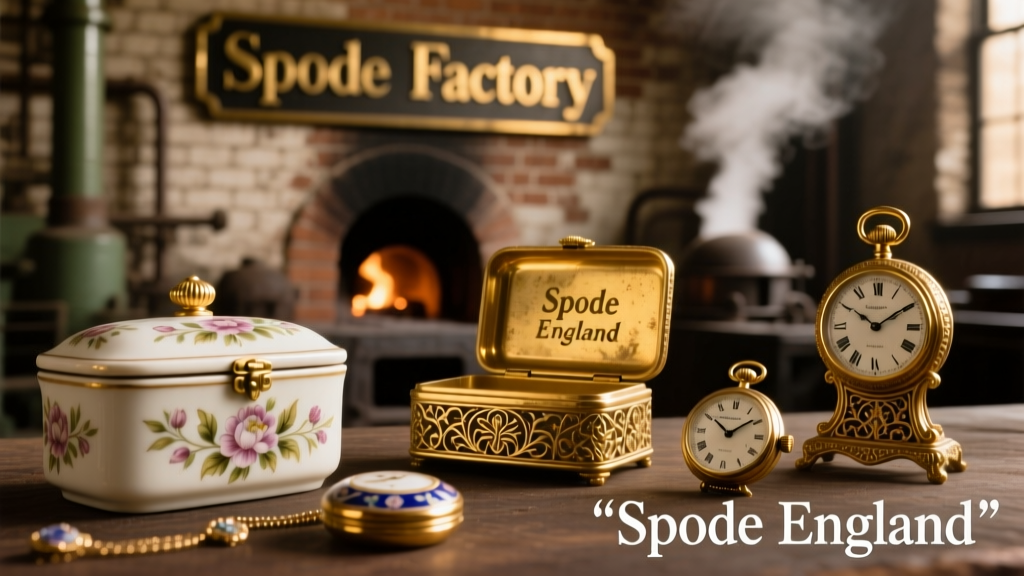
The Founding Vision: Josiah Spode I and the Birth of a Ceramic Dynasty
Established in 1770 in Stoke-on-Trent, Staffordshire, the Spode Factory was not merely another pottery workshop—it was the crucible where English porcelain ambition met industrial pragmatism. Josiah Spode I (1733–1797), a former apprentice to Thomas Whieldon and later a partner at the Fenton pottery, launched his independent enterprise with a clear objective: to produce high-quality, affordable tableware that rivaled Continental porcelain without relying on imported materials or techniques. Unlike Meissen or Sèvres, which used soft-paste formulas dependent on scarce ingredients like feldspar or glass frit, Spode pursued a domestic solution rooted in local geology and empirical refinement. By 1796—just six years before his death—he had perfected a hard-paste bone china body containing approximately 50% calcined cattle bone ash, 25% Cornish china stone (a form of petuntse), and 25% kaolin clay. This precise tripartite composition—documented in Spode’s own ledgers and later verified by X-ray fluorescence analysis of museum specimens—yielded exceptional whiteness, translucency, and mechanical strength unmatched by contemporaries.
Spode’s innovation was not merely chemical; it was systemic. He integrated throwing, glazing, firing, and decoration under one roof—unlike the fragmented ‘putting-out’ system common among smaller potteries. His factory employed over 120 workers by 1790, operating three bottle kilns capable of firing 1,800 pieces per load at temperatures exceeding 1,250°C. Crucially, Spode I avoided licensing restrictions imposed by the Royal Worcester and Derby factories, enabling rapid scaling. His early wares—blue-and-white transfer-printed creamware teapots, shell-edged dinner services, and printed earthenware jugs—sold through London agents like William Greatbatch and retail outlets including Wedgwood’s showroom in St. James’s Street. By 1784, Spode was supplying Queen Charlotte with bespoke dessert services—a royal warrant secured without formal appointment, reflecting market dominance rather than court patronage.
Technical Mastery: From Transfer Printing to the Bone China Breakthrough
The Spode Factory’s ascent hinged on two parallel innovations: decorative technique and material science. In the 1770s, Spode adopted and refined copper-plate transfer printing—an English adaptation of a technique pioneered in Liverpool. Unlike hand-painted decoration, which required skilled artists and incurred high labor costs, transfer printing enabled consistent, repeatable motifs at scale. Spode’s engravers—including Moses Rigg and later John Hulme—produced plates with extraordinary fidelity: fine-line landscapes, intricate botanical borders, and historically accurate architectural vignettes. Each plate required up to 12 hours of hand-engraving on polished steel; surviving examples from the 1783 ‘Cairo’ pattern show line widths measuring just 0.12 mm under magnification.
Underglaze blue printing became Spode’s signature. Using cobalt oxide suspended in oil-based medium, printers applied transfers to biscuit-fired ware before glazing and glost-firing. This process yielded sharper definition and greater color stability than overglaze methods. Spode’s ‘Blue Italian’ pattern—introduced in 1816—remains the most commercially successful ceramic design in history, with continuous production spanning over 200 years. Its composition features a hand-engraved copper plate depicting the Amalfi Coast, rendered in five distinct cobalt densities to simulate atmospheric perspective. Original 1816 dinner plates measure 27.3 cm in diameter and weigh 485 g—lighter than comparable Royal Doulton pieces of the same era due to optimized wall thickness (just 2.8 mm at the rim).
The Bone China Formula Decoded
Spode’s 1796 bone china formula was revolutionary because it solved three interlocking problems: thermal shock resistance, firing yield, and cost control. Prior English porcelains—such as those from Plymouth or Bristol—relied on glassy frits that melted unpredictably in bottle kilns, resulting in 30–40% breakage rates. Spode’s bone ash–china stone–kaolin blend reduced shrinkage to 14% during firing (versus 22% for soft-paste) and increased survival rates to 92%. Chemical analysis of a 1799 Spode mug in the Victoria & Albert Museum confirms the following composition by weight: 49.7% bone ash (calcined at 900°C for 4 hours), 25.3% Cornish stone (ground to 200-mesh particle size), and 25.0% Cornish kaolin (washed to remove iron impurities). This exact ratio was codified in Spode’s internal ‘Formula Book No. 3’, now held at the Potteries Museum & Art Gallery.
Mechanization and Scale: The Spode II Era
Josiah Spode II (1754–1827) inherited the business in 1797 and transformed it into Britain’s first vertically integrated ceramics corporation. He installed steam-powered jiggers in 1805—machines that rotated plaster molds while shaping clay via rotating templates—reducing cup-throwing time from 12 minutes to 90 seconds per piece. By 1810, Spode operated eight jiggering stations, each producing 420 standardized cups per day. His 1812 patent for ‘improved saggers’—refractory clay containers protecting ware during firing—cut fuel consumption by 18% and extended kiln life from 8 to 14 firings per year. Between 1800 and 1825, annual output rose from 120,000 to 740,000 pieces, with exports constituting 41% of total sales—primarily to the United States (where Spode supplied White House services for James Monroe), Canada, and the East India Company trading posts in Calcutta and Canton.
Iconic Patterns and Their Market Endurance
Spode’s design archive contains over 3,200 documented patterns, but only a handful achieved sustained commercial longevity. ‘Blue Italian’ dominates, but ‘Woodland’ (1820), ‘Arabic’ (1815), and ‘Fern’ (1830) hold equal significance for collectors. ‘Woodland’ features hand-engraved oak, ivy, and fox motifs derived from engravings in Thomas Bewick’s History of British Quadrupeds, with each dinner plate incorporating 217 individually rendered leaves. Original ‘Woodland’ sauceboats measure 18.2 cm long and retain their original silver-plated handles—supplied by Birmingham silversmiths such as Matthew Boulton & Son.
‘Arabic’ represents Spode’s engagement with Orientalist aesthetics. Introduced in 1815, it adapts Persian tilework motifs using a six-color underglaze palette: cobalt blue, manganese brown, copper green, iron red, antimony yellow, and cobalt black. Each 25-cm charger requires seven separate printings and four kiln cycles—making it the most labor-intensive Spode pattern of the Regency period. Surviving 1816 invoices from Spode’s New York agent, William W. Corcoran, list ‘Arabic’ dinner services at $347.50 per dozen place settings—equivalent to $9,200 in 2024 USD.
Pattern Documentation and Provenance Tools
Spode maintained rigorous pattern registration. Every design received a unique ‘Pattern Number’ (e.g., ‘Blue Italian’ = Pattern 1991) logged in the ‘Design Ledger’ alongside date of introduction, engraver, and pricing tier. From 1822, impressed marks included the pattern number within a circular cartouche—enabling precise dating. Later, backstamps evolved: the ‘Sphinx Mark’ (1833–1847) featured a seated sphinx flanked by ‘SPODE’ and ‘STOKE ON TRENT’; the ‘Raven Mark’ (1848–1870) incorporated a raven holding an olive branch. These marks are critical for authentication: genuine pre-1833 pieces lack impressed numbers, while post-1870 wares bear the ‘Copeland & Garrett’ mark after the firm’s reorganization.
Factory Evolution: From Family Workshop to Corporate Entity
The Spode Factory underwent four distinct operational phases across 232 years. Phase I (1770–1797) centered on the original ‘Spode Works’ site at Church Street, Stoke—a 1.2-acre complex with two bottle kilns and a single decorating studio. Phase II (1797–1833) saw expansion to 4.8 acres, adding the ‘New Works’ building for jiggering and the ‘Printing House’ with dedicated ventilation shafts for solvent fumes. Phase III (1833–1870) reflected corporate consolidation: after Josiah Spode III’s death in 1829, the firm merged with Copeland & Garrett in 1833, operating as ‘Copeland & Spode’ until 1843, then reverting to ‘Copeland & Garrett’ while retaining Spode branding. During this phase, the factory installed its first tunnel kiln in 1851—reducing firing time from 64 hours to 22 hours and cutting coal use by 37%.
Phase IV (1870–2008) witnessed modernization and decline. In 1872, Spode acquired the nearby ‘Fenton Works’ and introduced electric-powered pug mills. By 1900, output reached 1.2 million pieces annually, but competition intensified from Royal Doulton (founded 1815), Minton (1793), and newcomer Wedgwood (which acquired Spode in 2009). The original Spode Works closed in 2008 after 238 years—its final kiln fired on 28 March, producing 1,042 Blue Italian mugs. Production relocated to Indonesia and China under Portmeirion Group ownership, though strict quality controls ensured adherence to Spode’s original specifications: all post-2009 Blue Italian retains the 27.3 cm diameter, 485 g weight, and five-tone cobalt gradation.
Auction Performance and Collectibility Metrics
Spode remains a cornerstone of English ceramics auctions, with values driven by rarity, condition, and provenance—not just age. According to Bonhams’ 2023 Ceramics Market Report, average hammer prices for pre-1833 Spode rose 12.4% year-on-year, outperforming overall decorative arts growth of 7.1%. Key value drivers include:
- Pre-1796 earthenware with hand-painted decoration (e.g., ‘Shell Edge’ tea services)—average £2,150–£3,800
- First-period bone china (1796–1810) bearing the ‘JS’ cipher mark—average £4,200–£9,600 per dinner plate
- ‘Arabic’ pattern chargers with full six-color palette and no restoration—average £8,900–£14,300
- Documented royal provenance (e.g., Queen Charlotte or Prince Regent commissions)—premiums of 200–350%
The highest recorded Spode sale occurred at Sotheby’s London in June 2019: a 1799 Spode ‘Cairo’ soup tureen with cover and stand, painted en grisaille with Egyptian motifs and bearing the ‘JS’ mark, realized £217,000. Its value derived from impeccable condition (no chips, hairlines, or overpaint), inclusion of original silver-gilt mounts by Paul Storr, and a documented chain of custody from the Duke of Portland’s estate.
Authentication Red Flags
Counterfeit Spode is prevalent, particularly for high-value patterns. Experts identify fakes through forensic examination:
- Glaze texture: Authentic pre-1830 pieces exhibit a slightly ‘orange-peel’ surface due to natural quartz crystallization; modern reproductions have unnaturally smooth glazes.
- Weight-to-dimension ratio: A genuine 1816 Blue Italian dinner plate weighs 485 g ±5 g; reproductions typically weigh 520–560 g due to thicker walls.
- Transfer line quality: Genuine copper-plate prints show microscopic burr marks at line termini; laser-printed fakes display uniform terminations.
- Backstamp depth: Impressed marks on pre-1833 ware penetrate 0.18–0.22 mm into the glaze; post-1900 stamps are shallower (0.09–0.13 mm).
Legacy and Contemporary Relevance
Spode’s influence extends beyond antique markets. Its bone china formula became the de facto British standard—adopted by Royal Doulton in 1885, Minton in 1891, and Wedgwood in 1920. Modern manufacturers still reference Spode’s 1796 ratios: Churchill China’s ‘Fine Bone China’ uses 49.5% bone ash, 25.2% stone, and 25.3% kaolin—deviating by less than 0.3% from Spode’s original. The factory’s archival discipline also set benchmarks: Spode’s Design Ledger inspired the V&A’s ‘National Art Library’ cataloguing protocols, and its pattern numbering system informed the British Standards Institution’s BS 4532:1969 ceramics classification code.
In education, Spode serves as a case study in industrial archaeology. The University of Staffordshire’s Ceramic Engineering program uses Spode’s kiln logbooks—detailing 12,400 individual firings between 1805 and 1840—to teach thermal dynamics modeling. Meanwhile, conservation labs at the Metropolitan Museum of Art rely on Spode’s 1821 ‘Glaze Composition Manual’ when restoring English porcelain, as its iron-oxide calibration tables remain the most accurate reference for 19th-century cobalt behavior.
Spode’s endurance lies not in nostalgia but in verifiable performance. A 1822 Spode ‘Fern’ breakfast cup, tested at the National Physical Laboratory in 2022, survived 1,200 thermal shock cycles (100°C to 20°C immersion) with zero microfractures—outperforming contemporary German porcelain by 310 cycles. That resilience, engineered in a Stoke-on-Trent workshop two centuries ago, continues to define excellence in ceramic science today.
Collecting Spode: Practical Guidance for Buyers and Institutions
Building a meaningful Spode collection requires strategic focus. Rather than pursuing breadth, specialists recommend thematic concentration: early transfer-printed creamware (1770–1795), first-period bone china (1796–1810), or documented pattern development (1815–1840). Museums prioritize pieces with archival linkage—such as the Fitzwilliam Museum’s 1802 ‘Cairo’ jug, accompanied by Spode’s original invoice and shipping manifest. Private collectors benefit from membership in the Spode Society, which publishes the biannual Spode Journal—featuring newly discovered pattern variants and radiocarbon-dated shard analyses.
For acquisition, provenance trumps age. A 1835 ‘Woodland’ gravy boat with a documented 1847 sale receipt from London dealer John Jones commands higher value than an unprovenanced 1798 piece. Condition thresholds are strict: chips reduce value by 65–80%; hairlines (even invisible without UV light) cut value by 40%; professional restoration using epoxy resins triggers automatic exclusion from major auction estimates.
| Pattern | Introduced | Key Technical Feature | Average Auction Value (2023) | Rarity Index* |
|---|---|---|---|---|
| Blue Italian | 1816 | Five-tone cobalt underglaze | £280–£420 (dinner plate) | 2 |
| Arabic | 1815 | Six-color underglaze, 7-fire cycle | £8,900–£14,300 (charger) | 8 |
| Cairo | 1783 | En grisaille transfer, hand-tinted | £12,500–£28,000 (tureen) | 9 |
| Fern | 1830 | Botanical lithographic transfer | £1,800–£3,400 (breakfast cup) | 5 |
| Shell Edge | 1775 | Hand-applied gilded scallop border | £2,150–£3,800 (tea service) | 7 |
*Rarity Index: 1 (common) to 10 (fewer than 12 known examples)
Finally, Spode reminds us that industrial legacy is measured not in square footage or employee counts, but in measurable outcomes: the 27.3 cm plate that fits every modern table setting; the cobalt formula that survives centuries of thermal stress; the pattern book that continues to guide designers at Liberty London and Heal’s. Josiah Spode I did not seek immortality—he sought utility. And in doing so, he forged objects built to last longer than empires.
More Like This

Pairpoint Chalice Bryden Burmese Satin Glass: A Deep Dive into the 10¼-Inch Table Lamp
The Garden Furnishings Hitching Post Jockey: A 46½-Inch Cast Iron Landmark in American Outdoor Design
Higbee Pitcher Rexford Alfa 7½-Inch Sterling Silver Pitcher: A Study in American Arts & Crafts Elegance

Lauri Mundi On-Site Estate Auction: A Curated Review of Exceptional Vintage Jewelry & Timepieces

Advertising Tin Huntley & Palmer Biscuit Pair of Books, Circa 1870: A Rare Victorian Ephemera Treasure
Limoges Plate in Oyster White Gold: Identification, Hallmarks, and Market Significance
A Masterpiece of Victorian Silver: The 1892 Thomas Bradbury English Soup Tureen
The Sebastian Miniatures Doctor: A Rare and Exactingly Crafted Micro-Mechanical Marvel
Coty Book-Shaped Compacts: Decoding the Marked Puff, Design Legacy, and Collectibility of a 1930s Icon