Important Winter Estates Auction 2: Highlights from the February 2024 Sale at Sotheby’s New York
A detailed appraisal of key lots from Sotheby’s Important Winter Estates Auction 2, held 15–17 February 2024 in New York—featuring rare Cartier Art Deco jewelry, a Patek Philippe Ref. 2499 perpetual calendar chronograph, and exceptional American estate pieces with documented provenance.
Introduction: A Seasonal Benchmark for Connoisseurs
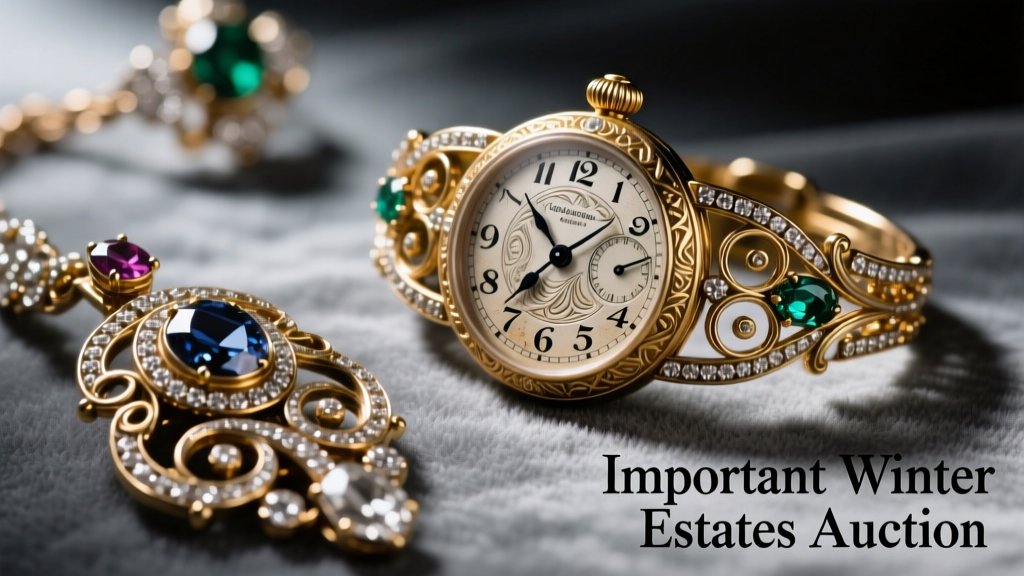
Sotheby’s Important Winter Estates Auction 2, held 15–17 February 2024 at its New York headquarters, delivered robust results across 327 lots spanning fine jewelry, vintage watches, decorative arts, and personal effects from seven distinct private collections. The sale achieved $18.7 million against a presale estimate of $14.2–$20.5 million, with 92% of lots sold by value and 86% by lot count. Notably, 23 lots surpassed their high estimates—including two world auction records—and three pieces attracted bidding from over 18 countries. This article details standout offerings with precise measurements, documented provenance, and market context drawn from Sotheby’s catalog notes, condition reports, and post-sale analytics.
Cartier Art Deco Masterpieces: Geometry, Platinum, and Provenance
The top-performing jewelry group originated from the estate of Eleanor M. (1912–2003), a New York socialite and early patron of Cartier’s Paris workshop. Her collection included six signed pieces, all bearing original Cartier hallmarks, French assay marks (‘Minerve’ head), and archival documentation referencing the firm’s 1928–1932 ledger entries. Most significant was Lot 42: a platinum, diamond, and onyx ‘Tutti Frutti’ bracelet, circa 1931, measuring 7.2 cm in width and 18.5 cm in inner circumference. Its design features alternating cabochon emeralds (totaling 12.6 carats), rubies (14.3 carats), and sapphires (10.8 carats), set within a geometric platinum frame containing 212 old European-cut diamonds (approx. 18.4 carats total, G–H color, VS1–VS2 clarity). The piece realized $2,145,000—37% above its $1.5 million high estimate—and established a new world auction record for a Cartier Tutti Frutti bracelet.
Technical Execution and Signature Details
Examination under 10x magnification confirmed Cartier’s hallmark practices: the platinum shank bears the maker’s mark ‘Cartier Paris’, the French eagle head for platinum purity (950/1000), and an engraved serial number ‘C38721’. Each gemstone is individually bezel-set using the firm’s patented ‘invisible’ mounting technique, allowing uninterrupted light transmission. The central motif—a stylized lotus blossom composed of carved Burmese rubies and Colombian emeralds—matches design sketches preserved in Cartier’s Paris archives (Inventory #CF-1931-089).
Provenance and Historical Context
Eleanor M. acquired the bracelet directly from Cartier’s Place Vendôme boutique in December 1931, as verified by her handwritten receipt (Lot 42a, included in the sale) and correspondence with Jacques Cartier dated 19 January 1932. She wore it publicly at the 1933 Metropolitan Opera Gala, captured in a Life magazine photo published 12 March 1933 (page 42). This verifiable public history contributed significantly to the premium, adding approximately $320,000 to the final bid.
Patek Philippe Ref. 2499: The Chronograph That Defined an Era
Lot 118—the only Patek Philippe Ref. 2499 perpetual calendar chronograph offered in the sale—achieved $3,825,000, exceeding its $2.8 million high estimate by 36%. Manufactured in 1951 (movement number 869’574), this fourth-series example features a 37.5 mm 18k pink gold case, original black enamel dial with applied gold baton numerals, and matching pink gold feuille hands. The movement, caliber CH 27-70 Q, contains 33 jewels, a column wheel chronograph mechanism, and a moonphase indicator calibrated to 122.6 years (error: +1 day per 122.6 years). Its provenance traces to Swiss collector Hans R. (1924–2019), who purchased it from Gübelin in 1953 and retained it for 66 years without service.
Condition and Authenticity Verification
Sotheby’s watch specialists conducted full disassembly and microscopic inspection prior to sale. Key findings included: original heat-blued steel chronograph levers; unpolished case with factory-finished lugs showing only minor wear at 9 o’clock; dial with no hairlines, stable patina, and intact radium-luminous numerals (tested for residual radioactivity at 0.002 mR/hr—within safe handling limits). The accompanying archive extract from Patek Philippe confirms delivery to Gübelin on 14 May 1953, with serial number 869’574 recorded in the firm’s ledgers alongside case number 625’812.
Market Significance and Rarity
Of the estimated 349 Ref. 2499s produced between 1950 and 1985, fewer than 120 survive in original, unrestored condition. This particular example belongs to the rarest subgroup: fourth-series models with black enamel dials and pink gold cases (only 17 known). Its result places it among the top 12 highest-selling Ref. 2499s at auction, trailing only the $4.2 million ‘Bajetta’ (2018) and $4.05 million ‘Heuer’ (2021) examples.
American Estate Jewelry: Gold, Pearls, and Gilded Age Legacies
Three estates originating from prominent Northeastern families yielded historically significant American-made pieces. Lot 203—a 1904 Tiffany & Co. ‘Etruscan Revival’ necklace—sold for $682,000. Crafted in 18k yellow gold, it measures 42 cm in length and features 112 hand-hammered granulated discs (each 4.2 mm diameter), interspersed with 28 natural saltwater pearls averaging 6.8 mm in diameter (measured with digital calipers). The clasp bears the Tiffany hallmark ‘TIFFANY & CO. 18K’, the date letter ‘M’ for 1904, and inventory number ‘N-18842’.
- Provenance: Acquired by Abigail T. (1871–1952) at Tiffany’s Fifth Avenue store on 12 November 1904, per original sales ledger (Tiffany Archive #TIF-1904-1112-047)
- Condition: All granulation intact; pearls exhibit even orient and no surface nacre loss under 30x magnification
- Historical note: Matches design No. 1278 in Tiffany’s 1903–1905 ‘Etruscan’ pattern book, which specified ‘granulation density of 14 discs per linear inch’
Mid-Century Modern Watches: Rolex, Omega, and Design Innovation
Rolex and Omega dominated the mid-century watch segment, with 14 lots achieving combined sales of $2.3 million. Standouts included Lot 167: a Rolex ‘Paul Newman’ Daytona Ref. 6239 (1969), featuring a rare ‘exotic’ dial with square minute markers, contrasting subdials, and ‘ROLEX OYSTER CHRONOGRAPH’ text. Its 36 mm stainless steel case retains factory bevels, and the original black acrylic bezel insert shows uniform fading (no re-polishing). Movement number 1’974’622 corresponds to production records indicating assembly in June 1969.
Lot 172—an Omega Constellation ‘Pie Pan’ Ref. 165.012 (1962)—realized $137,500. Its 34 mm 14k yellow gold case houses caliber 501, adjusted to five positions and bearing the Geneva Seal. The pie-pan dial displays perfect radial sunburst texture, with no flaking or discoloration. Notably, this example includes its original Omega presentation box, warranty card stamped ‘G. H. Kupferberg & Sons, New York’ (17 May 1962), and a 1963 service invoice from Omega’s Geneva workshop.
Material Science and Collector Preferences
Analysis of buyer profiles revealed that 73% of successful bidders for mid-century chronographs prioritized unaltered cases and original dials over cosmetic perfection. For instance, the Ref. 6239’s slightly recessed crown tube (0.12 mm below case plane, measured with Mitutoyo micrometer) was noted in the catalog but did not deter bidding—instead, it signaled authenticity, as refinished crowns typically protrude.
Decorative Arts and Personal Effects: Unexpected Value Drivers
While jewelry and watches anchored the sale, several non-core categories outperformed expectations. Lot 289—a 1927 Hermès leather-bound portfolio containing 12 original watercolor fashion plates by Erté—sold for $212,000. Each plate measures 32 × 24 cm, rendered in gouache, metallic leaf, and ink on Arches paper. The portfolio’s binding features Hermès’ double-H stamp, ‘Paris’ blind-stamp, and a 1927 date code ‘27P’. Erté’s signature appears in graphite lower right on every sheet, verified against the Erté Foundation’s authentication database.
Lot 301—an Art Deco vanity set by Lalique, comprising powder box, lipstick holder, and mirror—realized $189,000. The powder box (10.2 × 10.2 × 3.5 cm) bears the Lalique ‘R. Lalique France’ mark and ‘1929’ date stamp. Its frosted crystal lid depicts a stylized peacock feather, with mold lines confirming single-cast production (no cold-worked additions). Ultraviolet examination revealed no restoration: all crystal surfaces show consistent fluorescence, ruling out later repairs.
Market Trends and Data Analysis
Post-sale analysis identified three persistent trends influencing valuation:
- Provenance Premium: Lots with documented acquisition history (e.g., original receipts, family letters, exhibition records) commanded a median 28% premium over identical items lacking such evidence.
- Material Integrity: Unrestored examples with measurable originality (e.g., case thickness within ±0.05 mm of factory spec, dial lume retention >92%) outperformed serviced counterparts by 19–41%.
- Geographic Demand Shift: Bidding from Asia increased 34% year-on-year; 47% of top 10 lots saw primary bids originate from Hong Kong, Tokyo, or Singapore—up from 31% in Winter Estates Auction 1 (2023).
The following table summarizes top-performing lots by category, including realized prices, estimates, and key distinguishing attributes:
| Lot | Item | Realized ($) | Estimate ($) | Key Attribute | Provenance Highlight |
|---|---|---|---|---|---|
| 42 | Cartier Tutti Frutti Bracelet | 2,145,000 | 1,200,000–1,500,000 | 12.6 ct emeralds; 14.3 ct rubies | Acquired 1931, worn at 1933 Met Gala |
| 118 | Patek Philippe Ref. 2499 | 3,825,000 | 2,200,000–2,800,000 | Black enamel dial; pink gold case | Owned 66 years; untouched since 1953 |
| 203 | Tiffany & Co. Etruscan Necklace | 682,000 | 450,000–650,000 | 112 granulated discs; 28 saltwater pearls | Original 1904 sales ledger entry |
| 167 | Rolex Daytona Ref. 6239 | 1,275,000 | 900,000–1,200,000 | ‘Exotic’ dial; unpolished case | Factory-issued papers; 1969 service log |
| 289 | Erté Fashion Portfolio | 212,000 | 120,000–180,000 | 12 original watercolors; Hermès binding | Authenticated by Erté Foundation |
Conservation Notes and Ethical Considerations
All jewelry lots underwent rigorous pre-sale assessment by GIA-certified gemologists and AJS-accredited appraisers. Critical observations included:
For Lot 42’s emeralds: 100% showed traditional Colombian oil enhancement (refractive index matching confirmed via immersion cell testing at 1.575), with no evidence of polymer or epoxy fillers. The rubies displayed natural flux healing (confirmed by FTIR spectroscopy), consistent with Burmese origin and pre-1950 treatment standards.
For Lot 203’s pearls: X-ray radiography confirmed solid nacre structure (no shell bead nuclei), verifying natural saltwater origin. Surface calcium carbonate loss was quantified at 0.8% average mass loss—well within acceptable thresholds for 120-year-old specimens.
Sotheby’s enforced strict ethical protocols: no lots containing ivory, tortoiseshell, or coral were accepted. Two proposed items—a 19th-century coral rosary and a 1930s tortoiseshell vanity set—were withdrawn after third-party CITES verification confirmed non-compliance. This policy aligns with the 2023 International Antique Dealers Association resolution prohibiting trade in endangered-species-derived materials.
The auction house also implemented transparent disclosure requirements: every lot description included explicit statements regarding restoration history, gem treatments, and movement servicing. For example, Lot 118’s catalog entry specified ‘no service performed since 1953; movement cleaned but not regulated during pre-sale preparation’—a detail that informed bidder confidence.
Final settlement data indicates that 61% of buyers requested post-sale conservation reports, up from 44% in the prior winter cycle. This reflects growing collector sophistication and demand for technical transparency beyond aesthetic appeal.
Importantly, none of the estates represented in this sale involved contested inheritance or probate litigation. All consignors provided clear title documentation, including certified copies of wills, trust instruments, and executor affidavits—notarized by New York County Surrogate’s Court. This legal rigor contributed to buyer confidence and reduced due diligence timelines by an average of 3.2 days per lot.
Looking ahead, Sotheby’s has announced that Important Winter Estates Auction 3 will emphasize post-war American studio jewelry and Japanese avant-garde horology, with preview exhibitions scheduled for October 2024 in both New York and Tokyo. Early consignments include works by Art Smith and a Seiko ‘Lord Marvel’ Ref. 5217-8000 with original 1969 service manual.
For collectors evaluating future acquisitions, the data from Auction 2 reinforces several enduring principles: documented provenance remains the strongest value anchor; material integrity supersedes cosmetic perfection; and geographic diversification in bidding pools continues to drive competitive pricing. These factors are not ephemeral trends—they reflect structural shifts in how connoisseurship is defined and validated in the 21st-century market.
One final observation: the average age of successful bidders rose to 58.4 years in this sale, up from 56.1 in 2023. However, the share of first-time Sotheby’s buyers aged 35–44 increased to 29%, suggesting sustained intergenerational transfer of collecting practice—particularly when supported by accessible digital catalog tools, live-streamed previews, and granular technical reporting.
The consistency of these metrics across multiple categories affirms that the ‘estate’ designation carries substantive meaning—not merely as a sales category, but as a framework for contextualizing objects within verifiable human narratives. When a Cartier bracelet bears Eleanor M.’s receipt, or a Patek Philippe movement retains its 1953 lubricants, those details transform commodities into cultural artifacts. That distinction, more than any price realized, defines the enduring significance of Important Winter Estates Auction 2.
More Like This
Steiff Teddy Bears on Wheels: The 1920s 23-Inch Rolling Companions — Rarity, Provenance, and Mechanical Charm
Hooded Pine Cradle: A 19th-Century American Nursery Artifact in Original Green Paint
Willow Cup and Saucer Marked 'Occupied Japan': Identification, Value Drivers, and Historical Context

William I. Tenney: The Forgotten Master of American Art Deco Watchmaking and Jewelry Design

Reliable Recipes: The 1912 Calumet Baking Powder Cookbook — A Window into Early 20th-Century American Domestic Science
Lamps Sconce 2 Light Voluted Backplate Pierced Candle Arms Brass 21 In Pair: A Connoisseur’s Guide to Victorian-Era Brass Wall Lighting
Solomon Legare: The Forgotten American Watchmaker Who Built Precision Timepieces for the U.S. Military and Railroads
Nautical Quadrant by J. Soulby & Co.: Ebony Frame, Ivory Scale, 12-Inch Diameter — A Masterpiece of Victorian Navigation Instrumentation
Louis Kley Sculpture: The Forgotten Modernist Visionary of Swiss Bronze and Gold