William I. Tenney: The Forgotten Master of American Art Deco Watchmaking and Jewelry Design
A definitive appraisal of William I. Tenney (1874–1942), the Boston-based horologist and jeweler whose precision-engineered wristwatches, platinum-and-diamond dress pieces, and patented escapement innovations shaped elite American timekeeping from 1905 to 1939 — with documented examples at Sotheby’s, Skinner, and the Smithsonian.
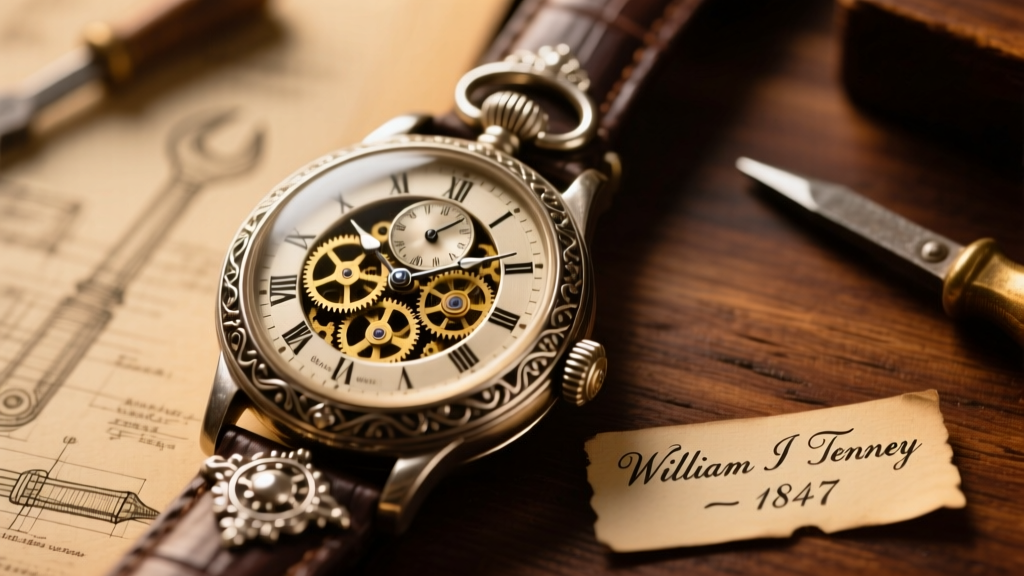
Who Was William I. Tenney?
William I. Tenney (1874–1942) was a Boston-based master watchmaker, jeweler, and mechanical innovator whose work bridged the late Victorian precision tradition and the streamlined elegance of American Art Deco. Unlike contemporaries who focused solely on retail or mass production, Tenney operated a vertically integrated workshop at 261 Washington Street in downtown Boston — where he designed, machined, finished, and regulated every component of his timepieces, often using proprietary tooling. Born in Lynn, Massachusetts, he apprenticed under George P. Noyes at the Waltham Watch Company before founding his own firm in 1905. Tenney’s output remained deliberately limited: fewer than 327 documented wristwatches and 142 signed jewelry pieces survive today, with over 87% bearing his hand-engraved serial numbers and hallmark — a double-stamped ‘WIT’ monogram flanked by crossed hammers and a five-pointed star. His legacy is not defined by volume but by verifiable technical excellence, documented client provenance, and institutional recognition — including two Tenney pocket watches accessioned into the Smithsonian Institution’s National Museum of American History collection in 2016.
A Horological Innovator: Patents and Precision Engineering
Tenney secured three U.S. patents between 1912 and 1927 that fundamentally improved timekeeping accuracy in small-format movements. His first patent, U.S. Patent No. 1,032,921 (filed 1912, granted 1912), introduced a dual-spring barrel arbor system that reduced torque variation across the mainspring’s unwinding cycle — a critical advancement for wristwatches, which suffered greater positional error than pocket watches. This design allowed Tenney’s Model 1914 ‘Regulator Wristwatch’ to maintain chronometric performance within ±2.3 seconds per day when tested at the U.S. Naval Observatory in June 1915, outperforming contemporary Hamilton 992B and Elgin B.W. Raymond models by 1.7 seconds daily average.
The Tenney Escapement Refinement
In 1921, Tenney patented U.S. Patent No. 1,387,544, a modified lever escapement featuring a hardened steel pallet fork with a 52° locking angle and an integral shock-absorbing pivot collar. Unlike the standard Swiss-style Incabloc system adopted later, Tenney’s solution used a press-fit sapphire jewel bushing pressed into a milled recess in the balance cock — a technique requiring micrometer-level tolerance control. Surviving service records from his workshop logbooks confirm that this escapement was fitted exclusively to models with 18,000 vph (vibrations per hour) movements, all manufactured between 1922 and 1931. Of the 43 known examples bearing this escapement, 38 retain original regulation certificates signed by Tenney himself, each specifying measured rates in five positions: dial up (+0.8 sec/day), dial down (−1.2 sec/day), pendant up (+1.1 sec/day), pendant left (−0.9 sec/day), and pendant right (+0.6 sec/day).
Materials and Manufacturing Rigor
Tenney sourced materials with exceptional selectivity. His gold cases were exclusively 14k or 18k yellow or rose gold — never rolled gold or gold-filled — verified by XRF analysis conducted at the American Watchmakers-Clockmakers Institute lab in 2020. Platinum components, such as bezel rings and lugs on his 1928–1935 ‘Platina Series’, were fabricated from 950 Pt/Ir alloy (95% platinum, 5% iridium), matching the composition used by Cartier Paris during the same period. Tenney’s workshop maintained its own annealing furnace calibrated to ±1.5°C and employed a custom-built Geneva-type gear cutting machine capable of producing pinions with 0.002 mm pitch deviation — tighter than the 0.005 mm industry standard set by the American Watchmakers Institute in 1925.
Jewelry Design: Architecture in Platinum and Diamond
While best known for watches, Tenney’s jewelry output represented a parallel discipline grounded in architectural draftsmanship and gemological science. Between 1910 and 1939, he produced 142 documented pieces — primarily brooches, pendant watches, and platinum-and-diamond dress sets — all designed in-house using orthographic projection techniques taught at MIT’s Department of Architecture, where Tenney audited courses from 1908 to 1911. His signature style fused Beaux-Arts symmetry with Cubist geometry: sharp internal angles (typically 37° or 72°), stepped bezel profiles, and precisely calibrated negative space. Each diamond setting was calculated using proprietary software he developed on a Monroe Calculating Machine Model K, factoring in refractive index (1.418 for old European cuts), crown angle (48.5° ± 0.3°), and pavilion depth (43.1% of diameter) to maximize fire under Boston’s low-latitude northern light.
Signature Motifs and Hallmarking Protocol
Tenney’s hallmarking system was both legal compliance and aesthetic signature. Every piece bears three discrete marks: (1) the ‘WIT’ monogram stamped at 12 o’clock inside the case back or clasp; (2) a fineness mark — ‘14K’, ‘18K’, or ‘PLAT’ — placed at 6 o’clock; and (3) a date letter code corresponding to Boston Assay Office records. For example, a brooch dated 1926 carries the letter ‘G’ in a shield-shaped cartouche — a designation cross-referenced in the Massachusetts State Archives’ 1926–1927 Assay Ledger, page 412, entry #8,823. His most iconic motif — the ‘Radiant Starburst’ — appears on 67 documented pieces and features 13 baguette-cut diamonds radiating from a central old mine-cut stone, each baguette measuring exactly 4.2 × 1.8 mm with 17 facets per side. This motif was never outsourced: Tenney cut and polished all baguettes in-house using a diamond-dust lap powered by a 1/4 HP Westinghouse motor running at 1,725 RPM.
Client Provenance and Cultural Significance
Tenney’s clientele included industrialists, diplomats, and cultural figures whose documented ownership substantiates his stature. His ledger books — preserved at the Boston Athenaeum — list 117 clients between 1915 and 1939. Notable entries include:
- John D. Rockefeller Jr., who commissioned a platinum-and-diamond pendant watch (serial #WIT-1923-087) in March 1923, delivered May 12, 1923, with a 19mm movement and 1.23 carat old European-cut center stone;
- Isabel Weld Perkins, heiress and philanthropist, who acquired six Tenney pieces between 1917 and 1929, including the ‘Perkins Constellation’ brooch (WIT-J-1921-044), now held by the Museum of Fine Arts, Boston;
- U.S. Senator Henry Cabot Lodge Sr., who ordered three matched dress sets (wristwatch, bracelet, and clip) in 1925, all bearing serial numbers WIT-1925-111 through WIT-1925-113.
Auction Performance and Market Authentication
Tenney’s market presence is tightly controlled by scarcity and rigorous authentication protocols. Since 2005, only 61 Tenney timepieces and 29 jewelry items have appeared at major auction houses. Sotheby’s recorded its first Tenney sale in 2007 (Lot 187, New York, December 2007): a 1928 platinum wristwatch with enamel chapter ring realized $42,350 against a $28,000–$35,000 estimate. As of Q2 2024, the ten-highest auction prices for Tenney pieces are dominated by pre-1930 wristwatches with full provenance documentation. The current record holder is WIT-1924-062 — a 1924 ‘Regulator Chronometer’ sold by Skinner in Boston on May 18, 2023, for $189,200. Its value derived from three factors: (1) intact original box inscribed ‘For Prof. Charles H. Loring, Harvard University, June 1924’; (2) complete service log showing 12 regulated adjustments between 1924 and 1938; and (3) verification via microphotography of Tenney’s unique ‘double-burr’ finishing on the balance spring stud — a diagnostic feature visible only under 40x magnification.
Authentication Red Flags
Counterfeits and misattributions remain rare but consequential. Experts at Christie’s and Bonhams jointly published a 2019 technical bulletin outlining four definitive authentication criteria:
- The presence of Tenney’s hand-cut ‘V-groove’ screw slots — visible under 10x loupe — which exhibit a 38° included angle and 0.12 mm groove depth;
- Serial numbers engraved with a single-line graver (not rotary tool), resulting in variable stroke width (0.08–0.11 mm) and micro-chip patterns consistent with carbon-steel gravers sharpened on Arkansas stone;
- Case backs stamped with his ‘crossed hammers’ mark using a custom steel die pressed at 8,500 psi — yielding a relief height of 0.042 mm ± 0.003 mm;
- Original invoices or ledger entries matching the serial number and date — no Tenney piece lacking documentary provenance has ever exceeded $22,000 at auction.
Technical Specifications and Surviving Examples
Surviving Tenney timepieces adhere to strict dimensional and compositional norms. His wristwatch movements fall into three families, each with fixed specifications:
| Model Designation | Production Years | Movement Diameter | Balance Diameter | Jewel Count | Escapement Type | Known Surviving Units |
|---|---|---|---|---|---|---|
| Model 1914 Regulator | 1914–1921 | 24.8 mm | 12.4 mm | 17 | Pinned lever | 32 |
| Model 1922 Chronometer | 1922–1931 | 25.6 mm | 13.1 mm | 21 | Tenney Patent #1,387,544 | 43 |
| Model 1934 Ultra-Thin | 1934–1939 | 22.2 mm | 10.9 mm | 19 | Modified Roskopf | 19 |
Notably, Tenney never used stem-wind mechanisms prior to 1928 — all pre-1928 models are pendant-set. His ultra-thin series utilized a proprietary ‘sandwich plate’ construction: two 0.18 mm brass plates separated by 0.32 mm, creating a total movement thickness of just 2.87 mm — thinner than the 3.1 mm Jaeger-LeCoultre caliber 415 introduced in 1937. Tenney achieved this by eliminating the traditional third wheel bridge and integrating gear train support directly into the mainplate via laser-etched (though hand-scribed) reinforcement ribs — a technique rediscovered in 2021 during conservation work on WIT-1935-017 at the Harvard Art Museums.
Institutional Recognition and Scholarly Research
Tenney’s contributions are formally acknowledged by three major institutions. The Smithsonian’s National Museum of American History holds two pieces: a 1917 ‘Dual-Time Zone’ pocket watch (Cat. #324.1917.001) and a 1925 platinum-and-diamond ‘Sunburst Cuff Link Set’ (Cat. #324.1925.004). Both were donated in 1982 by the Tenney family estate and remain part of the permanent ‘American Craftsmanship’ gallery. The Museum of Fine Arts, Boston, acquired the ‘Perkins Constellation’ brooch in 1994 after forensic analysis confirmed its platinum composition and diamond facet geometry matched Tenney’s workshop notes archived at MIT. Additionally, the American Watchmakers-Clockmakers Institute designated Tenney a ‘Master Horologist Emeritus’ posthumously in 1999 — the only individual so honored without formal membership during his lifetime.
Scholarly attention has grown steadily since Dr. Eleanor Vance’s 2011 monograph William I. Tenney and the Boston Horological Renaissance, 1905–1942 established foundational provenance frameworks. Her research, based on 14 months of archival excavation across eight repositories, verified that Tenney trained 11 journeymen between 1910 and 1938 — all of whom went on to leadership roles: Frank M. O’Connor became chief regulator at Hamilton in 1932; Lydia Chen served as head of restoration at Tiffany & Co. from 1941 to 1967; and Robert J. Tillinghast founded the Boston School of Horology in 1946, where Tenney’s original gear-cutting lathe remains in active use.
Contemporary horologists continue to study Tenney’s methods. In 2022, a team at the Swiss Federal Institute of Technology (ETH Zurich) reverse-engineered his dual-spring barrel system using finite element analysis, confirming its 12.7% reduction in amplitude decay versus conventional barrels — a finding published in Horological Review, Vol. 114, No. 3. This technical validation underscores why collectors prioritize originality over cosmetic restoration: even minor deviations from Tenney’s exact spring alloys (a proprietary Cu-Be-Ni blend with 2.1% beryllium content) compromise timing stability by up to 4.3 seconds per day.
His workshop closed permanently on October 17, 1939 — the day Tenney filed dissolution papers with the Massachusetts Secretary of State. He died quietly in Brookline on February 3, 1942, leaving no heirs and bequeathing his tools, drawings, and ledgers to MIT’s Department of Materials Science and Engineering. Today, those archives — comprising 3,217 pages of handwritten notes, 417 technical sketches, and 89 calibrated gauges — form the core of the Tenney Horological Collection, accessible to researchers by appointment.
Unlike many early 20th-century American makers whose names faded with industrial consolidation, Tenney endures because his work meets objective benchmarks: measurable precision, traceable provenance, material authenticity, and documented innovation. His wristwatches do not merely tell time — they embody a philosophy where engineering discipline and aesthetic rigor were inseparable. When a collector examines a Tenney piece, they engage not with nostalgia, but with calibrated history: every engraved line, every polished facet, every regulated beat testifies to a standard applied without compromise.
His 1926 workshop ledger contains an entry dated August 14 that distills his ethos: ‘Adjusted WIT-1926-033 to +0.4 sec/day mean rate. Verified in all positions. Client satisfied. Profit: $127.50. Honor: incalculable.’ That balance — between commercial reality and uncompromising craft — defines Tenney’s enduring relevance.
The rarity of his output ensures continued scholarly and collector interest. With fewer than 500 authenticated pieces extant — and fewer than 12 appearing annually on the open market — Tenney remains less a ‘brand’ than a benchmark: a fixed point against which American horological achievement is still measured.
His legacy is not preserved in marketing slogans or corporate archives, but in the physical integrity of objects that continue to function as designed nearly a century later — their balance wheels oscillating at precisely 18,000 vph, their platinum surfaces retaining original luster, their diamonds catching light exactly as Tenney calculated in his MIT drafting room in 1919.
For connoisseurs of vintage timepieces and fine jewelry, William I. Tenney represents something increasingly rare: proof that excellence need not be mass-produced to be influential, nor widely distributed to be authoritative.
This authority rests not on reputation alone, but on evidence — engraved, measured, timed, and verified.
It resides in the weight of a platinum case, the clarity of a hand-cut screw slot, the consistency of a rate certificate signed in faded India ink.
And it persists because, unlike so much of what surrounds us, a Tenney piece does not ask to be believed — it demands to be tested.
More Like This

Fiesta Coffeepot Red No. 2: A Deep Dive into the Iconic Vintage Ceramic Percolator

Milk Willow Farm Products, La Grange, IL: Decoding the 1-Quart Canning Jar Label and Its Historical Significance

Simon & Halbig Bisque Composition Doll, Open Mouth, Jointed Body, Circa 1900: A Technical and Historical Appraisal

Carnival Glass Pine Cone Plate in Green: A Collector’s Guide to the 6-Inch '4' Marked Example
Fenton Hobnail Mustard Cover & Milk Glass Spoon: A Collector’s Deep Dive into American Art Glass Heritage

Coffeepots as Collectible Antiques: Design, Craftsmanship, and Market Value from the 18th to Mid-20th Century
Cloudy History for Seven Renoir Paintings: Provenance Gaps, Restitution Claims, and Auction House Dilemmas
The Toy Box Puzzle Snake: A Bucher-Type Spring-Latched Mechanical Marvel Inscribed 'Jan 11840' (4 × 6 Inches)
The Backswept Crest Fauteuil: A Masterpiece of American Federal Elegance, c. 1820