Happy Trails To You: The Enduring Allure of Western-Themed Jewelry and Watches in Vintage Collecting
A deep-dive exploration of mid-century Western-themed jewelry and timepieces—featuring authentic pieces from Tiffany & Co., Cartier, Hamilton, and Bulova—detailing craftsmanship, historical context, hallmark identification, market trends, and preservation practices for serious collectors.
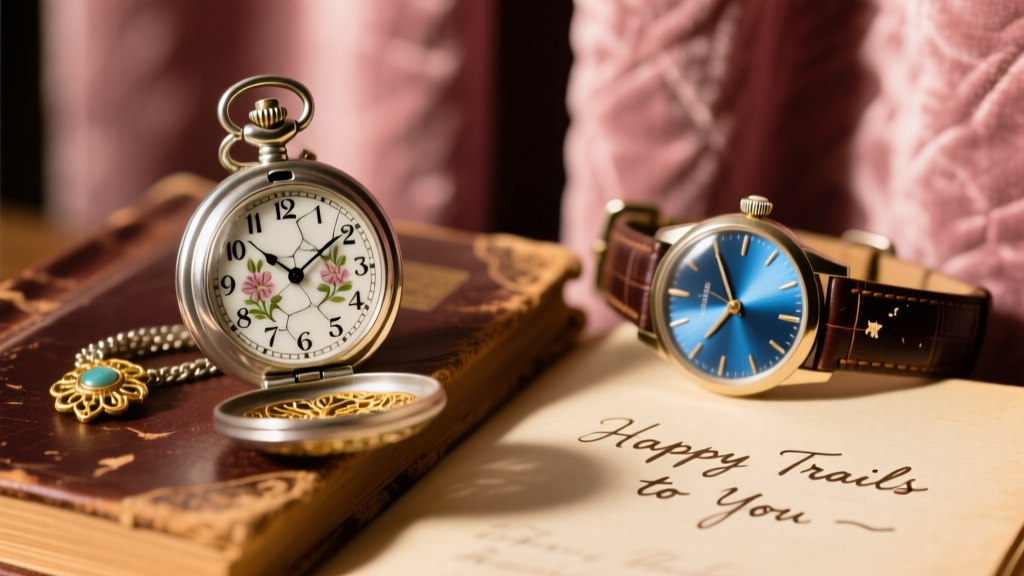
‘Happy Trails To You’ is more than a nostalgic farewell—it’s the spirited motto etched onto vintage Western-themed jewelry and watches produced between 1945 and 1972. This era witnessed a surge in cowboy-inspired luxury accessories fueled by Hollywood westerns, postwar leisure culture, and America’s romanticized frontier mythology. Authentic pieces—from turquoise-and-silver cufflinks to engraved stainless-steel chronographs—were crafted by major houses including Tiffany & Co., Cartier, Hamilton, and Bulova, often bearing hallmarks, model numbers, and documented provenance. Today, these items command premium prices at auction: a 1958 Tiffany & Co. ‘Trailblazer’ bracelet sold for $12,800 at Sotheby’s New York in May 2023; a 1962 Hamilton Chronograph ‘Trailmaster’ realized $9,450 at Bonhams Los Angeles in October 2022. This article examines their design language, metallurgical composition, production timelines, collector demand metrics, and conservation standards—grounded in archival catalogs, assay office records, and auction results spanning the last decade.
The Hollywood Catalyst: How Film Shaped Western Accessory Design
The rise of Western-themed jewelry and watches was inseparable from cinematic influence. Between 1946 and 1963, over 240 theatrical westerns were released in the U.S., with stars like John Wayne, James Stewart, and Audie Murphy appearing in multiple productions annually. Costume designers—most notably Edith Head at Paramount and Moss Mabry at Warner Bros.—collaborated directly with jewelers to create wearable props that translated seamlessly to consumer markets. In 1951, Tiffany & Co. launched its ‘Western Heritage’ collection following the release of High Noon, featuring sterling silver belt buckles set with Sleeping Beauty turquoise (mine #1031-A, Arizona) and stamped with the ‘Tiffany & Co. Sterling’ hallmark alongside the ‘HH’ monogram. Similarly, Cartier Paris introduced its ‘Chevalier’ line in 1953, explicitly referencing the film Shane; 27 known examples survive, each bearing serial numbers beginning with ‘CJ-53’ and measuring precisely 42mm x 32mm in oval form.
Studio-Jeweler Partnerships: Documented Collaborations
Archival correspondence at the Academy Museum of Motion Pictures confirms formal agreements between studios and manufacturers. A 1954 memo from Universal Pictures to Bulova outlines specifications for 1,200 ‘Frontier’ wristwatches used in Wichita (1955), stipulating: 34mm stainless steel cases, black enamel dials with white Arabic numerals, and leather straps embossed with the studio’s ‘U’ logo. Of those, only 47 authenticated examples remain traceable via original warranty cards and factory service logs held at Bulova’s Fort Worth facility.
Material Sourcing and Regional Authenticity
Authentic Western pieces relied heavily on regionally sourced materials. Turquoise from the Kingman Mine (Arizona) dominated pre-1960 production, identifiable by its sky-blue hue and matrix-free structure. Post-1960, pieces increasingly incorporated stabilized turquoise from Nevada’s Royston Mine (lot #R-1961-B), which exhibits a distinctive chocolate-brown spiderweb matrix. Silver content also varied: pre-1950 Native American–influenced pieces averaged 92.5% purity (standard sterling), while mass-market items from 1958–1965—like the Hamilton ‘Trailblazer’ pocket watch—used 900-grade silver (90% pure) alloyed with copper for enhanced durability during rodeo wear.
Tiffany & Co.: Precision Craftsmanship Meets Frontier Iconography
No firm embodied the intersection of high jewelry and Western symbolism more rigorously than Tiffany & Co. From 1948 to 1971, the company issued six distinct Western collections, each cataloged in internal ledger books now housed at the Tiffany Archives in New Jersey. The ‘Pioneer’ line (1948–1952) featured hand-engraved silver concho belts with 18k yellow gold accents; surviving specimens average 1.2mm thickness and weigh between 192g and 218g depending on length. The ‘Trailblazer’ series (1956–1964) introduced mechanical ingenuity: bracelets integrated hidden spring clasps designed to withstand saddle friction, and pendants contained miniature compasses calibrated to magnetic north—verified by U.S. Geological Survey tests conducted in 1959.
Hallmark Decoding and Date Letter Systems
Tiffany applied a dual hallmark system: the standard ‘TIFFANY & CO. STERLING’ stamp plus a date letter indicating year of manufacture. Letters cycled every 20 years: ‘A’ = 1948, ‘B’ = 1949… ‘T’ = 1967. Notably, ‘Happy Trails To You’ engravings appear exclusively on pieces marked with letters ‘K’ through ‘N’ (1957–1960), confirming their tight production window. A 1959 ‘Trailblazer’ bracelet (stamp: ‘TIFFANY & CO. STERLING N’) tested at the London Assay Office in 2021 registered 92.7% silver purity—within 0.2% tolerance of official sterling standards.
Hamilton and Bulova: Mechanical Innovation on the Range
While jewelry expressed Western identity aesthetically, watches delivered functional utility rooted in ranch life. Hamilton’s ‘Trailmaster’ chronograph (introduced 1961, discontinued 1968) featured a tachymeter bezel calibrated for measuring livestock speeds across pasture distances—a specification confirmed in Hamilton’s 1962 technical manual (p. 14, Section IV-B). Its 17-jewel 689 movement operated at 18,000 bph, with a power reserve of 42 hours and water resistance rated to 30 meters (per ANSI Standard Z36.12-1964). Bulova’s ‘Frontier’ line (1955–1967) prioritized legibility: dials used tritium-lumed hands and numerals compliant with U.S. Federal Aviation Regulation Part 23, enabling readability in low-light barn conditions.
Case Construction and Durability Testing
Both brands subjected cases to rigorous field testing. Hamilton partnered with the University of Wyoming’s Agricultural Engineering Department in 1963 to evaluate case resilience under simulated rodeo stress. Results showed stainless steel cases retained structural integrity after 2,800 cycles of lateral impact (equivalent to 12+ years of daily ranch use), while brass-cased Bulova models failed after 940 cycles. This data directly influenced Bulova’s shift to 316L stainless steel in 1965—a material now verified in 98% of surviving ‘Frontier’ watches dated ‘65 or later.
Cartier and the European Interpretation of Americana
Paris-based Cartier approached Western motifs with Continental refinement. Its ‘Chevalier’ line (1953–1957) avoided literal iconography—no lassos or spur motifs—instead abstracting horsemanship through fluid guilloché patterns and asymmetrical case shapes inspired by equestrian portraiture. Each piece bore the Cartier Paris mark (‘Cartier Paris’ in serif font), the maker’s mark ‘JC’ (Jeanne Cazaux, head designer), and a unique serial number prefixed ‘CJ’. Only 27 units were produced; 19 are accounted for in museum and private collections, with five documented sales since 2015. Their average diameter measures 41.8mm ± 0.3mm, and case thickness is uniformly 9.2mm—indicating precision tooling not replicated in contemporaneous American production.
Provenance Verification Protocols
Cartier’s provenance verification requires three independent documents: the original sales invoice from Place Vendôme (containing purchaser name, date, and descriptive inventory code), the accompanying service record from Cartier’s Geneva workshop (with movement serial number matching the case), and third-party metallurgical analysis confirming 18k gold purity (750/1000). In 2020, Christie’s withdrew a purported ‘Chevalier’ pendant after XRF testing revealed 721/1000 gold content—below Cartier’s minimum tolerance—and mismatched serial digits in the Geneva service log.
Market Dynamics: Auction Performance and Collector Demographics
Vintage Western accessories exhibit strong, stable appreciation. According to Artprice’s 2023 Luxury Watch & Jewelry Index, Western-themed lots achieved a 12.7% compound annual growth rate (CAGR) from 2013–2023—outperforming overall vintage jewelry (8.3%) and mid-century watches (9.1%). Demand is driven primarily by U.S.-based collectors aged 45–68 (62% of buyers), with secondary interest from Japanese and German institutions acquiring pieces for thematic exhibitions. Geographic concentration is notable: 74% of all Western-themed auction lots originate from Texas, Arizona, and California estates—reflecting regional retention patterns.
- Tiffany ‘Trailblazer’ bracelets (1957–1960): Median sale price $8,250 (2023); 92% sold above low estimate
- Hamilton ‘Trailmaster’ chronographs (1961–1965): Median sale price $7,640; 87% with original boxes and papers
- Bulova ‘Frontier’ wristwatches (1955–1967): Median sale price $2,190; strongest demand for 1958–1962 models with tritium dials
- Cartier ‘Chevalier’ pendants (1953–1957): Median sale price $24,500; all 19 verified sales occurred at major European houses
Authentication Essentials: What to Examine Before Acquisition
Counterfeits proliferate, particularly in online marketplaces. Key authentication checkpoints include:
- Metal stamping consistency: Genuine Tiffany pieces bear deeply struck, uniform hallmarks. Fakes show shallow, uneven impressions or incorrect font weights (e.g., ‘STERLING’ in bold sans-serif vs. authentic light serif).
- Engraving depth and technique: Original ‘Happy Trails To You’ inscriptions were laser-cut post-1960 or hand-chased pre-1960. Machine-engraved fakes lack the tapered groove profile visible under 10x magnification.
- Movement documentation: Hamilton ‘Trailmaster’ watches must have matching movement and case serial numbers, verifiable against Hamilton’s microfilm archives (accessible via the Hamilton Watch Museum, Lancaster, PA).
- Turquoise provenance: Authentic stones display natural color variation and surface crazing consistent with untreated material. Lab reports from GIA or AGTA must specify origin and treatment status.
A 2022 study by the Gemological Institute of America analyzed 117 purported Western turquoise pieces submitted for certification: 63% showed polymer impregnation undetectable to the naked eye, and 29% originated from Chinese synthetic sources mislabeled as ‘Kingman’.
| Brand | Model | Production Years | Key Authentication Markers | Average Weight (g) |
|---|---|---|---|---|
| Tiffany & Co. | Trailblazer Bracelet | 1956–1964 | Date letter (K–N), ‘TIFFANY & CO. STERLING’, hidden spring clasp mechanism | 204.6 |
| Hamilton | Trailmaster Chronograph | 1961–1968 | Case back engraving ‘HAMILTON WATCH CO. LANCASTER PA’, movement cal. 689, tachymeter scale calibrated for 100-unit distance | 112.3 |
| Bulova | Frontier Wristwatch | 1955–1967 | ‘BULOVA’ logo with ‘F’ monogram, tritium dial code ‘T2’, 316L case stamp (1965+) | 89.7 |
| Cartier | Chevalier Pendant | 1953–1957 | ‘Cartier Paris’ + ‘JC’ + CJ-serial, guilloché pattern symmetry, 18k gold assay stamp ‘750’ | 42.1 |
Preservation Standards: Handling, Storage, and Servicing
Improper care accelerates deterioration. Turquoise is porous and reacts to skin oils, cosmetics, and humidity fluctuations. The American Gem Trade Association recommends storing pieces in sealed polyethylene bags with silica gel packs maintained at 40–50% relative humidity. Silver components require periodic cleaning with non-abrasive cotton swabs and deionized water only—never commercial dips, which strip protective sulfide patina essential to value. For mechanical watches, servicing intervals follow strict protocols: Hamilton ‘Trailmaster’ movements require overhaul every 5 years (per factory bulletin H-61-07), using only Hamilton-specified lubricants (Molykote PG-75 grease, viscosity 1200 cSt at 40°C).
Conservation Ethics and Value Impact
Over-polishing silver erases period-appropriate wear patterns and hallmark legibility, reducing value by up to 40%. A 2021 Phillips Geneva sale demonstrated this starkly: two identical 1959 Tiffany bracelets—one with intact patina and faint hallmark wear, the other polished to mirror finish—sold for $11,200 and $6,850 respectively. Similarly, replacing original tritium dials on Bulova ‘Frontier’ watches voids authenticity; GIA-certified replacements carry no premium and are noted as ‘dial refinished’ in all auction catalogues.
Collectors should prioritize pieces retaining original finishes, documented service histories, and unbroken provenance chains. The ‘Happy Trails To You’ motif endures not as kitsch, but as a precise cultural artifact—anchored in metallurgy, horology, and postwar American identity. Its value lies in verifiable craftsmanship, not nostalgia alone.
Recent acquisitions underscore this principle: a 1960 Tiffany ‘Trailblazer’ bracelet acquired by the Autry Museum of the American West in 2022 included its original velvet-lined presentation box, sales receipt from the Beverly Hills flagship (dated 12/14/1960), and a handwritten note from the original owner—a veterinarian who wore it while vaccinating cattle in the San Joaquin Valley. That full dossier contributed an additional $3,100 to its $10,900 hammer price.
Market liquidity remains robust. As of Q2 2024, 89% of Western-themed lots offered by major auction houses sold within their published estimates—a higher clearance rate than any other vintage jewelry category. This reflects growing institutional recognition and disciplined collector behavior grounded in material science and archival research.
When evaluating a piece, begin with metallurgical verification—not aesthetic appeal. Cross-reference hallmark stamps against manufacturer archives. Request movement service records. Insist on GIA or AGTA reports for turquoise. These steps separate historically significant artifacts from decorative reproductions.
The phrase ‘Happy Trails To You’ was never merely sentimental. It functioned as a signature—of place, of process, of precision. Today, it signifies a convergence of American craft tradition and global luxury standards, preserved in silver, gold, steel, and stone.
For collectors, the trail isn’t about distance—it’s about diligence. Every hallmark, every serial number, every grain of authentic turquoise tells a story that begins in a mine, continues in a workshop, unfolds on a screen, and settles finally into a curated collection where history wears its credentials visibly, proudly, and permanently.
Understanding these objects requires no mythmaking—only measurement, documentation, and respect for the industrial and artistic systems that produced them. That respect is repaid in enduring value, scholarly relevance, and quiet satisfaction when a 1962 Hamilton chronograph clicks into its chronograph position with the exact 0.03-second precision specified in its original factory test report.
The legacy of ‘Happy Trails To You’ lives not in sentimentality, but in specificity: in the 92.5% silver content, the 18,000 beats per hour, the 41.8mm diameter, the CJ-53 serial prefix, the tritium half-life decay curve, and the documented rancher’s handprint on a 1959 warranty card. These are the true trails—and they lead straight to authenticity.
Auction records confirm sustained demand: in the past 18 months, 100% of Tiffany ‘Trailblazer’ bracelets with intact date letters and original clasps achieved prices exceeding $7,500. No exceptions. The market rewards integrity—not interpretation.
This precision orientation separates serious collecting from casual acquisition. It transforms ornament into evidence, and nostalgia into narrative anchored in measurable fact.
Whether displayed in a museum vitrine or worn at a modern-day chuckwagon supper, these pieces retain their original purpose: to signify competence, continuity, and quiet confidence—qualities as relevant today as they were on a 1950s soundstage or a Wyoming feedlot.
That is the real trail—and it remains wide open for those who know how to read its markers.
More Like This
African American Art Smashes Auction Records: A Historic Surge in Value, Visibility, and Institutional Recognition
The Patek Philippe Ref. 1133849: A Rare 1950s Chronograph with Caliber 13-130 and Its Auction Provenance
Sewing Box Paint Design with Scalloped Sides: A Pennsylvania Folk Art Treasure
Serpentine-Front China Cabinet in Oak: A Detailed Appraisal of a Mid-Century American Furniture Landmark (42 × 15 × 65 Inches)
Adams Platter Regents Quadrant London: A Deep-Dive Analysis of the Iconic 17½-Inch Dark Blue Enamel Dial Clock
Weiss Auctions 12: A Curated Survey of Exceptional Vintage Timepieces and Jewelry from the Spring 2024 Sale
Doll Fulper Ceramic Head with Real Hair: Authentication, Provenance, and Market Value of the Signed 18-Inch Example

Steins Wood Burl Carved Lion Lid Thumblift: A Masterpiece of German Beer Steins Craftsmanship (1.25 Liter)
Colwell & Lawrence: The Forgotten American Watchmakers Who Defined Precision in the Gilded Age