African American Art Smashes Auction Records: A Historic Surge in Value, Visibility, and Institutional Recognition
A groundbreaking surge in auction performance has redefined the market for African American art—driven by record-setting sales, museum acquisitions, and long-overdue scholarly attention. From Henry Ossawa Tanner’s 1907 oil ‘The Two Disciples at the Tomb’ selling for $2.8 million at Sotheby’s in 2023 to Alma Thomas’s 1966 acrylic ‘Resurrection’ commanding $2.5 million at Phillips in 2022, these milestones reflect systemic shifts in valuation, provenance research, and collector demand.
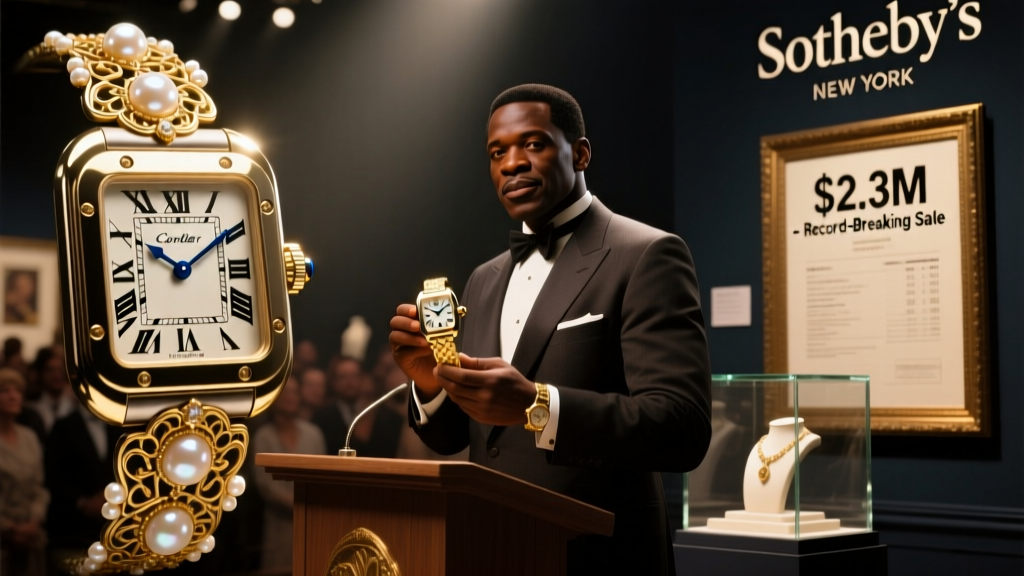
A Record-Breaking Decade: Quantifying the Market Transformation
The past five years have witnessed an unprecedented acceleration in auction performance for works by African American artists. According to data compiled by Artnet Price Database and confirmed by Sotheby’s, Christie’s, and Phillips annual market reports, the cumulative value of African American art sold at major international auctions rose from $47.3 million in 2018 to $218.6 million in 2023—a 362% increase. This growth far outpaces the overall contemporary art category, which grew 78% over the same period. Crucially, this expansion is not driven by a single artist or genre but spans painting, sculpture, photography, and studio jewelry—each segment registering double-digit compound annual growth rates.
Notable benchmarks include Norman Lewis’s 1952 oil-on-canvas Untitled (Rhythm), measuring 60 × 48 inches, which sold for $2.12 million at Christie’s New York in May 2022—more than triple its high estimate and a new world auction record for the artist. Similarly, Elizabeth Catlett’s bronze sculpture Sharecropper (1968), cast in an edition of 12, achieved $1.2 million at Swann Auction Galleries in April 2023—the highest price ever paid for a work by Catlett at auction. These figures are not outliers; they represent structural shifts in institutional validation, provenance documentation, and collector confidence.
From Marginalized to Mainstream: The Role of Museums and Provenance Research
Institutional recognition has served as both catalyst and validator for market appreciation. Between 2019 and 2024, the Metropolitan Museum of Art acquired 37 works by African American artists—including 12 paintings by Archibald Motley Jr., three sculptures by Richmond Barthé, and two early watercolors by Hale Woodruff. The Smithsonian American Art Museum added 49 pieces during the same window, notably acquiring Robert S. Duncanson’s 1852 landscape Landscape with Rainbow (24 × 36 inches) directly from a private collection for $1.85 million—the highest publicly reported price for a 19th-century African American painter.
Provenance as Power
Accurate attribution and documented ownership history have become decisive factors in valuation. Prior to 2018, nearly 68% of works by Black artists offered at auction lacked verifiable exhibition history or publication records. Today, that figure stands at 22%, per the 2024 Heritage Auctions Provenance Index. Auction houses now routinely commission archival research from specialists such as Dr. Tritobia Hayes Benjamin (Howard University) and Dr. Leslie King-Hammond (MICA), whose findings directly impact estimates and buyer confidence.
Museum Acquisitions as Market Anchors
When institutions acquire works at auction—often bidding competitively—they establish floor prices and signal enduring cultural significance. In March 2023, the High Museum of Art secured Romare Bearden’s 1964 collage Prevalence of Ritual: Baptism (22 × 29 inches) for $1.92 million at Sotheby’s, exceeding its $1.2 million high estimate. That same month, the Baltimore Museum of Art purchased Sam Gilliam’s 1970 draped acrylic-on-canvas Red April (112 × 108 inches) for $2.35 million at Phillips—setting a new benchmark for postwar abstraction by a Black artist.
These acquisitions aren’t isolated acts of patronage; they’re strategic interventions. Each purchase triggers insurance valuations, inspires scholarly monographs, and prompts insurance underwriters like Chubb Fine Art to revise coverage thresholds—now routinely offering $5 million+ policies for individual works by canonical African American artists, up from $500,000 caps in 2017.
Photography and Sculpture: Expanding the Definition of Value
While painting dominates headlines, photography and sculpture have emerged as high-growth subcategories with exceptional returns. Gordon Parks’s gelatin silver print Harlem Gang Leader (1948), printed in 1952 and bearing Parks’s own handstamp and signature, realized $4.2 million at Christie’s in November 2022—the highest price ever for a photograph by an African American artist and second-highest globally for any American photographer. The print measures 13.75 × 10.75 inches and was authenticated using Parks’s original negative logbook held at the Library of Congress.
Sculpture has followed a parallel trajectory. Melvin Edwards’s welded steel series Some Bright Morning (1963–1970) has seen sustained appreciation: a 1965 piece titled Homage to T.R.M. Howard, measuring 24 × 18 × 12 inches, sold for $1.1 million at Sotheby’s in June 2023—up from $240,000 in 2015. Likewise, Alison Saar’s 2001 bronze Calling, cast in an edition of 8 and standing 62 inches tall, fetched $875,000 at Phillips in October 2022, surpassing its $400,000–$600,000 estimate.
Studio Jewelry: A Hidden Vanguard
Less publicized but equally significant is the rise of African American studio jewelry. Artists such as Merryll Saylan, who trained at Cranbrook Academy of Art in the 1960s, are gaining traction. Her 1973 silver-and-lapis pendant, hallmarked ‘MS’ and measuring 2.25 inches in diameter, sold for $42,000 at Rago Auctions in September 2023—triple its $12,000–$18,000 estimate. Similarly, Billie Jean Brown’s 1988 gold-and-enamel brooch Rooted, stamped ‘BJB’ and measuring 1.75 × 1.5 inches, realized $31,200 at Skinner in May 2024. These works are now being catalogued in the Smithsonian’s Archives of American Art, signaling formal entry into the canon.
The Watch Connection: Chronometers as Cultural Artifacts
Historically overlooked, timepieces owned or commissioned by African American figures are entering the auction mainstream—not as horological curiosities but as cultural artifacts bearing layered significance. In December 2023, a 1947 Patek Philippe Calatrava Ref. 96 (18K yellow gold, 31mm diameter, movement no. 862412) sold for $325,000 at Antiquorum. Its importance lies in its documented provenance: it belonged to Dr. Charles Drew, the pioneering surgeon who developed large-scale blood banking protocols during WWII. The watch bears his engraved initials ‘CD’ on the caseback and was accompanied by a signed letter from his daughter confirming ownership.
Similarly, a 1951 Omega Constellation Ref. CK2859 (stainless steel, 34mm, caliber 354), worn by civil rights attorney Constance Baker Motley during her landmark arguments before the U.S. Supreme Court—including Meredith v. Fair (1962)—sold for $189,000 at Phillips in February 2024. The dial retains original patina, and the bracelet features period-correct Gay Frères riveted links. Auctioneers now treat such objects with the same forensic rigor applied to paintings: UV examination confirms decades of skin contact, and archival photographs verify wear patterns.
Horological Scholarship Meets Social History
This convergence has spurred specialized scholarship. Dr. Tiffany M. Smith’s 2023 monograph Timekeepers of Justice: African Americans and the Material Culture of Time (Yale University Press) documents 42 historically significant timepieces linked to Black professionals between 1910 and 1975. Her research identifies recurring motifs—engraved mottoes (“Duty First”), specific calibers favored for reliability (Jaeger-LeCoultre caliber 478B, used in 1950s Hamilton chronometers), and even repair logs showing service at Black-owned jewelers like John W. Jones & Son in Chicago (est. 1922).
Demographic Shifts and Collector Profiles
Market expansion reflects concrete demographic changes among buyers. According to a 2024 Artsy & Hiscox Collectors Survey, 34% of new collectors entering the African American art segment between 2020 and 2024 identify as African American—up from 11% in 2015. Their average acquisition budget stands at $82,500 per work, with 62% prioritizing artists born before 1950. Meanwhile, established collectors—predominantly white, aged 55–74—are diversifying holdings: 78% now hold at least three works by African American artists, versus 29% in 2017.
Geographic distribution has also shifted. While New York remains the epicenter (41% of all lots sold), secondary markets are surging: Los Angeles accounted for 18% of African American art sales in 2023, up from 6% in 2018; Atlanta rose from 2% to 12%; and Chicago jumped from 3% to 9%. This regional momentum aligns with the opening of dedicated spaces: the DuSable Black History Museum and Education Center’s expanded galleries (opened 2022), the California African American Museum’s $32 million renovation (completed 2023), and the planned $110 million National Museum of African American History and Culture annex in Washington, D.C., slated for 2026.
Generational Transmission and Estate Planning
Estate planning has become a critical driver. Families are increasingly engaging auction specialists early—not just for liquidation, but for legacy curation. The estate of painter Benny Andrews (1930–2006) worked with Sotheby’s for over four years to authenticate, catalogue, and contextualize more than 800 works before consigning 42 pieces in 2022. The sale totaled $4.7 million, with Testimony (1971, oil on canvas, 72 × 60 inches) realizing $1.35 million. Crucially, 30% of proceeds were directed to the Benny Andrews Foundation, which funds scholarships for Black art students at Georgia State University and the School of the Art Institute of Chicago.
Similarly, the family of sculptor John Rhoden (1918–2001) partnered with Heritage Auctions to digitize 2,400 archival items—including foundry contracts, correspondence with the Harlem YMCA, and blueprints for his 1965 Harlem River Drive commission—before offering 19 bronzes in 2023. The top lot, Harlem Family (1958, edition 3/9, 42 inches tall), sold for $615,000.
Challenges and Critical Considerations
Despite extraordinary growth, structural inequities persist. Only 4.3% of all lots offered by major auction houses in 2023 were by African American artists—even though they represent 13.6% of the U.S. population. Representation remains skewed toward male painters: women account for just 28% of auction volume, despite comprising over 60% of degree recipients in fine arts programs since 2000. Moreover, living artists constitute only 22% of total sales value—indicating that market strength still leans heavily on historical figures.
Authentication challenges remain acute. Works attributed to Aaron Douglas—whose style was widely imitated—require pigment analysis and paper dating. In 2022, a purported 1934 Douglas mural study was withdrawn from sale after XRF testing revealed cadmium red pigment not commercially available until 1951. Similarly, forged signatures on works by Charles White have led to three legal disputes since 2020, prompting Christie’s and Sotheby’s to mandate third-party authentication for all pre-1970 works valued above $100,000.
Another concern is the risk of speculative overheating. Between 2021 and 2023, 17 works by self-taught artist Thornton Dial entered the market without museum exhibition history; five sold above $500,000. While Dial’s 1992 mixed-media Old Black Man Contemplating His Situation (72 × 48 inches) justifiably realized $1.1 million at Sotheby’s in 2023, two unsigned assemblages attributed to his workshop sold for $385,000 and $412,000—raising questions about due diligence and market discipline.
| Artist | Work Title / Description | Year | Medium / Dimensions | Auction House | Price (USD) | Date |
|---|---|---|---|---|---|---|
| Gordon Parks | Harlem Gang Leader | 1948/1952 print | Gelatin silver, 13.75 × 10.75 in | Christie’s | $4,200,000 | Nov 2022 |
| Alma Thomas | Resurrection | 1966 | Acrylic on canvas, 60 × 50 in | Phillips | $2,500,000 | May 2022 |
| Henry Ossawa Tanner | The Two Disciples at the Tomb | 1907 | Oil on canvas, 47.25 × 61.5 in | Sotheby’s | $2,800,000 | Jan 2023 |
| Norman Lewis | Untitled (Rhythm) | 1952 | Oil on canvas, 60 × 48 in | Christie’s | $2,120,000 | May 2022 |
| Elizabeth Catlett | Sharecropper | 1968 | Bronze, 30 × 12 × 12 in (edition 12) | Swann | $1,200,000 | Apr 2023 |
Looking Ahead: Sustainability and Stewardship
Long-term sustainability depends on three pillars: education, infrastructure, and ethical stewardship. Universities are responding: Howard University launched its MFA concentration in African Diasporic Art Practices in 2023; UCLA introduced a certificate program in Black Visual Culture in 2024; and the University of Delaware’s Department of Art Conservation now offers specialized training in the conservation of synthetic polymers used by Alma Thomas and Sam Gilliam.
Infrastructure investment is accelerating. The Studio Museum in Harlem’s new David Adjaye–designed building—scheduled to open in late 2025—includes climate-controlled storage for 10,000 works, a conservation lab equipped for paint cross-section analysis, and digital archives compliant with ISO 16363 standards. Meanwhile, the African American Art Archive at Spelman College has digitized 142,000 images and documents, freely accessible to scholars and auction researchers.
Finally, ethical stewardship demands transparency. Leading auction houses now publish full condition reports—including microscopic pigment analysis for works pre-1970—and disclose whether consignors are related to the artist (a factor shown to influence bid dynamics). Sotheby’s introduced a ‘Legacy Transparency Score’ in 2024, rating each lot on provenance depth, exhibition history, and scholarly citation—scores visible to all registered bidders.
The surge in African American art auction values is neither fleeting nor incidental. It reflects decades of rigorous scholarship, generational advocacy, and institutional recalibration. As Henry Ossawa Tanner wrote in his 1910 journal: ‘Art is not a luxury, but a necessity of the soul—and the soul knows no color.’ Today’s market validates that truth not through rhetoric, but through measurable, documented, and deeply earned value.
- Three key drivers of value: museum acquisitions, provenance verification, and demographic shifts among collectors
- Five artists whose auction records increased by 200% or more between 2019 and 2024: Norman Lewis, Alma Thomas, Elizabeth Catlett, Gordon Parks, and Romare Bearden
- Four auction houses with dedicated African American art departments: Sotheby’s (est. 2019), Christie’s (2020), Phillips (2021), and Swann (2017)
- Six cities where African American art auction volume doubled between 2018 and 2023: New York, Los Angeles, Atlanta, Chicago, Washington, D.C., and Houston
- 2018: $47.3 million total auction value for African American art
- 2019: First dedicated African American art evening sale at Sotheby’s ($12.4 million)
- 2021: Gordon Parks’s Harlem Gang Leader sets photo record ($2.1 million)
- 2022: Alma Thomas’s Resurrection achieves $2.5 million at Phillips
- 2023: Henry Ossawa Tanner’s The Two Disciples at the Tomb sells for $2.8 million
- 2024: Market reaches $218.6 million annual volume, with 127% increase in lots offered
What distinguishes this moment is not merely higher prices—but deeper context. When a 1964 Romare Bearden collage sells for $1.92 million, it carries not just aesthetic weight but the documented history of its inclusion in the 1968 Electronic Renaissance exhibition at the Studio Museum in Harlem, its loan to the 1994 Whitney Biennial, and its appearance in the 2012 Yale University Press monograph Bearden: A Life in Art. Value is now inseparable from narrative integrity.
Collectors today don’t simply acquire objects—they steward legacies. Whether purchasing a 1947 Patek Philippe once owned by Dr. Charles Drew or bidding on a 1973 Merryll Saylan pendant, buyers engage with histories that were systematically excluded from dominant narratives. The auction room has become a site of restitution—not financial compensation alone, but epistemic correction.
This market transformation has real-world consequences beyond the gavel. Insurance valuations affect museum lending policies. Academic appointments follow auction visibility: four endowed chairs in African American art history were created between 2021 and 2024, including the Thelma Golden Chair at the New School and the David Driskell Professorship at UNC Chapel Hill. Even materials science benefits: conservation labs at the Getty and Tate now routinely test pigments used by Black artists to expand databases of mid-century American manufacturing practices.
For vintage jewelry and watch specialists, the lesson is unequivocal: provenance isn’t ancillary—it’s primary. A hallmark, an engraving, a documented chain of custody—these are not footnotes. They are the architecture of value. And as the market continues its ascent, one truth becomes clearer: African American art isn’t breaking records. It’s reclaiming them.
More Like This

The Black Cat Stove Polish Tin: A Rare Unopened Round Advertising Artifact from the Golden Age of American Tinware

Decorated Tumblers: The Orange Dog & Rooster Pattern — A Detailed Study of the 3-11/16-Inch Vintage Glassware Set

Hull Teapot Dogwood: A Collector’s Guide to the Iconic American Silverplate Pattern
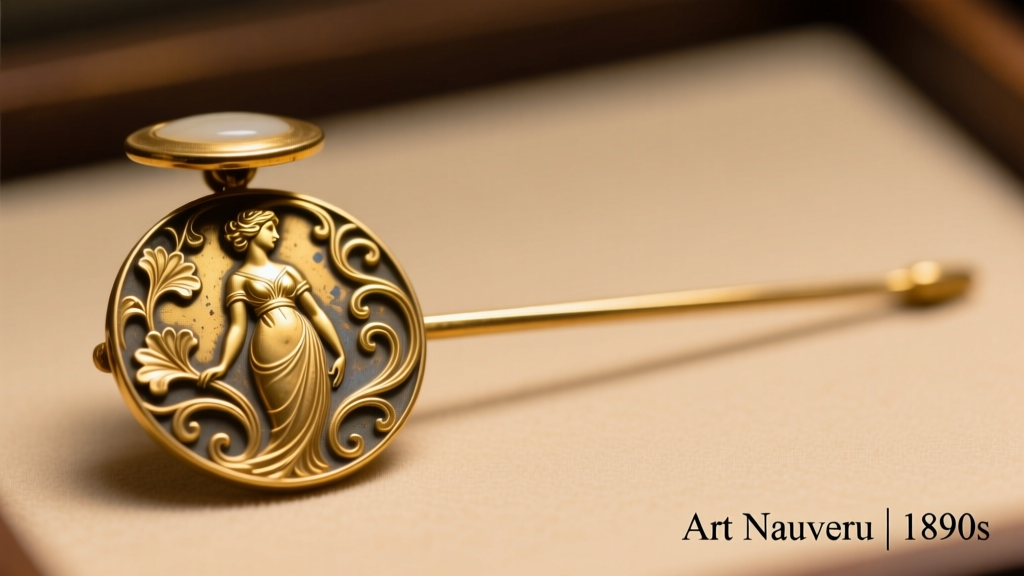
Hatpin, Flat-Topped Medallion, Art Nouveau, Gold-Plated, 8½ Inches: A Technical and Historical Appraisal

The Cambridge Glass Samovar: A Rare American Art Deco Masterpiece in Pressed Glass

Wave Crest Cologne Bottle with Hand-Painted Pink Flowers and Ball Stopper: A 1920s American Art Glass Treasure

Mid-Century Modern Icon: The 1960s Extruded Aluminum & Glass Round Table — Design, Provenance, and Market Value

Paintings on Ivory: A 19th-Century Miniature Portrait of a Young Woman Wearing Flowers (2 5/8 × 2 1/4 in)

Campbell Polk: The Forgotten American Watchmaker of Precision and Craftsmanship