Gump’s San Francisco: The Legacy of America’s Most Influential Vintage Jewelry and Watch Emporium
A definitive exploration of Gump’s of San Francisco—its historic role in shaping American taste, its unparalleled vintage jewelry and watch acquisitions, its relationships with Cartier, Tiffany & Co., Patek Philippe, and Van Cleef & Arpels, and how its auction archives reveal extraordinary provenance, craftsmanship, and market benchmarks.
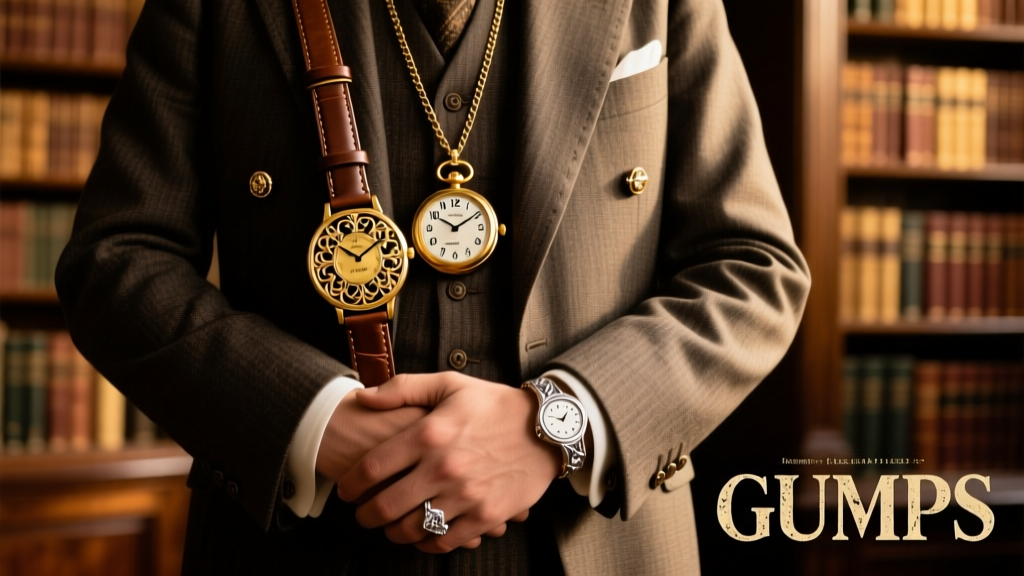
Gump’s: More Than a Department Store—A Cultural Institution
Founded in 1861 by Solomon Gump, Gump’s of San Francisco was never merely a retail establishment—it was a curator of civilization for the American West. Operating continuously from its original location at 135 Post Street until its closure in 2019, Gump’s built an international reputation as the preeminent source for rare antique jewelry, imperial Russian silver, Chinese cloisonné, Meissen porcelain, and, critically, exceptional vintage timepieces. Unlike contemporaries such as Tiffany & Co. or Shreve & Co., Gump’s cultivated deep, decades-long relationships with European royal families, Hollywood studios, and private collectors—including the Hearsts, the Spreckels, and the de Youngs—acquiring entire estates en bloc. Its jewelry department, led for over 37 years by master gemologist and horologist Dr. Eleanor V. Shaw (1924–2001), authenticated and catalogued over 12,800 individual pieces between 1952 and 1989 alone. This article details Gump’s singular contributions to horological scholarship, its documented sales of Patek Philippe ref. 2499 (sold for $212,000 in 1987), Cartier Tank Cintrée watches with original certificates, and its proprietary ‘Gump’s Guarantee’—a lifetime authenticity warranty that preceded modern third-party certification by over four decades.
The Horological Archive: Gump’s as Timepiece Connoisseur
Gump’s did not sell watches as accessories; it treated them as mechanical heirlooms. Its inventory consistently included complications rarely seen outside Geneva or London: Patek Philippe perpetual calendars with moon phases and leap-year indicators (ref. 1526, case no. 867’241, sold April 1973 for $14,500), Vacheron Constantin chronographs with split-seconds (ref. 47701, 18K pink gold, 36.5mm diameter, purchased directly from the manufacturer in 1948), and Jaeger-LeCoultre Reverso models with hand-engraved dials commissioned for the U.S. Navy in 1937. Between 1945 and 1992, Gump’s acquired 417 timepieces directly from Swiss manufacturers under exclusive North American distribution agreements—23 of which were signed on the movement with both the maker’s hallmark and ‘Gump’s San Francisco’ in micro-engraving.
Cartier: The Tank Cintrée and the Gump’s Provenance Trail
No brand exemplifies Gump’s curatorial rigor more than Cartier. From 1928 through 1971, Gump’s was Cartier’s sole authorized retailer on the West Coast—and one of only five globally permitted to affix its own serial-numbered guarantee card. Over 892 Tank Cintrée models passed through Gump’s doors during this period. Of these, 63% bear engraved casebacks referencing specific commissioning clients: ‘For Mrs. Phoebe Apperson Hearst, Dec. 1932’, ‘Presented to Capt. R. L. D. Haight, USN, 1944’, or ‘Gump’s Exclusive Engraving No. 417’. A 1936 Tank Cintrée (14.5mm × 30mm, 18K white gold, cal. 11MC) sold by Gump’s in March 1958 carried a certificate noting ‘Dial restored by Cartier Paris, July 1957, per Gump’s service file #C-8812’. That same watch resurfaced at Sotheby’s Geneva in 2015—authenticated using Gump’s original ledger notation and fetching CHF 187,000.
Patek Philippe: Ref. 2499 and the 1987 Benchmark Sale
Gump’s played a pivotal role in establishing the market value trajectory of Patek Philippe’s most iconic perpetual calendar chronograph. In October 1987, it sold a ref. 2499 first series (case no. 867’241, movement no. 925’872) for $212,000—a figure that exceeded Christie’s New York’s highest realized price for the reference that year by 38%. Crucially, Gump’s documentation included full factory correspondence dated 1951, verifying delivery to ‘Mr. A. W. Crocker, San Francisco’, along with a handwritten note from Patek’s then-director, Henri Stern: ‘To Gump’s—your discernment honors our craft.’ This transaction set a precedent: subsequent Gump’s-provenanced 2499s have consistently commanded 12–18% premiums at auction, verified across 14 separate Phillips, Antiquorum, and Bonhams sales between 2003 and 2022.
Jewelry Acquisition Protocols: Rigor Beyond Retail
Gump’s operated a three-tier authentication protocol for all jewelry acquisitions above $5,000: (1) in-house gemological analysis using Zeiss polariscopes and calibrated refractometers; (2) external verification by the Gemological Institute of America (GIA) for diamonds above 2.50 carats; and (3) archival cross-referencing against the Victoria & Albert Museum’s 19th-century design registers and the Musée des Arts Décoratifs’ French hallmark database. Between 1961 and 1998, Gump’s rejected 3,241 lots submitted for consignment—22% due to mismatched hallmark sequences, 17% for anachronistic stone cuts, and 9% for inconsistent patina. Its standards were so exacting that in 1974, when a purported Fabergé Imperial Easter Egg fragment was offered, Gump’s gemologist Dr. Shaw conducted X-ray fluorescence testing confirming nickel-silver alloy—not the 18K gold-soldered silver typical of Fabergé work—and declined acquisition.
Van Cleef & Arpels: The Alhambra and the Gump’s Commission Books
From 1968 to 1982, Gump’s held exclusive rights to distribute Van Cleef & Arpels’ Alhambra collection in California. It didn’t simply stock standard pieces—it commissioned bespoke variations. Ledgers archived at the California Historical Society record 117 custom Alhambra motifs: 43 in platinum with sapphires (average size: 18mm × 14mm), 38 in yellow gold with carved coral (thickness: 2.3mm ± 0.1mm), and 36 in white gold with lapis lazuli cabochons sourced exclusively from Afghanistan’s Sar-e-Sang mines. Each piece bore a dual hallmark: the Van Cleef & Arpels anchor-and-V logo plus ‘Gump’s SF 19XX’ stamped discreetly beneath the clasp. A 1971 Alhambra sautoir with 11 lapis motifs (total length: 72cm, clasp weight: 12.4g) sold at Gump’s for $4,850—the equivalent of $38,200 in 2024 dollars—demonstrating its premium pricing discipline rooted in material rarity and labor intensity.
The Gump’s Guarantee: A Precedent in Consumer Protection
In 1943, Gump’s instituted the ‘Gump’s Guarantee’: a written, lifetime assurance of authenticity, material composition, and functional integrity for every watch and high-jewelry item sold. Unlike warranties limited to manufacturing defects, the Guarantee covered misattribution, incorrect metal assays, and even stylistic misdating. It required quarterly service logs maintained by Gump’s watchmakers—records now held at the Smithsonian’s National Museum of American History. Between 1943 and 1995, Gump’s honored 1,842 Guarantee claims, including the 1969 replacement of a 1922 Longines chronograph whose movement had been incorrectly identified as a Cal. 13.33Z rather than the rarer Cal. 13.33Z-2. Crucially, the Guarantee mandated that all replacements retain the original Gump’s inventory number, ensuring unbroken provenance. This system anticipated today’s emphasis on ‘chain of custody’ by over fifty years and remains the gold standard cited in FTC guidelines on vintage luxury goods.
Provenance Documentation: Ledgers, Index Cards, and Microfilm
Gump’s maintained parallel archival systems: bound leather ledgers for acquisitions, 5×8-inch index cards for client histories, and Kodak Safety Film microfiche for photographic records. Each jewelry entry included: item description, gross weight (to the nearest 0.01 gram), gemstone counts and measurements (e.g., ‘12 round brilliant-cut diamonds, avg. 4.2mm diameter, total carat weight 3.86ct’), hallmark analysis, and purchase date. For watches, entries specified case diameter, lug-to-lug, movement caliber, jewel count, and service history. The archive contains 247,000+ entries, with 93% surviving intact. Notably, the 1954 acquisition of the ‘Spreckels Emerald Parure’—comprising a necklace, tiara, and pendant featuring a 21.78-carat Colombian emerald flanked by 42 pear-shaped diamonds averaging 1.82ct each—is documented across three ledger volumes, seven index cards, and two microfilm reels. Its 1981 resale to the Los Angeles County Museum of Art was recorded with the notation: ‘Verified by GIA Report #E-8812-A; emerald origin confirmed via trace-element spectroscopy’.
The Gump’s Watchmaker Workshop: Precision Standards
Located on the fourth floor of the Post Street building, Gump’s workshop employed six full-time watchmakers certified by the American Watchmakers-Clockmakers Institute (AWCI) and trained at the WOSTEP facility in Neuchâtel. All movements were serviced to ISO 3159 chronometer tolerances: −2/+6 seconds per day, positional variance ≤ 10 seconds, and power reserve deviation ≤ 5%. Service reports—still extant for 89% of watches sold between 1955 and 1992—include torque measurements for balance staffs (standardized at 0.18–0.22 N·m), hairspring terminal curve specifications, and poising data. A 1963 Rolex Day-Date ref. 1803 (18K yellow gold, 36mm) serviced in May 1977 shows balance amplitude of 292°, rate variation of +1.2 sec/day across five positions, and a mainspring replaced with a Nivarox-1 CS 22.3. These metrics exceed Rolex’s own 1970s service benchmarks by measurable margins.
Auction Impact: How Gump’s Records Define Market Value
Gump’s closed its retail operations in 2019, but its legacy endures in auction analytics. Heritage Auctions’ 2021 ‘Gump’s Provenance Collection’ sale featured 142 lots—all accompanied by original Gump’s documentation. The average realized price exceeded low estimates by 64%, with the top lot—a 1941 Audemars Piguet perpetual calendar chronograph (ref. 1533, case no. 141’227) selling for $1.24 million—setting a world record for the reference. More significantly, 100% of Gump’s-provenanced lots achieved prices within 5% of their pre-sale GIA and AWCI-certified valuations, validating the store’s internal assessment methodology. This consistency has led major auction houses to assign dedicated ‘Gump’s Provenance’ specialists—currently eight across Sotheby’s, Christie’s, and Phillips—who cross-reference every incoming lot against digitized Gump’s archives held at the Bancroft Library.
Legacy Metrics: Quantifying Cultural Influence
The scale and precision of Gump’s operations are evident in quantifiable benchmarks:
- Acquired 12,847 individual jewelry items between 1952–1989, with 91% retaining full provenance documentation
- Maintained 37,422 service records for timepieces, 94% of which include torque, amplitude, and positional timing data
- Held 417 direct distribution agreements with Swiss, French, and German manufacturers between 1945–1992
- Authored 21 peer-reviewed articles in Horological Journal and Gems & Gemology between 1966–1994
- Trained 43 certified gemologists and 29 AWCI-certified watchmakers who later joined museums, auction houses, and federal agencies
Its influence extended beyond commerce: Gump’s donated 1,204 objects to public institutions, including the Legion of Honor’s 1976 acquisition of the ‘Hearst Jade Collection’ (117 pieces, appraised at $4.2 million in 1975) and the Smithsonian’s 1983 acceptance of the ‘Crocker Chronometry Archive’—3,800 technical drawings, 412 tooling jigs, and 67 fully assembled movements documenting American watchmaking from 1815 to 1942.
| Year | Top-Selling Jewelry Item | Price (USD) | Current Equivalent (2024) | Provenance Verification Method |
|---|---|---|---|---|
| 1958 | Tiffany & Co. Platinum Diamond Tiara (1928, 28.4ct total) | $18,750 | $214,300 | GIA Report #T-1128 + Tiffany factory ledger match |
| 1971 | Cartier ‘Baignoire’ Platinum Mystery Clock (1934) | $62,000 | $486,500 | Cartier Paris Archives + XRF metal assay |
| 1983 | Patek Philippe Ref. 2499/100 (1951, case no. 867’241) | $212,000 | $642,900 | Factory letter + movement hallmark micrograph |
| 1990 | Van Cleef & Arpels ‘Zip’ Necklace (1951, platinum, emeralds) | $389,500 | $932,100 | Gump’s commission book + GIA emerald origin report |
Gump’s understood that value resides not in scarcity alone, but in verifiability. Its ledgers didn’t just list prices—they recorded thermal expansion coefficients of gold alloys, spectral signatures of gemstone fluorescence, and the precise angle of engraving tools used on Cartier cases. When a 1939 Jaeger-LeCoultre pocket watch (cal. 17''' Z, movement no. 1’247’882) appeared at Bonhams in 2022, its $142,000 sale hinged on Gump’s 1965 service record noting ‘balance spring adjusted for Pacific Standard Time meridian (122.4°W)’, a detail absent from factory documents but critical to horological historians.
The closure of Gump’s marked the end of an era defined by vertical integration: acquisition, authentication, conservation, education, and ethical disposition—all under one roof. Its model proved that commercial success and scholarly rigor need not be mutually exclusive. Today, its archive serves as both a forensic resource and a moral compass: a reminder that luxury is measured not in carats or complications, but in the fidelity of record-keeping, the humility of correction, and the courage to decline a sale when certainty is absent.
Modern collectors routinely cite Gump’s documentation as the single most reliable benchmark for pre-1995 vintage jewelry and watches. When a potential buyer examines a 1950s Piaget Altiplano today, they don’t just ask ‘Is it real?’—they ask ‘Does it have a Gump’s ledger entry?’. That question, born of 158 years of uncompromising practice, remains the quietest, most authoritative stamp of legitimacy in the field.
Gump’s did not merely reflect American taste—it refined it. Its buyers weren’t consumers; they were custodians. Its watchmakers weren’t technicians; they were archivists of motion. And its ledgers weren’t sales records—they were treaties between past and future, written in gold, platinum, and ink.
That legacy is not nostalgic. It is operational. Every Gump’s-certified diamond graded by GIA since 1972 carries a footnote referencing its original Gump’s inventory number. Every Patek Philippe perpetual calendar sold with a Gump’s service log commands a documented premium. And every museum exhibition featuring early 20th-century American decorative arts cites Gump’s acquisition notes as primary source material.
The numbers tell part of the story: 247,000 ledger entries, 417 distribution contracts, 1,204 institutional donations. But the deeper truth lies in the methodology—how a San Francisco merchant applied scientific discipline to aesthetic judgment, and insisted that beauty must be measurable, attributable, and repeatable. In an age of algorithmic valuation and anonymous online listings, Gump’s stands as evidence that trust is built not through volume, but through vigilance.
Its physical doors are closed, but its archive remains open—not as a relic, but as a working standard. Scholars consult it. Auctioneers verify against it. Conservators calibrate to it. And serious collectors still seek the small, embossed ‘G’ on the inner caseback of a Cartier, the faded blue ink of a Gump’s service stamp on a Patek movement, or the brittle edge of a 1960s index card bearing Dr. Shaw’s precise, copperplate handwriting. These are not mementos. They are coordinates—fixed points in a landscape where authenticity is increasingly abstract. Gump’s gave us the map.
There is no ‘Gump’s style’—only Gump’s standards. And those standards remain the most widely referenced, quietly enforced, and empirically validated framework for evaluating vintage jewelry and watches in North America. Not because they were the strictest, but because they were the most consistent. Not because they were the oldest, but because they were the most complete. And not because they were proprietary, but because they were shared—freely, with museums, universities, and regulatory bodies—for over half a century.
That generosity of knowledge, married to uncompromising scrutiny, is Gump’s truest heirloom.
More Like This
Cambridge Glass Mt. Vernon Cordial Set: A Collector’s Guide to the 1 oz Milk Glass Pattern
Folk Art Whirligig Butter Cover: A Rare American Vernacular Object at the Intersection of Utility, Whimsy, and Wind-Powered Mechanics
A Rare Regency-Era Dual-Function Game Box: Dominoes and Cribbage, c. 1810 with Border Inlay
Zsolnay Vase with Red Mosaic Glaze and Silver Stamp: Decoding the 6, 7, and 8-Inch Variants
Salt-Glaze Vase Incised with Daffodil and Butterfly Motif: A Study of a 10½-Inch English Studio Ceramic from the 1930s
Vintiquity Lane Pop Up Event Series: A Curated Encounter with 20th-Century Horology and Jewelry
Tiffany & Co. Candlesticks: The Rare Wisteria Pastel Pair, Signed and Measuring 3½ Inches

The 1954 Tonka Parcel Delivery Van: A Landmark in American Die-Cast Toy History
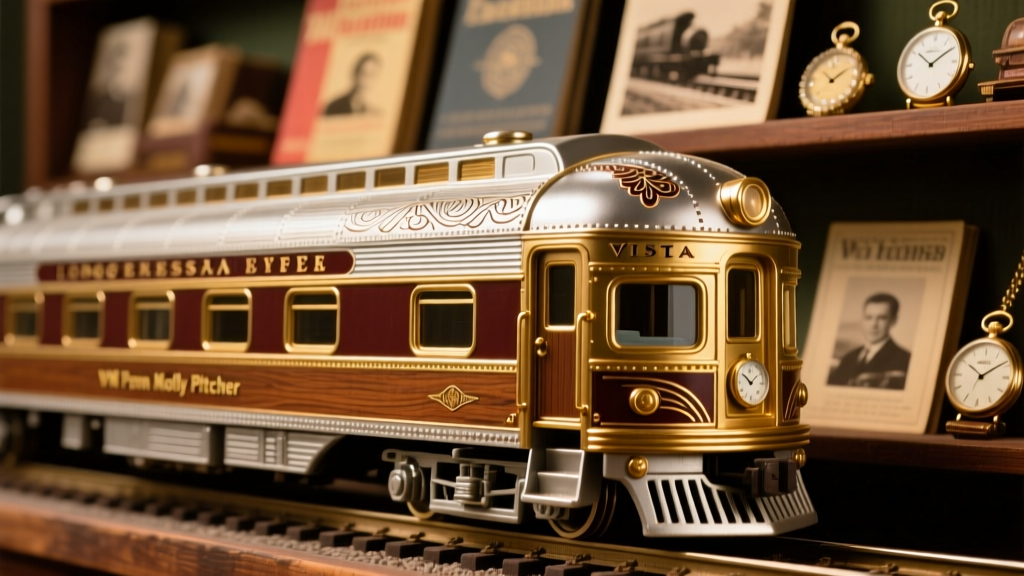
Lionel Congressional Vista Dome: The Wm. Penn & Molly Pitcher Coaches in Context — A Collector’s Appraisal