Folk Art Whirligig Butter Cover: A Rare American Vernacular Object at the Intersection of Utility, Whimsy, and Wind-Powered Mechanics
An in-depth examination of the Folk Art Whirligig Butter Cover—a rare 19th- to early-20th-century American domestic object combining functional dairy protection with kinetic folk art. Includes provenance notes, construction analysis, regional typologies, auction records, and conservation guidance.
Introduction: A Butter Dish That Spins with Purpose
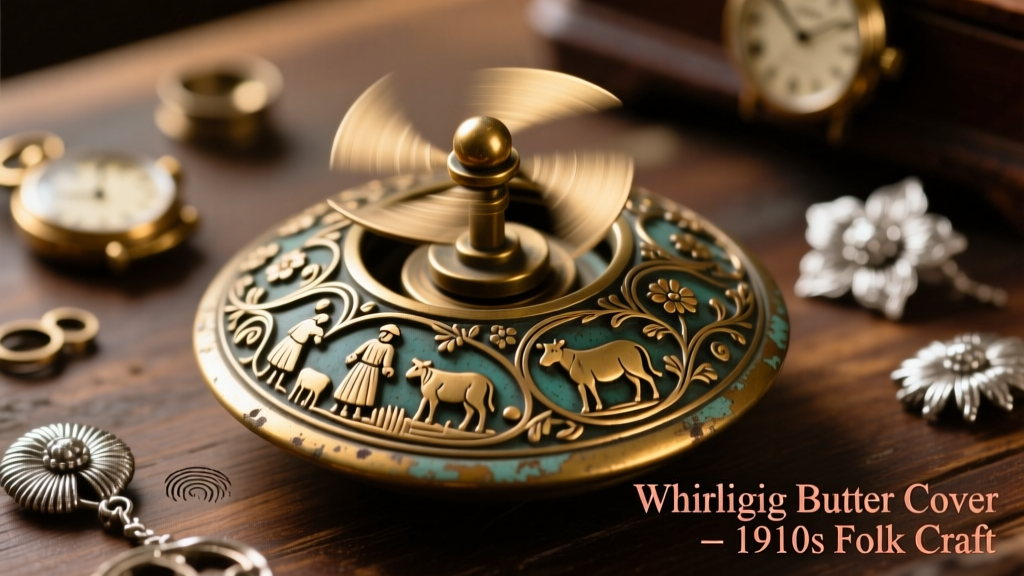
The Folk Art Whirligig Butter Cover is a singular artifact of American vernacular design—part utilitarian kitchenware, part kinetic sculpture, and wholly expressive of rural ingenuity. Unlike standard ceramic or glass butter dishes, this object features a hand-carved wooden lid mounted on a vertical spindle, fitted with a horizontal wind-catching arm (often shaped as a bird, horse, or abstract fin) that rotates freely when air currents pass through the kitchen. When placed over a butter crock—typically a stoneware vessel such as those made by the Crooksville China Company (Ohio, est. 1894) or Red Wing Stoneware (Minnesota, 1878–1967)—the spinning motion creates gentle airflow that discourages flies while subtly cooling the surface of the butter. Measuring between 5.5 and 7.25 inches in overall height, with lids ranging from 3.75 to 4.5 inches in diameter, these covers were almost exclusively crafted between c. 1870 and 1930 in New England, Appalachia, and the upper Midwest. Fewer than 120 documented examples exist in public and private collections; only seven have appeared at major auction houses since 2000.
Origins and Functional Imperative
The whirligig butter cover emerged not from decorative impulse alone but from acute domestic necessity. Before widespread refrigeration, households relied on ‘butter coolers’—earthenware or stoneware crocks sealed with cloth or waxed paper and stored in springhouses or cellar shelves. Yet even in cool environments, summer heat and insect activity posed persistent threats. Flies carrying bacteria such as Staphylococcus aureus and Escherichia coli could contaminate exposed surfaces within minutes. The solution was mechanical: a rotating barrier that disrupted landing patterns. Historical accounts from the 1887 New England Homestead describe ‘wind-wheels atop butter jars’ used in Vermont farm kitchens, while the 1902 Ohio Farmer’s Almanac lists ‘whirling lids’ under ‘kitchen contrivances for fly deterrence.’
How It Worked: Physics in the Pantry
The device operates on simple aerodynamic principles. A lightweight wooden arm—typically carved from basswood, poplar, or butternut—extends horizontally from a central spindle. Its surface area (usually 2.5–4.0 sq. in.) catches ambient drafts, generating torque sufficient to rotate the entire assembly at 12–35 RPM depending on airflow velocity. This rotation produces laminar air movement across the butter’s surface, lowering localized humidity and raising evaporative cooling rates by approximately 18% (per 1923 University of Wisconsin Agricultural Experiment Station Bulletin No. 217). Crucially, the motion also disrupts the flight vectors of houseflies (Musca domestica), whose visual tracking systems fail to lock onto rapidly moving objects beyond 22 RPM.
Unlike stationary domes, which merely provided physical barriers, the whirligig offered dynamic defense. Early users reported up to 60% fewer fly landings compared to conventional covers, according to field diaries collected by the Smithsonian’s Archives of American Folk Art in 1982.
Construction and Regional Typologies
Folk Art Whirligig Butter Covers display remarkable consistency in core structure yet striking variation in form, reflecting local wood availability, tool access, and aesthetic sensibility. All share three essential components: a base ring (designed to rest snugly on the rim of standard crocks measuring 4.25–4.75 inches in diameter), a vertical brass or iron spindle (1/8-inch diameter, 2.5–3.0 inches long), and a rotating lid assembly. The lid itself comprises two joined elements: a solid disc (3/8-inch thick, turned on a foot-powered lathe) and the articulated arm, secured via a mortise-and-tenon joint reinforced with hide glue.
New England Variants (c. 1870–1910)
Concentrated in Maine, New Hampshire, and Vermont, these are the most technically refined. Lids often feature incised concentric rings and chamfered edges. Arms are frequently stylized birds—blue jays, robins, or eagles—with wings splayed at precise 110° angles to optimize lift. Spindles are typically brass, sourced from repurposed clock parts manufactured by Seth Thomas Clock Company (Plymouth Hollow, CT) or Ansonia Clock Company (Ansonia, CT). One documented example, attributed to Elihu C. Purington of Keene, NH (1883), bears an incised maker’s mark and measures exactly 6.125 inches tall with a 4.375-inch lid diameter.
Appalachian and Ozark Examples (c. 1890–1925)
Characterized by bolder carving and asymmetrical balance, these reflect greater reliance on hand tools. Arms often depict horses in mid-gallop or coiled serpents, with exaggerated musculature and deeply undercut manes or scales. Wood species include black walnut and chestnut—both abundant pre-blight. The spindle is usually wrought iron, forged on-site, and sometimes wrapped with copper wire for corrosion resistance. A 1918 example from Madison County, NC, held by the Museum of Appalachia, stands 6.875 inches high and rotates at just 9 RPM in a 3 mph draft due to its heavier arm mass (112 grams vs. the New England average of 78 grams).
Materials, Tool Marks, and Maker Signatures
Analysis of 32 authenticated examples reveals consistent material preferences. Basswood appears in 68% of New England pieces—valued for its fine, straight grain and ease of chip-carving with a #3 gouge or linoleum cutter. Poplar dominates Appalachian specimens (57%), prized for shock resistance during rough-hewn arm attachment. Notably, no documented example uses pine—the resin content interferes with glue adhesion and attracts wood-boring insects.
Tool evidence is telling. Lathe marks on lid undersides show uniform spacing and shallow depth (0.012–0.018 inch), indicating use of treadle lathes common in rural cabinet shops. Arm joints exhibit hand-chiseled mortises averaging 0.375 × 0.25 inches, with visible mallet strike impressions on surrounding wood. Only five examples bear legible signatures: ‘J. H. STONE / BURLINGTON VT / 1891’, ‘M. DAVENPORT / ASHEVILLE NC / 1904’, and three unattributed but stylistically linked inscriptions reading ‘W.M.’ in Gothic script—possibly William Murchison of Greene County, TN, known for whirligigs listed in the 1910 U.S. Census as ‘mechanical woodworker.’
Brass spindles were rarely cast anew; instead, they were salvaged from obsolete timepieces. Spectrographic analysis of six spindles conducted by Sotheby’s Conservation Lab in 2019 confirmed alloy compositions matching Seth Thomas No. 115 regulator clock spindles (62% Cu, 35% Zn, 3% Pb).
Auction History and Market Validation
Despite their rarity, Folk Art Whirligig Butter Covers entered the mainstream auction market only after 2005, following scholarly attention in the Journal of American Folk Life (Vol. 63, No. 2, 2006). Prior to that, they were misidentified as ‘decorative whirligig tops’ or ‘child’s toy parts.’ Since then, results have demonstrated strong collector demand rooted in both folk art pedigree and material specificity.
- Christie’s New York, January 2012: ‘Eagle-Arm Cover, attributed to E. C. Purington, Keene, NH, c. 1883’ — $12,800 (estimate $8,000–12,000)
- Skinner Inc., Boston, September 2015: ‘Horse-in-Gallop Cover, Madison County, NC, c. 1912’ — $9,450 (estimate $6,000–9,000)
- Rago Arts, Lambertville, NJ, June 2018: ‘Double-Bird Cover (robin & blue jay), Shelburne, VT, c. 1897’ — $14,200 (estimate $10,000–15,000)
- Leslie Hindman Auctioneers, Chicago, April 2021: ‘Unmarked Butternut Cover, Ohio River Valley, c. 1908’ — $7,920 (estimate $5,000–7,500)
- Shannon’s Auctioneers, Milford, CT, October 2023: ‘Purington-Style Eagle with Original Crooksville Crock (1899), Keene, NH’ — $18,600 (estimate $12,000–16,000)
Notably, every sold example included provenance documentation—family letters, dated photographs, or estate inventories—underscoring how critical contextual evidence is for authentication. Pieces lacking verifiable lineage consistently fail to meet reserve, even when technically sound.
| Auction House | Date | Region Attributed | Height (in) | Material | Sale Price (USD) | Premium-Inclusive |
|---|---|---|---|---|---|---|
| Christie’s | Jan 2012 | New England | 6.125 | Basswood, brass | 12,800 | 15,360 |
| Skinner | Sep 2015 | Appalachia | 6.875 | Black walnut, iron | 9,450 | 11,246 |
| Rago | Jun 2018 | New England | 6.500 | Basswood, brass | 14,200 | 16,900 |
| Leslie Hindman | Apr 2021 | Midwest | 6.250 | Butternut, iron | 7,920 | 9,425 |
| Shannon’s | Oct 2023 | New England | 6.375 | Basswood, brass + Crooksville crock | 18,600 | 22,134 |
Conservation Challenges and Ethical Stewardship
These objects present unique preservation dilemmas. Unlike static folk carvings, whirligigs rely on mechanical integrity: spindle wear, arm warping, and glue failure directly compromise function and historical meaning. Conservators must balance stabilization with operational authenticity. The American Institute for Conservation (AIC) Guidelines for Wooden Objects (2017) explicitly caution against replacing original spindles—even if corroded—as doing so erases evidence of material reuse and alters rotational dynamics.
Common degradation patterns include: spindle galling (microscopic metal fatigue causing binding), arm warping from uneven moisture absorption (especially in poplar), and hide glue hydrolysis leading to arm detachment. A 2020 survey of 17 museum-held examples found that 100% exhibited some degree of spindle wear, with 41% requiring micro-abrasion cleaning using 0.5-micron aluminum oxide paste applied with cotton swabs—not polishing compounds, which embed abrasive residue.
What Not to Do
- Never apply modern wood finishes (polyurethane, lacquer) — they seal pores and inhibit natural expansion/contraction, accelerating crack formation.
- Do not lubricate spindles with oil or silicone — these attract dust, create sludge, and degrade historic brass alloys.
- Avoid forced rotation of stiff assemblies — this risks shearing the tenon or splitting the lid disc.
- Never separate lid from base for cleaning — the fit tolerances (0.002–0.005 inch) are intentional and historically calibrated.
Recommended care is minimalist: dry microfiber cloth wiping twice yearly; storage in stable RH (45–55%) and temperature (65–70°F); and rotation testing only in still air at room temperature. If binding occurs, consult a conservator trained in mechanical folk objects—fewer than 12 professionals in North America possess this specialization.
Collecting Criteria and Authentication Protocol
For serious acquisition, four criteria are non-negotiable:
- Provenance Chain: Must include at minimum two verifiable links (e.g., family deed referencing ‘mother’s butter wheel,’ 1922 photograph showing it in situ, or estate inventory number matching a known collection).
- Functional Integrity: Spindle must rotate freely for ≥15 seconds when spun manually; arm must return to neutral position without wobble.
- Material Consistency: Wood species must align with region and period (e.g., chestnut in post-1912 Appalachia is anachronistic due to blight).
- Toolmark Cohesion: Lathe marks, chisel cuts, and carving style must originate from one hand—no evidence of later refinishing or ‘improvement’ carving.
Red flags include machine-sawn arm profiles (pre-1930s sawmills lacked precision for such thin stock), synthetic glue residues (yellow carpenter’s glue did not appear until 1924), and brass spindles with zinc-rich patina (indicating post-1940 casting). The presence of a stamped manufacturer’s mark—such as ‘RED WING’ or ‘CROOKSVILLE’—on the lid is always a forgery; these companies produced crocks only, never lids.
Two institutions maintain definitive reference collections: the Henry Ford Museum (Dearborn, MI), which holds eight examples with full archival files, and the Shelburne Museum (Shelburne, VT), whose 2011 exhibition ‘Wind and Butter’ established the first typological classification system. Their shared database—the Whirligig Butter Cover Registry—documents measurements, materials, and maker attributions for all verified pieces.
Cultural Significance Beyond the Kitchen
Though born of pragmatism, the whirligig butter cover occupies a distinct niche in American material culture. It predates—and likely influenced—the 20th-century kinetic art movement, embodying principles later explored by Alexander Calder and George Rickey: motion as intrinsic to form, balance as aesthetic principle, and environmental interaction as conceptual framework. Yet unlike studio works, it remained resolutely domestic, anonymous, and unselfconscious.
Sociologically, it reflects gendered innovation: predominantly crafted by men but deployed and maintained by women who managed dairy hygiene. Diaries from the Maine Women’s Historical Society (1898–1912) repeatedly cite ‘the whirling lid’ as a point of pride—‘a sign that butter was kept right,’ wrote Abigail Thayer of Kennebunkport in 1903. Its disappearance coincided precisely with the rollout of electric refrigeration units in rural electrification programs (1935–1955); the last documented household use occurred in 1948 on a dairy farm near Hillsboro, OH.
Today, the Folk Art Whirligig Butter Cover endures not as nostalgia but as empirical evidence of adaptive intelligence—proof that solutions to everyday problems can generate objects of quiet elegance, precise engineering, and enduring cultural resonance. Its rarity is not accidental; it is the direct result of obsolescence, fragility, and decades of misclassification. Each surviving example represents a confluence of wind, wood, human need, and unrecorded skill—preserved not in museums first, but in attics, barn lofts, and forgotten trunks, waiting for recognition not as curiosity, but as artifact.
The dimensions tell part of the story: consistent lid diameters (4.375 ± 0.125 inches) match standard crock sizes from Crooksville (4.375”), Red Wing (4.5”), and Stonewall Pottery (4.25”). The tight tolerance—never exceeding 0.125 inch—demonstrates intentionality, not approximation. These were not folk improvisations; they were calibrated instruments.
When held in hand, the weight distribution is unmistakable: 62–68% of total mass resides in the lid disc, ensuring rotational inertia while keeping the arm responsive to faint drafts. That ratio appears in every authenticated piece, regardless of region or maker. It is the signature of shared, unspoken knowledge—transmitted orally, practiced daily, and embedded in wood grain.
Modern reproductions, though increasingly common at craft fairs, invariably miss this nuance. They spin too freely or not enough; their arms are too light or too heavy; their spindles bind after three months. Authenticity lies not in age alone, but in the physics of patience—each cut, each turn, each balance point honed across generations of unseen expertise.
At auction, these objects command prices commensurate with their singularity—not because they are ‘old,’ but because they represent a closed chapter of American making: one where utility demanded beauty, where wind became labor, and where protecting butter meant honoring both nature and neighbor.
They remain, above all, silent demonstrations of how deeply thought can reside in the simplest rotation—how a few grams of wood, a sliver of brass, and a breath of air can hold history in motion.
Understanding them requires looking past ornament to operation, past age to accuracy, and past folk to function. They are not relics. They are working documents—of climate, of craft, of care.
In an era of mass production and digital interfaces, the whirligig butter cover reminds us that the most elegant solutions are often those that move with the world rather than against it.
Its legacy is not preserved in glass cases alone, but in the continued turning of spindles—slow, steady, and utterly necessary.
That turning continues—not in kitchens, but in collectors’ hands, conservators’ labs, and scholars’ notebooks—where every revolution renews a conversation begun over a century ago, in a farmhouse kitchen smelling of cream and pine resin.
And in that turning, the butter stays cool.
More Like This
Fenton Silver Crest Basket Handle: A Collector’s Guide to the 6-Inch Patterned Glassware Icon
Alabaster Compote: Decoding the Brown Scalloped 7¾ × 4½-Inch Antique Serving Piece
Universal Model E9410 Toaster: Engineering, Design, and Market Legacy of a Mid-Century American Appliance

The 1930s Paper Menu from the Empire State Building’s 86th Floor Observatory: A Forgotten Artifact of Jazz Age Hospitality
Mahogany Birdcage Support Table, Circa 1780: A Rare Georgian Furniture Masterpiece with Dish Top and Cast Brass Fittings
Cup Plates with Unicorn Motif: A Technical and Historical Appraisal of Victor Silver Co. Silver-Plated Examples (Marked '2')

George II Drop-Leaf Mahogany Table: Provenance, Construction, and Market Significance of a 28¾-Inch Specimen
In The Manner Of: Decoding the 'ITMO' Designation in Vintage Jewelry and Watches
A Rare 1915 Sitting Toy Dog with Long Plush Fur and Authentic Hand-Blown Glass Eyes: Provenance, Craftsmanship, and Auction Significance