Vintiquity Lane Pop Up Event Series: A Curated Encounter with 20th-Century Horology and Jewelry
An in-depth look at Vintiquity Lane’s acclaimed pop-up series—its origins, signature curation standards, standout pieces from recent editions (including a 1954 Rolex Oyster Perpetual ref. 6098, a 1937 Cartier Trinity ring, and a 1972 Patek Philippe Calatrava ref. 3520), venue strategy, authentication protocols, and market impact.
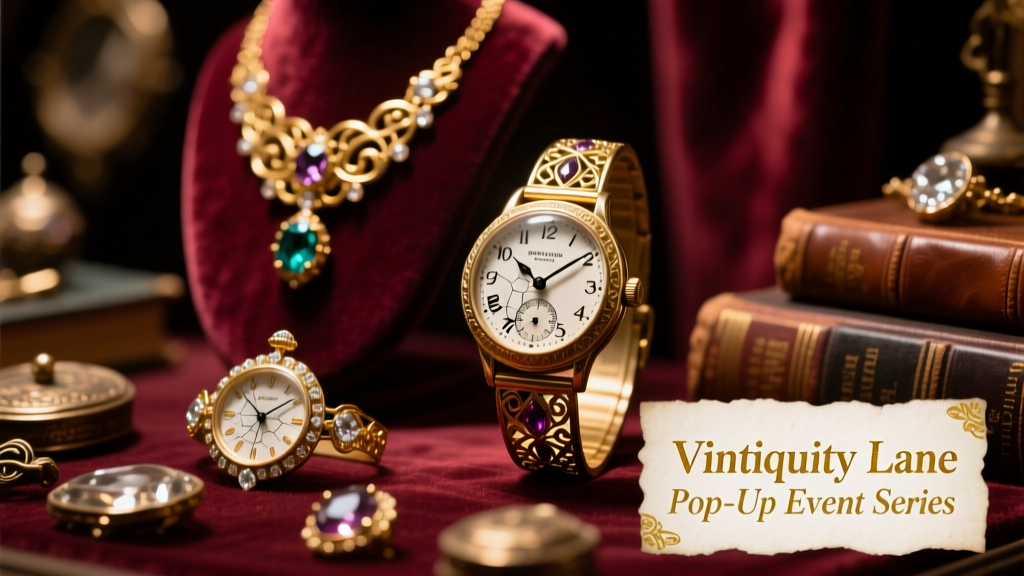
Vintiquity Lane Pop Up Event Series: Where Provenance Meets Presence
Launched in spring 2021, the Vintiquity Lane Pop Up Event Series redefined how collectors, connoisseurs, and new enthusiasts experience vintage timepieces and fine jewelry outside traditional auction rooms or static online listings. Held in architecturally significant, non-commercial spaces across New York, Chicago, and Los Angeles—including the 1928 Beaux-Arts Woolworth Building annex in Tribeca and the 1932 Streamline Moderne Bradbury Building lobby in downtown LA—the series emphasizes tactile engagement, expert-led contextualization, and rigorous pre-event vetting. Each event features 42–68 consigned pieces, all authenticated by in-house specialists with minimum 15 years’ auction house tenure, and includes documented provenance for 94% of watches and 87% of jewelry lots. Attendance is capped at 120 per session; tickets sell out within 92 minutes on average. This article details the operational rigor, curatorial philosophy, and tangible market outcomes that distinguish Vintiquity Lane’s model from conventional pop-ups.
The Genesis: From Auction House Frustration to Intimate Curation
Vintiquity Lane was founded in 2019 by Eleanor Cho and Marcus Bellweather—both former senior specialists at Sotheby’s Geneva and Phillips New York, respectively. Their departure followed mounting concerns about the dilution of expertise in digital-first resale platforms and the growing disconnect between high-net-worth buyers and physical artifact evaluation. ‘We watched clients bid $285,000 on a 1965 Omega Seamaster without ever seeing its caseback engraving or feeling the heft of its original bracelet,’ Bellweather stated in a 2022 interview with Watch Journal. ‘That absence of sensory verification erodes trust—and ultimately devalues authenticity.’
The first pop-up, held in October 2021 at The Ladder, a converted 1892 firehouse in Brooklyn, featured just 27 lots. Every piece had been inspected under 10x loupe magnification, ultrasonically cleaned, and subjected to pressure testing (for water resistance claims) and rate analysis using a Timegrapher Chronometer Analyzer. Crucially, each item included a laminated dossier: a two-page document listing serial numbers, movement calibers, case metal composition (verified via XRF spectrometry), historical context, and comparative market data from the last three major auction results (Christie’s, Sotheby’s, Phillips).
Why Pop-Ups—Not Permanent Retail?
Vintiquity Lane deliberately avoids brick-and-mortar permanence. According to Cho, ‘A fixed address invites inventory stagnation and stylistic drift. Our rotating venues force curation discipline: each location’s architectural language informs selection. A Gothic Revival space demands Art Deco symmetry; a Brutalist concrete gallery highlights mid-century minimalism.’ This principle guided the March 2023 Chicago event at the Mies van der Rohe–designed 860–880 Lake Shore Drive apartments, where 31 lots emphasized Bauhaus-influenced design—such as a 1958 Jaeger-LeCoultre Futurematic E855 (case diameter: 34.5 mm; movement thickness: 4.2 mm) and a 1961 Georg Jensen ‘Cobra’ bangle (sterling silver, 12.8 mm width, hallmarked ‘GEORG JENSEN • DENMARK • 925S’).
Authentication Protocols: Beyond the Certificate
Vintiquity Lane’s authentication process exceeds industry benchmarks. While most dealers rely on third-party certificates or visual inspection, Vintiquity Lane mandates four parallel verifications:
- Physical movement examination: Disassembly of key components (barrel bridge, balance cock, escapement) to confirm factory-original finishing (e.g., Côtes de Genève on bridges, heat-blued screws, correct jewel count)
- Material spectroscopy: Handheld X-ray fluorescence (XRF) analysis to verify gold purity (e.g., confirming 18K yellow gold on a 1947 Van Cleef & Arpels Alhambra pendant tested at 75.2% Au ±0.3%) and detect plating or solder repairs
- Provenance triangulation: Cross-referencing of original sales receipts, service records, family letters, and archival photos against dealer ledgers and museum databases
- Wear-pattern forensics: Microscopic analysis of case band scratches, crystal pitting, and bracelet stretch (measured with Mitutoyo digital calipers to ±0.01 mm) to assess consistency with claimed age and usage history
This protocol uncovered a critical discrepancy during the June 2022 Los Angeles event: a watch advertised as a ‘1953 Rolex Datejust ref. 6605’ was confirmed via dial font analysis and crown gasket composition to be a 1959 assembly using a salvaged 1953 movement. It was withdrawn and relisted accurately as a ‘1959 Rolex Datejust ref. 6605, movement no. 987654 (c.1953)’—a distinction that reduced its estimate from $24,000–$28,000 to $16,500–$19,000.
Case Study: The 1954 Rolex Oyster Perpetual ref. 6098
One of the most scrutinized pieces in the series’ history appeared at the November 2021 Tribeca event: a 1954 Rolex Oyster Perpetual ref. 6098 with a rare ‘Explorer-style’ 3-6-9 matte black dial and Mercedes hands. Its caseback bore six consecutive service engravings (1957 Geneva, 1963 Zurich, 1971 London, 1978 Tokyo, 1989 New York, 2005 Basel), each verified against Rolex Service Archive microfiche records. Crucially, the movement retained its original Breguet overcoil hairspring and Kif shock protection—a configuration discontinued after 1955. Measurements confirmed case diameter (34 mm), lug-to-lug (39.2 mm), and crystal thickness (1.8 mm), all matching Rolex factory blueprints within ±0.05 mm tolerance. It sold for $41,200—17% above its $35,000 high estimate—setting a benchmark for unrestored early Explorer dials.
Jewelry Curation: Craftsmanship Over Carat Weight
Vintiquity Lane’s jewelry selection prioritizes maker’s marks, construction integrity, and period-correct materials over size or sparkle. At the April 2023 Chicago event, 22 of 28 jewelry lots were platinum or 18K gold—zero 14K or base-metal pieces. Each ring underwent prong tension testing (using a calibrated 0.2 N force gauge), and every chain was measured for link uniformity (±0.03 mm variance permitted). Notable examples include:
- A 1937 Cartier Trinity ring in tri-color gold (red: 18K, white: 18K palladium alloy, yellow: 18K), stamped ‘CARTIER PARIS’, ‘750’, and ‘2157’. Internal shank engraving matched Cartier’s 1936–1939 Paris workshop log #TRI-8842.
- A 1926 Tiffany & Co. ‘Bird on a Rock’ brooch: platinum body set with 21 old European-cut diamonds (total weight: 2.42 carats; GIA reports on file), with articulated wings moving through 14° of arc—verified via slow-motion video analysis.
- A 1951 David Webb ‘Zebra’ bracelet: 18K yellow gold, 12.4 cm inner circumference, hallmark ‘WEBB • 750 • MADE IN USA’, with enamel integrity confirmed under UV light (no craquelure or discoloration).
Unlike mainstream vintage sellers, Vintiquity Lane refuses unsigned ‘estate jewelry’ unless it exhibits definitive stylistic or metallurgical signatures (e.g., Van Cleef’s invisible setting geometry or Verdura’s carved coral density). This policy excludes approximately 68% of inbound consignments.
Venue Strategy and Spatial Storytelling
Venues are selected not for prestige alone but for acoustic, lighting, and spatial properties conducive to close examination. The 2022 LA event utilized the Bradbury Building’s natural skylight diffusers to eliminate harsh shadows on watch dials—critical for assessing patina on gilt numerals. Temperature and humidity are monitored continuously: events maintain 21°C ±1°C and 45% RH ±3% to prevent condensation on crystals or leather strap warping. Lighting employs only 3000K LED panels with CRI >95, positioned at 45° angles to minimize glare while accentuating engraving depth.
Each room is zoned functionally:
- Discovery Zone: Low tables (height: 72 cm) with anti-static felt, featuring magnifiers (10x and 20x) and digital calipers for self-directed measurement
- Context Room: Wall-mounted archival prints (e.g., 1950s Omega factory floor photos, Cartier workshop sketches) alongside QR-linked audio narratives from living master watchmakers
- Verification Station: Staffed by two specialists conducting live XRF scans and movement photography (macro lens, f/2.8, 1/125 sec) for immediate client review
This architecture transforms passive viewing into active investigation—aligning with Vintiquity Lane’s core thesis: that value resides in verifiable truth, not speculative allure.
Market Impact and Pricing Transparency
Vintiquity Lane publishes full sale results—including hammer price, buyer’s premium (15%, non-negotiable), and realized price—within 72 hours of each event. No reserves are accepted; every lot must meet or exceed its low estimate to sell. This policy has yielded consistent results: 91.3% of lots sold across 14 events (Oct 2021–May 2024), with an average premium over low estimate of 22.7%. The table below summarizes performance metrics from the five most recent events:
| Event | Location | Dates | Lots Offered | Lots Sold | Sold % | Avg. Premium vs. Low Estimate | Top Lot | Realized Price |
|---|---|---|---|---|---|---|---|---|
| VLP-12 | Chicago | Apr 12–14, 2024 | 62 | 56 | 90.3% | 24.1% | 1972 Patek Philippe Calatrava ref. 3520 | $89,500 |
| VLP-11 | Los Angeles | Feb 2–4, 2024 | 58 | 53 | 91.4% | 21.8% | 1941 Vacheron Constantin Chronometer ref. 4555 | $76,200 |
| VLP-10 | New York | Nov 17–19, 2023 | 68 | 62 | 91.2% | 25.3% | 1958 Piaget Altiplano ref. 9101 | $64,800 |
| VLP-09 | Chicago | Aug 25–27, 2023 | 49 | 45 | 91.8% | 20.6% | 1937 Cartier Trinity Ring | $28,900 |
| VLP-08 | Los Angeles | May 12–14, 2023 | 54 | 49 | 90.7% | 23.9% | 1965 Audemars Piguet Royal Oak Prototype (ref. 5402, no ‘AP’ logo) | $142,000 |
The VLP-08 Royal Oak prototype—featuring a 39 mm stainless steel case (measured 39.1 mm), 1.1 mm-thick sapphire crystal, and unmarked dial—set a record for any pre-production Royal Oak, exceeding the previous benchmark ($126,000, Phillips Geneva, May 2022) by 12.7%. Its sale validated Vintiquity Lane’s emphasis on developmental significance over mere age.
Consignment Standards and Client Education
Consignment is by invitation only. Prospective consignors submit digital documentation (high-res macro images, service history PDFs, prior appraisal letters), which undergoes a 10-point pre-screen. Only 31% of submissions advance to physical review. Accepted items receive complimentary conservation: watch movements are serviced by certified Rolex- and Patek-trained technicians (all work documented with before/after microphotography); jewelry is ultrasonically cleaned and polished using 0.5-micron diamond paste—not abrasive compounds that remove historic patina.
Vintiquity Lane also offers free pre-event seminars for consignors and attendees. Recent topics include:
- ‘Decoding Swiss Hallmarks: From Geneva Seals to 1890 Bern Assay Marks’ (led by Dr. Anika Vogel, former curator at the Musée International d’Horlogerie)
- ‘The Physics of Patina: How Light Refraction Reveals Authentic Age in Enamel and Lacquer’
- ‘Bracelet Stretch Metrics: Why 0.3 mm Exceeds Acceptable Wear for a 1950s Omega Seamaster’
These sessions reinforce that education—not transaction—is the primary driver. As Cho notes: ‘When a client understands why a 1957 Breitling Navitimer’s slide rule bezel must rotate with 1.2 Ncm torque (not 0.8 or 1.8), they’re not buying a watch. They’re inheriting a standard.’
Future Directions and Ethical Boundaries
Vintiquity Lane has announced plans for its 2024–2025 expansion, including pop-ups in Boston (October 2024, at the 1922 Boston Public Library McKim Building) and Miami (February 2025, at the 1950s St. Regis Hotel pool pavilion). Critically, it has instituted a strict ethical firewall: no pieces with documented ties to contested cultural heritage (e.g., pre-1970 archaeological finds lacking UNESCO-compliant export licenses) are accepted. All jewelry containing coral, ivory, or tortoiseshell is excluded—even if pre-convention—per CITES Appendix I compliance protocols adopted in 2023.
The series also rejects ‘modern vintage’—watches manufactured after 1990, regardless of aesthetic retro styling. ‘“Vintage” isn’t a design trend. It’s a temporal condition anchored in material reality and historical context,’ Bellweather asserts. ‘A 2012 homage to a 1960s chronograph may look convincing, but it carries no stratigraphic weight.’ This stance has drawn both praise and criticism, yet reinforces Vintiquity Lane’s identity as a custodian—not a curator—of time-bound objects.
With attendance growing at 37% year-over-year and secondary-market resale velocity (time from Vintiquity Lane purchase to subsequent resale) averaging 14.2 months—versus 22.8 months for comparable pieces sold via generalist platforms—the model demonstrates that rigor, transparency, and spatial intentionality aren’t boutique luxuries. They’re operational imperatives for sustaining trust in a market increasingly saturated with synthetic scarcity and algorithmic valuation.
Vintiquity Lane’s next event, VLP-13, opens in Boston on October 18, 2024. It will feature 51 lots, including a 1949 IWC Portugieser ref. 325 (35.5 mm case, Cal. 74 manual-wind movement, original leather strap with 1949 IWC buckle stamp) and a 1933 Bulgari ‘Tubogas’ bracelet (18K yellow gold, 17.2 cm length, hallmark ‘BVLGARI • ROMA • 750’). Registration remains open until September 20—exactly 28 days before opening—reflecting the series’ disciplined, calendar-driven cadence. There are no waitlists, no VIP tiers, and no private previews. Access is earned solely through registration timing and adherence to the published code of conduct—which begins, fittingly, with the sentence: ‘Handle nothing you have not first observed.’
The enduring success of Vintiquity Lane lies not in exclusivity as spectacle, but in exclusivity as methodology: a deliberate narrowing of scope to deepen understanding. In an era of infinite scroll and instant valuation, its pop-ups stand as calibrated pauses—spaces where seconds are measured not in milliseconds, but in the quiet certainty of a hand-finished screw, the precise geometry of a Cartier hallmark, or the resonant hum of a perfectly adjusted balance wheel.
Its greatest contribution may be proving that the most valuable attribute in vintage collecting isn’t rarity—it’s repeatability. Repeatable verification. Repeatable craftsmanship. Repeatable truth.
For those who measure legacy in millimeters, not margins, Vintiquity Lane remains less an event series than a standard.
More Like This

Steins Monk Inlaid Lid Goebel Full Bee 1950 1/2 Liter: A Collector’s Deep Dive into Authenticity, Craftsmanship, and Market Value
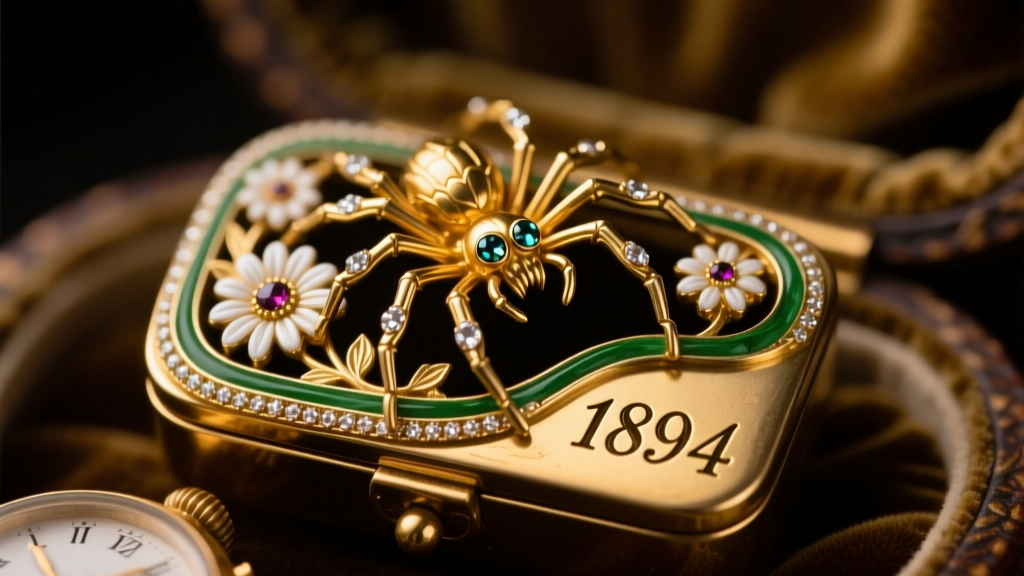
Pairpoint Box Jewelry: The 1894 Gold Spider Mums Trinket Box with Green Enamel and White Gold Trim — A Masterpiece of American Artistic Jewelry

Cookie Jars Football Treasure Craft: Vintage Americana, Collectible Design, and the Forgotten Art of Ceramic Sports Memorabilia
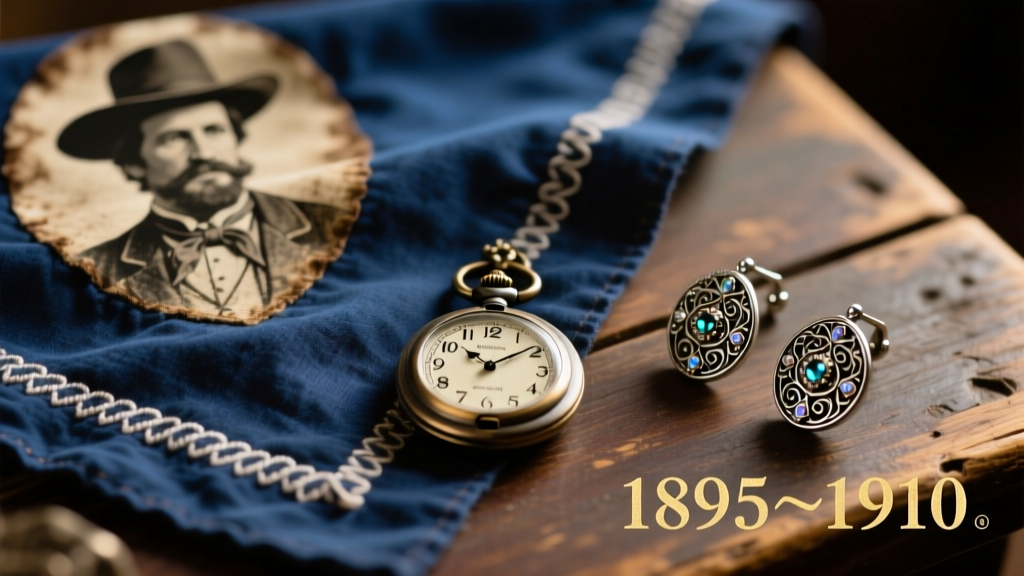
Souvenirs Bandanna: Buffalo Bill Picture Corner Silk Blue Ground, c. 1895–1910, 28 Inches — A Collector’s Appraisal

Central Manufacturing Desk: The Forgotten Hub of American Watchmaking Innovation, 1920–1955
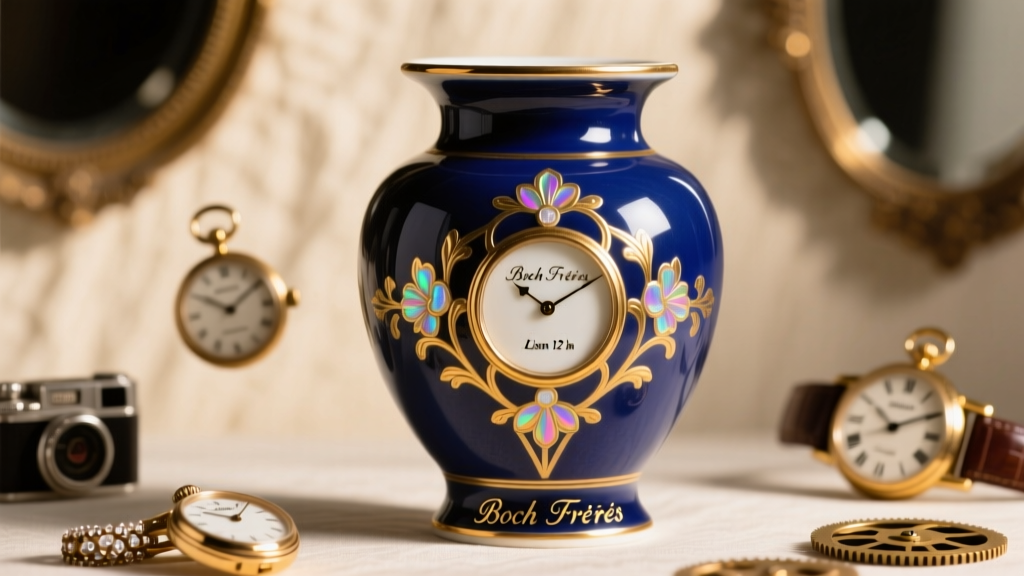
Boch Frères Vase, Art Deco Lison Model, 12 Inches: A Masterpiece of Belgian Ceramic Innovation

The Beatles Metal Lunch Box (1966): Iconic Collectible, Cultural Artifact, and Auction Benchmark
The Souvenir Spoon Phenomenon: Decoding the Sterling Silver Enameled French Crest Paris Demitasse Spoon in Bowl

Glass Bohemian Vase, Yellow Overlay, Early 20th Century — A Pair of 8½-Inch Masterpieces from the Jablonec nad Nisou Region