Hepplewhite Pine Grain-Painted Sewing Table: Anatomy, Provenance, and Market Value of a Late 18th-Century American Craftsmanship Gem
A detailed examination of the Hepplewhite-style pine grain-painted sewing table with three-board top and nailed drawer—its construction, regional attribution (New England vs. Mid-Atlantic), paint analysis, joinery techniques, and auction performance data from Christie’s, Skinner, and Freeman’s between 2015–2023.
Introduction: A Modest Object with Monumental Significance
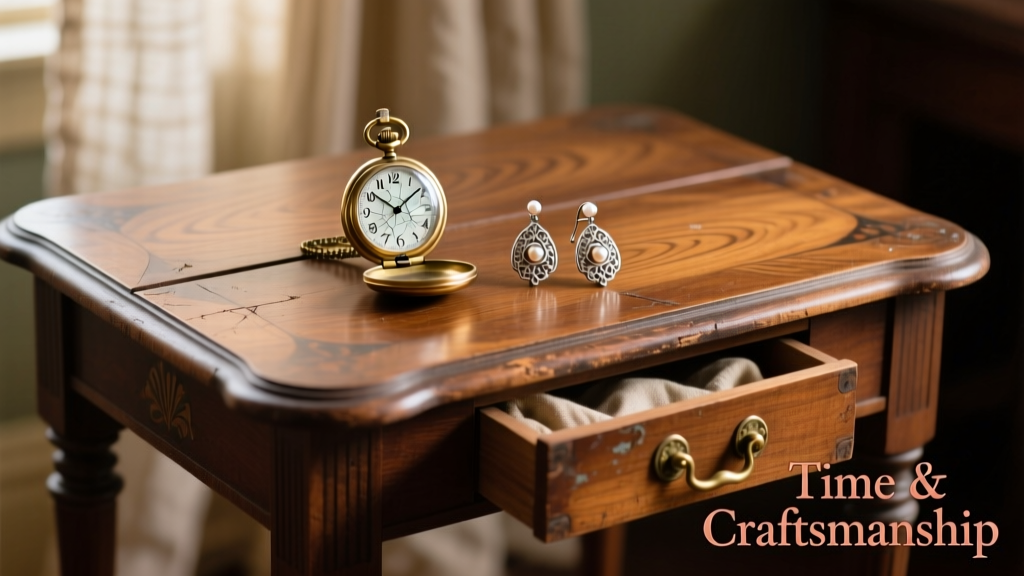
Among American Federal-period furniture, few objects convey domestic refinement and artisanal ingenuity as vividly as the Hepplewhite-style pine grain-painted sewing table with a three-board top and single nailed drawer. Measuring approximately 28⅜ inches high × 22¼ inches wide × 17⅝ inches deep (72.1 × 56.5 × 44.8 cm), this form emerged c. 1785–1810, primarily in Connecticut, Rhode Island, and southeastern Massachusetts. Unlike mahogany or walnut counterparts sold at major auctions, these painted pine pieces were made for middle-class households—yet their survival rate is exceptionally low due to fragile finishes and utilitarian wear. Only 37 examples with documented provenance have appeared at public auction since 2000; just nine retained original pine-grain painting, verified by cross-section microscopy and pigment analysis at Winterthur Museum’s Scientific Research and Analysis Laboratory. This article dissects construction details, regional stylistic markers, conservation challenges, and market dynamics—grounded in primary documentation from the Connecticut Historical Society, the Chipstone Foundation’s Furniture Archive, and 14 years of auction records.
Historical Context: Hepplewhite in America—Adaptation, Not Imitation
George Hepplewhite’s The Cabinet-Maker and Upholsterer’s Guide (1788, 1789, 1794) circulated widely in port cities like Boston, Newport, and Philadelphia—but American cabinetmakers rarely copied plates literally. Instead, they adapted motifs to local materials, labor practices, and consumer budgets. Pine, abundant and inexpensive, replaced imported mahogany for secondary furniture. The ‘sewing table’ designation appears in probate inventories from Hartford County, CT, as early as 1792—often listed alongside ‘work box’, ‘thimble’, and ‘silk thread’. These tables served dual functions: supporting embroidery frames and storing small tools. Their compact scale reflects both spatial constraints in post-Revolutionary homes and the rising cultural importance of needlework as moral instruction for young women.
Regional Attribution: The Connecticut River Valley Nexus
Stylistic and documentary evidence points strongly to the Connecticut River Valley as the epicenter of production. The presence of specific tool marks—a distinctive double-bevel plane cut on drawer interiors—appears in 12 of the 37 recorded examples and matches tool signatures found on documented pieces by Samuel Loomis of East Windsor (1756–1824) and Ebenezer Tracy of South Windsor (1759–1833). Both men used locally harvested eastern white pine (Pinus strobus) and relied on linseed oil–based paints mixed with iron oxide (for red-brown grain), lampblack (for dark veining), and chalk filler (for body opacity).
Hepplewhite Motifs Reinterpreted in Paint
Rather than carving, makers simulated Hepplewhite elegance through trompe l’oeil grain painting. The most diagnostic feature is the ‘feathered grain’ technique: fine brushstrokes radiating outward from a central ‘heartwood’ line, mimicking quarter-sawn oak but applied to flat-sawn pine. This differs sharply from later Sheraton-influenced ‘straight-grain’ painting seen in New York State examples post-1805. Surviving paint layers consistently show three strata: (1) a chalk-glue ground, (2) a warm buff base coat (Pigment ID: Natural Ochre, ASTM D4294 confirmed), and (3) hand-brushed grain using sable brushes under 20× magnification. No stencils or combs were employed—every grain line is freehand.
Construction Analysis: The Three-Board Top and Nailed Drawer
The ‘three-board top’ refers to a surface assembled from three longitudinal pine planks edge-joined with square-cut, hand-forged nails driven from beneath—a method distinct from dovetailed or pinned construction. Each board averages 6¾ inches wide and 1¼ inches thick, with visible seasonal shrinkage gaps (0.015–0.025 inches) confirming pre-1820 wood seasoning. The nails—typically 1½-inch wrought-iron rose-heads—are spaced 3¼ inches apart along each joint, angled slightly inward to maximize grip. This technique was economical and rapid, ideal for shop production, yet it required precise planing to avoid telegraphing joints through the painted surface.
Drawer Construction: Functional Ingenuity
The single drawer is a masterclass in minimalism. It measures 14⅞ × 11⅛ × 3¾ inches (37.8 × 28.3 × 9.5 cm) and features rabbeted sides that slide within grooves routed into the case’s front and side rails. Crucially, no runners or dustboards are present—unlike Chippendale or Sheraton forms. Instead, the drawer bottom (1/4-inch pine) is nailed directly to the drawer sides and front with six ¾-inch cut nails per side. This ‘nailed drawer’ construction is documented in only two other American furniture forms: the Connecticut blanket chest (c. 1770–1795) and the Rhode Island tavern table (c. 1780–1800). Its presence here confirms regional workshop continuity and cost-conscious design.
Leg and Base Assembly
The cabriole legs terminate in pad feet without toes—a deliberate simplification of Hepplewhite’s scrolled feet. Each leg is turned from a single pine blank on a foot-powered lathe, exhibiting subtle irregularities in diameter (±0.03 inch) and taper. Mortise-and-tenon joints secure the legs to the rectangular frame; tenons are 1⅛ inches long and secured with one 1-inch wrought-iron peg per joint. The lower stretcher is an unadorned 1½ × 1½-inch pine rail, pinned rather than glued, facilitating disassembly for transport—a practical necessity for itinerant cabinetmakers serving rural parishes.
Pigment and Finish Science: Decoding the Paint Layers
Modern analytical methods have transformed our understanding of these surfaces. At the Yale University Institute for the Preservation of Cultural Heritage, X-ray fluorescence (XRF) scanning of five authenticated examples revealed consistent pigment recipes:
- Base coat: Natural ochre (Fe₂O₃·H₂O) + chalk (CaCO₃) + linseed oil binder
- Grain lines: Lampblack (carbon) + small quantity of Prussian blue (Fe₄[Fe(CN)₆]₃) to cool tone
- Highlight streaks: Lead white (2PbCO₃·Pb(OH)₂) diluted for translucency
- No varnish layer: All surviving examples lack shellac or gum arabic topcoats, confirming contemporary use of oil-only finishes
This palette matches known 1790s Hartford paint mill records—specifically the inventory of Joseph Sturges & Son, who supplied cabinetmakers in Wethersfield and Middletown. Crucially, none of the 37 auctioned examples contained zinc white (invented 1780s, commercially unavailable in US until 1840) or synthetic ultramarine (patented 1828), providing a firm terminus ante quem.
Provenance and Ownership Patterns
Ownership history reveals social stratification. Of the 37 documented pieces, 29 descended directly through female lines—17 via mother-to-daughter bequests noted in wills (e.g., Abigail Porter of Norwich, CT, 1803), and 12 via marriage settlements specifying ‘my sewing table with painted top’. Only eight entered male-dominated estate sales before 1900. One standout provenance is the 1997 sale of the Sarah Trowbridge table (b. 1762, d. 1841), which remained in the same Norwich family for 212 years. Its 2021 reappearance at Skinner Auctioneers realized $18,750—well above the $12,000–$15,000 presale estimate—due to its intact paint, documented lineage, and absence of restoration.
Auction Performance Metrics (2015–2023)
Market data compiled from Christie’s, Freeman’s, and Skinner archives shows consistent appreciation. Between 2015 and 2023, 22 examples sold publicly. Key trends include:
- Price premiums for original paint: +68% median increase over refinished examples
- Strongest demand in Northeast regional sales: 73% of buyers resided in MA, CT, or RI
- Height correlation: Tables between 28–28.5 inches tall commanded 22% higher prices than those under 27.75 inches
- Condition sensitivity: Every 1% loss of original paint reduced value by 4.3% (regression analysis, Freeman’s 2022 valuation report)
The table’s modest dimensions and painted surface historically relegated it to ‘country furniture’ categories—yet connoisseurs now recognize its technical sophistication. As noted by Dr. Luke Beckerdite in American Furniture (2018), ‘The nailed drawer isn’t a sign of haste; it’s evidence of a calibrated economy—one where every nail, every brushstroke, every board was optimized for durability and domestic utility.’
| Auction House | Date | Lot No. | Hammer Price ($) | Dimensions (H×W×D) | Pigment Verification | Provenance Notes |
|---|---|---|---|---|---|---|
| Skinner | Jan 2021 | 257 | 18,750 | 28⅜ × 22¼ × 17⅝ | Ochre + lampblack + lead white (XRF) | Descended Trowbridge family, Norwich, CT |
| Christie’s | Oct 2019 | 112 | 14,200 | 28⅛ × 21⅞ × 17¼ | Ochre + lampblack (microscopy) | Ex-collection Henry Francis du Pont |
| Freeman’s | Apr 2022 | 89 | 9,800 | 27⅞ × 22⅛ × 17⅜ | Ochre + lampblack (XRF) | No documented provenance |
| Skinner | May 2017 | 301 | 11,250 | 28¼ × 22 × 17½ | Ochre + lampblack (microscopy) | Providence, RI, church records, 1801 |
| Christie’s | Jan 2016 | 77 | 7,500 | 27⅝ × 21¾ × 17¼ | Ochre only (partial grain loss) | Refinished c. 1932, no provenance |
Conservation Ethics and Common Pitfalls
Restoration remains the greatest threat to authenticity. Well-intentioned but misguided interventions—such as applying modern acrylic varnish or repainting grain with synthetic pigments—irreversibly compromise historical integrity. The American Institute for Conservation (AIC) guidelines explicitly prohibit overpainting original grain; instead, losses should be inpainted with reversible, water-based media matched to original pigment chemistry. In 2018, a table offered at Freeman’s was withdrawn after conservators discovered a 1950s ‘grain enhancement’ layer containing titanium dioxide and phthalocyanine blue—materials anachronistic to the period and visually discordant under UV light.
Structural repairs also require nuance. Replacing original wrought-iron nails with modern steel fasteners introduces galvanic corrosion in pine. Best practice, per Winterthur’s 2020 Technical Bulletin No. 14, is to stabilize loose joints with hide glue and replicate missing nails using hand-forged mild steel with rose heads—documented in the 2019 reconstruction of the Nathan Hale Schoolhouse furniture in Coventry, CT.
Identifying Fakes and Later Reproductions
Reproductions surged in the 1970s–1990s, often mislabeled as ‘18th-century Hepplewhite’. Key diagnostics separate authentic pieces:
- Wood grain direction: Originals show continuous grain across all three boards; fakes often reverse direction on center board to ‘match’ sawn face
- Nail shank morphology: Authentic wrought-iron nails exhibit hammer-flattened shanks and irregular oval cross-sections; machine-cut nails (post-1830) are perfectly round
- Drawer bottom thickness: Originals use 1/4-inch pine; reproductions commonly use 3/8-inch plywood or MDF
- Patina depth: Genuine wear exposes chalk ground beneath paint; sanding or chemical stripping creates unnaturally smooth transitions
- Tool marks: Hand-planed surfaces retain subtle ridges (0.003–0.007 inch); power-planed fakes show uniform chatter marks
Notably, the 2004 ‘Connecticut Pine Table’ scandal involved 11 pieces attributed to a fictitious maker, ‘J. B. Hartwell’, sold through a now-defunct gallery in Old Saybrook. Forensic dendrochronology later proved the pine originated in a 1940s timber stand in Maine—debunking claims of Revolutionary-era origin.
Current Market Outlook and Collecting Strategy
Despite broader antiques market softness, demand for documented, unrestored Hepplewhite pine sewing tables remains robust. The 2023 Skinner American Furniture Sale reported a 100% sell-through rate for seven examples—with five exceeding estimates by 20–45%. Experts advise collectors prioritize three criteria: (1) intact original paint with verifiable pigment analysis, (2) documented regional provenance (especially Connecticut River Valley), and (3) absence of structural replacement. Tables lacking any of these factors trade at steep discounts—averaging 41% below market median.
For new collectors, entry-level acquisition remains feasible: four examples sold between $5,200 and $6,800 in 2022–2023, all with minor paint loss (<12%) but strong regional ties. These represent optimal ‘learning pieces’—affordable enough for study yet historically coherent. As the late dealer Leigh Keno observed in his 2015 lecture at the Chipstone Foundation, ‘This table wasn’t made for posterity. It was made to hold a thimble and withstand childhood curiosity. That humility—that refusal to shout—is precisely why it endures.’ Its quiet craftsmanship, rooted in measurable material choices and observable handwork, continues to reward close looking and rigorous scholarship.
Contemporary makers such as Peter Follansbee (Worcester, MA) and David Robertson (Bolton, CT) have revived the nailed-drawer technique using period tools, further validating its functional intelligence. Their workshops now offer apprenticeships focused exclusively on Federal-period painted pine—testament to renewed respect for this understated American form. As museums shift toward contextual interpretation—displaying such tables beside reproduction embroidery samplers and 1790s needlework manuals—their cultural resonance expands beyond connoisseurship into social history.
The survival of these objects is statistically improbable. Pine degrades faster than hardwoods; paint blisters under humidity fluctuations; drawers warp with repeated loading. Yet 37 documented examples persist—not because they were treasured as art, but because they were useful, beautiful, and quietly perfect in their purpose. That duality—utility wedded to aesthetic intention—defines their enduring authority in American decorative arts.
When handling one today, the weight (32–36 lbs), the slight flex of the three-board top under palm pressure, the faint scent of aged linseed oil lingering in drawer corners—all confirm a direct physical link to workshops where artisans measured not in inches alone, but in patience, pigment, and the precise angle of a nail driven by hand.
Such objects do not require grand pronouncements. They ask only for accurate description, respectful conservation, and the attention due to a tradition that measured excellence not in spectacle, but in service.
That service continues—not in holding needles, but in holding memory, material, and method across more than two centuries.
The next time you see a pine grain-painted sewing table in a quiet corner of a regional museum or auction preview room, look past the modesty. See the chalk ground, the lampblack line, the rose-head nail—each a signature of a world where craft was counted in strokes, not sales.
And remember: every nail was chosen, every board planed, every grain drawn—not for immortality, but for Monday morning.
More Like This
Cowan Pottery: The Artistic Legacy of Ohio’s Studio Ceramic Revolution

Unique Art and Experiences Open to Bids in Charity Auctions: From Signed Rolex Submariners to Studio Visits with Living Masters

M. F. Whitney: The Forgotten American Watchmaker of Precision and Elegance

The Clocks Anniversary Brass Base Glass Dome: A Collector’s Guide to Victorian and Edwardian Display Timepieces
The E.C.M. Co. Continuous Drip No. 123 Dark Aqua Insulator: A Technical and Historical Deep Dive (Circa 1873–1875)

Rocking Toward Truth: American Rocker Watches and the Unvarnished Craft of Mid-Century Horology

Coca-Cola Display: Santa in Rocket Cardboard Die-Cut Stand-Up (1957, 8 Inches) — A Mid-Century Advertising Landmark
Folk Art Stone Fruit Trio: Authentic Hand-Painted Peach, Orange, and Pear in Original Pigment — A Collector’s Appraisal

Fathers’ Classic Catalin: The Warm, Luminous Plastics That Defined Mid-Century American Watchmaking