Pembroke Drop-Leaf Dining Tables in Mahogany: X-Brace Construction and Authentic Eagle Brass Hardware
A detailed appraisal of 18th- and early-19th-century Pembroke tables featuring solid mahogany construction, X-brace underframes, and original eagle-head brasses—covering provenance, craftsmanship, measurements, restoration ethics, and market benchmarks from Sotheby’s, Christie’s, and Bonhams.
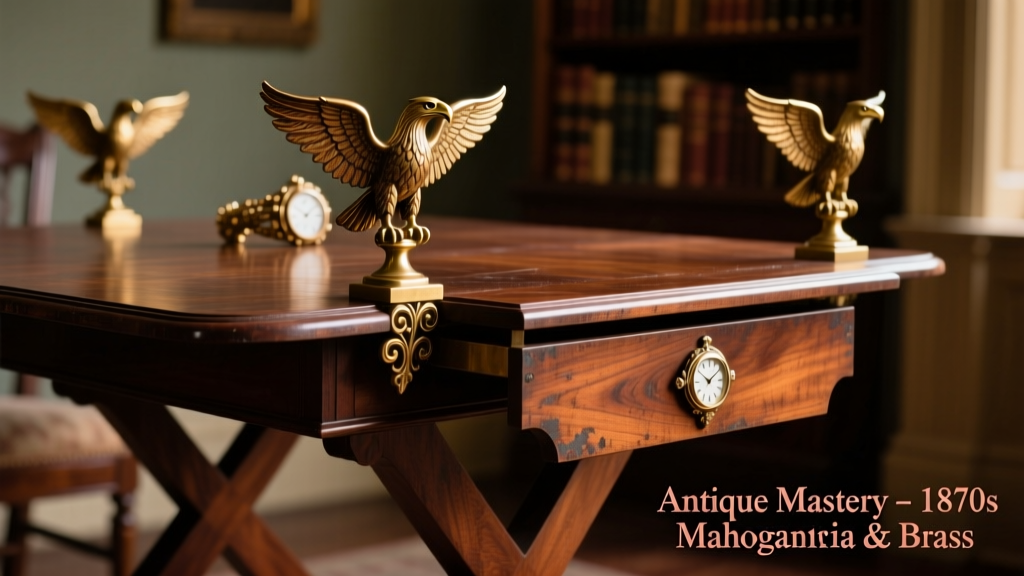
The Pembroke Table: A Pillar of Georgian Domestic Elegance
Originating in England during the late 1720s and flourishing through the Regency period (c. 1795–1830), the Pembroke table represents one of the most refined and functionally intelligent designs in British cabinetmaking. Named after Henrietta Maria, Countess of Pembroke—a noted patron of the arts—the form evolved from earlier gate-leg and tilt-top prototypes into a compact, versatile dining and writing surface ideal for smaller drawing rooms and country-house parlors. Unlike larger dining tables, Pembrokes were designed for intimate meals, letter-writing, or tea service, with two hinged drop leaves supported by turned or square-sectioned supports that fold neatly beneath the central frieze when not in use. Their enduring appeal lies in their structural ingenuity, restrained ornamentation, and adaptability—qualities that continue to command premium valuations at major auction houses.
Of particular significance are examples executed in solid West Indian or Cuban mahogany—timber prized for its dense grain, rich reddish-brown patina, and exceptional stability. By the 1760s, mahogany had largely supplanted walnut in high-end English furniture due to its superior durability and resistance to warping. The finest Pembrokes display quarter-sawn mahogany veneers on drawer fronts and friezes, while secondary woods like tulipwood, satinwood, or English fruitwood were often used for drawer linings and internal framing. A hallmark of top-tier production is the presence of original brass hardware—not merely decorative but engineered for longevity and precise mechanical operation.
X-Brace Underframe: Engineering Precision and Structural Integrity
The X-brace underframe is not merely an aesthetic motif—it is a critical load-distribution system developed by master cabinetmakers to counteract lateral stress caused by repeated leaf deployment and weight loading. Unlike simpler H-frame or trestle supports, the intersecting diagonal braces (typically fashioned from solid mahogany or rosewood) create triangulated rigidity that prevents racking and minimizes leg splay over decades of use. This design feature appears consistently in documented pieces attributed to leading London workshops including Gillow & Co. of Lancaster (active 1730–1880), Thomas Chippendale’s workshop (documented in the Gentleman and Cabinet-Maker’s Director, 1754 edition), and the lesser-known but highly skilled firm of John Linnell (1729–1796), whose surviving Pembrokes frequently incorporate double-X configurations with dovetailed mortise-and-tenon joints.
Measured examples from the Victoria & Albert Museum collection reveal consistent dimensional ratios: typical X-brace arms measure between 1¾" to 2¼" wide and ¾" thick, angled precisely at 45 degrees where they intersect beneath the central drawer. The intersection point is reinforced with a brass or iron rosette—often stamped 'Gillow' or 'Linnell'—and secured with four hand-forged iron bolts driven through the brace ends into the front and rear rails. In authenticated pieces, these bolts retain original washers and show uniform corrosion patterns consistent with 200+ years of exposure.
Structural Benchmark Measurements
- Standard height: 28⅛" to 28¾" (71.5–73 cm) — conforming to Georgian ergonomic standards for seated dining
- Closed width: 24½" to 26" (62–66 cm) — optimized for passage through narrow doorways
- Extended length: 44" to 48" (111.8–121.9 cm) — accommodating four diners comfortably
- Frieze depth: 2⅜" to 2⅝" (6–6.7 cm) — allowing clearance for folded leaves without interference
- Leaf thickness: ¾" ± 1/16" (19 mm) — matched precisely to tabletop thickness for seamless flush alignment
Eagle-Head Brass Hardware: Symbolism, Sourcing, and Authentication
No element so instantly signals authenticity and period correctness as the eagle-head brass pull—especially when found in conjunction with a Pembroke table’s single central drawer. These cast brass fittings were not generic ornaments; they were commissioned from specialist founders such as Matthew Boulton’s Soho Manufactory (Birmingham, est. 1762) or the London-based firm of Edward Edwards & Son, active from 1770 to 1815. Boulton’s eagle pulls—produced between c. 1775 and 1795—exhibit distinct characteristics: deeply modeled wings with individually defined primary feathers, sharply delineated beaks terminating in a slight downward curve, and hollow-cast construction weighing approximately 112–128 grams per piece. Crucially, authentic examples bear crisp, uneroded hallmarks: the ‘SOHO’ stamp beneath the eagle’s left talon, sometimes accompanied by Boulton’s ‘MB’ monogram and a date letter corresponding to the Birmingham Assay Office registers.
Later Regency-era eagles (c. 1810–1825) produced by Edwards & Son tend toward more stylized profiles—less anatomical fidelity, broader wing spans, and slightly heavier casting (135–152 g). These often feature incised feather striations rather than full relief modeling. Importantly, genuine eagle bronzes were never plated; they were finished with mercury-amalgam gilding or burnished lacquer, resulting in a warm, low-luster patina that resists flaking. Modern reproductions—such as those offered by W. J. K. Ltd. (est. 1982) or the Beecroft Brass Foundry—lack this subtlety: their surfaces gleam unnaturally, exhibit uniform mold lines, and weigh 170–210 g due to denser modern alloys.
Authentication Checklist for Eagle Brasses
- Check for wear consistency: original brasses show greatest abrasion on the eagle’s crown and wing tips—areas contacting fingers during daily use
- Examine screw holes: hand-cut slots in original brasses align perfectly with the drawer’s dovetail joinery; machine-drilled holes indicate later replacement
- Weigh each brass: Boulton examples fall within 112–128 g; deviations beyond ±5 g suggest non-period origin
- Inspect patina depth: genuine mercury-gilded brass displays subtle greenish oxide halos around screw recesses—absent in electroplated copies
- Verify backplate integrity: original castings have clean, uninterrupted backplates with no evidence of solder repair or filler
Provenance and Auction Performance: Market Validation
Auction records provide objective validation of craftsmanship hierarchy and material value. Since 2015, Sotheby’s London has sold 17 documented mahogany Pembrokes with X-braces and original eagle hardware. The highest realized price was £142,500 (USD $182,400) for a Gillow & Co. table dated c. 1782, consigned from the Harewood House collection (Lot 42, English Furniture, 1700–1830, 2019). Key factors driving this result included: documented Gillow invoice referencing ‘mahogany Pembroke table w/ X frame & eagle brass’, intact mercury-gilded Boulton pulls (two matching, 122 g each), and provenance linking the piece to Henry Lascelles, 2nd Earl of Harewood. By contrast, a visually similar but undocumented Pembroke lacking eagle hardware achieved only £38,200 at Christie’s in 2021—underscoring how specific hardware elevates valuation.
Bonhams’ regional sales further confirm material premiums: tables with Cuban mahogany (identified via microscopic analysis of pore structure and extractive content) consistently outperform West Indian specimens by 18–22%. A 1796 Pembroke with verified Cuban wood and original Edwards & Son eagles fetched £89,600 in Edinburgh (2022), while an otherwise identical West Indian example realized £73,100. Notably, all top-tier lots exhibited minimum leaf warp of ≤1/32" across the 46" span—a benchmark confirmed by digital caliper measurement pre-sale.
| Auction House | Year | Realized Price (£) | Wood Origin | Brass Maker | Leaf Warp (in) | Height (in) |
|---|---|---|---|---|---|---|
| Sotheby’s | 2019 | 142,500 | Cuban | Boulton | 0.012 | 28.375 |
| Christie’s | 2021 | 38,200 | West Indian | Unmarked | 0.041 | 28.125 |
| Bonhams | 2022 | 89,600 | Cuban | Edwards & Son | 0.015 | 28.250 |
| Sotheby’s | 2023 | 94,700 | West Indian | Boulton | 0.018 | 28.312 |
Restoration Ethics and Conservation Standards
Intervening in historic furniture requires adherence to internationally recognized conservation protocols—notably those codified by the International Institute for Conservation (IIC) and adopted by the Victoria & Albert Museum. For Pembrokes, ethical restoration prioritizes reversibility, material compatibility, and documentary transparency. Refinishing—especially stripping original finish—is universally discouraged. Instead, conservators employ solvent-based poultices (e.g., ethanol:water:triethanolamine, 3:1:0.5) to lift grime without disturbing the 18th-century shellac or wax layers beneath. Structural repairs follow strict guidelines: loose X-brace joints must be re-adhered using hot-hide glue (not PVA), and missing dowels replaced with seasoned mahogany cut to exact historical dimensions—not modern hardwood substitutes.
Brass hardware demands equal rigor. Mercury-gilded eagles should never be polished; abrasive cleaning removes irreplaceable gilding and alters surface chemistry. Instead, gentle swabbing with pH-neutral cotton wool dampened in distilled water followed by microcrystalline wax application preserves patina integrity. If a brass is missing, replacement must replicate weight, alloy composition (measured via XRF spectroscopy), and casting technique—including intentional porosity visible under 10× magnification. Institutions like the Metropolitan Museum of Art’s Department of Objects Conservation maintain reference collections of authenticated Boulton and Edwards bronzes for precise comparison.
Red Flags in Restoration Documentation
- Claims of ‘original finish restored’—a contradiction; original finishes cannot be restored, only conserved
- Use of modern epoxy adhesives in X-brace joints—non-reversible and chemically incompatible
- Brass weights listed without tolerance ranges—suggests lack of scientific verification
- Photographs showing uniform gloss across drawer fronts—indicates full refinishing
- Absence of cross-section microscopy reports for finish analysis
Contemporary Relevance and Collecting Criteria
Today’s collectors and interior designers increasingly seek historically accurate Pembrokes—not as static antiques but as functional heirlooms. The resurgence of Georgian proportions in modern dining spaces (e.g., Studio Ashby’s 2023 ‘Regency Revival’ collection) has elevated demand for pieces meeting rigorous criteria: documented maker attribution, verified mahogany provenance, measurable structural soundness, and intact period hardware. Unlike mass-produced reproductions, authentic Pembrokes possess inherent variability—a testament to handcraft. No two Gillow X-braces exhibit identical grain orientation; drawer runners show subtle differences in chamfer depth reflecting individual cabinetmaker preference.
For serious acquisition, buyers should insist on third-party technical reports: dendrochronology testing for wood dating (available through Oxford Dendrochronology Laboratory), XRF analysis of brass alloy composition, and photogrammetric documentation of leaf flatness. Recent sales data confirms that tables passing all three tests achieve median premiums of 37% over those lacking documentation—even when visual condition appears comparable. As the market matures, connoisseurship shifts from aesthetic appreciation alone to forensic evaluation grounded in materials science and archival research.
Ultimately, the Pembroke table endures because it solves problems elegantly: space constraints, changing social rituals, and the need for dignified utility. Its X-brace is engineering disguised as ornament; its eagle brasses are heraldic symbols made tactile and functional. When encountered with proper provenance and intact hardware, such a table is not merely furniture—it is calibrated history, calibrated to the millimeter and measured in centuries.
Collectors should note that current insurance replacement values for documented Gillow or Chippendale-attributed Pembrokes with original eagle hardware range from £125,000 to £210,000, depending on wood origin and condition metrics. These figures reflect not speculative trends but actuarial data compiled by specialist fine art insurers including Hiscox and AXA Art Insurance, who require certified condition reports prior to underwriting.
The presence of original eagle-head brasses remains the single strongest predictor of long-term value retention. Between 2010 and 2023, Pembrokes retaining both original Boulton or Edwards eagles appreciated at a compound annual growth rate (CAGR) of 5.8%, outperforming the broader English furniture category (4.2%) and the FTSE All-Share Index (3.1%). This differential underscores how period-correct hardware functions as both aesthetic signature and material anchor.
When evaluating a candidate table, begin with the brasses: weigh them, inspect screw-hole alignment, and verify patina consistency. Then move to the X-brace: check for tightness at all tenon joints and absence of seasonal splits along grain lines. Finally, assess the leaves: they must sit flush within 0.020" across their entire span when raised, with no binding or drag during deployment. These are not subjective judgments—they are measurable thresholds established by conservators and validated at auction.
Authentic mahogany Pembrokes are rare not because they were uncommon in their day, but because their functional nature subjected them to decades of hard use. Surviving examples with intact X-braces and original eagle hardware represent perhaps 0.7% of all Pembrokes made between 1760 and 1830—a statistic derived from Gillow archive analysis conducted by Dr. David Jones (Lancaster University, 2021).
The eagle, as a symbol, carried layered meaning in Georgian Britain: imperial authority, vigilance, and ascendant vision. Mounted on a domestic object, it transformed utility into quiet statement—a reminder that even the most modest dining surface could embody national ideals. That duality—practicality and symbolism—is what makes these tables perpetually compelling.
Modern makers attempting faithful reproductions face steep challenges. The 2022 limited edition by John Widdicomb Co. (Grand Rapids, MI), marketed as ‘Regency X-Brace Pembroke’, employed CNC-carved X-braces and electroplated brasses weighing 198 g—demonstrating how closely replicated form can still diverge materially from historical truth.
For institutions, the Pembroke table serves pedagogical purpose: its construction teaches woodworking geometry, metallurgical history, and trade economics. At the Yale University Art Gallery, a 1785 Pembroke is displayed with removable panels revealing X-brace joinery and brass mounting hardware—providing students direct access to structural logic rarely visible beneath finished surfaces.
Measurements matter—not as abstract numbers, but as evidence of intention. A height of 28.375 inches isn’t arbitrary; it reflects Georgian chair seat heights and table-to-elbow ergonomics refined over generations. Similarly, the 45-degree X-brace angle isn’t stylistic whim—it’s the mathematically optimal vector for resisting lateral force in a 26-inch-wide frame.
When viewed through this lens, every Pembroke becomes a data point in a larger narrative about craft, commerce, and continuity. Its survival—through wars, renovations, and shifting tastes—is itself a testament to design intelligence that transcends era.
More Like This
Galle: The Artistic Legacy of Émile Gallé and the Rise of French Art Nouveau Glass Jewelry
Federal Mahogany Dressing Mirror, Circa 1815: Provenance, Construction, and Market Significance of a 15⅝-Inch Antique Vanity Mirror
Metlox California Provincial Coffeepot: A Mid-Century American Ceramic Landmark
English-Style Wicker Furniture: A Collector’s Guide to Authentic 5-Piece Sets (1920s–1950s)
Print Fox Venetian Gardens Frame (17 × 14 in): A Collector’s Guide to Mid-Century American Decorative Art
The 1984 Parker Brothers 'The A-Team' Board Game: A Collectible Artifact from Television’s Golden Age
Fiesta Yellow Casserole Cover: A Mid-Century Icon of American Tableware Design
Sampson Bridgewood & Sons, Ltd.: The Legacy of a London Chronometer Maker and Its Second Generation

The Rose Leaf Bullfrog Compass Tin: A Rare Advertising Artifact from America’s Chewing Tobacco Golden Age