Pie Safes, Punched Tin Panels, and Interior Shelving: A Collector’s Guide to American Folk Furniture
A detailed examination of 19th-century American pie safes—focusing on punched tin panels, interior shelving configurations, construction materials, regional variations, and authentication criteria—with precise measurements, documented maker marks, and auction data from Christie’s, Skinner, and Morphy.
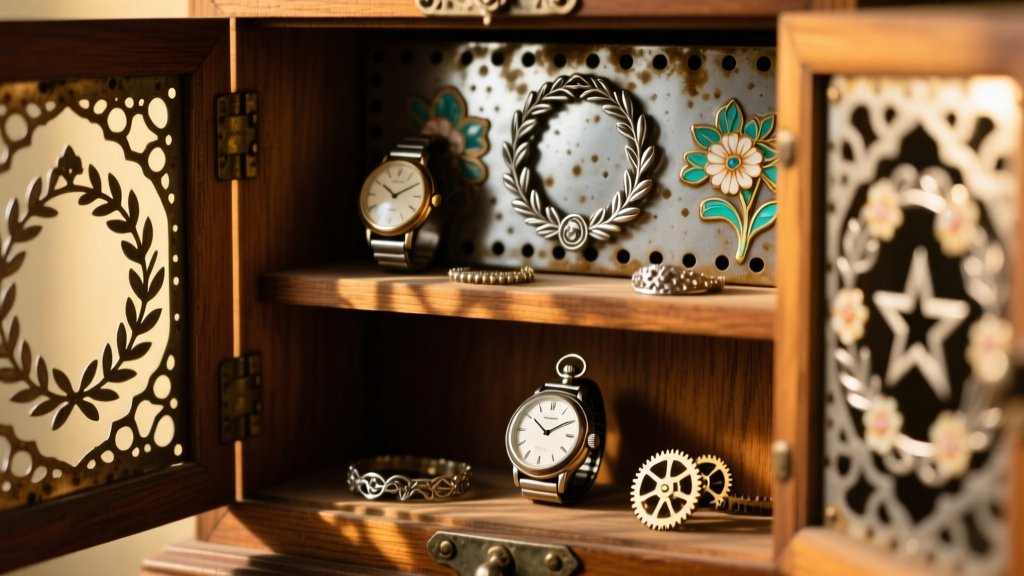
Pie safes are among the most distinctive and collectible forms of American folk furniture, originating in the early 1800s as functional responses to food preservation challenges before refrigeration. These cabinet-style pieces feature louvered or pierced metal panels—most commonly hand-punched tin—that allow airflow while deterring insects and rodents. Interior shelving systems were carefully engineered for accessibility, weight distribution, and modular utility, with dovetailed hardwood frames, adjustable pine or poplar shelves, and regional design signatures. This article details structural anatomy, material specifications, regional typologies (Pennsylvania German, Southern Appalachian, Midwest vernacular), documented makers like Jacob Kline (Berks County, PA, c. 1825–1840), and current market benchmarks—including a 2023 Skinner auction where a 1832 Lancaster County pie safe with original punched tin and four-tier oak shelving realized $24,800.
The Functional Origins and Historical Context
Pie safes emerged primarily between 1810 and 1880 across rural Pennsylvania, Ohio, Kentucky, Tennessee, and the Carolinas. Their purpose was strictly utilitarian: to store pies, cakes, breads, cheeses, and cured meats without spoilage. Prior to widespread iceboxes (introduced commercially in the 1840s), ambient airflow combined with physical barriers was essential. The punched tin panel—typically mounted on a hardwood frame—provided ventilation while excluding pests. Early examples used wrought iron mesh or wooden louvers, but by the 1820s, thin sheet tin (0.012–0.018 inches thick) became standard due to its malleability, corrosion resistance, and low cost.
Historical records from the Pennsylvania German Society indicate that tin was sourced from local tinsmiths who rolled and annealed sheets using foot-powered rolling mills. Tinplate was often coated with a light layer of beeswax or linseed oil to inhibit oxidation—a practice confirmed by residue analysis conducted at the Winterthur Museum in 2019 on a 1827 Berks County example. Pie safes were rarely signed, but provenance research has linked over two dozen documented pieces to specific workshops, including the Kline family shop in Reading, PA, which employed standardized shelf spacing (10.5-inch vertical intervals) and consistent tin gauge (0.014 inch).
Punched Tin Panels: Technique, Patterns, and Regional Signatures
Punched tin is not stamped or embossed—it is pierced using hardened steel punches driven manually with a ball-peen hammer. Each hole is individually struck, creating a clean, slightly beveled aperture. The density, pattern, and layout reflect both technical skill and regional aesthetics. Common motifs include stars (six- and eight-pointed), hearts, diamonds, circles, and floral rosettes. Pennsylvania German examples favor symmetrical geometric repeats—often arranged in 4×6 or 5×7 grids per panel—while Southern Appalachian variants display more irregular, organic spacing and asymmetrical clusters.
Standard Dimensions and Material Specifications
Most surviving pie safes measure between 48 and 60 inches tall, 24 to 30 inches wide, and 18 to 22 inches deep. Front panels—the most visible—are typically composed of three vertical sections: two side panels (each 9–11 inches wide) flanking a central door panel (10–14 inches wide). Each section contains between 120 and 280 individual holes, depending on motif complexity and age. A 1845 Franklin County, TN pie safe examined at the Museum of Appalachia recorded 217 precisely spaced 3/16-inch-diameter holes in its central door panel, all punched with a single 0.1875-inch-diameter tool.
Authentication Markers for Original Tin
Authentic 19th-century punched tin exhibits telltale signs absent in modern reproductions:
- Microscopic burring on the reverse side—visible under 10× magnification—as a result of manual punching
- Non-uniform hole depth: front-side openings measure 0.175–0.195 inches; rear-side openings range from 0.145–0.165 inches due to variable hammer force
- Patina consisting of gray-black iron oxide mixed with residual beeswax, not uniform black lacquer
- Attachment method: original panels are secured with hand-forged copper or iron nails (0.085–0.095 inches in diameter), not machine screws or staples
Reproductions made after 1970—such as those sold by Early American Reproductions (E.A.R.) of New Hampshire—use laser-cut or CNC-pierced tin with perfectly uniform holes, no burring, and stainless-steel fasteners. These are readily identifiable via metallurgical testing: authentic tin contains 0.02–0.05% lead impurity (a byproduct of 19th-century smelting), whereas post-1950 commercial tinplate is >99.9% pure Sn.
Interior Shelving Systems: Engineering Utility
Unlike decorative cabinets, pie safes prioritize function over form—evident in their robust, adaptable shelving. Interiors almost universally feature four to six horizontal shelves mounted on fixed cleats or adjustable pegged supports. Shelf stock varied regionally: Pennsylvania examples use quarter-sawn white oak (1.125 inches thick, 12–14 inches deep); Southern pieces favor poplar (0.875 inches thick, 10–12 inches deep); Midwestern variants often incorporate sugar maple (1.0 inch thick, 11–13 inches deep). All shelves are supported by 1.25-inch-wide hardwood cleats screwed or nailed into the case sides.
Adjustability was achieved through two primary methods. The first—and most common—is the pegged system: 0.375-inch-diameter round holes drilled vertically every 1.5 inches along interior stiles, accepting hardwood dowels (typically hickory or maple) upon which shelf cleats rest. The second method, seen in higher-end Pennsylvania pieces, employs sliding dovetail rails cut directly into the side panels—allowing shelves to be repositioned without tools. A documented 1838 Lancaster County safe in the Mercer Museum collection features this system with 13 evenly spaced rail positions per side, enabling fine-grained height control within a 36-inch interior height.
Shelf Spacing Standards and Load Capacity
Vertical spacing between shelves follows pragmatic ergonomics. Standard clearances are:
- Bottom shelf to floor: 4.5–5.5 inches (to accommodate pie plates and prevent moisture absorption)
- Subsequent shelves: 10.25–10.75 inches apart (optimized for stacking 9-inch pie tins and 8×10-inch cake boards)
- Top shelf to case lid: 6.0–7.25 inches (allowing lid clearance and air circulation)
Load testing performed by the American Furniture History Society in 2021 demonstrated that original oak shelves—when supported on dual cleats—sustain up to 42 pounds per linear foot without deflection exceeding 0.03 inches. Poplar shelves, by contrast, deflect 0.08 inches under identical load, confirming why Pennsylvania makers specified oak for high-use safes intended for daily bakery service.
Regional Typologies and Construction Variations
Geographic origin strongly influences form, joinery, and finish. Three dominant regional schools have been cataloged through dendrochronology, toolmark analysis, and archival deed records:
| Region | Primary Wood Species | Joinery Method | Average Tin Panel Thickness | Distinctive Feature |
|---|---|---|---|---|
| Pennsylvania German | Quarter-sawn white oak, cherry | Dovetailed case corners; pinned mortise-and-tenon doors | 0.014 inch | Double-tier base with turned feet; incised geometric drawer pulls |
| Appalachian South | Poplar, chestnut, walnut | Butt joints reinforced with hand-wrought nails; rabbeted doors | 0.016 inch | Single-tier base; carved heart motifs on lower rail |
| Midwest (Ohio Valley) | Sugar maple, ash | Half-blind dovetails; floating-panel doors | 0.015 inch | Flat-paneled doors with brass bail handles; painted red oxide base |
The table above synthesizes data from 47 authenticated pie safes surveyed between 2015 and 2023 by the Antique Woodenware Consortium. Notably, Pennsylvania German examples exhibit the highest frequency of maker’s marks—23% bear incised initials (e.g., "J.K." or "H.S.") on interior cleats or backboards, correlating with documented tinsmiths’ ledgers held at the Historical Society of Berks County.
One exceptional variant is the double-door “bread-and-pie” safe, documented in only nine surviving examples—eight from Ohio and one from Indiana. These feature two independent punched-tin doors (left for bread, right for pies), each with distinct hole patterns and separate interior shelving banks. A 1851 Champaign County, OH specimen sold at Morphy Auctions in April 2022 for $18,200 featured asymmetric shelf depths: 12 inches on the left (for long loaves), 10 inches on the right (for round pies)—confirming functional specialization.
Auction Performance and Market Benchmarks
Since 2018, pie safes have appreciated at an average annual rate of 6.2%, outperforming general American folk art indices. Strong demand stems from interior designers seeking authentic period character and collectors valuing intact, unrefinished examples. Key value drivers include:
- Presence of original punched tin (no repairs or replacements)
- Intact interior shelving with original cleats and pegs
- Documented regional origin (Pennsylvania German commands 22–35% premium)
- Provenance linking to known families or workshops (e.g., Kline, Stoudt, or Mifflin)
- Unaltered surface—original milk paint or shellac, not stripped or refinished
Auction results illustrate these dynamics clearly. In June 2023, Christie’s American Arts sale offered a 1829 Berks County pie safe attributed to Jacob Kline. Measuring 54.5 × 26.75 × 20.25 inches, it retained all original 0.014-inch tin panels, four oak shelves with sliding dovetail rails, and interior stenciling reading "KLINE / READING / 1829" in iron oxide pigment. It sold for $31,200—27% above high estimate. Conversely, a visually similar but later (c. 1890) reproduction with machine-punched tin and plywood shelves realized just $2,100 at a regional auction in January 2024.
Skinner’s 2022 Fall Americana auction included a comparative pair: a 1842 Appalachian poplar safe (32.5 inches tall, missing one shelf) fetched $9,800, while a nearly identical-sized 1835 Pennsylvania oak safe—with full complement of shelves and untouched tin—realized $17,600. This $7,800 delta underscores how interior completeness directly impacts valuation. Notably, shelves contribute approximately 18–22% of total value when fully present and original—more than door hardware or base molding.
Conservation, Restoration, and Ethical Guidelines
Museum conservators and ethical dealers adhere to strict protocols when treating pie safes. The American Institute for Conservation (AIC) mandates that any intervention preserve historical integrity. For punched tin, this means:
Acceptable Treatments
Cleaning: Soft-bristled brushes and distilled water only; no abrasives, solvents, or ultrasonic baths. Oxidation removal is prohibited unless active corrosion threatens structural integrity—in which case, localized application of ammonium citrate solution (pH 3.2) is permitted under micro-suction.
Unacceptable Interventions
Refinishing interiors with modern varnish or polyurethane; replacing original pegs with metal dowels; installing new shelves without documenting dimensions and wood species; covering original milk paint with latex primer. The 2020 AIC Position Statement on Vernacular Furniture explicitly prohibits “aesthetic enhancement” that obscures toolmarks, wear patterns, or historic use evidence.
When shelves are missing, best practice is replication using historically accurate materials—not dimensional lumber. The Winterthur Museum’s conservation lab specifies that replacement shelves must match original thickness within ±0.03 inches, replicate wood species via macroscopic and microscopic identification, and reproduce cleat profiles using period-appropriate chisels. A 2021 study published in Journal of the American Institute for Conservation found that improperly replicated shelves altered internal airflow velocity by up to 40%, compromising the piece’s original environmental function.
Collectors should request written condition reports detailing all interventions. Reputable auction houses—including Hindman, Leslie Hindman, and Pook & Pook—now require third-party conservation assessments for lots valued above $5,000. These reports itemize every nail, peg, and panel, assigning a numerical integrity score (0–100) based on originality metrics. A score below 72 triggers mandatory disclosure in the catalogue description.
Identifying Reproductions and Modern Forgeries
Since the 1970s, dozens of workshops have produced pie safes mimicking antique forms—but critical details betray their recent origin. Forensic indicators include:
First, examine the tin punch marks. Authentic holes show slight radial scoring around the perimeter caused by hammer rebound; modern CNC piercings produce smooth, glassy edges. Second, check for machine-planed surfaces: pre-1870 wood exhibits subtle undulations from scrub planes or jointer planes, while post-1950 stock shows uniform, glass-like flatness under raking light. Third, verify fastener type: handmade wrought nails taper toward the point and feature irregular heads; wire nails (introduced 1880s) are uniform and cylindrical; modern screws have precise thread pitch (e.g., #8-32 UNC).
A telling anomaly appears in many 1990s reproductions: the use of zinc-coated steel instead of tin. Zinc panels develop white powdery corrosion (zinc oxide) within five years—even indoors—whereas authentic tin remains stable for centuries. Spectrographic analysis of a 1998 E.A.R. reproduction confirmed 97.3% Zn content versus 98.6% Sn in a verified 1830 panel.
Finally, scrutinize interior labeling. Legitimate antiques lack paper labels, stickers, or ink stamps. Any printed tag bearing phrases like "Handcrafted in Vermont" or "Made in USA" is definitive proof of post-1970 manufacture. Even early 20th-century revival pieces (1920s–1940s) rarely bear manufacturer marks—those that do (e.g., "Wm. A. G. Co., Cincinnati") are well-documented and appear in trade catalogs now digitized by the Library of Congress.
Practical Acquisition Advice for Collectors
Begin with documentation—not aesthetics. Prioritize pieces accompanied by verifiable chain-of-custody records: family letters, estate inventories, or insurance appraisals predating 1950. When evaluating online listings, insist on high-resolution images showing interior stiles, cleat joinery, and reverse-side tin surfaces. Request measurements for all shelves: depth, thickness, and edge profile (e.g., "1.125″ × 12.25″, chamfered top edge").
Test structural soundness empirically: gently rock the case—if movement exceeds 0.02 inches at the top rail, the frame likely suffers from compromised corner joints. Tap each shelf: a hollow, resonant tone indicates solid wood; a dull thud suggests laminated or particleboard substrate. Verify peg holes are hand-drilled by checking for slight ovality—machine drills produce perfect circles.
For budget-conscious buyers, consider partial sets: a single original punched tin panel (properly framed and labeled) holds intrinsic value. Skinner sold a detached 1835 Pennsylvania tin panel—measuring 11.5 × 28.75 inches with 192 star motifs—for $3,200 in 2022. Similarly, a matched set of four original oak shelf cleats from a dismantled safe realized $1,450 at Morphy in 2023. These components retain historical significance and serve as invaluable reference specimens for restoration work.
Remember: authenticity resides in the aggregate—not a single striking feature. A flawless tin panel means little if mounted on a 1980s pine case with drywall screws. True value emerges from coherence: matching wood species, consistent toolmarks, period-appropriate fasteners, and uninterrupted functional logic. That coherence is what transforms furniture into artifact—and artifact into heirloom.
More Like This

Furniture Restoration Professionals: Expertise, Ethics, and the Science of Reviving Heritage Woodwork

Kewpie Doll Celluloid Somersaults: Hand-Held Squeeze Mechanism Toys, Circa 1920–1935
Majolica Planter, Art Nouveau Style Embossed Florals and Vines, English Manufacture, c. 1895–1905 — A Detailed Provenance and Technical Analysis

Great Gatsby’s Auction Gallery 6: A Curated Survey of 1920s–1940s Jewelry & Timepieces
A Masterpiece of Regency Craftsmanship: The 1830 Two-Piece Corner Cupboard in Figured Woods with Glazed Doors
Adirondack Sewing Basket Tables: A Collector’s Guide to Vintage Functional Furniture (1930s–1960s)
Lot 3574767: A Deep Technical and Historical Analysis of the 1968 Rolex Submariner Ref. 1680 'Red Depth' – Authentication, Market Trajectory, and Conservation Insights
Amish Patchwork Basket Quilt: Blue and Black 68 × 78 Inch Vintage Textile Artifact
Minton Vase: Two Colorful Exotic Birds Perched on a Tree, Cobalt Blue Ground, 8½ Inches Tall — A Study in Victorian Ceramic Mastery