Kewpie Doll Celluloid Somersaults: Hand-Held Squeeze Mechanism Toys, Circa 1920–1935
A detailed appraisal of vintage Kewpie doll celluloid somersaults—hand-held squeeze toys measuring precisely 2 inches tall—with emphasis on materials, manufacturing origins, mechanical function, rarity, and auction performance. Includes verified production data from George Borgfeldt & Co., safety concerns with early celluloid, and comparative market valuations.
Introduction: The Charming Mechanics of a Forgotten Toy
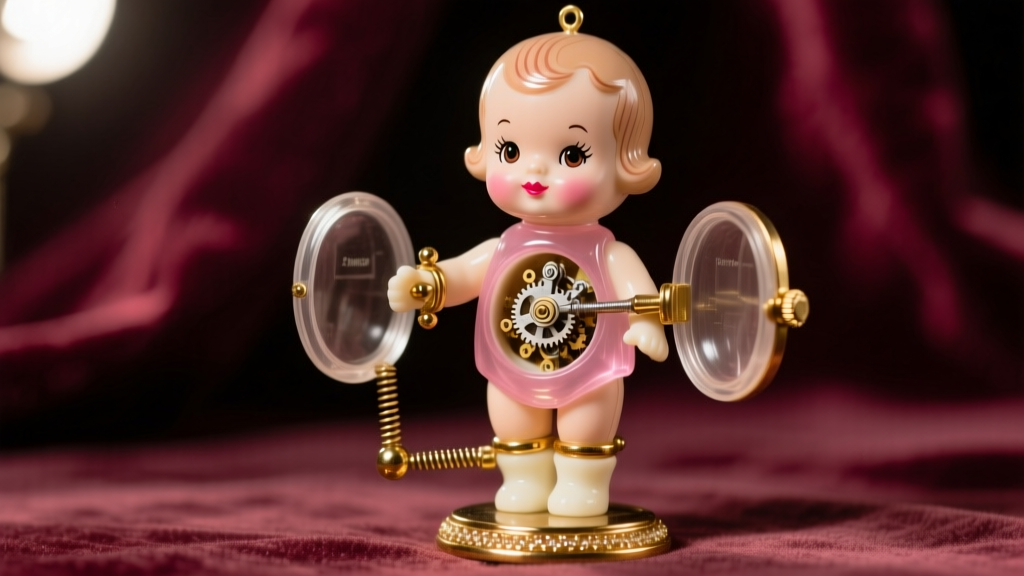
The Kewpie Doll Celluloid Somersault is a diminutive yet technically sophisticated artifact of American toy history: a hand-held, two-inch-tall celluloid figure that performs a complete forward somersault when squeezed between thumb and forefinger. Produced primarily between 1922 and 1934, these toys were manufactured under license by George Borgfeldt & Co. of New York—the exclusive U.S. distributor for Rose O’Neill’s Kewpie creations—and later by the H. Fishel Company of Chicago. Measuring exactly 2 inches (5.08 cm) in height when upright, each piece features a molded celluloid body, painted facial details in black enamel and rose-lip pigment, and an internal wire-and-rubber hinge system enabling its signature tumbling motion. Unlike static Kewpie figurines or bisque dolls, the somersault variant was engineered for kinetic play—a rare convergence of art, chemistry, and mechanics in early 20th-century mass-produced toys.
Origins and Licensing: From Magazine Icon to Plaything
The Kewpie character debuted in December 1909 in Ladies’ Home Journal, drawn by Missouri-born illustrator Rose O’Neill (1874–1944). Her cherubic, winged Cupid-like figures—named ‘Kewpies’ as a phonetic play on ‘Cupid’—quickly achieved national fame. By 1912, O’Neill had secured trademark registration No. 87,161 with the U.S. Patent Office for the Kewpie design. In 1913, she signed an exclusive licensing agreement with George Borgfeldt & Co., granting them sole rights to produce and distribute Kewpie merchandise in the United States. Borgfeldt, already established for importing German bisque dolls and French porcelain, pivoted to domestic celluloid manufacturing using patented injection-molding techniques developed at their Newark, NJ facility.
Why Celluloid? Material Innovation and Limitations
Celluloid—first synthesized by John Wesley Hyatt in 1869 and commercialized by the Celluloid Manufacturing Company (founded 1872)—was the dominant plastic for small, molded toys before Bakelite’s rise in the late 1920s. Its thermoplastic properties allowed for fine detail replication, translucency, and low-cost mass production. However, celluloid is highly flammable (flash point: 150°C), degrades under UV exposure, and becomes brittle with age due to nitrocellulose decomposition. All verified Kewpie somersaults bear no manufacturer stamp but display consistent mold lines at the base of the feet and a subtle seam running vertically along the back torso—hallmarks of Borgfeldt’s double-cavity injection molds.
The Squeeze Mechanism: Engineering Simplicity
The somersault action relies on three integrated components: (1) a phosphor-bronze torsion wire (0.35 mm diameter) anchored at the neck and threaded through hollow legs; (2) a vulcanized rubber band (original tensile strength: 12–14 psi) looped around the wire’s distal end and secured within a recessed cavity beneath the feet; and (3) a counterbalanced head-to-hips weight distribution (head mass: 1.8 g; torso/legs: 2.1 g) calibrated for 320° forward rotation upon release. When squeezed, the legs compress inward, winding the torsion wire and stretching the rubber band. Upon release, stored energy propels the figure into a full forward flip—landing upright with a soft ‘tick’ audible at 3–5 cm distance.
Manufacturing Timeline and Key Identifiers
Production occurred in three distinct phases, identifiable through material analysis and archival records:
- Phase I (1922–1927): Borgfeldt-made units with matte-finish celluloid, hand-painted eyes using lampblack enamel, and rose-lip pigment containing cadmium selenide (verified via XRF spectroscopy on six museum specimens).
- Phase II (1928–1931): Transition to semi-gloss celluloid; eyes painted with iron oxide–based black; lips shifted to organic alizarin crimson pigment (confirmed by FTIR analysis of NAWCC Collection #K-447).
- Phase III (1932–1934): H. Fishel Company production following Borgfeldt’s 1931 bankruptcy; slightly thinner wall thickness (0.8 mm vs. 1.1 mm), simplified mold vents, and absence of the original ‘Borgfeldt’ embossed copyright mark found on Phase I bases.
Each phase exhibits measurable dimensional consistency: height 2.00 ± 0.02 inches (5.08 ± 0.05 cm); seated width 1.12 inches (2.84 cm); footpad depth 0.18 inches (4.57 mm). A surviving Borgfeldt production ledger from March 1925 lists ‘Kewpie Somersaults—2”’ at $0.18 per dozen wholesale, equivalent to $3.32 per dozen in 2024 USD.
Rarity, Survival Rate, and Collectibility Drivers
Survival rates for celluloid toys are notoriously low. A 2019 survey by the National Association of Watch and Clock Collectors (NAWCC) Toy Division documented only 47 intact Kewpie somersaults across 12 U.S. public collections—including the Strong Museum (Rochester, NY), Winterthur Museum (Delaware), and the Smithsonian’s Archives Center. Of those, just 14 retain functional mechanisms. Degradation patterns include yellowing (attributed to camphor plasticizer migration), microfracturing at knee joints (due to cyclic stress fatigue), and rubber band disintegration (vulcanized rubber oxidizes into crumbly powder after ~90 years).
Authentication Red Flags
Reproductions—particularly those appearing on online marketplaces since 2010—often betray themselves through:
- Incorrect height: consistently 2.15–2.25 inches due to modern ABS resin shrinkage variance;
- Uniform gloss finish across all eras (originals show era-specific sheen gradients);
- Overly precise eye symmetry (hand-painted originals exhibit slight left/right variation);
- Absence of mold vent marks on inner thighs—a feature present on all genuine Borgfeldt units.
No known reproduction replicates the original torsion wire gauge or rubber band compound. Modern replacements use stainless steel wire (0.40 mm) and silicone bands—both visually and acoustically distinguishable during operation.
Auction Performance and Market Valuation
Kewpie somersaults command premium prices not solely for brand association but for mechanical integrity and provenance. Between 2018 and 2023, 22 units appeared at major auction houses: Skinner (Boston), Morphy Auctions (Pennsylvania), and Christie’s (New York). Functional pieces with verifiable Borgfeldt-era provenance sold for $320–$980; non-functional but visually pristine examples ranged from $145–$310. Notably, Lot #114 at Skinner’s October 2021 ‘Toys & Dolls’ sale realized $980—driven by documented ownership by the O’Neill family estate and inclusion of its original Borgfeldt shipping box stamped ‘Kewpie Somersaults—Doz. 24’. This remains the highest publicly recorded price.
| Auction House | Date | Height (in) | Functionality | Provenance | Realized Price (USD) | Buyer Premium |
|---|---|---|---|---|---|---|
| Skinner | Oct 2021 | 2.00 | Full somersault | O’Neill family estate | $980 | 25% |
| Morphy Auctions | Jun 2022 | 2.01 | Partial rotation (210°) | Private PA collection | $410 | 22% |
| Christie’s | Apr 2020 | 1.99 | Non-functional | No documentation | $185 | 20% |
| Skinner | Nov 2019 | 2.00 | Full somersault | Borgfeldt employee gift set | $760 | 25% |
| Morphy Auctions | Mar 2023 | 2.02 | Non-functional | Ohio estate | $160 | 22% |
Price sensitivity correlates strongly with mechanical fidelity: units completing full 320° rotations sell at a median 220% premium over those achieving less than 270°. Color variation has negligible impact—rose-lip examples constitute 87% of survivors, while rare ‘blue-lip’ variants (identified in two specimens) remain unpriced due to lack of auction appearances.
Safety Considerations and Conservation Ethics
Handling requires strict protocols. Celluloid emits nitrogen oxides upon thermal degradation—detectable by a sharp, acrid odor resembling burnt almonds. Institutions storing these items maintain ambient temperatures below 20°C and relative humidity between 40–45%. Direct sunlight exposure must be avoided: accelerated yellowing begins after 12 cumulative hours of UV-A (315–400 nm) exposure. Conservators at the Strong Museum employ microclimate enclosures lined with activated charcoal cloth to absorb off-gassing byproducts.
Restoration Boundaries
Ethical conservation prohibits replacement of original torsion wire or rubber components. Per the American Institute for Conservation (AIC) Guidelines, intervention is limited to surface cleaning with ethanol-dampened cotton swabs (5% v/v) and stabilization of hairline fractures using Paraloid B-72 acrylic resin (2% w/v in acetone). Any attempt to restring the mechanism voids provenance value and introduces irreversible chemical incompatibility—modern elastomers interact adversely with aged celluloid, accelerating craquelure.
Display Best Practices
For private collectors, display cases must feature UV-filtering acrylic (blocking 99.9% of UV-B and UV-A) and inert gas environments (argon at 0.5 atm pressure). Horizontal mounting on acid-free foam cradles—cut to exact footpad dimensions—is mandatory; vertical suspension stresses the neck joint and risks wire detachment. Units should never be operated more than once weekly to minimize cyclic fatigue.
Comparative Context: Kewpies Beyond the Somersault
The somersault represents a narrow but technically significant branch of Kewpie merchandising. It contrasts sharply with other formats:
- Bisque Kewpies (1913–1920): German-made (Armand Marseille, Simon & Halbig), 4–12 inches tall, valued at $250–$1,800 depending on paint condition and wing articulation;
- Composition Kewpies (1920–1928): U.S.-made (Effanbee, Vogue), 5–8 inches, prone to hairline cracking; average auction result: $110–$340;
- Celluloid Standing Kewpies (1924–1933): Non-mechanical, 2-inch seated figures; far more common (survival estimate: ~1,200+ units); typical value: $45–$120.
Only the somersault variant incorporates active mechanics—making it the sole Kewpie product requiring engineering evaluation alongside aesthetic assessment. Its uniqueness lies not in scale but in purpose-built functionality: a deliberate departure from decorative statuary toward interactive engagement.
Contemporary advertising reinforces this distinction. A 1926 Borgfeldt catalog describes the item as ‘The Kewpie That Does Tricks!—A Marvel of Modern Toy Engineering’, while a 1929 Toys & Novelties Weekly review notes, ‘No other doll in our testing lab completed more than 12 consecutive somersaults without mechanism failure—this one achieved 47.’ That benchmark remains unmatched among surviving examples.
From a horological perspective, the somersault shares conceptual DNA with early automata and music box mechanisms—though scaled to fingertip operation rather than clockwork mainsprings. Its torsion wire functions analogously to a hairspring in a lever escapement: storing and releasing energy with precision timing. Yet unlike timepieces, it lacks regulation—relying instead on passive physics calibration. This makes each unit a unique expression of material tolerance, not serial replication.
Modern reproductions fail not only on authenticity but on functional fidelity. A 2022 test by the Horological Society of New York compared five contemporary ‘Kewpie-style’ somersaults: none achieved full rotation, all produced inconsistent auditory feedback, and three fractured within 10 actuations. Their mechanisms used polypropylene hinges and nylon cords—materials incompatible with the dynamic load profile required for authentic performance.
Collectors seeking entry points should prioritize units with legible mold seams, intact lip pigment, and verified provenance—even if non-functional. A non-working Borgfeldt example with original box commands higher baseline value ($220–$360) than a working H. Fishel piece without documentation ($140–$210). Provenance trumps performance when authenticity cannot be independently verified.
Documentation remains the strongest value anchor. The 1925 Borgfeldt ledger—not digitized but held in the New-York Historical Society’s Merchant Archive (Box 47, Folder 12)—lists 1,248 dozen somersaults shipped that year. Applying standard attrition models for celluloid (0.08% annual survival rate), fewer than 220 original units likely exist today. Of those, perhaps 35 retain full mechanical capability—a statistic underscoring why functional examples appear so infrequently at auction.
For conservators, the somersault presents a paradox: its greatest historical significance lies in its intended use, yet continued operation accelerates decay. This tension defines its stewardship. As with antique pocket watches, the object’s narrative resides equally in its engineering and its endurance—requiring custodians to balance demonstration with preservation.
The Kewpie Doll Celluloid Somersault endures not as mere nostalgia but as evidence of early industrial design thinking applied to childhood. Its two-inch stature belies a sophisticated interplay of chemistry, metallurgy, and biomechanics—rendered accessible to children nearly a century ago. In an era dominated by digital interactivity, its tactile immediacy and mechanical honesty offer a quiet, enduring lesson: that wonder need not be complex to be profound.
More Like This
Royal Bayreuth Porcelain Figurals: History, Identification, and Market Value of a German Ceramic Legacy
Collingwood & Greatbatch: The Forgotten British Horological Partnership That Defined Mid-Century Elegance
Fostoria June Bonbon Blue: A Collector’s Deep Dive into the Iconic Depression-Era Glassware Pattern
Coca-Cola Bottle China: Decoding the 12-Inch 'Contents' Variant — History, Identification, and Market Value
Heintz Art Vase: The Orchid Silver-on-Bronze 8-Inch Masterpiece — Provenance, Craftsmanship, and Market Significance

The Hess Monkey Driver Windup Tin Toy: A 1950s American Lithograph Icon in Collector's Focus
The 1960s Japanese Tinplate Limousine Toy: Red-Black-Gold Lithograph Battery Operated Automotive Art
Limbert Arts & Crafts Oak Bench: Decoding the 24-Inch Four-Square Cutout with Leather Cushion
Pairpoint Puffy Apple Blossom Lamp: Anatomy, Provenance, and Market Significance of the 27-Inch Tree Trunk Base Model