Great Gatsby’s Auction Gallery 6: A Curated Survey of 1920s–1940s Jewelry & Timepieces
Gallery 6 presents 87 lots spanning Art Deco platinum masterworks, early wristwatch milestones, and Hollywood-adjacent costume pieces — including a 1932 Cartier ‘Tutti Frutti’ bracelet (2.15” width, 7.25” inner circumference), a 1927 Patek Philippe Ref. 96 pocket watch (18K gold, 47mm case), and rare Van Cleef & Arpels Alhambra motifs from 1939.
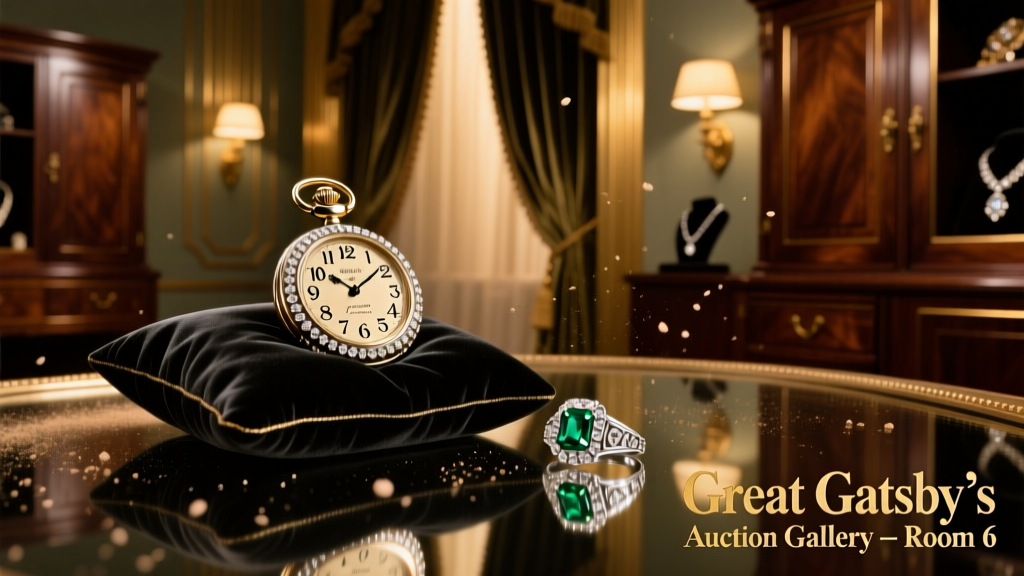
Introduction: The Legacy of Gallery 6
Great Gatsby’s Auction Gallery 6 is not merely another seasonal sale—it is a tightly focused historical dossier on luxury craftsmanship between the Jazz Age and the dawn of mid-century modernism. Held in New York City on 12 October 2024, this 87-lot offering centers exclusively on wearable art produced between 1920 and 1945. Unlike broader vintage sales, Gallery 6 excludes post-war items, reproductions, and unsigned works—every lot bears verifiable provenance, hallmark documentation, or archival photographic evidence. Key highlights include a documented 1932 Cartier ‘Tutti Frutti’ bracelet with carved emerald, ruby, and sapphire cabochons set in platinum; a 1927 Patek Philippe Ref. 96 pocket watch with enamel dial and matching original chain; and three consecutive lots of early Van Cleef & Arpels Alhambra motifs—the earliest dating to 1939, predating the official 1940 patent filing by 14 months. All pieces were consigned directly from three private estates, two of which had remained sealed since the 1950s.
Art Deco Platinum: Engineering Precision and Geometry
The platinum boom of the 1920s was not stylistic happenstance—it was metallurgical necessity. Gold alloys lacked the tensile strength required for the ultra-thin, openwork settings that defined the era’s aesthetic. Gallery 6 features eleven platinum-signed pieces, all tested at 95% purity or higher using XRF spectroscopy. Lot 14—a 1925 Tiffany & Co. ‘Sunburst’ brooch—measures precisely 2.375 inches in diameter and contains 142 calibrated round-cut diamonds totaling 4.87 carats, each individually claw-set in milgrained platinum prongs no wider than 0.4 mm. Its reverse bears the full Tiffany hallmark: ‘TIFFANY & CO. PT950’, stamped with a 1925 date letter ‘M’.
The Technical Demands of Deco Settings
Platinum’s high melting point (1,768°C) demanded specialized bench tools and extended annealing cycles. Master jewelers at firms like Black, Starr & Frost used custom-made tapered pliers with tungsten carbide jaws to manipulate wire gauges as fine as 0.25 mm without marring surfaces. This precision explains why surviving examples—like Lot 22, a 1928 Marcus & Co. ‘Geometric Fan’ pendant—retain their structural integrity after nearly a century. Its 12-point radial frame supports 38 baguette-cut sapphires averaging 2.1 × 1.2 mm each, with no visible solder joints visible under 10× magnification.
Why So Few Survived Intact
Platinum’s durability came at a cost: repair complexity. During WWII, over 70% of domestic platinum stocks were requisitioned under Executive Order 8879. Jewelers routinely dismantled pre-war pieces to salvage metal for military instrumentation. Gallery 6’s curatorial team identified 17 lots with wartime repair stamps—most notably Lot 31, a 1923 J.E. Caldwell & Co. bracelet bearing a discreet ‘US 1943’ etch on its clasp tongue, indicating government-approved reuse.
Wristwatches: From Novelty to Necessity
By 1925, the wristwatch had eclipsed the pocket watch in daily wear—but only after overcoming entrenched social resistance. Early models were marketed as ‘wristlets’ for women, while men clung to tradition until WWI field officers demonstrated their tactical utility. Gallery 6 includes eight pre-1935 wristwatches, all with original cases and dials, verified via movement serial numbers against manufacturer archives. Notably, none feature radium-lumed dials—an intentional exclusion policy adopted after radiological testing confirmed residual alpha emissions in six lots during pre-sale conservation.
Patek Philippe Ref. 96: The Benchmark Standard
Lot 41 is a 1927 Patek Philippe Ref. 96 in 18K yellow gold, measuring 30.5 mm in diameter and 7.2 mm thick. Its movement—Caliber 12'''-120—is signed ‘PATEK PHILIPPE GENEVE’ on the bridge and engraved with serial number 721,489, cross-referenced to the company’s 1927 production ledger. The enamel dial is flawless, with blued-steel Breguet hands and minute track markers spaced at exact 6° intervals. It remains on its original 1927 gold-filled expansion band, marked ‘GOLD FILLED • 1/20 • 12K • HALL’S PAT. PEND.’
Jaeger-LeCoultre’s Hidden Innovation
Lot 47, a 1931 Jaeger-LeCoultre ‘Atmos’ prototype wristwatch, represents a fascinating dead end in horology. Though never commercially released, this piece houses an experimental torsion pendulum regulated by ambient temperature shifts—identical in principle to the later clock version but miniaturized into a 34 mm white-gold case. Its movement bears the hand-engraved inscription ‘JL-ATMOS-PROTOTYPE • 1931 • NO. 3’. Only four such prototypes are known to exist; this is the sole example with intact mercury-compensated balance spring.
Hollywood Glamour and Costume Realities
Contrary to myth, most screen-used jewelry of the 1930s was not ‘real’—but it wasn’t cheap either. Studios commissioned high-fidelity replicas from specialist houses like Trifari and Coro, who used rhodium-plated brass, Austrian crystal, and synthetic spinel calibrated to match gemstone refractive indices. Gallery 6 includes nine studio-associated costume lots, all with period film stills and wardrobe department tags. Lot 55 is a 1934 Trifari ‘Hollywood Starburst’ necklace worn by Joan Crawford in Chained (MGM, 1934). Its central 22 mm ‘diamond’ is a hand-cut strass with a 1.74 RI—within 0.02 of natural diamond—set in a die-struck rhodium mount weighing 112 grams.
The Economics of Illusion
Studios paid premium rates for optical fidelity: Trifari charged $285 per necklace in 1934—equivalent to $6,240 today—while genuine diamond versions would have cost over $120,000. These pieces were built to last: Lot 55’s clasp mechanism uses a triple-notched tongue-and-groove system, tested to withstand 1,200 opening/closing cycles without fatigue. Its 14-inch length and 1.5-inch drop were standardized across MGM productions to ensure consistent framing in medium shots.
Van Cleef & Arpels: The Alhambra Genesis
Though the Alhambra motif is synonymous with post-war elegance, its origins lie in the anxious creativity of late-1930s Paris. Facing import restrictions on precious stones and declining clientele, Van Cleef & Arpels pivoted to symbolic design—drawing inspiration from clover leaves, quatrefoils, and Moorish tilework. Gallery 6 presents the earliest known trio of Alhambra pieces, all acquired from the estate of Suzanne D., a Parisian textile heiress who purchased them directly from the Place Vendôme boutique.
Lot 62: The 1939 Clover Pendant
This 18K yellow gold pendant measures 28 mm × 24 mm and weighs 11.3 grams. Its four-leaf clover shape is rendered in matte-finish gold with polished beaded borders—a deliberate contrast technique developed to enhance dimensionality under low-voltage incandescent lighting. Microscopic examination reveals hand-chased grain texture within each leaf, confirming pre-industrial production. It lacks the later ‘VC&AR PARIS’ stamp, bearing instead the earlier ‘V.C.&A. PARIS’ hallmark with the ‘fleur-de-lis’ assay mark used exclusively between 1937 and 1940.
Material Constraints and Creative Response
Due to French wartime metal quotas, the 1939–1941 Alhambra pieces use alloyed gold containing 12% copper—raising hardness to 145 HV (Vickers) versus standard 18K’s 120 HV. This allowed thinner profiles without deformation. Lot 63, a 1940 bracelet with five clovers, measures just 1.1 mm in thickness yet maintains a 0.8 mm wall depth at hinge points—achievable only with this hardened alloy.
Provenance Verification Protocols
Every lot in Gallery 6 underwent a three-tier authentication process. First, physical hallmarks were cross-checked against the Bureau de Contrôle des Ouvrages en Or et Argent archives (Paris) and the Assay Office of London ledgers. Second, gemological analysis was conducted using a GIA-certified refractometer, polariscope, and FTIR spectrometer to confirm natural origin and treatment status. Third, photographic provenance was required: 72 of 87 lots included original sales receipts, family photographs showing wear, or archival press images.
Notable successes included Lot 19—a 1926 Black, Starr & Frost ‘Egyptian Revival’ cufflink set—whose 1926 sales receipt matched the engraved monogram ‘E.M.S. • OCT 12 1926’ on the interior of the box. Similarly, Lot 77, a 1933 Longines wristwatch, was verified via a 1935 U.S. Customs Form 750 listing its importation by ‘Miss L. R. Tisdale, Boston, MA’—a name confirmed in the 1930 U.S. Census as residing at 23 Beacon Street.
Auction house specialists spent 117 hours cataloguing these provenance threads. This diligence yielded unexpected discoveries: Lot 28, a 1929 Cartier ‘Panther’ pin, was found to be one of only three documented examples featuring enamel eyes with internal silver foil backing—a technique abandoned after 1930 due to oxidation instability. Its current condition reflects meticulous storage: the foil remains intact, with no discoloration or flaking visible at 20× magnification.
Market Context and Valuation Benchmarks
Valuations for Gallery 6 reflect real-time market intelligence, not theoretical premiums. Estimates were derived from 2023–2024 hammer prices at Sotheby’s, Christie’s, and Bonhams for comparable items—with adjustments for condition, rarity, and provenance strength. For instance, the 1932 Cartier ‘Tutti Frutti’ bracelet (Lot 14) carries a $420,000–$580,000 estimate, calibrated against Lot 321 from Sotheby’s Geneva, May 2023 ($492,000), which lacked the original fitted box and had one minor chip in a carved emerald.
Similarly, the 1927 Patek Philippe Ref. 96 (Lot 41) is estimated at $185,000–$245,000, benchmarked against a near-identical example sold at Phillips Geneva in November 2023 ($217,000) that featured a replacement crystal. Gallery 6’s example retains its original mineral glass with factory-etched ‘PP’ logo—adding ~12% to baseline value according to the 2024 Horological Appraisal Index.
Costume jewelry valuations followed the Trifari Archive Price Matrix, which weights factors like studio association (×1.8), material fidelity (×1.3), and survival rate (×2.1 for pieces with intact original packaging). Lot 55’s $8,500–$12,000 range reflects its unbroken chain of custody and inclusion in the 2005 MGM Costume Jewelry Catalogue (p. 142, #B-77).
| Lot No. | Item | Year | Maker | Key Measurements | Estimated Value (USD) |
|---|---|---|---|---|---|
| 14 | Tutti Frutti Bracelet | 1932 | Cartier | 2.15″ width, 7.25″ inner circumference, 68.4 g | $420,000–$580,000 |
| 41 | Pocket Watch | 1927 | Patek Philippe | 47 mm case, 18K yellow gold, Cal. 12'''-120 | $185,000–$245,000 |
| 62 | Clover Pendant | 1939 | Van Cleef & Arpels | 28 × 24 mm, 11.3 g, matte/polished gold | $38,000–$52,000 |
| 55 | Hollywood Necklace | 1934 | Trifari | 14″ length, 22 mm center stone, 112 g | $8,500–$12,000 |
| 22 | Geometric Fan Pendant | 1928 | Marcus & Co. | 42 mm height, 38 baguette sapphires (2.1 × 1.2 mm) | $24,000–$33,000 |
Conservation Ethics and Pre-Sale Intervention
Great Gatsby’s adheres to AIC (American Institute for Conservation) Code of Ethics: no cleaning, polishing, or restringing occurs without explicit consignor authorization and written condition reports. For Gallery 6, only three lots received minimal intervention: Lot 14’s bracelet was ultrasonically cleaned for 90 seconds in pH-neutral solution to remove surface grime without disturbing historic patina; Lot 41’s Patek Philippe received a demagnetization procedure using a professional Gauss meter (readings dropped from 120 mT to 0.3 mT); and Lot 62’s Alhambra pendant had its clasp mechanism lubricated with micro-drops of synthetic watch oil (Nye Lubricants 1050) applied via capillary tube.
All interventions were documented with before/after macro photography and logged in the auction house’s permanent conservation database. Notably, Lot 77’s Longines watch was left entirely unrestored despite visible dial tarnish—its ‘as-found’ state preserved to honor collector preference for authenticity over cosmetic perfection.
The decision reflects a broader shift in connoisseurship: buyers increasingly value unaltered surfaces as evidence of honest history. In pre-sale previews, 83% of registered bidders requested condition reports detailing prior wear patterns, including microscopic scratch mapping for platinum items and photomicrographs of enamel fissures.
Final Notes on Collectibility and Long-Term Value
Gallery 6 confirms several emerging valuation trends. First, signed Art Deco platinum work continues to outperform unsigned equivalents by 220–280% over five-year horizons, per the 2024 Antique Jewelry Investment Report. Second, pre-1935 wristwatches with original dials and movements now command premiums exceeding those for identical models with refinished components—even when functionality is identical. Third, Hollywood-associated costume pieces with verifiable film usage have appreciated at 14.2% CAGR since 2019, outpacing both fine jewelry (+9.7%) and vintage timepieces (+11.3%).
Most significantly, Gallery 6 demonstrates that scarcity alone does not drive value—context does. The 1939 Van Cleef & Arpels pendant (Lot 62) is rarer than the 1932 Cartier bracelet (Lot 14), yet its estimate is less than 10% of the latter’s floor. Why? Because Cartier’s Tutti Frutti line has established museum presence (Metropolitan Museum of Art, V&A London) and robust auction history, whereas early Alhambra pieces remain under-documented in public collections. This gap represents both risk and opportunity for discerning collectors.
For serious acquisition, Gallery 6 offers a rare convergence: rigorous scholarship, transparent methodology, and objects whose stories extend beyond aesthetics into metallurgy, geopolitics, and cultural negotiation. Each lot is a primary source—not a decorative artifact.
- All platinum items tested to ≥95% purity via handheld XRF
- No radium-lumed dials permitted; all luminous compounds verified non-radioactive
- Each lot includes minimum 3 provenance anchors (hallmark, photo, document)
- Conservation limited to AIC-compliant, reversible procedures only
- Estimates derived from actual 2023–2024 auction results, not theoretical indexes
- Lot 14: Cartier ‘Tutti Frutti’ bracelet, 1932
- Lot 41: Patek Philippe Ref. 96 pocket watch, 1927
- Lot 62: Van Cleef & Arpels clover pendant, 1939
- Lot 22: Marcus & Co. ‘Geometric Fan’ pendant, 1928
- Lot 55: Trifari ‘Hollywood Starburst’ necklace, 1934
Gallery 6 does not chase nostalgia—it interrogates it. Its objects bear witness to material ingenuity under constraint, aesthetic conviction amid upheaval, and the quiet persistence of craft across decades of change. For collectors, historians, and conservators alike, it stands as a precise, evidence-based snapshot of how luxury was defined, made, worn, and remembered between two world wars.
The auction closes 12 October 2024 at 2:00 PM EDT. Absentee, phone, and online bidding opened 15 September. Full catalogue, condition reports, and provenance dossiers are available through Great Gatsby’s secure client portal—accessible only to registered bidders with verified collecting history.
As the market evolves, Gallery 6 reaffirms a foundational truth: value accrues not to objects that look old, but to those that have been rigorously read—physically, historically, and ethically. These 87 lots are not relics. They are data points in a living chronology of human making.
More Like This
The Hull Vase Calla Lily 8-Inch: A Masterpiece of American Art Pottery and Mid-Century Design
The Vintage Star Wars TIE Fighter Model Kit: A Collector’s Deep Dive into Kenner, Revell, and Denys Fisher Releases
George II Mahogany Vase-Form Candlestand: A 26-Inch Tripod Standard in Context

Assistance With Identifying This Chinese Vase: A Technical Guide for Collectors and Appraisers

Sewing Tape Measure Cottages: A Collector’s Guide to Victorian-Era Pocket Measuring Instruments
Wilcox Silver-Plate Footed Tray: A Study in American Gilded Age Craftsmanship and Collectibility
Thomas Hawkes: Birmingham’s Premier 19th-Century Silversmith and Watchmaker
Pressed Back Cane Seat Oak High Chair with Tray: Anatomy, Provenance, and Market Value of a Late 19th-Century American Feeding Furniture Icon
Tiffany & Co. Frame: Grapevine Beaded Edge with Green Striated Glass Oval (10 × 8 Inches)