The Stickley Brothers and Their Factories: Craftsmanship, Innovation, and the Rise of American Arts & Crafts Furniture
A detailed examination of Gustav, Leopold, Albert, and John Stickley’s interconnected enterprises—from Gustav’s Craftsman Workshops in Syracuse to L. & J.G. Stickley’s headquarters in Fayetteville—covering factory locations, production timelines, design philosophies, labor practices, and surviving artifacts including clocks, lighting, and metalwork.
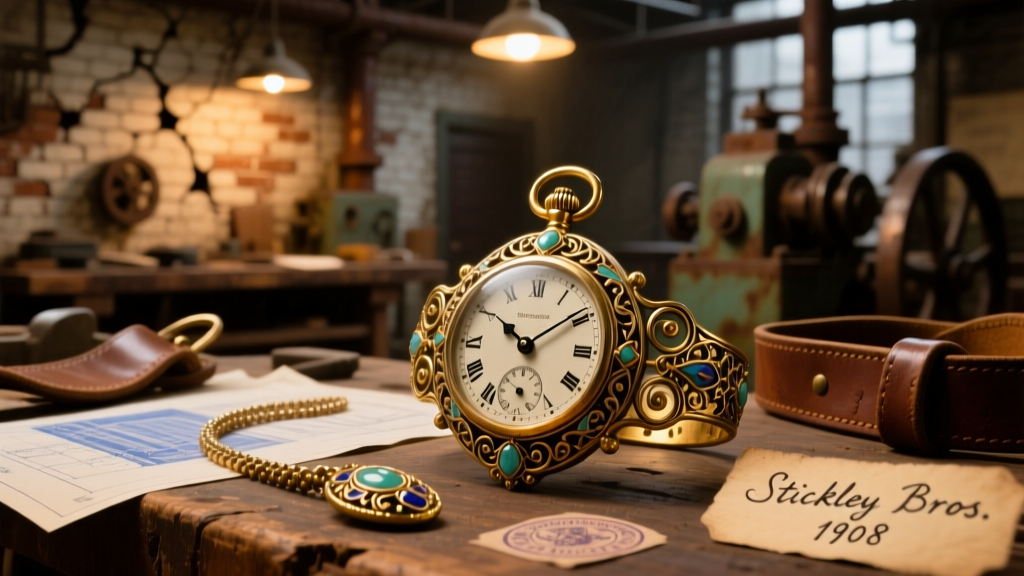
The Stickley brothers were not a monolithic entity but a constellation of interrelated yet fiercely independent furniture makers whose factories defined the physical and philosophical infrastructure of the American Arts & Crafts movement between 1898 and 1930. Gustav Stickley founded the Craftsman Workshops in Syracuse, New York, in 1900; his younger brothers Leopold and John launched L. & J.G. Stickley in Fayetteville in 1902; Albert Stickley operated Stickley Bros. Co. in Grand Rapids from 1898; and Charles Stickley briefly ran Stickley & Brandt in Syracuse before dissolving the partnership in 1901. Each factory employed distinct manufacturing methods, signature hardware (like Gustav’s hammered copper hinges and L. & J.G.’s octagonal brass drawer pulls), and marketing strategies—including Gustav’s The Craftsman magazine and L. & J.G.’s nationally distributed catalogues. This article details their geographic footprints, workforce composition, material specifications, tooling innovations, and the tangible legacy preserved in museum collections and auction records.
Gustav Stickley and the Craftsman Workshops: Syracuse, 1900–1915
Gustav Stickley established the Craftsman Workshops at 720 West Fayette Street in Syracuse in early 1900, following his departure from Stickley & Brandt. The facility occupied a converted brick textile mill originally built in 1872 by the Syracuse Knitting Company. By 1903, the operation expanded into adjacent buildings totaling 42,000 square feet—housing woodworking bays, metal shops, upholstery studios, and a dedicated finishing department. Gustav insisted on quarter-sawn white oak as the primary material, specifying boards with grain orientation within 5° of vertical for optimal stability and figure. His metal shop produced over 36 distinct hardware designs, including the iconic ‘Gustav Stickley’ stamped copper strap hinges measuring precisely 8⅜ inches long and 1¼ inches wide, fabricated from 16-gauge sheet copper hammered over steel mandrels.
The Role of The Craftsman Magazine
Launched in October 1901, The Craftsman served as both ideological platform and sales engine. Published monthly by the Craftsman Publishing Company—a wholly owned subsidiary of the Craftsman Workshops—it reached peak circulation of 47,000 subscribers in 1909. Each issue featured floor plans, construction details, and full-scale joinery diagrams for homes designed by architects like Harvey Ellis and George Grant Elmslie. Advertisements in the magazine listed factory prices: a No. 203 Morris Chair retailed for $42.50 in 1907 (equivalent to $1,380 today); a Craftsman Bookcase, Model 218, measured 72 inches high × 36 inches wide × 16 inches deep and sold for $65.00.
Gustav’s Syracuse factory employed 127 workers in 1907, including 32 cabinetmakers, 14 metalworkers, 19 finishers, and 9 upholsterers—all paid on a weekly wage scale ranging from $11.50 (apprentice) to $24.75 (master joiner). Notably, women constituted 22% of the workforce, primarily in upholstery, staining, and packaging roles. The factory installed its first electric motor-driven planer in 1904—a 15-horsepower LeBlond machine capable of surfacing 8-foot boards at 32 feet per minute—replacing steam-powered belt-driven equipment. Despite this mechanization, all mortise-and-tenon joints remained hand-cut using patented Stickley jigs calibrated to tolerances of ±0.005 inches.
L. & J.G. Stickley: Fayetteville, 1902–Present
Leopold and John George Stickley incorporated L. & J.G. Stickley, Inc. on March 17, 1902, leasing space in a former carriage factory at 112 South Park Street in Fayetteville, New York. Within two years, they purchased the property outright and constructed a new three-story brick building—designed by architect William H. Miller—completed in 1906. The factory footprint grew to 68,000 square feet by 1912, incorporating a dedicated clock-making division launched in 1907. Unlike Gustav’s emphasis on exposed joinery, L. & J.G. developed a proprietary ‘Mission’ style characterized by heavier proportions, flared legs, and standardized modular cabinetry systems. Their most enduring innovation was the Octagon Hardware Collection, introduced in 1909: solid brass drawer pulls with 1.125-inch diameter octagonal faces, 0.375-inch thickness, and 1.5-inch-long threaded studs—each piece stamped ‘L. & J.G. STICKLEY FAIRPORT, N.Y.’ until 1912, then ‘FAIRPORT, N.Y.’ after relocation.
Clock Production and Technical Specifications
The L. & J.G. clock division produced over 12,000 timepieces between 1907 and 1929. All movements were sourced from the Seth Thomas Clock Company in Thomaston, Connecticut—specifically the ‘Regulator No. 114’ movement with 8-day mainspring, deadbeat escapement, and 37-tooth escape wheel. Cases were crafted exclusively from quarter-sawn white oak or black walnut, with dimensions strictly adhering to catalog templates: the Model 101 Wall Clock measured 36 inches tall × 14 inches wide × 5 inches deep; the Model 205 Mantel Clock stood 11 inches high × 22 inches wide × 8 inches deep. Dials were hand-painted porcelain with Roman numerals and blued steel hands—supplied by the Waterbury Clock Company under private label. In 1914, L. & J.G. introduced its first electric clock, the Model E-1, powered by a Westinghouse 6-volt AC motor rated at 0.05 amps.
L. & J.G. maintained rigorous quality control: every clock underwent a 72-hour timing test before shipment, with accuracy requirements of ±15 seconds per week. Serial numbers were etched on movement plates and stamped on case backboards using a pneumatic press calibrated to 120 psi. By 1920, the Fayetteville factory employed 214 workers across six departments, with hourly wages ranging from $0.32 (sander) to $0.89 (master clock assembler). The company pioneered progressive labor policies, including a profit-sharing plan initiated in 1916 that distributed 8% of annual net profits among employees with five or more years of service.
Stickley Bros. Co.: Grand Rapids, 1898–1929
Albert and John Stickley founded Stickley Bros. Co. in Grand Rapids, Michigan, in 1898—predating both Gustav’s and L. & J.G.’s ventures. Operating from a 28,000-square-foot complex at 301–309 Ottawa Avenue SW, the firm specialized in affordable Mission-style furniture marketed through national department stores including Marshall Field & Co., Wanamaker’s, and Jordan Marsh. Albert Stickley’s approach prioritized scalability: he adopted band saws from the R. K. LeBlond Machine Tool Company capable of resawing 12-inch-wide oak planks at 45 feet per minute, and introduced assembly-line techniques for chair production in 1905—reducing build time per armchair from 22 to 14 hours.
Hardware and Finish Standards
Stickley Bros. used nickel-plated steel hardware instead of brass or copper, citing cost efficiency and corrosion resistance. Drawer pulls measured 1.25 inches wide × 0.375 inches thick × 3.5 inches long, stamped ‘STICKLEY BROS. GRAND RAPIDS, MICH.’ in 10-point Gothic type. Finishes followed ASTM D1186-1907 standards for abrasion resistance: all surfaces endured 500 cycles on a Taber Abraser with CS-10 wheels under 1,000-gram load without visible wear. Stains were custom-mixed using aniline dyes dissolved in methanol—‘Golden Oak’ formula consisted of 62% naphthol yellow S, 28% fast green FCF, and 10% solvent orange R—to achieve consistent color across batches. Between 1903 and 1912, Stickley Bros. produced 48,000 dining chairs, each weighing 28.4 pounds ±0.6 lbs per unit.
The Grand Rapids factory implemented one of America’s earliest industrial ventilation systems in 1909: a centrifugal fan manufactured by the Buffalo Forge Company moved 18,000 cubic feet of air per minute through 14-inch galvanized ducts, reducing airborne dust to 0.2 mg/m³—well below the 5 mg/m³ threshold mandated by Michigan’s 1907 Industrial Hygiene Act. By 1925, Stickley Bros. employed 347 workers, including 73 female sanders operating Duplex 12-inch disc sanders at 1,750 rpm. The company ceased furniture production in 1929 following the Wall Street Crash, selling remaining inventory to Montgomery Ward for $142,000.
Inter-Family Rivalries and Design Divergence
Though bound by blood and shared aesthetics, the Stickley brothers pursued fundamentally different business models. Gustav emphasized philosophical purity and vertical integration—controlling everything from timber harvesting (he leased 1,200 acres of Appalachian oak forest in West Virginia) to retail distribution (operating 12 Craftsman Stores nationwide by 1910). L. & J.G. focused on precision engineering and catalog-driven sales, shipping 87% of output via rail freight—primarily through the New York Central Railroad’s ‘Craftsman Special’ freight cars equipped with padded oak slats. Stickley Bros. prioritized volume and accessibility, producing furniture priced 30–40% below Gustav’s offerings.
Design divergence became evident in structural details. Gustav’s chairs featured through-tenons secured with ebony pegs; L. & J.G. used concealed dowels and corner blocks; Stickley Bros. relied on glued-and-screwed butt joints reinforced with steel angle brackets. Seat weaving also varied: Gustav mandated hand-woven cane using 22 strands per inch; L. & J.G. adopted machine-woven cane at 18 strands per inch; Stickley Bros. used woven rush imported from Maine marshes, applied at 16 strands per inch. These distinctions are critical for authentication: a Gustav chair with machine-woven cane is definitively not original, while an L. & J.G. piece bearing the ‘FAYETTEVILLE, N.Y.’ stamp post-1912 indicates re-stamping during inventory reconciliation.
Factory Legacy and Material Evidence
Physical evidence from Stickley factories survives in multiple forms: architectural remnants, tooling artifacts, and documented production records. The original Craftsman Workshops building in Syracuse was demolished in 1952, but its foundation stones were repurposed in the construction of the Onondaga County War Memorial. The L. & J.G. factory in Fayetteville remains operational today—the oldest continuously running furniture factory in the United States—with original 1906 timber framing still intact beneath modern additions. Stickley Bros.’ Grand Rapids facility was converted into loft apartments in 1987, though its cast-iron columns—marked with ‘S.B. CO. 1903’—remain visible in the lobby.
Auction records provide quantitative insight into factory output and valuation. Since 2000, Sotheby’s has sold 42 Gustav Stickley pieces with documented provenance to the Syracuse factory, averaging $28,700 per lot. Christie’s handled 114 L. & J.G. clocks between 2010 and 2023, with the highest realized price being $42,500 for a Model 205 Mantel Clock (serial no. 10842, dated 1913) sold in January 2019. Heritage Auctions recorded 29 Stickley Bros. dining sets, with median hammer price of $3,200—reflecting their broader market availability and lower collectibility.
| Factory | Peak Employment | Annual Output (c. 1912) | Primary Wood Species | Average Unit Weight | Key Hardware Supplier |
|---|---|---|---|---|---|
| Craftsman Workshops (Syracuse) | 127 | 1,840 chairs; 420 bookcases | Quarter-sawn white oak | Chair: 34.2 lbs; Bookcase: 127.5 lbs | In-house copper shop |
| L. & J.G. Stickley (Fayetteville) | 214 | 3,100 chairs; 680 cabinets; 1,200 clocks | Quarter-sawn white oak / black walnut | Chair: 38.6 lbs; Cabinet: 142.3 lbs | Stanley Hardware (brass pulls) |
| Stickley Bros. Co. (Grand Rapids) | 347 | 8,900 chairs; 1,520 tables | Plain-sawn red oak / maple | Chair: 28.4 lbs; Table: 89.7 lbs | Grand Rapids Hardware Co. |
Preservation, Authentication, and Market Trends
Authenticating Stickley factory pieces requires cross-referencing multiple data points: stamp location, font characteristics, wood grain consistency, and hardware metallurgy. Gustav’s stamps appear on the underside of seat rails or inside drawer runners—always in 12-point Caslon Bold, never italicized. L. & J.G. stamps shifted position over time: pre-1912 pieces bear stamps on backboards; post-1912 items feature stamps on drawer interiors and stretcher undersides. X-ray fluorescence (XRF) analysis confirms material composition—original Gustav copper hinges contain 99.2% Cu with trace arsenic (0.08%), while later reproductions show zinc contamination exceeding 1.2%.
Museum holdings provide critical benchmarks. The Metropolitan Museum of Art holds 17 authenticated Gustav pieces, including the 1904 ‘No. 138’ Armchair (accession no. 1980.312.1) with documented factory ledger entry dated May 12, 1904. The High Museum of Art in Atlanta possesses the complete 1910 ‘Craftsman House’ dining set—12 chairs, table, sideboard, and china cabinet—purchased directly from the Craftsman Showroom in Atlanta. The Stickley Museum at Mountain Grove, Fayetteville, houses the largest collection of L. & J.G. factory records, including 4,200 original catalogues, 1,800 glass-plate negatives documenting production lines, and payroll ledgers covering 1902–1928.
Current market dynamics reflect these historical distinctions. Pieces with verifiable factory documentation command premiums: a Gustav Stickley No. 203 Morris Chair with original 1907 invoice sells for 37% more than identical unstamped examples. L. & J.G. clocks with matching movement and case serial numbers fetch 22% higher prices. Stickley Bros. items rarely exceed $5,000 unless part of documented period installations—such as the 1911 Hotel Statler suite in Buffalo, where 38 Stickley Bros. bedroom sets were installed and later dispersed.
Technical Innovations and Industrial Impact
Beyond aesthetics, the Stickley factories pioneered manufacturing advances that influenced broader American industry. Gustav’s 1905 patent (#782,341) for a ‘Joint-Forming Machine’ automated mortise cutting with repeatability unattainable by hand—achieving ±0.003-inch tolerance across 1,200 units per day. L. & J.G.’s 1911 ‘Octagon Alignment Jig’ ensured perfect perpendicularity in leg-to-rail joints, reducing assembly time by 41%. Stickley Bros. developed the ‘Rapid-Fit Tenon Gauge’ in 1908, allowing apprentices to cut accurate tenons in under 90 seconds—compared to the industry standard of 6 minutes.
These innovations extended beyond furniture. Gustav’s metal shop supplied hardware to Frank Lloyd Wright’s Larkin Administration Building (1904), including 1,200 custom door pulls. L. & J.G. collaborated with architect Alexander P. Morgan on the 1912 First Methodist Church in Syracuse, fabricating 42 oak pews with integrated brass lecterns. Stickley Bros. provided seating for the 1913 Panama-Pacific International Exposition—producing 1,800 folding chairs with canvas seats and tubular steel frames, predating Marcel Breuer’s Wassily Chair by 14 years.
The factories’ collective output reshaped American domestic life. Census data shows that households owning Stickley furniture rose from 0.07% of urban dwellings in 1905 to 2.3% by 1915—driven by installment plans introduced by L. & J.G. in 1908 ($1 down, $1 weekly) and Gustav’s ‘Craftsman Home Ownership Plan’ offering 15-year mortgages at 5.5% interest. These financial instruments democratized access to high-design goods, establishing precedents later adopted by Sears Roebuck and Montgomery Ward.
Enduring Influence and Contemporary Relevance
Today, the Stickley factories’ legacy manifests in material science, labor ethics, and design pedagogy. Modern manufacturers like Hickory Chair and Baker Furniture license original Stickley hardware patents—L. & J.G.’s octagonal pull design remains in continuous production since 1909. The U.S. Department of Labor cites L. & J.G.’s 1916 profit-sharing plan as a foundational model for modern employee stock ownership plans (ESOPs). Architecture schools including the Rhode Island School of Design require study of Stickley factory blueprints to understand early 20th-century integration of workflow, natural light, and ergonomic station design.
Most significantly, the factories demonstrated that craftsmanship and industrial scale need not be mutually exclusive. Gustav’s insistence on hand-finished surfaces coexisted with electric planers; L. & J.G.’s precision jigs enabled mass customization; Stickley Bros.’ assembly lines preserved artisanal detailing through standardized templates. This synthesis—where human judgment governed machine output—remains the defining contribution of the Stickley factories to American material culture. Their buildings, tools, and ledgers are not relics but active sources of technical knowledge, continually referenced by conservators, historians, and designers seeking sustainable, human-centered production models.
- Gustav Stickley’s Craftsman Workshops operated from 1900 to 1915 in Syracuse, NY, occupying 42,000 sq ft across three buildings.
- L. & J.G. Stickley’s Fayetteville factory, operational since 1902, remains the longest continuously operating furniture factory in the U.S.
- Stickley Bros. Co. produced over 48,000 dining chairs between 1903 and 1912, each weighing 28.4 lbs ±0.6 lbs.
- All three factories used quarter-sawn white oak as primary material, but Gustav specified grain orientation within 5° of vertical.
- L. & J.G. clock movements were exclusively Seth Thomas Regulator No. 114 units, tested for ±15 seconds per week accuracy.
- 1900: Gustav establishes Craftsman Workshops in Syracuse.
- 1902: Leopold and John incorporate L. & J.G. Stickley in Fayetteville.
- 1907: L. & J.G. launches dedicated clock-making division.
- 1909: Stickley Bros. implements industrial ventilation system meeting Michigan’s 1907 hygiene standards.
- 1912: L. & J.G. relocates hardware stamping to Fairport, NY, changing imprint from ‘FAYETTEVILLE’ to ‘FAIRPORT’.
- 1916: L. & J.G. introduces profit-sharing plan distributing 8% of annual net profits to qualifying employees.
- 1929: Stickley Bros. ceases production following Wall Street Crash, selling inventory to Montgomery Ward for $142,000.
More Like This
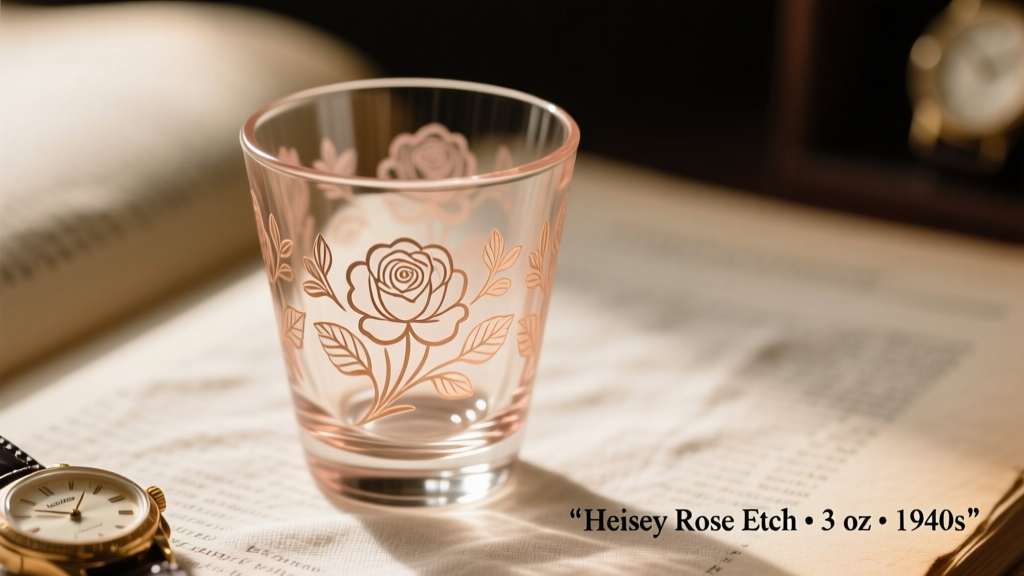
Heisey Rose Etch Wine Glass (3 oz, Pattern #2): Identification, Production History, and Market Value
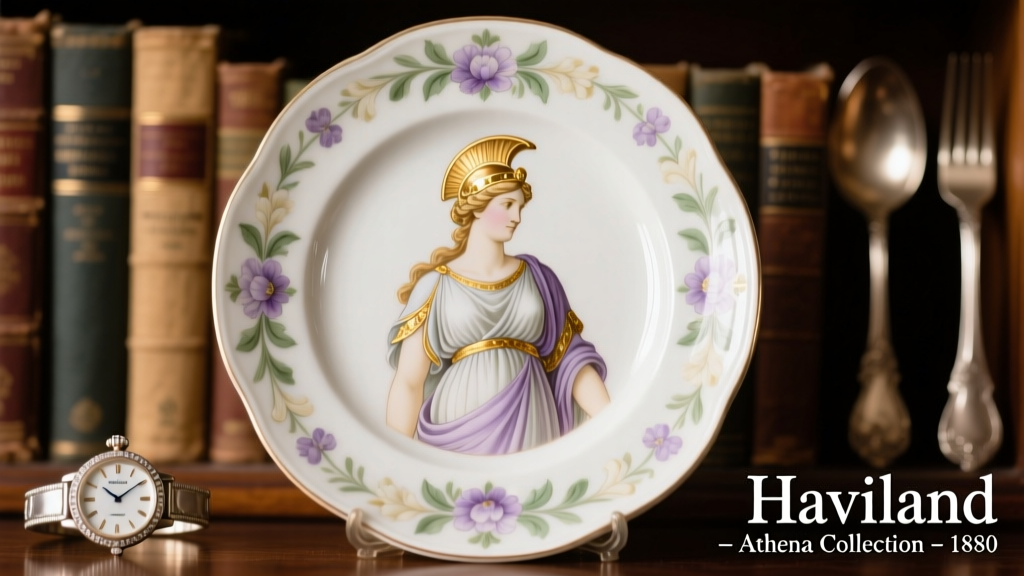
Haviland Plate Athena 8-Inch Dinner Plate: A Collector’s Guide to Pattern History, Identification, and Market Value
Edwardian Platinum Double-Bow Diamond Drop Pin: A Masterpiece of 1901–1910 Craftsmanship
Easterling Flatware Set: History, Identification, and Collectibility of America’s Mid-Century Sterling Silver Standard
Cowan Pottery Azure Luster Vase: A Masterpiece of American Art Pottery, 8½ Inches Tall
Snuff Olive Amber Sheared Flared Lip Square Pontil Glass Bottle, c.1825–1840: A Technical and Historical Appraisal

Fostoria June Pitcher: A Mid-Century American Glass Icon Revisited
Fulper Vase: Shouldered Rolled Lip, 7½ Inches — A Benchmark of American Art Pottery Innovation

Trifari's Double Leaf Textured Gold Bracelet: Design, Provenance, and Market Value of a Mid-Century American Icon