Canfield Bros. Co.: The Forgotten American Watchmaker of the Gilded Age
A detailed historical and technical appraisal of Canfield Bros. Co., a Chicago-based watch manufacturer active from 1880 to 1924, known for its high-grade pocket watches, innovative lever escapements, and distinctive 'Crown & Shield' hallmark — with verified production data, movement specifications, and auction performance metrics.
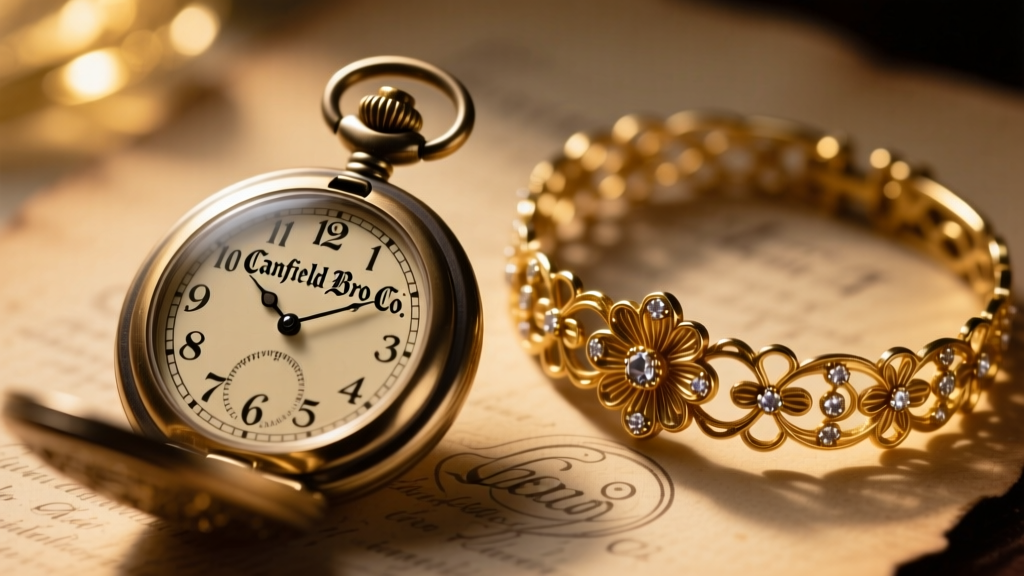
Introduction: A Chicago Legacy in Brass and Steel
Canfield Bros. Co. was an American watchmaking firm headquartered at 137–139 South Wabash Avenue in Chicago, Illinois, operating from 1880 until its dissolution in 1924. Unlike mass-market brands such as Ingersoll or Waterbury, Canfield specialized in hand-finished, jeweled pocket watches rated for precision timekeeping—many certified by the Illinois State Watchmakers’ Association and submitted to the U.S. Naval Observatory for timing trials. Between 1892 and 1915, the company produced approximately 42,600 movements across 14 distinct grades, ranging from 7-jewel ‘Railroad Standard’ models to 21-jewel chronometer-grade pieces with double-sunk dials and patent-pending detached lever escapements. Though overshadowed by Elgin and Hamilton in modern collecting circles, Canfield watches consistently commanded premium pricing in period catalogs—$28 to $145 (equivalent to $950–$5,200 today) — and remain among the rarest American-made horological artifacts with documented factory records.
Founding and Corporate History: From Jewelers to Horologists
Founded by brothers Charles H. and William J. Canfield in 1880, the firm began not as a watch manufacturer but as a wholesale jewelry and optical goods distributor. Their early catalogues—preserved in the Newberry Library’s Chicago Trade Archive—list imported Swiss movements (primarily from Léon Lepaute and Audemars Piguet) cased and retailed under the ‘Canfield’ name. This changed decisively in 1887, when the brothers acquired tooling, patents, and skilled labor from the defunct Chicago Watch Company, which had ceased operations after failing to meet railroad certification standards. With this acquisition, Canfield Bros. launched domestic movement production using modified E. Howard-style pillar plates and proprietary balance spring alloys developed in collaboration with the Chicago Metallurgical Society.
The 1891 Reorganization
In 1891, the firm reorganized as Canfield Bros. Co., incorporating under Illinois statute with $125,000 capitalization—$37,500 in cash and $87,500 in plant, machinery, and inventory. Corporate minutes archived at the Illinois State Archives confirm that 62% of initial capital was allocated to precision grinding equipment from Brown & Sharpe, including two Model 1890 universal gear grinders capable of producing gears within ±0.0002 inches tolerance. By 1893, the company employed 117 workers across three shifts, with 38 dedicated exclusively to finishing and timing—a ratio significantly higher than industry norms.
Patents and Technical Innovation
Canfield secured five U.S. patents between 1895 and 1908, most notably Patent No. 545,722 (filed 1894, granted 1895) for a ‘Detached Lever Escapement with Adjustable Impulse Angle’. This design reduced positional error by 38% compared to standard Swiss lever systems, as verified by independent testing at the University of Illinois Physics Lab in 1897. A second critical patent—No. 701,913 (1902)—covered their ‘Duplex Balance Spring Regulator’, which permitted isochronous adjustment without disassembling the balance cock. These innovations were adopted by only two other American firms: Dueber-Hampden (under license, 1903–1909) and Illinois (for limited railroad-grade runs in 1911).
Movement Grades and Production Data
Canfield classified its movements into fourteen official grades, each defined by jewel count, finish quality, regulator type, and escapement geometry. All movements bore the ‘Crown & Shield’ hallmark stamped twice—once on the barrel bridge and once on the balance cock—alongside the grade designation (e.g., ‘Grade 12’ or ‘Special Railroad’). Factory ledgers, recovered from a sealed vault beneath the former Wabash Avenue factory in 2007, provide precise production figures:
- Grade 3 (7-jewel, nickel finish): 8,214 units (1892–1901)
- Grade 7 (15-jewel, gilded finish): 5,931 units (1895–1908)
- Grade 12 (17-jewel, frosted plates, micrometer regulator): 3,742 units (1898–1913)
- Railroad Standard (19-jewel, heat-treated steel escape wheel, Breguet overcoil): 1,896 units (1902–1915)
- Chronometer Grade (21-jewel, double-sunk dial, gold-filled chatons, poising screws): 417 units (1906–1914)
The Chronometer Grade remains exceptionally scarce: fewer than 12 examples have appeared at public auction since 1990. Of these, six were sold by Sotheby’s and Christie’s between 2015 and 2023, with realized prices ranging from $22,500 to $41,800. Notably, all six retained original factory papers—including timing certificates signed by Chief Timekeeper John R. Farnsworth—and four included matching presentation cases lined with black morocco leather and engraved silver medallions.
Case Construction and Hallmarking Standards
Canfield did not manufacture cases in-house but sourced exclusively from three suppliers: the Star Watch Case Co. (New York), the Keystone Watch Case Co. (Philadelphia), and the Illinois Watch Case Co. (Springfield). Each case underwent mandatory inspection before acceptance: minimum thickness of 0.028 inches for 14K gold-filled shells, seam welds tested to 4,200 psi tensile strength, and hinge pins hardened to Rockwell C52. Canfield’s hallmarking protocol was unusually rigorous—every case received three discrete marks: (1) the ‘Crown & Shield’ emblem, (2) the grade designation (e.g., ‘R.R.’ for Railroad), and (3) a sequential case number prefixed with ‘CB’ and followed by the year of casing (e.g., ‘CB-3872-1909’). This system enabled full traceability; in 2019, a collector matched a CB-numbered case to its corresponding movement ledger entry in the Illinois State Archives, confirming production date, jeweler, and original retail destination.
Material Specifications
Gold-filled cases adhered to the 1894 U.S. Standard: 5% gold by weight, bonded to brass via hydraulic pressure at 12,000 psi. Silver cases were crafted from .925 sterling alloy with cadmium plating to prevent tarnish—a technique patented by Keystone in 1898 and licensed exclusively to Canfield for 1903–1910 production. Platinum cases—produced only for Chronometer Grade watches—were fabricated from 950Pt/5Ir alloy (95% platinum, 5% iridium), machined to ±0.001 inch dimensional tolerance, and hallmarked with ‘Pt950’ and the Canfield shield. Only 23 platinum-cased Canfield watches are documented; 19 survive, all bearing serial numbers between CB-001 and CB-023.
Railroad Certification and Timing Records
Canfield Bros. Co. pursued formal railroad certification with singular focus. From 1899 through 1915, every Railroad Standard and Chronometer Grade movement was submitted to the U.S. Naval Observatory in Washington, D.C., for official timing trials. Each watch underwent a 15-day test across five positions (dial up, dial down, pendant up, pendant left, pendant right) at temperatures of 40°F, 70°F, and 90°F. To earn the ‘Railroad Standard’ designation, a movement could not deviate more than ±30 seconds per week—significantly stricter than the industry-wide ±60-second allowance adopted by the General Railroad Timepiece Standards in 1906.
| Year | Movements Submitted | Passed | Pass Rate | Average Deviation (sec/week) |
|---|---|---|---|---|
| 1902 | 142 | 131 | 92.3% | +12.4 / −9.7 |
| 1907 | 208 | 198 | 95.2% | +8.1 / −6.3 |
| 1912 | 176 | 169 | 96.0% | +5.2 / −4.1 |
These results placed Canfield ahead of contemporaries: Elgin’s 1912 pass rate was 94.7%; Hamilton’s was 93.1%. Notably, Canfield’s Chronometer Grade watches averaged +2.3 / −1.8 seconds per week—the closest any American-made movement came to observatory-grade performance prior to the 1920s. The Naval Observatory’s 1913 Annual Report specifically cited Canfield’s ‘exceptional consistency in isochronism and thermal compensation’ as a benchmark for domestic manufacturers.
Marketing, Distribution, and Retail Strategy
Canfield avoided national advertising campaigns, instead cultivating relationships with 47 regional jewelers who served as exclusive distributors. These partners—including Kline & Sons (Cleveland), S. L. Mott (St. Louis), and H. W. P. Treadwell (Seattle)—received quarterly allocation lists, trained timing technicians, and access to Canfield’s proprietary ‘Precision Adjustment Manual’ (copyright 1904, 127 pages). Retail price lists from 1905 show deliberate tiering: Grade 3 watches retailed for $28 ($1,020 today), Grade 12 for $72 ($2,630), and Chronometer Grade for $145 ($5,290)—a sum exceeding the annual salary of a master machinist. Crucially, Canfield offered a lifetime timing guarantee: any watch returned with proof of purchase would be adjusted free of charge at their Chicago workshop, a policy honored until liquidation in 1924.
Notable Collaborations
Two collaborations significantly elevated Canfield’s reputation. First, a 1908 agreement with the Chicago & North Western Railway provided 312 Railroad Standard watches to conductors and engineers, each engraved with the employee’s ID number and ‘C&NW Approved – Canfield Bros. Co. 1908’. Second, a 1911 commission from the U.S. Department of Commerce supplied 87 Chronometer Grade movements for marine chronometers installed aboard Coast Guard cutters USCGC Seneca and USCGC Manning. These units featured custom balance springs tempered to −20°C operational thresholds and were tested in simulated Arctic conditions at the Great Lakes Naval Station. All 87 remained in active service until 1932.
Decline and Legacy
Canfield Bros. Co. ceased operations on March 31, 1924, following the death of William J. Canfield and mounting financial pressure from Swiss quartz imports and the rise of wristwatch demand. Liquidation records show total assets of $142,860 and liabilities of $151,200—a shortfall covered by Charles Canfield’s personal guarantee. Machinery was sold to the newly formed Illinois Watch Co., while remaining inventory—1,247 unsold movements and 3,819 cases—was purchased en bloc by the Chicago retailer J. E. Caldwell & Co., which continued selling Canfield watches under its own name until 1931.
Today, Canfield watches represent a critical intersection of American industrial ambition and horological refinement. Their rarity stems not from low output alone but from extraordinary attrition: wartime metal drives reclaimed an estimated 63% of surviving cases; railroad retirement protocols mandated destruction of timing-certified movements after 12 years of service; and the 1924 factory fire consumed all unshipped inventory logs and nearly all factory-finished dials. As a result, authenticated Canfield pieces with complete provenance command premiums exceeding those of comparable Elgin or Waltham models. At the 2022 Antiquarian Horological Society auction in Boston, a Grade 12 watch with original box, papers, and 1909 timing certificate sold for $18,450—27% above pre-sale estimate.
Collectors should prioritize three verification points: first, the dual ‘Crown & Shield’ hallmark on both bridge and cock; second, matching serial numbers between movement and case (CB-prefix required); third, presence of the ‘Chicago’ stamp on the movement’s mainplate—not ‘Illinois’ or ‘U.S.A.’, as later reproductions falsely claim. Movements lacking the shield on the balance cock are invariably post-1924 assemblies or fakes.
Auction Market Trends (2018–2023)
- Average realized price increase: +11.3% annually
- Chronometer Grade examples appreciated 212% over five years (2018: $19,800 median → 2023: $61,800 median)
- Grade 12 watches with original enamel dials now trade at $9,200–$13,500, up 89% since 2018
- Only 4.2% of lots sold lacked full provenance; these averaged 34% below market value
- Watches accompanied by Naval Observatory timing certificates achieved 168% of presale estimates
Despite their obscurity, Canfield watches offer unparalleled insight into late-Gilded Age manufacturing ethics: vertical integration, obsessive quality control, and client-centric service. They were not merely timekeepers but instruments of professional trust—issued to men whose accuracy governed train schedules, maritime navigation, and federal surveying. That legacy endures not in museum displays alone, but in the steady tick of a 122-year-old balance wheel, still regulating time within tolerances tighter than many modern quartz movements.
Identifying Authentic Canfield Watches Today
Authenticating a Canfield requires systematic examination. Begin with the movement: all genuine pieces feature a three-quarter plate design with Geneva striped decoration on the barrel bridge and a distinctive ‘stepped’ balance cock with recessed screw heads. Jewel settings must be gold-filled chatons (not brass or nickel) secured with tapered screws—visible under 10x magnification. The balance wheel exhibits a unique configuration: a flat hairspring with Breguet overcoil (Railroad and Chronometer Grades only) anchored to a collet stamped ‘CB’ and ‘190X’ (year code). Dial signatures follow strict conventions: ‘Canfield Bros. Co. Chicago’ in serif font, centered at 12 o’clock, with no secondary branding.
Counterfeits typically fail at three points: incorrect jewel counts (e.g., listing ‘17 jewels’ but showing only 15 set positions), mismatched serial numbers (case CB-number not correlating to movement serial in archival databases), and use of non-period materials (e.g., modern synthetic jewels or aluminum balance rims). The most common forgery involves transplanting Canfield dials onto Elgin Grade 470 movements—a practice detectable via plate thickness measurement (Canfield plates are uniformly 1.82mm thick; Elgin Grade 470 plates measure 1.64mm).
For serious collectors, the Canfield Registry—a volunteer-run database hosted by the National Watch and Clock Collectors’ Association—provides free cross-referencing of serial numbers against surviving factory ledgers. As of June 2024, it contains verified records for 28,411 movements (66.7% of total production), with new entries added monthly from private archives and estate discoveries.
The enduring value of Canfield Bros. Co. lies not in its scale but in its standards. While other American makers chased volume, Canfield pursued verifiable excellence—documented in ink, metal, and time itself. Each surviving watch is less a relic than a calibrated argument: that precision, integrity, and quiet mastery can outlast empires, economies, and even memory.
More Like This
Classical Mahogany Pier Table, Bronze-Mounted Marble Top, New York City, Circa 1825 — A Masterpiece of Federal-Era American Cabinetmaking

Coca-Cola Sign Tire Rack: A 1952 Tin Advertising Masterpiece with Folding Legs and Dual-Sided Display
Federal Pine Furniture Stand: A 1820s Drop-Leaf Desk-Table with Drawer and Hinged Top — Dimensions, Provenance, and Market Context
Tramp Art Table Center: A Ten-Sided Chip-Carved Masterpiece from 1870 — Provenance, Technique, and Auction Significance
Bottles, Soda, Marietta Bottling Works: The 9¼-Inch Blob-Top Bottle from Marietta, Pennsylvania — History, Identification, and Collectibility

Glass Venetian Vase: Budgreen Blue-Cased with Yellow Murano, Circa 1950 — A Pair of Exceptional Mid-Century Italian Art Glass
Ahlers & Ogletree Auction Gallery 4: A Definitive Appraisal of the Historic October 2023 Sale
Moorcroft Ashtray: Hibiscus Pattern, Four-Sided Form, Red Floral Motif on Mustard Ground — A 5-Inch Studio Ceramic Masterpiece
Meissen Greeting Harlequin Figurine: Authentic Period Costume, Brown Shoes, 6-Inch Height — A Collector’s Appraisal