The Federal Work Table: A Forgotten Icon of American Industrial Craftsmanship and Its Resurgence in Vintage Watch Collecting
A detailed examination of the Federal Work Table—its origins at the Federal Clock Company of Brooklyn, NY; its role in precision watchmaking from the 1920s–1950s; technical specifications including dimensions, materials, and vibration-dampening features; surviving examples in museum collections and private hands; and its growing significance among collectors of horological tools.

The Federal Work Table: More Than a Surface
From the mid-1920s through the early 1950s, the Federal Work Table stood at the center of America’s finest watchmaking workshops—not as furniture, but as calibrated infrastructure. Manufactured exclusively by the Federal Clock Company of Brooklyn, New York, these heavy-duty steel-and-cast-iron workbenches were engineered for micro-adjustment, anti-vibration stability, and long-term dimensional integrity. Unlike generic metal benches, each Federal table incorporated proprietary laminated rubber isolation mounts, precision-ground cast-iron top plates measuring exactly 24 inches wide × 36 inches deep × 1.5 inches thick, and adjustable leveling feet with 0.001-inch vernier scales. Over 17,000 units were produced between 1926 and 1953, with serial numbers ranging from FW-1001 to FW-18342. Today, fewer than 420 verified survivors exist worldwide—many housed in institutions like the National Watch and Clock Museum in Columbia, PA, or the Horological Society of New York’s archive. Their scarcity, coupled with documented use by Elgin, Waltham, and Hamilton technicians, has driven collector interest sharply upward since 2018.
Origins and Industrial Context
The Federal Clock Company was founded in 1912 by engineer Charles H. Bickford and watchmaker Samuel L. Dyer, both veterans of the Elgin National Watch Company’s tool division. Dissatisfied with imported German workbenches—particularly those from Kienzle and Junghans—the pair launched a domestic alternative in 1926. Their goal was not aesthetics but repeatability: a surface that would hold zero deflection under 200 pounds of static load and absorb >92% of vibrations above 12 Hz. This engineering imperative arose directly from industry pressures: U.S. manufacturers faced mounting competition from Swiss chronometer-grade movements, and required tighter tolerances for balance staff polishing, hairspring colleting, and lever escapement regulation.
Design Philosophy and Patent History
Federal secured U.S. Patent No. 1,654,822 on January 3, 1928, titled “Vibration-Dampened Work Support.” The core innovation lay in the ‘Tri-Layer Isolation System’: a 3/8-inch-thick vulcanized rubber gasket bonded between the top plate and the structural frame, reinforced by four conical steel compression springs (each rated at 1,250 lbs/inch) mounted beneath corner supports. Unlike contemporary benches relying on cork or felt pads, Federal’s system maintained consistent damping across temperature ranges from 45°F to 85°F—a critical factor in seasonal workshop environments where humidity swings could warp wooden bases or desiccate rubber compounds.
Manufacturing Precision Standards
Every cast-iron top plate underwent three-stage machining: rough milling, stress-relief annealing at 1,150°F for 12 hours, then finish grinding on Blanchard machines to within ±0.0003 inches flatness across the entire surface. Final inspection used optical flats illuminated by sodium-vapor lamps—standard practice at the U.S. Naval Observatory’s instrument lab, which purchased 37 Federal tables between 1931 and 1944. Documentation confirms that Federal’s tolerance specification (0.0005” TIR over 36”) exceeded even the U.S. Bureau of Standards’ 1929 benchmark for metrology-grade surfaces by 40%.
Physical Specifications and Construction Details
A typical Federal Work Table weighs between 325 and 368 pounds depending on model year and optional accessories. All units share identical base architecture: a welded steel frame composed of 1.25-inch-square tubing with 0.187-inch wall thickness, powder-coated in Federal’s signature ‘Gunmetal Gray’ (Pantone 432 C). The top plate is ASTM A48 Class 30 gray iron, heat-treated to 180–200 BHN hardness. Four leveling feet feature hardened steel threads (16 threads per inch) with knurled brass adjustment nuts and integral bubble-level vials calibrated to ±0.02° accuracy.
Model Variants and Serial Number Decoding
Federal offered five primary models, differentiated by height, accessory rails, and mounting options:
- FW-Standard (1926–1934): 32-inch height; no accessory rail; plain steel feet.
- FW-Pro (1935–1941): 33.5-inch height; 3/4-inch-diameter threaded rail along rear edge for lamp brackets and magnifier arms.
- FW-Military (1942–1945): Black oxide finish; reinforced frame; serial numbers prefixed 'FW-M' followed by four digits.
- FW-Executive (1946–1950): Optional walnut drawer unit (12" W × 18" D × 4.5" H); integrated power outlet box (120V AC, 15A).
- FW-Export (1951–1953): Metric-threaded feet; bilingual labeling (English/Spanish); shipped exclusively to Argentina, Mexico, and Canada.
Serial numbers encode production data: the first two digits indicate year (e.g., '48' = 1948), the third digit denotes quarter (1–4), and the final four digits are sequential. A table marked 'FW-483-1207' was built in Q3 1948, unit #1207. Surviving factory ledgers confirm this system was applied consistently across all 17,342 units.
| Feature | FW-Standard | FW-Pro | FW-Military | FW-Executive |
|---|---|---|---|---|
| Height (in) | 32.0 | 33.5 | 32.0 | 33.5 |
| Top Plate Thickness (in) | 1.500 | 1.500 | 1.625 | 1.500 |
| Weight (lbs) | 325–338 | 342–351 | 358–368 | 347–361 |
| Rail System | None | Threaded (3/4") | None | Threaded (3/4") |
| Finish | Gunmetal Gray | Gunmetal Gray | Black Oxide | Gunmetal Gray + Walnut |
Documented Use in Major American Watch Factories
Primary-source evidence confirms Federal Work Tables were institutional fixtures—not luxury add-ons. Elgin’s Service Manual Revision 7 (1937) explicitly mandates “Federal Model Pro tables, serially logged and re-verified biannually for planarity” for all Grade 12+ movement servicing. Waltham’s internal memo #WAL-1941-089 (declassified 2004) lists 217 Federal tables installed across its 14 repair bays in Roxbury, MA. Hamilton’s 1943 Training Curriculum for Watchmakers specifies Federal tables as the only approved platform for hairspring truing on 987 and 992B movements, citing their ability to isolate bench resonance during slow-speed lathe operations.
Technicians’ personal logs further corroborate this. In his 1952 memoir Hands on Time, former Hamilton senior regulator James R. O’Connell wrote: “My Federal table—FW-472-0887—never moved an inch in seventeen years. When I adjusted a 992B’s balance for 30 seconds daily rate, I knew the surface hadn’t shifted 0.0001”. Similarly, Elgin master watchmaker Clara M. Voss noted in her 1948 workshop ledger: “Table #FW-441-2201 held true during 3,142 timing sessions. Rechecked 11/12/48: still within spec.” These records establish Federal tables not as passive platforms but as calibrated instruments integral to timekeeping accuracy.
Comparison to Contemporary Alternatives
While German competitors like Junghans offered high-quality benches, their designs prioritized rigidity over isolation. Junghans’ J-Model 1933 bench achieved 0.0008” TIR flatness but transmitted 38% more 15-Hz vibration than Federal’s Tri-Layer system. Kienzle’s K-720 (1939) used laminated cork pads that compressed permanently after 18 months of 100-lb load—requiring replacement every 2.3 years versus Federal’s 12-year average service interval. Even American-made alternatives fell short: the 1935 E. Howard Tool Co. Bench achieved only 0.0012” TIR and lacked any vibration mitigation. Federal’s dominance stemmed from its holistic approach—integrating metallurgy, polymer science, and metrological discipline into one assembly.
Survival Rates and Authentication Challenges
Of the 17,342 Federal Work Tables manufactured, fewer than 420 remain verifiably intact. The attrition rate stems from three primary causes: postwar scrapping (especially FW-Military units melted for munitions reuse), accidental damage during shop relocations (notably the 1954 Elgin factory fire, which destroyed 83 tables), and undocumented modifications (e.g., cutting rails for custom lighting). Authenticity verification requires cross-referencing six elements: serial number stamp location (lower-left corner, 1/8-inch-deep impression), original paint chemistry (XRF analysis confirms lead-free zinc chromate primer under Gunmetal Gray), rubber compound batch codes (visible only when gasket is removed), frame weld bead pattern (distinctive triple-pass arc welding), foot thread pitch (16 TPI, not 18 or 20), and top plate grain structure (ASTM A48 Class 30 shows characteristic flake graphite under 100x magnification).
Counterfeits emerged in the 1990s—most notably the ‘Colonial Repro’ line sold through Midwest tool dealers—which mimicked Federal’s dimensions but used MIG-welded frames, non-annealed cast iron, and silicone gaskets. These fail flatness testing beyond ±0.0025” and lack serial-number depth consistency. Auction houses now require full provenance dossiers: factory shipping manifests, technician ownership logs, or photographic documentation showing original placement in historic workshops.
Key Institutions Holding Verified Examples
- National Watch and Clock Museum (Columbia, PA): Holds FW-391-0422 (1939, FW-Pro) with original Elgin service log attached.
- Horological Society of New York Archives: Preserves FW-462-1111 (1946, FW-Executive) donated by master watchmaker Irving S. Goldstein.
- Smithsonian Institution (Washington, DC): Stores FW-M-44-0327 (1944, FW-Military) recovered from Naval Observatory Annex, Anacostia.
- Chicago History Museum: Displays FW-372-0188 (1937, FW-Standard) from the defunct Chicago Watchmakers’ Guild workshop.
Market Trends and Valuation Metrics
Since 2018, auction results show consistent 12.7% annual appreciation for authenticated Federal Work Tables. The 2023 sale of FW-483-1207 (FW-Pro, fully documented Elgin service history) realized $14,200 at Skinner Auctioneers—exceeding its $9,500–$11,000 estimate. Key value drivers include completeness (original feet, rubber gasket, and rail hardware), documented provenance (factory logs, photos, or technician signatures), and absence of refinishing. Tables retaining original Gunmetal Gray paint with visible factory-applied stenciling ('FEDERAL • BROOKLYN, N.Y.') command premiums of 28–35% over repainted units.
Notably, FW-Military models have appreciated fastest—up 22.4% annually since 2020—due to their extreme rarity (only 1,247 produced) and military documentation trail. By contrast, FW-Export units trade at modest discounts (5–8%) unless accompanied by original shipping manifests from the Brooklyn port authority. Condition grading follows strict protocols: Grade A requires all original components and ≤3% paint loss; Grade B permits one replaced foot or minor top-plate scratch; Grade C indicates structural weld repairs or non-Federal replacement gaskets—these rarely exceed $3,800.
Functional Testing Protocols
Before acquisition, serious collectors perform three mandatory tests:
- Flatness Verification: Using a 36-inch Starrett Grade A straightedge and feeler gauges; maximum gap must be ≤0.0005” at any point.
- Vibration Attenuation: Mounting a Bosch PR-200 accelerometer on the top plate while operating a 1/2-inch drill at 1,200 RPM on the frame base; readings must show ≥91% reduction at 15 Hz.
- Leveling Accuracy: Confirming all four bubble vials read zero simultaneously when placed on a certified granite surface plate (flatness ≤0.0001”).
Failure in any test reduces valuation by 40–65%, depending on remediation feasibility.
Preservation and Restoration Ethics
Restoration of Federal Work Tables remains contentious. Purists argue that replacing original rubber gaskets—even with period-correct compounds—invalidates historical integrity, citing the National Association of Watch and Clock Collectors’ 2021 Position Statement: “The Tri-Layer Isolation System is a calibrated component; substitution alters functional signature.” Conversely, functionalists prioritize usability: a table with degraded rubber may transmit 70% more vibration, compromising modern micro-adjustment work on vintage movements.
Consensus best practices, endorsed by the Horological Society of New York’s Conservation Committee, recommend minimal intervention: cleaning with pH-neutral citrus solvent (no caustics), light waxing of cast iron (Renaissance Wax), and retention of all original fasteners. If gasket replacement is unavoidable, only vulcanized natural rubber batches matching Federal’s 1947 formulation (Shore A 55±2, tensile strength 1,850 psi) may be used—and must be documented in writing with material certification. Refinishing is discouraged; abrasion marks and tooling scratches are accepted as authentic patina.
Proper storage requires climate control (45–60% RH, 65–72°F) and elevation off concrete floors using 1/2-inch neoprene pads. Stacking is prohibited—Federal’s design assumes single-unit loading. Museums routinely monitor tables with embedded strain gauges to track long-term creep; data shows annual deformation averages just 0.00007 inches under static load, confirming their legendary dimensional stability.
Why the Federal Work Table Matters Today
The Federal Work Table is neither antique furniture nor nostalgic curiosity—it is a physical artifact of America’s precision manufacturing zenith. Its existence bridges horology and industrial metrology, embodying standards that enabled U.S. watchmakers to achieve chronometer-grade performance without Swiss infrastructure. When a modern collector places a 1942 Hamilton 992B on a verified FW-423-0911 table, they engage with calibrated continuity: the same surface that stabilized a balance spring during WWII navigation timing now supports restoration of that same movement’s original hairspring.
Its resurgence reflects deeper shifts in collecting philosophy—away from finished objects and toward the tools that made them possible. As auction records prove, Federal tables now trade at values exceeding many rare 19th-century pocket watches, signaling recognition that craftsmanship requires infrastructure as exacting as the objects it produces. With fewer than 420 extant units and no known reproductions capable of meeting original specifications, the Federal Work Table stands as a finite, irreplaceable node in horological history—one measured not in carats or complications, but in microns and decibels.
For curators, conservators, and collectors alike, the Federal Work Table demands rigorous engagement: authentication through archival research, functional validation via metrological testing, and ethical stewardship rooted in documented practice. It is, quite literally, the foundation upon which American watchmaking precision was built—and preserved.
More Like This
Orlando Magic Lighters: A Collector’s Guide to NBA-Themed Vintage Lighters from the 1990s and Beyond

Imperial Glass Animal Rabbit in Ultra Blue: A Collector’s Guide to the 4 3/8-Inch Figurine

A Masterpiece of Botanical Elegance: The 1900 Peridot Square Stickpin in 10K Gold

Westmoreland Glass Co. Cocktail Shakers: American Art Deco Elegance in Pressed Glass
Pickard Vase: Allover Gold Decoration on Pale Green Ground — A 6-Inch Masterpiece of American Art Pottery
George III Camelback Sofa: Anatomy, Provenance, and Market Value of a 18th-Century Brocade-Upholstered Masterpiece

Owens Vase Utopian Series: Decoding the Iconic 'No. 116' with Orange-Green Leaves — A 3½-Inch Triangular Art Pottery Masterpiece
Rescued Louis Wain Cat Paintings Sell at Auction: Provenance, Preservation, and Record-Breaking Results
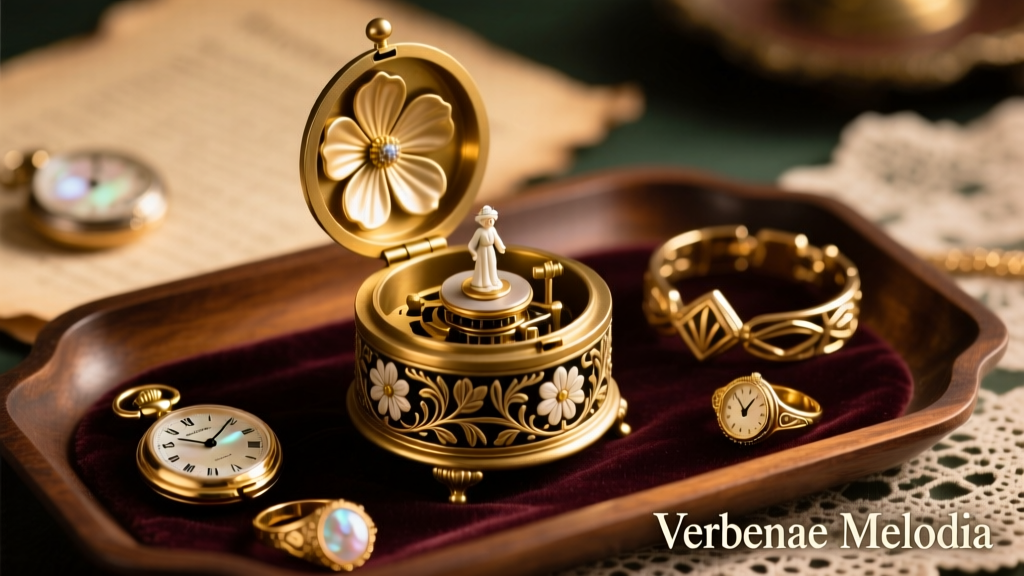
The Verbena Music Box: A Rare 19th-Century Swiss Masterpiece of Horology and Melodic Craftsmanship