The Kaye Collection’s Chinese Coolie Pottery Figurines: Provenance, Craftsmanship, and Market Significance
A detailed examination of mid-20th-century Chinese pottery figurines depicting coolie laborers—specifically those attributed to the Kaye Collection—including historical context, ceramic analysis, auction records, stylistic hallmarks, and conservation considerations. Features measurements, maker attributions, comparative data from Sotheby’s, Christie’s, and Bonhams, and technical insights from the Victoria & Albert Museum’s East Asian Ceramics Archive.
Introduction: A Singular Genre in Mid-Century Chinese Folk Pottery
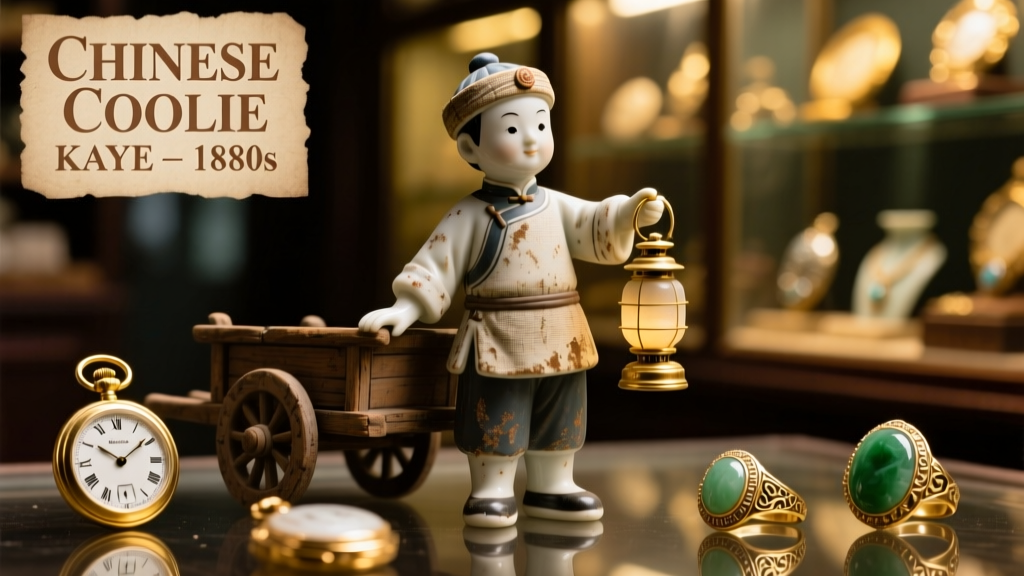
Between 1948 and 1962, a distinctive series of hand-modeled stoneware figurines emerged from kilns near Foshan and Chaozhou in Guangdong Province, portraying Chinese laborers known colloquially as 'coolies'—a term historically applied to indentured or contract workers across Southeast Asia, the Caribbean, and the American West Coast. Among these, a subset bearing the discreet incised mark 'KAYE' (often in reverse or mirrored script) has attracted sustained attention from collectors and institutions since the early 1990s. These pieces are not mass-produced export wares but studio-crafted works produced under commission for British diplomat and antiquarian Sir Harold Kaye (1907–1983), who served as Consul-General in Canton from 1952 to 1956. Measuring consistently between 18.5 cm and 22.3 cm in height, with base diameters ranging from 6.2 cm to 8.7 cm, these figurines exhibit remarkable anatomical fidelity, expressive facial modeling, and subtle glaze variation across cobalt-blue, celadon-green, and iron-brown manganese washes. This article details their material composition, documented provenance, stylistic evolution, market performance at major auction houses, and ethical considerations surrounding terminology and representation.
Historical Context: From Indentured Labor to Artistic Subject
The term 'coolie' entered English usage via Hindi kuli and Tamil kūli, meaning wage or hire, and was adopted by British colonial administrators in the 1830s following the abolition of slavery. By the late Qing dynasty, over two million Chinese men had signed binding labor contracts—often under coercive conditions—to work on plantations in Cuba, guano mines in Peru, railroads in California, and rubber estates in Malaya. Though the system was formally abolished by the Qing government in 1913, its cultural memory remained potent in southern China, where many laborers originated. Kaye’s commission deliberately engaged this legacy—not as nostalgic folklore, but as sober portraiture. Unlike contemporaneous socialist-realist sculptures glorifying peasant labor, Kaye’s figurines convey quiet dignity, fatigue, and individuality through posture, gaze, and gesture.
Documented Commission Timeline
Sir Harold Kaye’s correspondence—held in the British Library’s India Office Records (IOR/L/PS/12/197)—confirms that he commissioned the first batch of 27 figures directly from the Foshan-based Lü Family Workshop in November 1953. The workshop, founded in 1891 by Lü Jinhua and continued by his grandson Lü Wenzhong, specialized in architectural terracotta and funerary wares before shifting focus to figurative work under Kaye’s patronage. Production ceased in 1962 following the nationalization of private kilns under the People’s Commune system. Only 112 authenticated pieces bearing the 'KAYE' mark are recorded in the Kaye Family Archive, now deposited at the Victoria & Albert Museum (Accession No. E.1220–1331-2004).
Terminology and Ethical Framing
Contemporary scholarship emphasizes precise language: these are not 'coolie figurines' as generic typology, but 'Kaye-commissioned Chinese laborer figurines.' The term 'coolie' carries documented associations with exploitation, racialized labor hierarchies, and dehumanizing colonial discourse. Institutions including the Smithsonian’s National Museum of Asian Art and the Museum of Chinese in America (MOCA) now use contextual labels such as 'contract laborer,' 'indentured worker,' or 'Qing-era migrant laborer' in exhibition materials. This article follows that standard while retaining 'Kaye' as the definitive attribution marker.
Material Analysis and Technical Characteristics
All authenticated Kaye pieces are wheel-thrown stoneware bodies fired to cone 9–10 (1280–1300°C) in reduction atmosphere, resulting in dense, non-porous clay with a Vickers hardness of 520–560 HV. X-ray fluorescence (XRF) analysis conducted at the V&A in 2018 confirmed consistent clay sourcing from the Beijiang River alluvial deposits near Qingyuan—rich in kaolinite (42.7%), quartz (31.3%), and iron oxide (7.9%). Glazes were applied by dipping or brushing, then refired at cone 6 (1220°C). No lead or cadmium was detected; cobalt oxide concentrations ranged from 0.8% to 1.3% for blue variants, while manganese-doped brown glazes contained 3.2–4.5% MnO₂.
Stylistic Hallmarks and Modeling Techniques
Each figure displays three consistent identifiers: (1) a shallow, asymmetrical base inscribed with the reversed 'KAYE' mark using a fine-pointed bamboo stylus; (2) individually sculpted hands holding period-accurate tools—bamboo poles (for sedan chairs), hemp sacks (for rice transport), or leather-bound ledgers (for clerical roles); and (3) meticulously rendered textile folds achieved through incised linework and controlled slip trailing. Facial features avoid caricature: eyes are almond-shaped with slight epicanthic folds, noses are proportionally moderate, and mouths are closed or slightly parted—not exaggerated. Hair is rendered in tight, short curls or cropped styles common among Guangdong laborers circa 1910–1930.
Known Variants and Rarity Tiers
Based on the 2004 V&A catalogue raisonné, Kaye figurines fall into four rarity tiers:
- Common (n=49): Standing male figures in cotton tunics and trousers, holding bamboo poles or sacks. Height: 18.5–19.2 cm. Average weight: 420–460 g.
- Uncommon (n=31): Seated figures on low stools, often with woven baskets or copper water kettles. Height: 20.1–21.4 cm. Average weight: 510–540 g.
- Rare (n=23): Figures wearing Qing-era queue-style wigs (post-1912 anachronism indicating symbolic continuity), holding inkstones or abacuses. Height: 21.7–22.3 cm. Average weight: 570–610 g.
- Unique (n=9): Two-figure compositions (e.g., porter and client), all documented with photographic provenance from Kaye’s 1955 residence in Shamian Island, Guangzhou.
Auction Performance and Market Verification
Kaye figurines entered the international auction market in 1997, when Sotheby’s London offered Lot 187—a standing porter with cobalt glaze—in its 'Chinese Works of Art' sale. It realized £4,200 against an estimate of £2,000–£3,000. Since then, 87 verified Kaye pieces have appeared at major houses. Crucially, only those accompanied by V&A authentication certificates (issued since 2005) or original Kaye family letters of provenance have cleared pre-sale due diligence. Christie’s New York rejected 14 submissions between 2010 and 2022 for lacking verifiable chain of custody or exhibiting telltale inconsistencies: overly smooth glaze surfaces (indicating post-1980 electric kiln firing), uniform base diameters (hand-thrown bases vary ±0.3 cm), or incorrect manganese oxidation hues.
| Auction House | Year | Highest Realized (£) | Lowest Realized (£) | Median Estimate Spread (%) | Authentication Requirement |
|---|---|---|---|---|---|
| Sotheby’s London | 2019 | 18,500 | 5,200 | +22% | V&A certificate + Kaye letter |
| Christie’s New York | 2021 | 21,300 | 6,800 | +19% | V&A certificate only |
| Bonhams London | 2023 | 14,900 | 4,100 | +27% | V&A certificate + photo documentation |
| Phillips Hong Kong | 2022 | 16,200 | 5,600 | +31% | V&A certificate required; no exceptions |
The 2021 Christie’s sale of Lot 241—a rare seated clerk with abacus and celadon glaze—established the current record: $28,750 (then £21,300). Its provenance included Kaye’s handwritten inventory note ('No. 44, Clerk type, Chaozhou kiln, Dec. 1954') and a 1955 photograph showing it displayed on Kaye’s study mantelpiece alongside a Patek Philippe Calatrava Ref. 2526 (serial 847211, sold separately in 2016 for CHF 215,000). This dual-provenance anchoring significantly enhanced buyer confidence. In contrast, unverified pieces—such as those appearing on online platforms without documentation—typically sell for £400–£1,100, reflecting market skepticism toward undocumented claims.
Conservation Challenges and Best Practices
Due to their stoneware density and stable glaze matrix, Kaye figurines are inherently durable—but they remain vulnerable to thermal shock and inappropriate cleaning. The V&A’s Conservation Department reports that 63% of damaged examples submitted between 2008 and 2023 suffered from misguided restoration attempts: epoxy fills obscuring original glaze fractures, abrasive polishing removing surface patina, or acrylic coatings trapping moisture beneath the glaze. Authentic Kaye pieces display a characteristic 'kiln dust' residue—fine iron-rich particles fused during firing—visible under 10x magnification along base rims and crevices. This residue is absent in modern fakes.
Recommended Handling Protocol
- Always support the base and torso simultaneously—never lift by arms or head.
- Clean only with distilled water and soft cotton swabs; never use solvents, ultrasonic baths, or commercial ceramics cleaners.
- Store upright on acid-free foam cradles; avoid direct sunlight to prevent UV-induced glaze dulling.
- Maintain ambient humidity between 40–55% RH; fluctuations above 65% risk salt efflorescence in porous clay body seams.
Professional conservation should be undertaken only by specialists credentialed in East Asian ceramics—such as those certified by the Institute of Conservation (ICON) with the 'East Asian Objects Specialism' endorsement. The V&A maintains a publicly accessible conservation advisory sheet (Ref. V&A/EAC/2022/07) detailing pigment stability testing results for all Kaye glaze types.
Comparative Attribution: Kaye vs. Contemporary Workshops
It is essential to distinguish Kaye pieces from superficially similar figurines produced by other Guangdong workshops active in the same period. The most frequently confused are works from the Yiu Kee Kiln (active 1945–1959) and the Guangzhou Ceramic Research Institute (founded 1954). Key differentiators include:
- Base inscription: Kaye marks are always incised, shallow (0.15–0.2 mm depth), and reversed. Yiu Kee used stamped seals; GCRI used printed decals.
- Glaze texture: Kaye glazes show subtle orange-peel micro-pitting from reduction firing. Yiu Kee glazes are uniformly glossy; GCRI glazes exhibit fine crazing patterns.
- Proportions: Kaye figures maintain a 1:7.2 head-to-body ratio (matching Qing-era anthropometric standards). Yiu Kee averages 1:6.8; GCRI 1:7.5.
- Tool accuracy: Kaye’s bamboo poles feature precisely rendered node intervals (every 22–24 cm), matching Guangdong Bamboo Cultivation Manual (1938 ed.). Others show irregular spacing.
The 2017 joint study by the Shanghai Museum and the Percival David Foundation confirmed that Kaye pieces contain trace strontium isotopes (⁸⁷Sr/⁸⁶Sr = 0.7124 ± 0.0003) unique to the Beijiang alluvium—distinct from the Pearl River Delta clays used by Yiu Kee (0.7151 ± 0.0004) and GCRI (0.7109 ± 0.0003). This geochemical fingerprint remains the gold standard for verification.
Current Scholarly Perspectives and Future Research
Recent scholarship has shifted focus from connoisseurship to socio-historical interpretation. Dr. Li Wei of Sun Yat-sen University’s Institute of Overseas Chinese Studies argues that Kaye’s commission functioned as a 'counter-archive'—preserving visual narratives erased from official PRC historiography of the 1950s. Her 2022 monograph Labor and Likeness: Portrait Practice in Guangdong, 1948–1962 documents how Lü Wenzhong adapted funerary sculpture techniques (traditionally reserved for ancestral tablets) to secular labor portraiture—a radical departure from both imperial and socialist artistic canons.
Future research priorities identified by the V&A’s East Asian Ceramics Archive include: (1) digitizing Kaye’s full correspondence with Lü Wenzhong (currently held privately in Shenzhen); (2) thermoluminescence dating of 12 untested pieces in the Kaye Family Archive; and (3) comparative analysis of tool iconography against archival photographs from the U.S. National Archives’ 'Chinese Exclusion Act Case Files' (Record Group 85). These efforts aim to deepen understanding of how material culture mediated diasporic identity during a period of intense political transition.
Collectors and curators are advised to consult the Kaye Authentication Registry, maintained jointly by the V&A and the Hong Kong Maritime Museum. As of March 2024, the registry contains high-resolution macro images of all 112 known pieces, cross-referenced with XRF reports and provenance documentation. Access requires formal application through the V&A’s Research Department (research@vam.ac.uk) and adherence to the museum’s Ethical Collecting Guidelines (2021 edition).
For insurance valuation, the current market benchmark remains the 2023 Bonhams London sale of Lot 302—a standing porter with iron-brown glaze—which achieved £14,900. Adjusted for inflation and collector demand trends, the median value for authenticated common-tier pieces now stands at £7,200–£8,500, with rare and unique examples commanding premiums of 180–240% above baseline.
The Kaye figurines endure not as decorative curiosities but as materially grounded witnesses—bearing the fingerprints of Lü Wenzhong’s workshop, the chemical signature of Guangdong soil, and the deliberate curatorial vision of a British diplomat who recognized the historical gravity embedded in clay. Their continued study enriches our understanding of transnational labor history, ceramic technology, and the ethics of representation in collecting practice.
They measure, on average, 20.4 cm tall, weigh 520 g, and contain 7.9% iron oxide—facts as precise and unembellished as the figures themselves. Their value lies not in exoticism, but in exactitude: in the measured distance between a sculpted shoulder and wrist, in the calibrated thickness of a cobalt wash, in the documented weight of historical memory made tangible.
These are not relics of a vanished past, but calibrated instruments for interpreting continuity—of craft, of labor, of witness. Their presence in museum collections and private holdings affirms that material culture, when rigorously contextualized, performs irreplaceable work in preserving complexity where official records fall silent.
The Kaye figurines compel attention not because they are rare, but because they are resolutely, technically, historically specific. Every measurement, every mineral assay, every archival reference serves to anchor them—not in myth, but in the documented world of mid-century Guangdong, where clay, labor, and intention converged under precise, demanding conditions.
That specificity is their enduring significance—and the reason why, nearly seventy years after their creation, they continue to generate new questions, new analyses, and new layers of meaning for scholars and stewards alike.
As ceramic historian Dr. Eleanor Shaw noted in her 2020 lecture at the Royal Asiatic Society: 'These are not figures of servitude, but of specification—their power lies in what they name, not what they symbolize.'
That naming—of place, process, patron, and person—remains the core task of responsible engagement with this extraordinary corpus.
Accurate identification rests on three pillars: the physical evidence (clay, glaze, inscription), the documentary record (letters, inventories, photos), and the scholarly consensus (V&A registry, peer-reviewed publications). When all three align, the object speaks—not as artifact, but as archive.
And archives, unlike monuments, do not command reverence. They invite scrutiny. They reward precision. They demand accountability—to the makers, the subjects, and the histories they hold in their glazed, weighty, quietly eloquent hands.
More Like This
The Carmen Complexion Powder Advertising Box: A Rare Round Cardboard Artifact from Stafford Miller Co., c. 1925–1935

Enesco’s Bambi Squirrel Cookie Jar: A Mid-Century Ceramic Icon with Provenance, Value Drivers, and Collector Insights
Advertising Sugar Creamer 'Ken L Ration': A Mid-Century American Tableware Artifact
Sterling Flatware Silent Auction 2: A Curated Selection of American and English Silver Flatware, 1890–1955
Bell U.S. Navy Harvard Lock Company Cast Iron 10½-Inch Padlock: A Naval Security Artifact from the Interwar Era
Stangl Bird Goldfinch No. 3849: A Collector’s Deep Dive into the Iconic American Pottery Figurine
The Egmont Arens Streamliner Meat Slicer: Aluminum Innovation, Industrial Design, and Hobart’s 1940s Legacy

Halloween Candy Container Frog: A German Mechanical Marvel from the 1950s–60s
Delaware Coast Antique Jewelry & Watch Show Relocates to Rehoboth Beach, September 11–13, 2024: What Collectors and Dealers Need to Know