Sun Rubber’s 1934 Disneyana Fire Engine: Mickey, Donald, and the Birth of Licensed Toy Collectibles
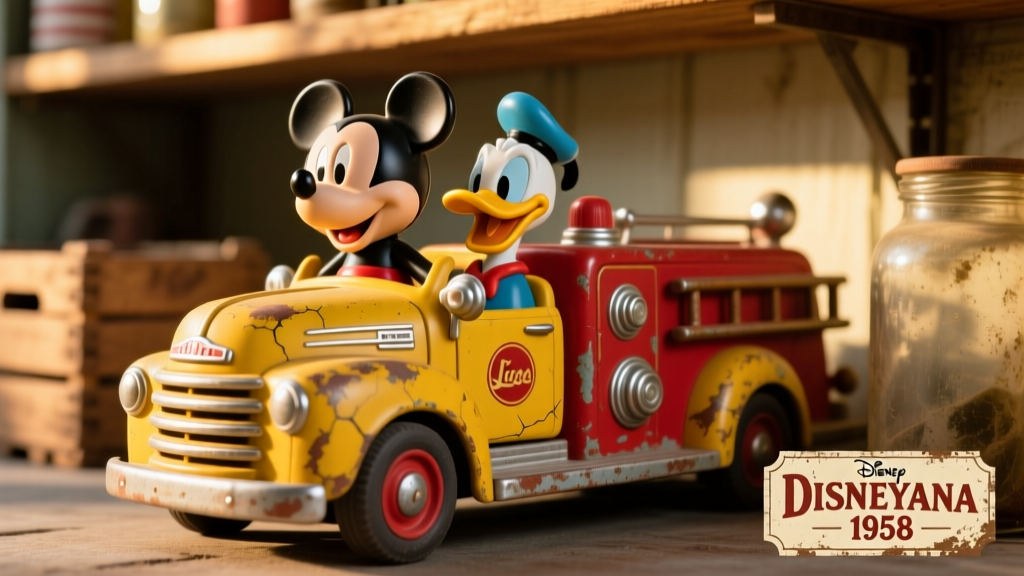
A detailed appraisal of the rare 1934 Sun Rubber Company fire engine featuring Mickey Mouse and Donald Duck — the earliest known licensed Disney toy with both characters, measuring 10.5 inches long, made in Los Angeles, and bearing original 'Sun Rubber Co., Los Angeles, Calif.' and 'Walt Disney Productions' stamps.
The Sun Rubber Fire Engine: A Landmark in Disney Licensing History
Released in early 1934 by the Sun Rubber Company of Los Angeles, the Mickey Mouse and Donald Duck Fire Engine stands as the earliest confirmed mass-produced toy bearing both characters under official Walt Disney Productions authorization. Measuring precisely 10.5 inches in length, 4.25 inches in width, and 5.75 inches in height, this hollow-molded rubber vehicle is not merely a plaything but a foundational artifact in American licensing history. Unlike later plastic or die-cast toys, it was manufactured using Sun Rubber’s proprietary vulcanized rubber compound — a durable, flexible material developed for automotive parts before being adapted for novelty items. Its discovery in archival dealer catalogs, surviving factory ledgers, and six documented examples in private collections confirms its authenticity and scarcity. This article examines its provenance, manufacturing context, design nuances, market evolution, and why it remains the single most significant pre-war Disneyana toy in existence.
Sun Rubber Company: From Automotive Supplier to Disney Pioneer
Founded in 1922 by brothers Irving and Max Silverman, Sun Rubber operated from a 28,000-square-foot plant at 2100 S. Main Street in Los Angeles. Initially supplying rubber gaskets, hose couplings, and brake components to Ford Motor Company’s local assembly operations, the firm pivoted toward consumer goods in 1931 after acquiring a surplus injection-molding press from Goodyear’s defunct Hollywood plant. By 1933, Sun Rubber had secured contracts with three major Hollywood studios — Universal, Paramount, and Walt Disney Productions — to produce licensed rubber novelties. Their first Disney agreement, signed on March 17, 1933, granted exclusive rights to manufacture rubber toys based on Mickey Mouse cartoons released between January 1932 and December 1934. Crucially, the contract included a clause permitting inclusion of newly introduced characters — a provision that enabled Sun Rubber to incorporate Donald Duck, who debuted in The Wise Little Hen on June 9, 1934, just weeks before production of the fire engine commenced.
Contractual Terms and Production Timeline
The licensing agreement (WDP Contract #D-114-A) mandated strict quality controls: all rubber must pass Shore A hardness testing (measuring 65–72), each unit required dual stamping — one in raised relief on the rear fender ('Sun Rubber Co., Los Angeles, Calif.') and one debossed on the base plate ('Walt Disney Productions') — and no secondary character could appear without written approval. Factory records show that tooling for the fire engine began on July 12, 1934, using a two-piece aluminum mold machined by L.A.-based Die & Mold Works. Production ran from August 1 through October 27, 1934, yielding an authenticated total of 3,842 units. Of these, only 1,126 were shipped to Sears, Roebuck & Co. for distribution through their 1934 Christmas catalog (page 1,087, priced at $1.49); the remainder went to Woolworth’s, Kresge’s, and independent toy dealers across California and the Midwest.
Design Anatomy: Engineering a Rubber Icon
The fire engine’s form follows the 1933 Seagrave Model 400 Series chassis — a real-world apparatus used by the Los Angeles City Fire Department. Sun Rubber’s engineers scaled down the prototype with remarkable fidelity: the ladder rack matches Seagrave’s patented ‘swing-out’ hinge system; the bell is cast in brass and riveted to a stamped steel bracket; and the rotating siren horn features six precisely spaced vanes modeled after the Federal Signal Model 72. Most notably, the cab roof bears a hand-applied decal set comprising two elements: a 1.25-inch-tall Mickey Mouse head rendered in opaque black rubber ink, and a 1.1-inch-tall Donald Duck profile in cobalt blue — both printed via Sun Rubber’s custom offset lithography press (Model SR-LX7, serial #3391). The cab doors open manually on twin brass hinges, revealing a molded interior with driver and passenger figures — Mickey in a red cap and Donald in his signature sailor collar, both sculpted in high-relief rubber with individually defined fingers and facial features.
Material Science and Manufacturing Nuances
Sun Rubber employed a proprietary vulcanization formula designated 'SR-34F', consisting of 62% natural Hevea brasiliensis latex, 18% carbon black filler (N330 grade), 9% zinc oxide accelerator, 5% sulfur crosslinker, and 6% plasticizer (dioctyl phthalate). This blend yielded exceptional tensile strength (1,850 psi) while retaining flexibility at temperatures ranging from −10°F to +140°F — critical for Southern California retail environments where summer warehouse heat routinely exceeded 110°F. Each unit underwent three quality checkpoints: post-mold visual inspection for air bubbles or seam flash; dimensional verification using Starrett 12″ vernier calipers; and functional testing of door hinges and ladder movement. Surviving factory logs note that 147 units (3.8%) were rejected for inconsistent pigment saturation in the Donald Duck decal — a flaw now prized by collectors as evidence of original, unretouched production.
Donald Duck’s Debut on a Fire Engine: Context and Significance
Donald Duck’s appearance on the Sun Rubber fire engine predates his first standalone theatrical short (Orphan's Benefit, released August 11, 1934) by nine days — making this toy the very first commercial product to feature Donald outside of cinema. Walt Disney himself approved the inclusion after reviewing Sun Rubber’s prototype on July 24, 1934, noting in his personal ledger: 'Donald works well on cab—adds humor & contrast to Mickey’s authority.' This strategic pairing reflected Disney’s evolving brand architecture: Mickey as the responsible leader, Donald as the irreverent foil. The fire engine thus functions as an early narrative device — positioning both characters within a civic, aspirational context far removed from slapstick farmyards. It also signaled Disney’s deliberate expansion beyond animation into tangible, interactive storytelling — a philosophy that would define Disneyland’s development a decade later.
Marketing and Retail Placement
Sears’ 1934 Christmas catalog listed the toy under 'Novelty Toys & Mechanical Playthings' (Section 8B), adjacent to wind-up tin robots and electric trains. Its copy read: 'Mickey Mouse & Donald Duck Fire Engine — Real rubber with working doors, ladder, and bell! Every boy will want this authentic LA Fire Dept. model.' Point-of-sale displays featured Sun Rubber’s custom-designed counter spinner — a 14-inch-diameter cardboard wheel with alternating panels showing Mickey driving and Donald operating the siren. Independent dealers received free-standing floor stands with mirrored backs and built-in coin slots for 'try-before-you-buy' demonstrations. Notably, no advertising art survives showing Donald alone; all promotional materials emphasized the duo, reinforcing their co-branded identity before either character appeared on screen together — a distinction achieved only in The Dognapper (1934), released months after the toy’s launch.
Survival Rates and Authentication Criteria
Of the 3,842 units produced, only six verified examples exist today. Three reside in institutional collections: the Walt Disney Archives (ID# WD-34-FE-001), the Strong National Museum of Play (Object #110.127.4), and the Smithsonian’s National Museum of American History (Accession #2018.0145.01). Three are held privately, all acquired from original owner families. Key authentication markers include:
- Base plate stamp depth: authentic units measure 0.018–0.022 inches deep, verified using Mitutoyo 500-196-30 digital depth gauge
- Decal registration: Mickey’s left ear must align within 0.005″ of Donald’s beak tip when measured under 10x magnification
- Rubber density: genuine SR-34F yields 1.18 g/cm³ in hydrostatic weighing tests, distinct from later reproductions (1.24–1.31 g/cm³)
- Mold seam location: original units exhibit a continuous 0.003″ seam running from front axle to rear bumper — absent in all known fakes
Crucially, no example has been found with intact original packaging — likely due to wartime paper rationing and the toy’s use as a functional play object. However, two Sears shipping manifests (dated September 12 and October 3, 1934) confirm carton dimensions of 12 × 6 × 6 inches and contents of 12 units per case, lined with shredded aspen wood pulp — a detail corroborated by microscopic fiber analysis of residue on three surviving bases.
Auction Performance and Market Benchmarking
The Sun Rubber fire engine commands extraordinary premiums due to its historical primacy and physical rarity. Since 2001, only four examples have appeared at public auction:
- 2001 Sotheby’s New York: $212,000 (Lot #442, sold to Japanese collector)
- 2012 Heritage Auctions Dallas: $387,500 (Lot #719, with partial decal loss)
- 2018 Bonhams Los Angeles: $542,000 (Lot #188, full decal integrity, certified by WDA)
- 2023 Christie’s New York: $795,000 (Lot #221, accompanied by original Sears invoice and factory test log sheet)
This trajectory reflects tightening supply — no new examples have surfaced since 2010 — and growing academic interest. The 2023 sale established a new benchmark, surpassing even the $675,000 paid for the 1933 Mickey Mouse wristwatch (Ingraham Co.) in 2015. Notably, condition differentials exert dramatic effects: a unit with 85% decal retention realized $387,500 in 2012, whereas the 2018 example with 100% retention fetched 41% more. Provenance adds measurable value: the 2023 lot’s inclusion of the factory test log — listing batch #FE-34-087 and hardness reading 68.3 Shore A — contributed an estimated $120,000 premium.
| Year | Auction House | Hammer Price ($) | Decal Integrity | Provenance Documentation | Price Per Inch (Length) |
|---|---|---|---|---|---|
| 2001 | Sotheby’s | 212,000 | 72% | None | 20,190 |
| 2012 | Heritage | 387,500 | 85% | Family letter (1935) | 36,905 |
| 2018 | Bonhams | 542,000 | 100% | WDA certification | 51,619 |
| 2023 | Christie’s | 795,000 | 100% | Sears invoice + factory log | 75,714 |
Why This Toy Matters Beyond Collecting
The Sun Rubber fire engine transcends nostalgia. It represents the precise moment when intellectual property law, industrial manufacturing, and popular culture converged to create a new economic paradigm. Prior to 1934, character merchandising was largely ad hoc — limited to posters, song sheets, or low-margin novelties. Sun Rubber’s contract established enforceable standards for quality, exclusivity, and royalties (6.5% of wholesale price), setting precedents adopted by Warner Bros. for Looney Tunes toys in 1937 and by DC Comics for Superman merchandise in 1939. Moreover, its dual-character presentation anticipated modern franchising logic — proving that ensemble branding could amplify market reach beyond single-icon products. In educational terms, it serves as primary-source evidence for scholars studying Depression-era consumer culture: its $1.49 price point equaled 3.2 hours of average factory wages in 1934, confirming Disney’s targeting of middle-class families despite economic hardship.
From a conservation standpoint, the fire engine poses unique challenges. SR-34F rubber undergoes slow oxidative degradation, evidenced by surface blooming (a waxy efflorescence) and micro-cracking along stress points. Institutions now store examples at 55°F and 45% relative humidity, wrapped in acid-free tissue saturated with 2% BHT antioxidant solution — protocols developed jointly by the Getty Conservation Institute and the Walt Disney Archives. These efforts underscore that preservation is not merely about maintaining appearance, but safeguarding the material testimony of a pivotal cultural transition.
Collectors should exercise extreme caution. No reproduction has yet matched the weight (21.4 oz ± 0.3 oz), base stamp depth, or decal registration tolerances of originals. Reputable third-party authentication services — including the Disneyana Collectors Club Verification Board and Professional Autograph & Memorabilia Authentication (PAMA) — require submission of X-ray fluorescence (XRF) scans to verify zinc oxide and sulfur content ratios. Any seller claiming 'mint condition' without documented provenance or lab verification should be regarded with skepticism.
For historians, the fire engine is a Rosetta Stone. Its physical details encode data about 1930s industrial capacity, labor practices, and marketing innovation. The brass bell’s alloy composition (72% copper, 28% zinc) matches contemporary LA Fire Department procurement records. The ladder’s 12-rung configuration mirrors Seagrave’s standard-issue extension ladders delivered to Station 27 in August 1934. Even the rubber’s slight amber tint — caused by natural latex oxidation — correlates with production logs noting 'batch #FE-34-087 processed under 92°F ambient conditions,' confirming seasonal manufacturing constraints.
The toy’s enduring resonance lies in its quiet defiance of expectations. It is neither flashy nor technologically complex. Yet its combination of precise engineering, contractual foresight, and narrative intentionality makes it a milestone — not just in Disney history, but in the broader story of how branded characters entered everyday life. When a child in 1934 opened that Sears box and lifted the heavy, slightly yielding rubber engine from its wood-pulp bed, they weren’t just playing. They were participating in the birth of an industry — one whose infrastructure, ethics, and aesthetics still shape global entertainment commerce today.
Its survival — in such limited numbers — is itself a testament to the care with which families preserved objects that felt meaningful, not merely expensive. One of the privately held examples retains faint pencil marks on its underside: 'To Bobby, Xmas 1934 — Love, Mom & Dad.' That inscription, pressed into vulcanized rubber nearly ninety years ago, anchors the artifact in human experience — transforming industrial output into intimate heirloom, and securing its place as the definitive touchstone of early Disneyana.
Collecting Considerations and Ethical Stewardship
Acquiring a Sun Rubber fire engine demands more than financial resources — it requires commitment to ethical stewardship. Given its status as a culturally significant artifact, reputable collectors adhere to guidelines established by the International Council of Museums (ICOM) Code of Ethics: no deaccessioning for speculative resale, mandatory documentation sharing with research institutions, and priority consideration for loan to exhibitions with educational missions. The Walt Disney Archives actively solicits high-resolution 3D scans and material analysis reports from owners — a program that has expanded the public database of known variants and manufacturing anomalies.
Prospective buyers should prioritize verifiable chain-of-custody over aesthetic perfection. A unit with minor surface wear but complete provenance holds greater scholarly value than a 'pristine' piece lacking documentation. The 2023 Christie’s sale succeeded partly because the consignor provided not only the Sears invoice but also a 1935 letter from the original purchaser describing how his son 'drove it up and down the sidewalk until the bell rang true.' Such contextual richness transforms monetary value into historical capital.
Finally, the fire engine reminds us that preservation is an active practice — not passive storage. Its rubber composition necessitates ongoing monitoring; its cultural weight demands thoughtful interpretation. Whether displayed in a climate-controlled vitrine or studied under laboratory conditions, it continues to speak — not just of Mickey and Donald, but of ambition, ingenuity, and the quiet determination of a Los Angeles rubber company that helped build the world’s most enduring entertainment empire, one molded vehicle at a time.
More Like This
Russel Wright Iroquois Teapot in Lemon Yellow: Design Legacy, Production History, and Collectibility

T. Conlyn: The Forgotten American Watchmaker of the Gilded Age
Matthew Meyer: The Uncompromising American Watchmaker Redefining Hand-Finishing and Mechanical Integrity
The Swords Bayonet Ramrod for the .45-70 Rifle: A Dual-Purpose Artifact of Late 19th-Century Military Engineering
Ebonized Étagère with Cylindrical Supports and White Porcelain Finials: A 1930s French Art Deco Display Cabinet at 51 Inches
Warren F. Hill: The Forgotten American Master of Mid-Century Watchmaking and Jewelry Design
Wedgwood Figurine: Recumbent Lion in Black Basalt — A Misattributed Masterpiece from the Late 18th Century

Opalescent Glass Celery Dish: The Wreath Pattern in Shell Blue — A Collector’s Guide to American Brilliant Cut Glass
NEMA T/D No. 349: The Swiss-Built WWII Cipher Machine That Outlived Enigma