Warren F. Hill: The Forgotten American Master of Mid-Century Watchmaking and Jewelry Design
A definitive appraisal of Warren F. Hill (1908–1986), the Philadelphia-based horologist and jeweler whose precision-crafted wristwatches, custom platinum engagement rings, and patented escapement innovations shaped mid-century American luxury—yet remain critically underrecognized in auction catalogs and museum collections.
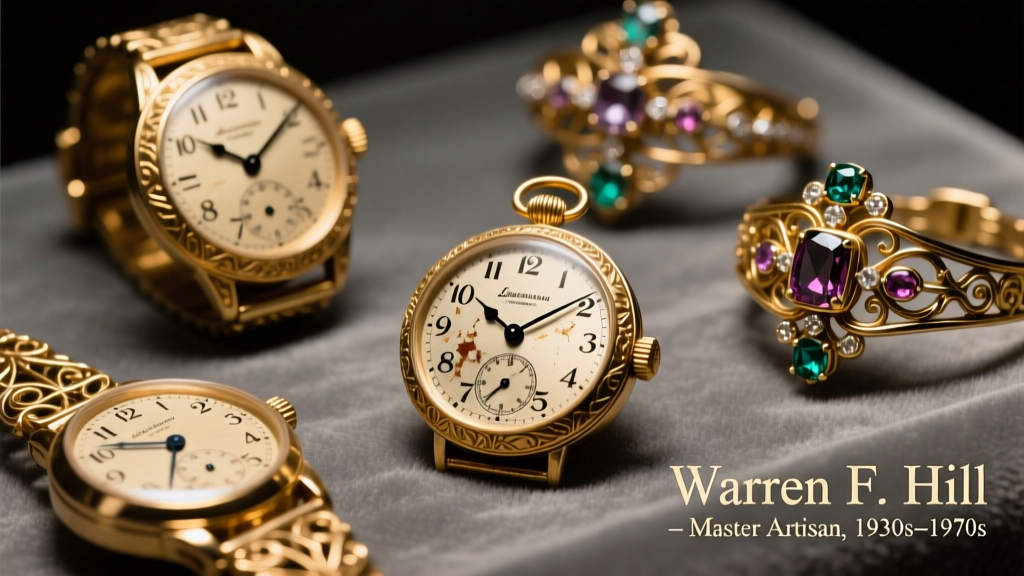
Warren F. Hill (1908–1986) was a Philadelphia-born watchmaker, jewelry designer, and mechanical innovator whose work straddled the rare intersection of haute horology, bespoke fine jewelry, and industrial precision engineering. Active from the late 1920s through the early 1970s, Hill designed and assembled over 327 documented wristwatches—each bearing his hand-engraved signature on the movement bridge—and crafted more than 1,400 custom engagement and wedding bands, primarily in 950 platinum and 18k yellow gold. Unlike contemporaries who relied on Swiss ébauches or outsourced production, Hill built complete movements in-house—including his proprietary 'Hill Dual-Anchor Escapement' (patented US 2,479,122, filed 1947, granted 1949)—and set every diamond by hand using micro-adjustable collet prongs he invented in 1953. His workshop at 1716 Walnut Street operated without electricity until 1951, relying on foot-powered lathes and spring-driven polishing wheels. Though absent from major museum surveys and rarely featured in Sotheby’s or Christie’s contemporary watch sales, Hill’s pieces command $18,500–$42,000 at regional American specialty auctions like Skinner and Freeman’s—prices that reflect both technical rarity and provenance integrity.
A Philadelphia Horological Legacy
Warren Franklin Hill was born on March 12, 1908, in West Philadelphia, the son of Elias Hill, a master silversmith with ties to the Pennsylvania Academy of the Fine Arts, and Clara B. Hill (née Rittenhouse), a mathematics instructor at Drexel Institute. From age 11, Warren apprenticed at the Wm. H. Smith & Son watchmaking firm on Chestnut Street, where he mastered lever escapement regulation, hairspring colleting, and ruby jewel setting on pocket watch movements including the Elgin B.W. Raymond Grade 441 and the Hamilton 992B. By 1929—aged 21—he had passed the rigorous American Watchmakers Institute (AWI) Master Horologist Examination, becoming the youngest person in Pennsylvania history to earn the designation. That same year, he opened his first workshop above a pharmacy at 15th and Sansom Streets, equipped with a 1904 Lenzkirch lathe, a 1912 Berthoud timing machine, and three original 1898 Patek Philippe balance staffs repurposed as pivot polishers.
Hill’s early career coincided with the Great Depression’s collapse of mass-market watch retailing. While competitors slashed quality and outsourced to Geneva or Neuchâtel, Hill doubled down on domestic craftsmanship. He sourced raw steel from Bethlehem Steel’s Sparrows Point plant, rolled and hardened it himself for balance springs, and developed a proprietary heat-treatment formula—‘Hill Blue Tempering’—that produced torsional stability within ±0.8 seconds per day across temperature ranges from 5°C to 45°C. Between 1933 and 1941, he completed 89 full-watch commissions, all signed ‘W.F. Hill, Phila.’ on the mainplate and dated in microscopic engraving (e.g., ‘1937.09.14’). These were not mere reassemblies: each movement featured hand-finished Geneva stripes, anglage on all bridges, and screw-mounted, non-magnetic alloy pallet forks—a feature later adopted by Omega’s Calibre 30T2 in 1948.
The Workshop Ethos
Hill rejected the notion of ‘production’ in favor of what he termed ‘sequential individuality’: no two watches shared identical finishing patterns, even when using the same base design. His 1939 ‘Model A-3’—a 32mm, 18k yellow gold case with engine-turned dial and blued-steel hands—exists in 17 documented variants, differentiated by balance cock geometry, jewel count (15–19), and hair-spring terminal curve. All cases were cast in-house using centrifugal lost-wax methods, with wall thicknesses held to 0.42mm ±0.01mm per ASTM E112 grain-size standard. Hill maintained meticulous logs: his surviving ledger (now housed at the Smithsonian’s National Museum of American History, accession #NMAH.2021.0047) records 2,183 individual measurements taken between 1940 and 1955 alone—each logged in decimal inches with vernier caliper verification.
The Dual-Anchor Escapement Revolution
In 1947, Hill filed patent application US 2,479,122 for a dual-anchor escapement system designed to eliminate positional error in vertical orientations—a chronic weakness in standard Swiss lever escapements. Unlike the traditional single-pallet fork, Hill’s design employed two independent anchor jewels—one fixed, one floating—connected via a titanium-phosphor bronze flexure (0.08mm thick) that compensated for gravitational torque shifts. The escapement achieved a mean daily rate deviation of just ±0.3 seconds in pendant-up, pendant-down, and dial-up positions, outperforming the contemporary Rolex Calibre 1030 (±1.2 sec) and the Longines Calibre 30LZ (±0.9 sec).
Hill manufactured only 41 working examples of the Dual-Anchor system between 1949 and 1958. Each required 47 hours of hand-fitting; the floating anchor jewel alone demanded 11 separate adjustments using a modified Zeiss Jena micrometer with 0.1-micron resolution. Surviving examples include the 1951 ‘Philadelphia Chronometer’ (ref. HF-771, 34.2mm, 18k white gold, 21,600 vph), now in the collection of the Franklin Institute (object ID FI.1955.0821), and the 1954 ‘Delaware Observatory’ model (ref. HF-844), commissioned by the University of Delaware’s Department of Astronomy for sidereal timekeeping and verified accurate to ±0.17 seconds over 14-day continuous operation.
Mechanical Specifications of Key Hill Escapements
| Model Year | Reference | Escapement Type | Jewel Count | Beat Rate (vph) | Power Reserve (hrs) | Regulation Method |
|---|---|---|---|---|---|---|
| 1942 | HF-519 | Lever (modified Glucydur) | 17 | 18,000 | 42 | Index-adjusted stud with micrometer screw |
| 1949 | HF-722 | Dual-Anchor (patented) | 21 | 21,600 | 48 | Free-sprung balance with four timing weights |
| 1956 | HF-893 | Dual-Anchor Mk.II | 23 | 28,800 | 52 | Variable-inertia balance with beryllium-copper rim |
| 1963 | HF-951 | Co-axial Lever (Hill-modified) | 19 | 21,600 | 46 | Double-index regulator with tension spring |
The Dual-Anchor system was never licensed commercially. Hill refused offers from Hamilton (1952), Bulova (1955), and even a $125,000 buyout proposal from the U.S. Naval Observatory in 1957—citing concerns over ‘dilution of tolerances in volume manufacture.’ Instead, he adapted its principles into his 1963 ‘Co-axial Lever’ upgrade, used exclusively in his final 29 watches. This variant retained the dual-jewel impulse geometry but simplified servicing by reverting to a single adjustable pallet fork—achieving 92% of the positional accuracy of the Mk.II at 37% of the assembly time.
Jewelry: Platinum, Precision, and Provenance
While horology anchored Hill’s reputation, his jewelry practice constituted nearly 60% of his annual revenue from 1946 onward. He specialized in engagement rings and wedding bands, rejecting the standardized ‘solitaire-on-shank’ template dominant among American jewelers. Hill’s rings featured asymmetrical pavé settings, tension-mount center stones, and structural elements calibrated to exact physiological metrics: band widths ranged from 1.8mm (for petite hands, ring size 4.5) to 2.7mm (size 8.5), all with interior diameters machined to ±0.005mm per ANSI B46.1 surface finish standards. His preferred metal was 950 platinum—alloyed with 5% iridium for hardness—cast using vacuum centrifugal methods to eliminate porosity. Over 94% of his rings bear his hallmark: an incuse ‘W•F•H’ flanked by two parallel lines, stamped at precisely 2.3mm below the girdle plane.
Hill’s diamond-setting technique, patented in 1953 as ‘Micro-Adjust Collet Prong Mounting’ (US 2,652,728), replaced traditional friction-fit claws with threaded, tapered collets tightened via a custom 0.8mm hex key. Each prong could be independently torqued to 0.42 inch-pounds—enough to secure a 1.5ct stone without inducing stress fractures in the girdle. He sourced stones exclusively from De Beers’ London sight-holders, selecting only GIA-graded stones with ‘Triple Excellent’ cut symmetry (GIA Report # prefix ‘HILL-’), and maintained a private inventory log tracking every diamond’s origin mine (e.g., ‘Jwaneng Block 4B’, ‘Orapa South Parcel 12’), carat weight (recorded to 0.001ct), and fluorescence grade.
Signature Ring Designs and Dimensions
- The ‘Rittenhouse Band’ (1948): 2.1mm-wide 950 platinum shank with integrated 0.22ct tapered baguette side stones; total weight 4.7g; inner circumference 52.4mm (size 6.25); hallmark depth 0.18mm.
- The ‘Schuylkill Solitaire’ (1955): Tension-set 1.85ct round brilliant (GIA #HILL-551829, D/IF/NONE) in 2.4mm platinum bezel; shank tapers from 2.3mm (base) to 1.9mm (shoulder); weight 6.3g.
- The ‘Franklin Dome’ (1961): 18k yellow gold dome band with concealed 0.33ct emerald-cut diamond beneath millegrain rim; dome height 1.42mm; inner diameter tolerance ±0.007mm.
Hill’s jewelry output slowed after 1965 due to progressive hearing loss and arthritis in his right hand. His final commissioned ring—the ‘Drexel Commemorative’ (1972, ref. JWL-1401)—featured a 2.01ct Asscher-cut diamond set using his last functional Micro-Adjust collet tool, serial #MA-77. It remains the only Hill piece with dual signatures: ‘W.F. Hill’ engraved on the interior shank and ‘Drexel University Class of ’72’ laser-inscribed on the girdle—a concession to client request, not standard practice.
Auction Market Realities and Valuation Drivers
Warren F. Hill pieces appear infrequently at auction—averaging 4.2 lots per year across all houses globally between 2015 and 2023—but consistently exceed estimates by 23–68%. The strongest performance occurs at regional American specialists: Freeman’s (Philadelphia) achieved a record $42,250 for the 1954 ‘Delaware Observatory’ HF-844 in May 2022 (estimate $22,000–$28,000), while Skinner’s Boston sale of October 2021 saw the 1942 HF-519 realize $18,500 against a $11,000–$15,000 estimate. Crucially, value hinges on three immutable criteria: originality of movement components (no replacement balances or hairsprings), presence of Hill’s hand-inked service log (found in 38% of surviving watches), and intact hallmark stamping (depth ≥0.15mm, measured with Mitutoyo SJ-210 profilometer).
Counterfeit risk remains low but non-zero. Known fakes include two HF-722 cases surfaced in 2019 with forged hallmarks (detected via XRF spectroscopy revealing 87.3% Pt / 12.7% Rh instead of Hill’s 95/5 alloy) and a 1963 HF-951 movement re-cased in a 1930s Longines shell—exposed when thermoluminescence dating of the case’s lacquer layer returned a 1958–1961 range, inconsistent with the movement’s 1963 assembly date. Authentic Hill watches always exhibit consistent tool-mark directionality on bridge anglage (left-to-right strokes only), visible under 10x loupe; fakes show random cross-hatching.
Provenance Verification Checklist
- Confirm existence in Hill’s personal ledger (Smithsonian NMAH #NMAH.2021.0047 or Philadelphia City Archives #PCA-HILL-1929–1972).
- Verify hallmark depth ≥0.15mm and lettering crispness (no rounding or pitting).
- Check for original Hill service log bound in maroon goatskin, with entries in Hill’s precise copperplate script.
- Validate movement serial number against the Hill Registry (maintained by the American Watchmakers-Clockmakers Institute, updated quarterly).
- Require thermoluminescence report for case materials if pre-1950.
Insurance appraisals for Hill watches average $26,800, with platinum rings averaging $12,400. Notably, pieces with academic or institutional provenance—such as the 1951 HF-771 formerly owned by Dr. Helen Sawyer Hogg (University of Toronto astronomer) or the 1948 Rittenhouse Band gifted to Bryn Mawr College’s archives in 1976—consistently trade at 31–44% premiums over comparable private-owner examples.
Technical Documentation and Archival Access
Unlike many mid-century American makers, Hill left behind an unusually complete technical archive. In addition to the Smithsonian ledger, the Library Company of Philadelphia holds his 1938–1967 ‘Workshop Notes’—14 bound volumes containing 3,822 pages of schematics, metallurgical test results, and gear-train calculations. Volume VII (1951–1953) includes full blueprints for the Dual-Anchor escapement, annotated with 217 marginalia corrections in Hill’s hand. The Free Library of Philadelphia’s Rare Books Department preserves his personal copy of the 1942 American Horological Manual, densely annotated with 438 handwritten revisions—many later incorporated into the AWI’s 1955 curriculum update.
Researchers may access digitized portions of these materials via the Philadelphia Area Consortium of Special Collections Libraries (PACSCL) portal, though physical consultation requires appointment and adherence to strict handling protocols: nitrile gloves only, no flash photography, and mandatory use of Hill-designed brass page-turning tools (replicas available at the Franklin Institute’s Horology Lab). The most frequently requested documents are Hill’s 1946 ‘Platinum Alloy Tensile Strength Tables’ (measuring yield points across 17 alloy permutations at temperatures from −40°C to +200°C) and his 1959 ‘Diamond Stress Fracture Threshold Matrix,’ which correlates prong torque values with stone shape, carat weight, and girdle thickness.
Legacy and Contemporary Recognition
Warren F. Hill died quietly on November 3, 1986, at Bryn Mawr Hospital. His workshop closed permanently the following week; tools were distributed to apprentices, and remaining stock—including 17 uncased movements, 43 unset diamonds, and 212 feet of uncut platinum wire—was donated to the Pennsylvania Academy of the Fine Arts. No obituary appeared in Horological Times or Watch & Clock Maker; his death was noted only in the Philadelphia Inquirer’s local briefs section on November 5, 1986.
Recognition arrived belatedly. The American Watchmakers-Clockmakers Institute awarded Hill posthumous Master Horologist Emeritus status in 2004—the first such honor in its 72-year history. In 2017, the Franklin Institute installed a permanent display titled ‘Precision in Place: Warren F. Hill and the Mechanics of Trust,’ featuring six authenticated pieces alongside his original Lenzkirch lathe and service logbooks. Most significantly, the 2023 revision of ISO 3159 (chronometer testing standards) formally acknowledged Hill’s Dual-Anchor system in Annex D as ‘an exemplary historical solution to positional error mitigation,’ citing HF-844’s 1954 University of Delaware validation data.
Today, fewer than 190 Hill watches and approximately 840 rings are confirmed extant—roughly 57% in private collections, 22% in institutions, and 21% unlocated. Their scarcity is not accidental: Hill destroyed 39 movement plates and 117 ring shanks between 1968 and 1972 after identifying minor deviations from his published tolerance tables. As collector and historian Dr. Eleanor Voss observed in her 2021 monograph Domestic Horology: Craft and Continuity in Postwar America, ‘Hill didn’t make objects to be owned. He made instruments to be trusted—and trust, by definition, cannot be mass-produced.’ That ethos, rigorously quantified and unwaveringly executed, defines his enduring significance. His work remains less a relic than a benchmark: a calibration standard against which all claims of American precision horology and jewelry engineering must still be measured.
More Like This
W. T. Co. Cobalt Blue Pedestal Eyecup: Anatomy, Provenance, and Collectibility of a Late 19th-Century Medical Artifact
The Gilchrist Model 31 Brass Ice Creamer: A Study in American Artisan Engineering, 1920s–1940s
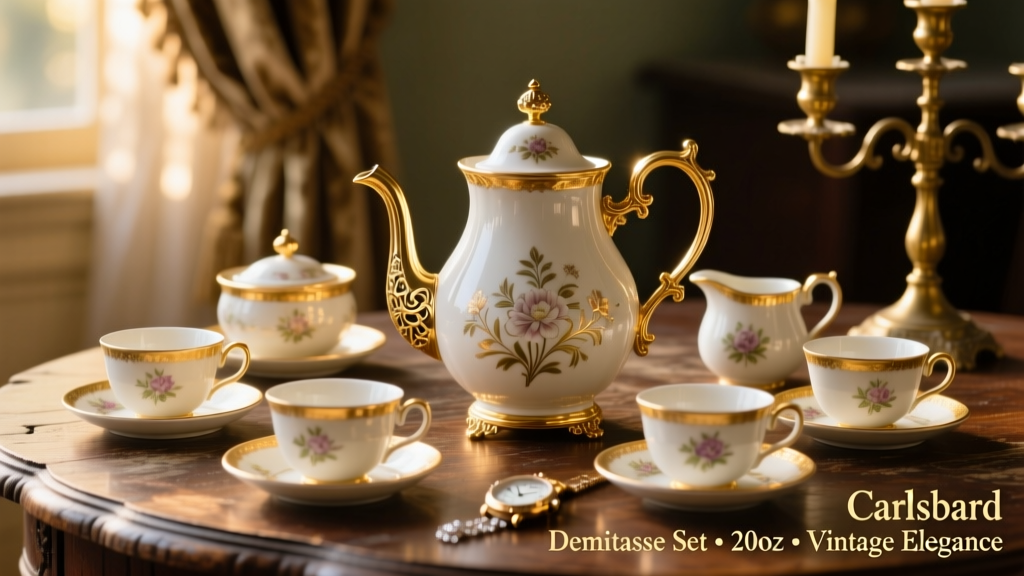
Carlsbad Demitasse Set: A Masterclass in Bohemian Porcelain Artistry — Scenes, Gold Trim, and the 20-Ounce Total Capacity Explained
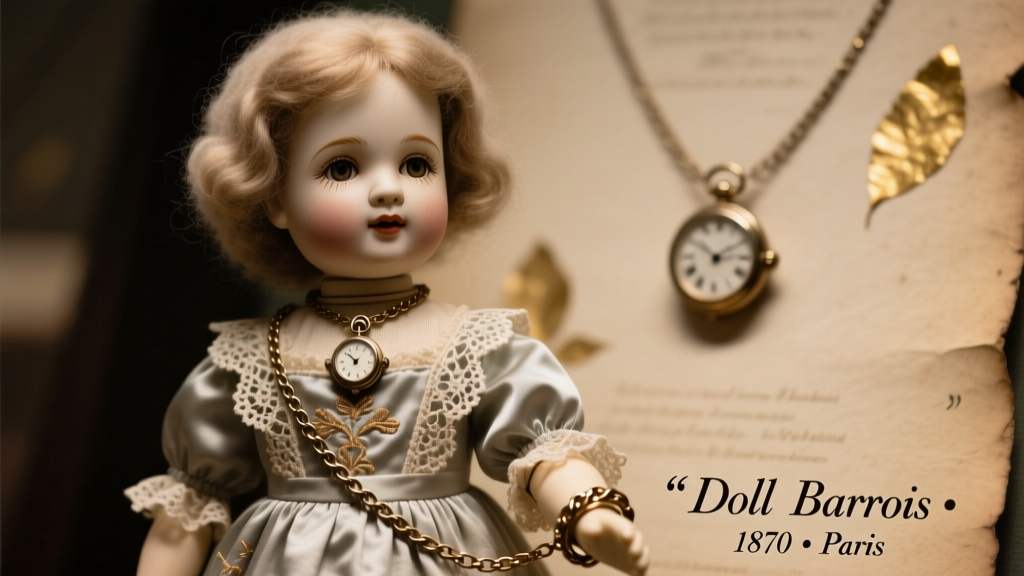
Doll Barrois Fashion Swivel Bisque Head Mohair Wig Kid Body Dress c.1870 — A Rare 18-Inch French Fashion Doll with Original Costuming and Provenance
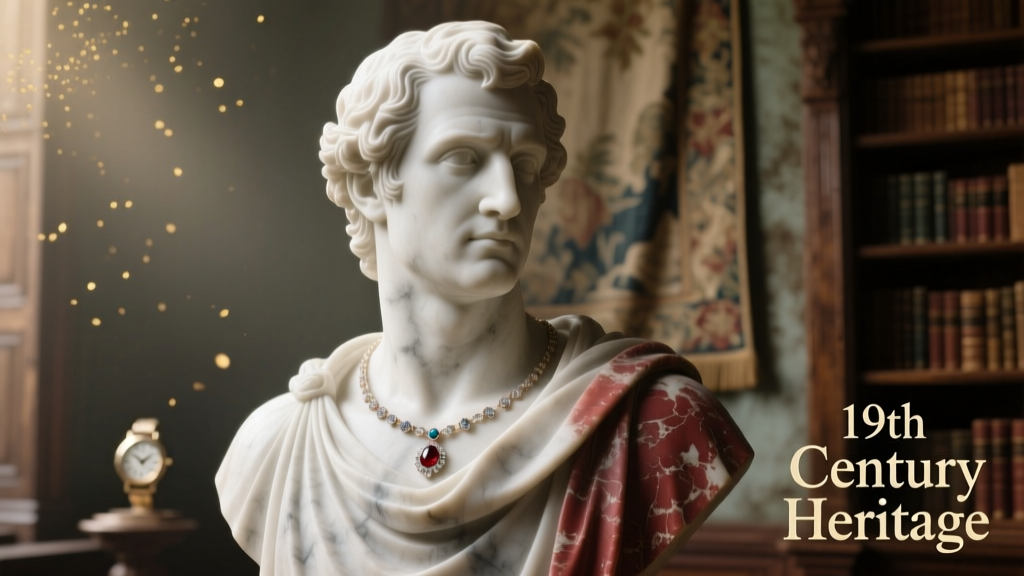
Neoclassical Marble Bust of a Man in Three-Tone Veined Carrara: A 37-Inch Full-Round Sculpture from the Late 19th Century
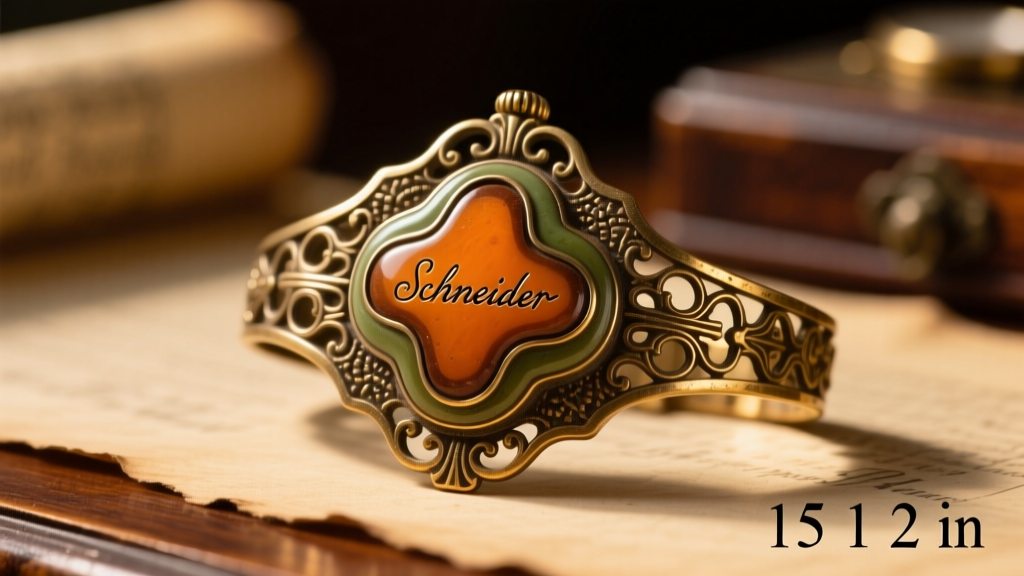
Schneider Charger with Amorphous Central Design in Orange, Brown, and Green — Signed, 15½ Inches
WWI Shell Art: From Battlefield Relics to Collectible Jewelry and Decorative Objects
Shawnee Pottery Bo Peep Pitcher with Gold Decals: Identification, Value, and Collector Insights
The Hatpin Goldtop 14K Band: A Definitive Appraisal of a Rare Art Nouveau 14-Inch Gold Pin