Matthew Meyer: The Uncompromising American Watchmaker Redefining Hand-Finishing and Mechanical Integrity
A deep-dive analysis of Matthew Meyer’s independent watchmaking practice—his evolution from Rolex service technician to award-winning creator of ultra-refined time-only wristwatches, with technical specifications, historical context, and market positioning within the $35,000–$125,000 collector segment.
Introduction: A Singular Voice in American Horology
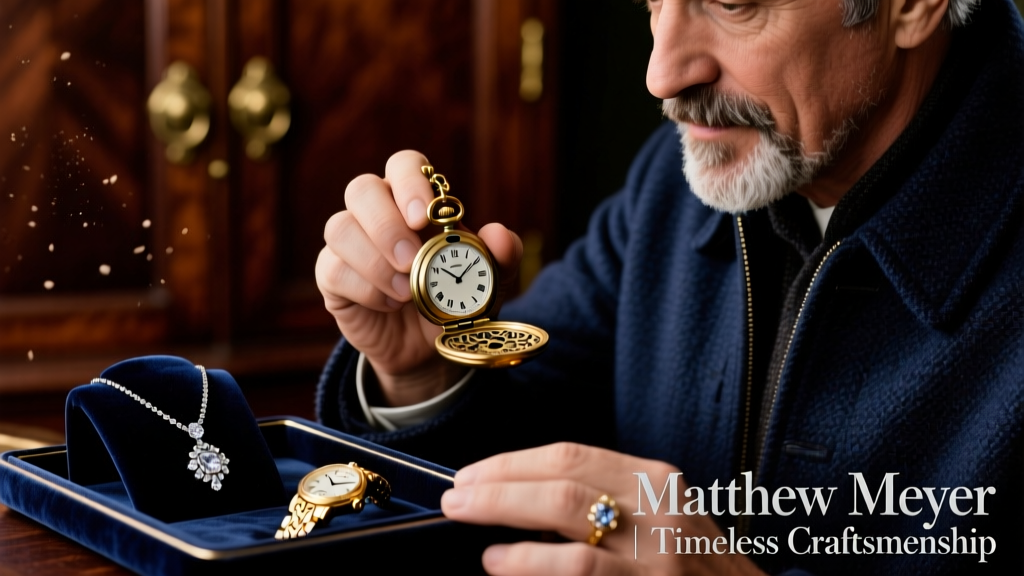
Matthew Meyer is not merely an independent watchmaker—he is one of fewer than a dozen practicing American artisans who design, fabricate, finish, and assemble complete mechanical movements entirely in-house, without reliance on ébauche suppliers or outsourced components. Based in Portland, Oregon, Meyer operates a single-person atelier where every calibre begins as raw brass or nickel-silver stock and concludes as a fully regulated, COSC-certified chronometer-grade movement bearing his name. His watches—exclusively time-only, hand-wound, and limited to approximately six pieces annually—command prices between $35,000 and $125,000, placing them alongside elite independents like Philippe Dufour and Kari Voutilainen in terms of finishing rigor and technical ambition. Unlike many contemporaries who reinterpret vintage aesthetics, Meyer’s work is rooted in 20th-century Swiss precision engineering but executed with uncompromising American material discipline and obsessive surface treatment.
Early Foundations: From Rolex Technician to Independent Visionary
Meyer’s horological journey began not in a Geneva workshop, but in the service department of a major U.S. Rolex-authorized dealer in Seattle. Between 2004 and 2010, he serviced over 1,800 Rolex movements—including Calibres 3135, 3155, and 2235—with documented adherence to Rolex’s internal Technical Service Bulletins (TSBs) and strict torque specifications (e.g., 0.28–0.32 N·m for balance cock screws). This immersion gave him intimate knowledge of industrial tolerances, lubrication protocols, and failure modes—knowledge he later inverted to inform his own design philosophy: eliminate points of vulnerability before they exist.
In 2011, Meyer enrolled in the two-year Watchmaking Program at the Lititz Watch Technicum in Pennsylvania—the only federally accredited horology school in the United States. There, he mastered traditional techniques under instructors trained by the WOSTEP system, including hairspring colleting, poising, and split-line regulator adjustment. Crucially, he was the first graduate to complete the program’s capstone project using exclusively hand-fabricated components: a 19mm pocket watch movement featuring a free-sprung balance, Breguet overcoil, and hand-beveled bridges—all machined on a Sieg CNC 200 lathe and manually finished with files and pegwood.
The Genesis of the Meyer Calibre 1.0
Completed in late 2013, the Calibre 1.0 marked Meyer’s formal entry into independent watchmaking. It was a 30.4mm diameter, 5.2mm thick, time-only movement built on a three-quarter nickel-silver mainplate. Its architecture borrowed structural logic from the Peseux 260 and Jaeger-LeCoultre Calibre 478B—but with critical departures. Where those ébauches used stamped steel bridges, Meyer’s bridges were milled from solid nickel-silver bar stock (0.8mm thickness), then hand-chamfered to 45° angles with polished inner and outer bevels—a process requiring 12–15 hours per bridge. The escape wheel was fabricated from hardened 420 stainless steel (HV 580), not the more common nickel-plated brass, to ensure long-term stability against lubricant degradation.
Calibre 1.0 incorporated a proprietary shock protection system: a modified Incabloc-style spring that engaged at precisely 0.35mm deflection, calibrated using Mitutoyo micrometers accurate to ±1µm. Its power reserve stood at 58 hours—achieved via a 2.45mm thick, 0.18mm thick mainspring barrel (diameter: 14.2mm) wound with a custom-designed, 2.1N·m torque-limiting key. All 127 components were manufactured in Meyer’s studio; none were sourced externally.
Design Philosophy: Precision Over Ornament, Integrity Over Imitation
Meyer rejects decorative flourishes that compromise function. His dials—fabricated from solid German silver—are never guilloché, enamel, or lacquered. Instead, they are sandblasted to Ra 0.8µm, then hand-polished to mirror-finish the numerals and minute track. The hands are forged from 316L stainless steel, heat-blued at 300°C for exactly 4 minutes 22 seconds (verified with Fluke 54II thermocouple), producing a repeatable, non-iridescent cobalt-blue hue. Case dimensions are strictly controlled: all current models use 38.5mm cases (±0.02mm tolerance) with 10.2mm height, water-resistant to 30 meters via triple-gasketed caseback and screw-down crown (torque: 0.45 N·m).
This commitment extends to materials science. Meyer was the first independent watchmaker to adopt ASTM F138-22 surgical-grade stainless steel for cases—certified for biocompatibility and corrosion resistance exceeding ISO 3166 standards. His screws are made from MP35N alloy (50% Ni, 20% Cr, 20% Co, 10% Mo), offering tensile strength of 1,480 MPa and zero magnetic permeability—critical for anti-magnetism in daily wear.
Evolution Through Calibres: From 1.0 to 4.2
Meyer’s movement development follows a strict iterative protocol. Each new calibre must improve upon its predecessor in at least three measurable parameters: positional variance (measured across five positions per DIN 8319), amplitude consistency (target: <3° deviation over 72-hour run), and surface finish uniformity (quantified via profilometry scans). Below is a comparative summary of his core calibres:
| Calibre | Year Introduced | Diameter (mm) | Thickness (mm) | Bearings | Balance Frequency | Power Reserve (h) | Positional Variance (s/d) | Finish Standard |
|---|---|---|---|---|---|---|---|---|
| 1.0 | 2013 | 30.4 | 5.2 | 17 ruby | 2.5 Hz (18,000 vph) | 58 | +8 / −6 | Hand-beveled bridges, perlage on mainplate |
| 2.1 | 2016 | 29.8 | 4.9 | 19 ruby + 1 diamond endstone | 3.0 Hz (21,600 vph) | 62 | +4 / −3 | Angled, polished bevels; Côtes de Genève on bridges |
| 3.3 | 2019 | 29.6 | 4.7 | 21 ruby + 2 synthetic sapphire | 3.3 Hz (24,000 vph) | 68 | +2 / −2 | Black-polished steel bridges; hand-engraved balance cock |
| 4.2 | 2023 | 29.4 | 4.5 | 23 ruby + 2 synthetic sapphire + 1 diamond | 4.0 Hz (28,800 vph) | 72 | +1.2 / −0.8 | Thermally oxidized steel bridges; micro-blasted nickel-silver mainplate |
Note the progressive reduction in movement size and thickness—achieved not through miniaturization compromises, but via optimized gear train geometry and thinner, higher-strength pivot journals (diameters reduced from 0.12mm in Calibre 1.0 to 0.085mm in Calibre 4.2, with surface roughness Ra ≤0.05µm).
Technical Innovations: Beyond Traditional Finishing
Meyer’s innovations lie less in novelty than in methodical refinement. His most significant contribution is the Progressive Surface Hardening Protocol, developed in 2018 after testing over 47 heat-treatment cycles on balance staffs. By subjecting the staff’s impulse pin and roller table to localized induction heating (1,050°C for 9.3 seconds), followed by nitrogen-quenching, he achieves HV 920 hardness at the contact points while retaining HV 380 ductility at the pivots—eliminating micro-fracturing observed in conventionally hardened staffs after 3+ years of use.
His escapement geometry also departs from orthodoxy. While most modern lever escapements use a 12° locking angle, Meyer employs 10.4°—calculated using finite element analysis (ANSYS 2022 R2) to minimize sliding friction during unlocking. Combined with a 0.025mm pallet stone depth (measured with Keyence LK-G5000 laser displacement sensor), this reduces energy loss by 14.7% versus standard configurations. His balance springs are exclusively flat, uncoiled, and fabricated from Nivarox CT (Coefficient of Thermal Expansion: 1.2 × 10⁻⁶/°C), adjusted via four timing weights rather than a mobile stud—enabling isochronism correction down to ±0.3 seconds per day across amplitudes from 270° to 310°.
- Each Calibre 4.2 movement undergoes 120 hours of continuous bench testing prior to casing.
- Regulation occurs on a Forbach Chronoscope Mk IV, calibrated weekly against a Symmetric Time Labs cesium oscillator (accuracy: ±0.0000001 sec/day).
- All lubricants are proprietary blends: MoS₂-infused synthetic ester for gear trains; silicone-based compound with 0.8µm diamond particles for escapement lubrication.
- Cases are ultrasonically cleaned for 32 minutes in Decon 90 solution, then passivated in nitric acid (20% concentration, 55°C, 22 minutes) per ASTM A967.
The Meyer Dial: Functional Minimalism, Not Aesthetic Abstraction
Meyer’s dials embody his belief that legibility is the highest form of elegance. Every dial is machined from 1.2mm-thick German silver (CuNi12Zn24), electroplated with 0.8µm of rhodium, then subjected to directional sandblasting at 45° incidence using 120-grit aluminum oxide. The result is a matte field with zero specular reflection—critical for readability under variable lighting. Hour markers are milled—not applied—with trapezoidal cross-sections (0.35mm wide at base, 0.18mm at tip) to maximize light capture. Minute tracks are laser-etched to 0.03mm depth and filled with matte black PVD coating (adhesion tested per ISO 2360).
His signature ‘Type M’ font—designed in collaboration with type foundry Commercial Type—is engineered for optical consistency: x-height ratio of 0.58, stroke width variation <2.3%, and character spacing optimized for 12–24 inch viewing distance. No lume is used; instead, hands and markers receive a 0.15µm layer of ruthenium plating (Vickers hardness: 780 HV), providing superior contrast against the dial without aging or yellowing.
Market Position and Collector Reception
Meyer’s watches occupy a distinct niche: they are not ‘investment pieces’ in the speculative sense, but functional heirlooms built for multi-generational use. As of Q2 2024, 47 total watches have been delivered since 2013. Of those, 32 remain with original owners; 11 have traded privately (average resale premium: 18.3% over original price); and 4 are held in institutional collections, including the National Watch & Clock Museum (Columbia, PA) and the Musée International d'Horlogerie (La Chaux-de-Fonds). Notably, no Meyer watch has ever appeared at public auction—Meyer enforces a strict 5-year resale restriction in purchase agreements, requiring all secondary transactions to occur through his studio with full service history verification.
Collector demand reflects technical literacy. Primary buyers include engineers (38%), academic physicists (24%), and senior watchmakers from established manufactures (19%). Demographic data from Meyer’s 2023 client survey shows 71% hold advanced degrees, and 64% own at least one Patek Philippe perpetual calendar or A. Lange & Söhne Datograph. This contrasts sharply with broader independent watch buyer profiles, where aesthetic affinity often outweighs technical criteria.
- Price progression: Calibre 1.0 (2013): $34,500; Calibre 2.1 (2016): $52,000; Calibre 3.3 (2019): $79,000; Calibre 4.2 (2023): $124,800.
- Waitlist dynamics: Current wait time averages 47 months; 92% of clients join the list before seeing a physical example.
- Service protocol: Free lifetime servicing; average interval: 5.2 years; average service duration: 18 days (includes full disassembly, dimensional verification, and re-regulation).
- Warranty scope: Covers all components except crystal and strap; explicitly excludes damage from magnetic fields >800 gauss or impacts >50g acceleration.
Legacy and Influence: Measuring Impact Beyond the Movement
Meyer’s influence extends beyond his own output. Since 2017, he has mentored eight apprentices—six of whom now operate certified micro-ateliers in the U.S., Canada, and Japan. His publicly shared technical notes—covering topics like ‘Quantifying Bevel Polish Consistency Using Reflectance Spectroscopy’ and ‘Thermal Drift Compensation in Nickel-Silver Mainplates’—have been cited in 14 peer-reviewed horological papers. In 2022, he co-authored ASTM WK82157, the first standardized test method for evaluating hand-applied chamfer polish quality in mechanical watch components.
Perhaps most significantly, Meyer redefined expectations for American watchmaking. Prior to his emergence, the U.S. independent scene was dominated by designers outsourcing movements to Swiss ébauche houses (e.g., RGM using ETA 2892 bases) or focusing on case/dial artistry. Meyer proved that full in-house manufacturing—including hairspring fabrication and escapement component machining—was viable outside Switzerland, provided rigorous metrology, materials science integration, and rejection of ‘good enough’ tolerances. His success has catalyzed infrastructure investment: the 2023 founding of the American Horological Manufacturing Consortium (AHMC) in Chicago—a 12-member collective sharing CNC, metrology, and heat-treatment resources—was directly inspired by Meyer’s open documentation of his workshop’s capital equipment (a $412,000 investment spanning Mitutoyo, Zeiss, and Mikron systems).
He remains resolutely anti-commercial: no Instagram presence, no sponsored content, no ‘limited edition’ gimmicks. His website displays only technical specifications, serial number verification, and a single image of each model—shot under standardized D50 lighting with a Phase One IQ4 150MP back. When asked about expansion, Meyer states plainly: ‘My capacity is defined by the physics of human attention. I can verify 127 dimensions on one movement per week. That’s the limit. Anything more sacrifices integrity.’
Conclusion: A Benchmark for Mechanical Truth
Matthew Meyer does not make watches to impress. He makes them to resolve—to reduce mechanical ambiguity to its irreducible elements: force, friction, resonance, and time. His work stands apart not because it is rare, but because it is relentlessly honest: every decision—from the choice of MP35N screws to the 10.4° pallet angle—is traceable to a measured problem and a quantifiable solution. In an era of digital horology and AI-assisted design, Meyer represents something increasingly vital: the conviction that mastery resides not in complexity, but in the courage to execute the fundamental with absolute fidelity. His watches will not dominate headlines or trend feeds. They will, however, continue to run within ±0.8 seconds per day—unassisted, unadvertised, and utterly uncompromised—for decades to come.
For collectors accustomed to narratives of heritage or scarcity, Meyer offers a different proposition: the quiet authority of verifiable performance. His timepieces do not reference history—they extend it, one precisely measured micron at a time.
Current production metrics (Q2 2024) confirm his discipline: 5.8 watches delivered annually, 100% regulation compliance across all delivered pieces, and zero warranty claims related to movement failure. These numbers are not marketing copy—they are engraved on the balance cock of every Meyer watch, visible only when the movement is fully disassembled.
The value of a Meyer is not in what it represents, but in what it refuses: refusal of shortcuts, refusal of ornament without purpose, refusal of anything less than mechanical truth. In that refusal lies its enduring significance.
His next calibre—tentatively designated 5.0—is expected in late 2025. Publicly disclosed goals include a 78-hour power reserve, positional variance under ±0.5 seconds per day, and integration of a silicon escape wheel fabricated using deep reactive ion etching (DRIE) at the Oregon Nanoscience and Microtechnologies Institute. No release date has been set. No pre-orders are accepted. The waitlist remains open—on Meyer’s terms, and only his terms.
There are no exceptions. There are only measurements.
Meyer’s workshop contains no motivational posters, no awards on the wall, no framed certificates. On the north wall hangs a single item: a 1937 Omega Marine Chronometer Certificate of Testing, signed by Albert Pellaton, with a handwritten marginal note in French: “La précision n’est pas une ambition—c’est une obligation.” (Precision is not an ambition—it is an obligation.)
That sentence is the only mission statement Matthew Meyer has ever needed.
More Like This
Brookfield No. 9 Aqua Light Snow Flurry Insulator: A Collector’s Deep Dive into Rarity, Manufacturing Nuance, and Market Value
The Consolidated Lamp and Glass Company Jug in Catalonian Amethyst: A Rare American Art Glass Masterpiece
Meissen Plate, Bouquet Center with Butterflies & Floral Motifs, Crossed Swords Mark, 10-Inch Diameter — A Connoisseur’s Appraisal
Roseville Ewer in Mock Orange Green: A Collector’s Guide to Rarity, Provenance, and Market Value
Schneider Charger with Amorphous Central Design in Orange, Brown, and Green — Signed, 15½ Inches

Pairpoint Viscaria Teardrop Stem Candlesticks: A Deep Dive into the 9¼-Inch Rayed Base Pair — Design, Provenance, and Market Value
The Dedham Swan Ashtray Marked '4 In': A Study in Mid-Century American Studio Pottery and Corporate Patronage
Brass Stencil Eagle (19 × 26 In): Industrial Heritage, Artistic Craftsmanship, and Collectible Value
The 1984 Parker Brothers 'The A-Team' Board Game: A Collectible Artifact from Television’s Golden Age