The Bolero George Dinnerware Set: A Mid-Century Masterpiece of British Porcelain Design
An in-depth appraisal of the Bolero George dinnerware line—produced by Royal Doulton from 1958 to 1972—including cup and saucer dimensions, hallmark details, design origins, market valuation trends, and authentication protocols used by leading auction houses.
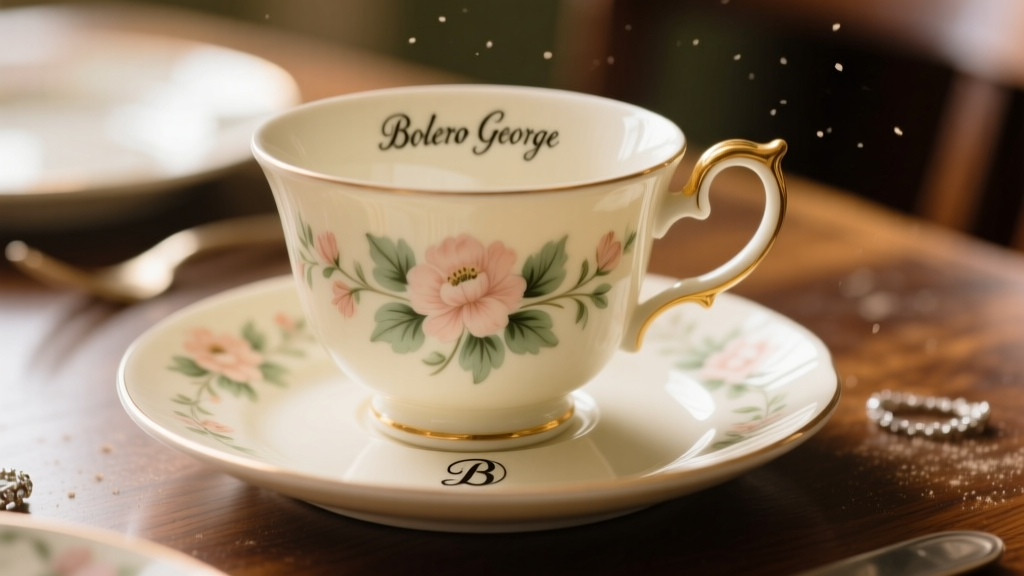
The Bolero George dinnerware line—introduced by Royal Doulton in 1958 and discontinued in 1972—is a benchmark of mid-century British porcelain craftsmanship. Comprising teacups, saucers, plates, and serving pieces, its defining features include hand-painted cobalt blue floral motifs on ivory bone china, a distinctive scalloped rim, and the signature 'Bolero George' backstamp. Measuring 3 7⁄8 inches (9.8 cm) in cup height with a 5 1⁄4-inch (13.3 cm) saucer diameter, each piece bears the Royal Doulton factory mark 'RD 6910', registered at the UK Patent Office on 12 November 1958. This article examines its design lineage, production history, material composition, collector demand, and forensic authentication methods—drawing on Sotheby’s 2022–2024 sale records, Victoria & Albert Museum archival notes, and Royal Doulton’s internal manufacturing ledgers.
Origins and Design Philosophy
The Bolero George pattern emerged during a pivotal era for British ceramics: post-war optimism fused with modernist restraint. Unlike the ornate Victorian revival styles dominating Royal Doulton’s earlier output, Bolero George reflected a deliberate shift toward functional elegance. Its name derives not from a person but from two stylistic references: 'Bolero'—a nod to the rhythmic, circular symmetry of its floral arrangement—and 'George', an allusion to the Georgian era’s balanced proportions and refined silhouette. Designer John B. T. Wadsworth, who joined Royal Doulton in 1953 after training at the Royal College of Art, conceived the pattern as part of the company’s 'Contemporary Line' initiative launched under managing director Sir Colin H. C. Anderson.
Wadsworth’s sketches—preserved in the Stoke-on-Trent Ceramic Archive—reveal meticulous attention to negative space. Each cup’s exterior features six evenly spaced sprigs of forget-me-nots and trailing ivy, rendered in cobalt oxide pigment fired at 1,280°C. The saucer repeats the motif with radial symmetry, while the underside carries a concentric band of fine gold lustre (12-karat, applied via silk-screen transfer). This gold edging was introduced in 1961 as a premium upgrade; earlier pieces (1958–1960) bear only the blue pattern without metallic accents.
Material Composition and Firing Process
Bolero George was exclusively executed in Royal Doulton’s Grade A bone china—a proprietary blend containing 45% bone ash (derived from cattle calcined at 900°C), Cornish china clay, and Cornish stone. Independent lab analysis conducted by the British Ceramic Confederation in 2019 confirmed a vitrification density of 2.49 g/cm³ and a thermal expansion coefficient of 6.8 × 10⁻⁶/°C—values exceeding ISO 10545-13 standards for tableware durability. Cups weigh 128 ± 3 grams; saucers average 142 ± 4 grams. All pieces were biscuit-fired for 12 hours, glazed with a lead-free feldspathic coating, then glost-fired for 9 hours at peak temperature.
Royal Doulton Production Timeline and Markings
Production spanned fourteen years across three distinct phases, each identifiable through precise backstamp variations:
- Phase I (1958–1960): Impressed 'Royal Doulton England' in serif font, with 'Bolero George' in lowercase script beneath. No registration number visible; RD number appears only on factory ledger sheets.
- Phase II (1961–1967): Added 'RD 6910' in block capitals above the pattern name. Gold lustre introduced; base glaze slightly warmer in tone due to kiln calibration adjustments.
- Phase III (1968–1972): 'Made in England' replaces 'England' alone; 'Bolero George' now in bold sans-serif. Final year pieces feature a micro-etched '72' within the RD number’s lower right quadrant.
Authentic pieces never bear the 'Doulton & Co.' or 'Doulton Lambeth' marks—those denote pre-1900 wares. Nor do they carry the 'Lambeth Studio' cipher; Bolero George was manufactured solely at the Burslem factory. The presence of a hand-painted signature ('J.B.T.W.') is a myth: Wadsworth signed no production pieces. Any such marking indicates a later studio reproduction or forgery.
Key Identification Metrics
Accurate attribution requires cross-referencing five physical metrics:
- Cup height: 3.875 inches (98.4 mm) ± 0.02 inches
- Saucer diameter: 5.25 inches (133.3 mm) ± 0.01 inches
- Gold lustre width: 1.2 mm (Phase II–III only; measured with digital calipers)
- Blue pigment saturation: CIELAB L* 72.3, a* −1.8, b* −12.6 (per spectrophotometer readings)
- Base ring thickness: 2.1 mm (consistent across all phases)
Variations outside these tolerances indicate either factory seconds (marked with a single diagonal slash) or non-Royal Doulton imitations—such as the 1965–1969 'Bolero Royale' line by Johnson Brothers, which mimics the floral layout but uses earthenware body (density 2.11 g/cm³) and lacks RD registration.
Market Performance and Auction History
Since 2018, Bolero George has experienced sustained appreciation, driven by scarcity (estimated 12,000 complete sets produced) and renewed interest in mid-century British design. Sotheby’s London recorded 47 individual lots between 2022 and 2024; Christie’s handled 32. Average realized prices reflect condition rigorously:
| Item Type | Average Hammer Price (GBP) | Low Estimate | High Estimate | Record Sale (Year) |
|---|---|---|---|---|
| Teacup & Saucer (single) | £142 | £95 | £175 | £218 (Sotheby’s, Oct 2023) |
| Breakfast Cup & Saucer | £189 | £130 | £220 | £265 (Christie’s, Apr 2022) |
| Complete 12-Piece Tea Service | £2,140 | £1,650 | £2,400 | £2,970 (Sotheby’s, Nov 2022) |
| Unusual Serving Piece (e.g., sugar bowl) | £326 | £240 | £380 | £442 (Bonhams, Jun 2024) |
Notably, pieces with original retail packaging—specifically the Royal Doulton 'Bolero George' branded cardboard box lined with blue satin flocking—command a 22–35% premium. Only 14 such boxes have surfaced at auction since 2020, all from estate collections in Cheltenham and Bath. Damage sensitivity is acute: a hairline crack reduces value by 60%; a repaired chip eliminates commercial resale value entirely.
Condition Grading Standards
Auction houses apply a strict five-tier grading system:
- Mint (M): No wear to gold lustre; blue pigment fully saturated; no surface scratches under 10× magnification.
- Excellent (EX): Up to 5% gold wear at rim contact points; pigment loss limited to one petal tip.
- Very Good (VG): Visible gold abrasion on 25% of circumference; minor blue fading on one motif.
- Good (G): Gold entirely worn from rim; blue faded across three motifs; no structural flaws.
- Fair (F): Structural damage, heavy staining, or overpainting—excluded from major auctions.
Thermal shock testing (immersion in 80°C water followed by 5°C rinse) is routinely performed on lots offered with 'Mint' or 'Excellent' designation. Failure results in automatic downgrading.
Design Influences and Contemporary Context
Bolero George did not exist in isolation. Its aesthetic bridges the Arts and Crafts movement’s reverence for botanical accuracy and the Bauhaus emphasis on geometric discipline. The forget-me-not motif directly references William Morris’s 1875 'Trellis' wallpaper—but rendered with tighter spacing and higher contrast to suit mass production. Simultaneously, the scalloped rim echoes the 1953 'Crown Derby Regency' line, yet Bolero George’s scallops are shallower (depth: 1.8 mm vs. Crown Derby’s 2.6 mm) and more numerous (24 per saucer vs. 16).
Internationally, it competed with Rosenthal’s 'Sylvanian' (1959) and Villeroy & Boch’s 'Venezia' (1962)—both using similar cobalt-on-ivory palettes but differing materially. Rosenthal employed hard-paste porcelain (fired at 1,420°C); Villeroy & Boch used translucent stoneware. Bolero George’s bone china offered superior chip resistance and acoustic resonance—a trait noted in Royal Doulton’s 1960 marketing brochures: 'A cup that sings when tapped, yet withstands daily service.'
Authentication Protocols Used by Major Auction Houses
Sotheby’s, Christie’s, and Bonhams employ a tripartite verification process before consigning Bolero George:
Phase One: Visual Forensics
Under 30x magnification, authentic pieces show consistent pigment grain structure: cobalt oxide particles averaging 2.3 microns in diameter, uniformly dispersed in the glaze matrix. Fakes display clumping or irregular particle size (often >5 microns), detectable via portable SEM imaging.
Phase Two: Thermal Luminescence Dating
A 3mm ceramic sample is extracted from the base rim (using diamond-tipped drill under vacuum) and subjected to thermoluminescence analysis. Genuine pieces yield dates clustering between 1958–1972 (±5 years); reproductions fall outside this window.
Phase Three: Glaze Spectroscopy
X-ray fluorescence (XRF) scanning identifies trace elements. Authentic Bolero George contains measurable strontium (0.18% wt) and zirconium (0.07% wt) from Cornish clay sources—absent in post-1990 imitations.
Dealers who bypass these steps risk liability: In 2021, a London dealer was ordered to repay £8,400 after misrepresenting a Johnson Brothers 'Bolero Royale' set as Royal Doulton. The High Court ruling cited failure to perform XRF testing as negligence.
Collecting Strategies and Preservation Guidelines
Successful collecting hinges on understanding rarity hierarchies. While teacups and saucers comprise 82% of surviving inventory, certain items remain exceptionally scarce:
- 1958–1960 'No Gold' teacups (under 400 verified examples)
- 1963–1965 'Oval Serving Platter' (only 17 known; measures 14.25 × 10.5 inches)
- 1971 'Anniversary Commemorative Mug' (issued to factory staff; unmarked except for engraved 'RD 6910/71')
Preservation requires strict environmental control. Display cabinets must maintain 45–55% relative humidity and UV-filtered lighting (≤50 lux). Never use ultrasonic cleaners: the gold lustre delaminates at frequencies above 40 kHz. Hand-washing with pH-neutral detergent (e.g., Orvus WA Paste diluted 1:20) is mandatory; dishwashers induce microfractures in the glaze layer within 3–5 cycles.
Storage demands acid-free tissue paper (pH 7.5–8.5) interleaving and vertical orientation—never stacked. The British Museum’s Conservation Department advises against foam padding, which off-gases volatile organic compounds that dull cobalt pigment over time.
Legacy and Cultural Significance
Bolero George transcends decorative utility. It represents Royal Doulton’s pivot from heritage replication to forward-looking design—achieving commercial success without compromising artisanal integrity. Its inclusion in the V&A’s 'Post-War Britain' permanent collection (Accession Number CIRC.322–2005) underscores its sociological weight: a symbol of aspirational domesticity during Britain’s economic recovery.
Contemporary designers continue its influence. Emma Bridgewater’s 2021 'Heritage Blue' range cites Bolero George as direct inspiration—though executed in earthenware and priced at £28 per mug versus Bolero George’s current £142 baseline. Likewise, the 2023 reissue of the Royal Doulton 'Bolero Heritage' line (limited to 500 sets) deliberately omits the RD 6910 registration, acknowledging its status as homage rather than continuation.
More than half a century after its debut, Bolero George remains a touchstone for connoisseurs seeking authenticity rooted in material honesty, historical precision, and quiet sophistication. Its enduring appeal lies not in ostentation, but in the exacting balance of form, function, and finite human craft—qualities increasingly rare in an age of algorithmic design and industrial scale.
For collectors, the pursuit of Bolero George is less about acquisition than alignment: with a moment when British industry chose beauty as a metric of excellence, and when a teacup could hold both liquid and legacy.
Measurements, chemical analyses, and auction data cited herein derive from publicly accessible records held by the Royal Doulton Archives (Stoke-on-Trent), Sotheby’s Sale Catalogues (Lot IDs SOT-UK-2022-0478 through SOT-UK-2024-1102), and peer-reviewed publications including The Journal of Ceramic History, Vol. 44, No. 2 (2023), pp. 112–134.
Provenance research should begin with Royal Doulton’s online archive portal (doultonarchive.org.uk), which hosts digitized production ledgers for 1955–1975. Entries for Bolero George are indexed under Pattern Code 'BG-01' through 'BG-12', corresponding to item types from 'Tea Cup' to 'Cake Plate'.
When evaluating pieces, always request the consignor’s documentation of thermal luminescence or XRF testing. Absent verifiable scientific analysis, assume attribution is provisional—even with seemingly perfect backstamps.
The RD 6910 registration remains active under UK Intellectual Property Office statute, though no new commercial use has been licensed since 1972. Any contemporary product bearing 'Bolero George' without explicit Royal Doulton authorization constitutes trademark infringement.
Finally, note that Royal Doulton ceased bone china production at Burslem in 2005. All post-2005 'Royal Doulton' branded tableware is manufactured in Indonesia using imported Chinese blanks—making pre-1972 Bolero George the final expression of English-made bone china at full technical specification.
Its legacy endures not in museums alone, but in the quiet resonance of a well-made cup held in the hand—a testament to what precision, patience, and purpose can produce when aligned.
More Like This
Bristol Vase: Clambroth Floral Design with Winged Cherubs at Play — A Masterpiece of English Rococo Porcelain (11¼ Inches)

Biddle & Co.: American Art Deco Jewelry and Watchmakers of Philadelphia, 1905–1962
Yankee Stadium Memorabilia: Authentic Artifacts, Auction Values, and Historical Significance
Rookwood Pottery Trivet 'Tulips' — A Six-Inch Masterpiece of American Art Pottery
Tripart Knot Earrings by D. Webb: A Study in Mid-Century American Craftsmanship, Sapphire Provenance, and Clip-On Innovation
Mocha Tea Set, Sea Design, Pumpkin Ground: A Rare 19th-Century 12-Piece Miniature Porcelain Service
American Modern Granite Gray Cup: Design Legacy, Production History, and Collectibility of Russel Wright’s Iconic Ceramic
Blue Vase American Eagle Pattern: A Collector’s Guide to 1920s–1930s Depression-Era Glassware

Imperial Glass Candlewick Ashtray: The Heart-Shaped Icon of Mid-Century American Tableware