American Modern Granite Gray Cup: Design Legacy, Production History, and Collectibility of Russel Wright’s Iconic Ceramic
An in-depth examination of the American Modern Granite Gray cup — a cornerstone of Russel Wright’s revolutionary 1939 dinnerware line. Covers design origins, manufacturing at Steubenville Pottery, precise dimensions (3.25" H × 3.75" D), glaze chemistry, market valuation trends, and authentication criteria for collectors.
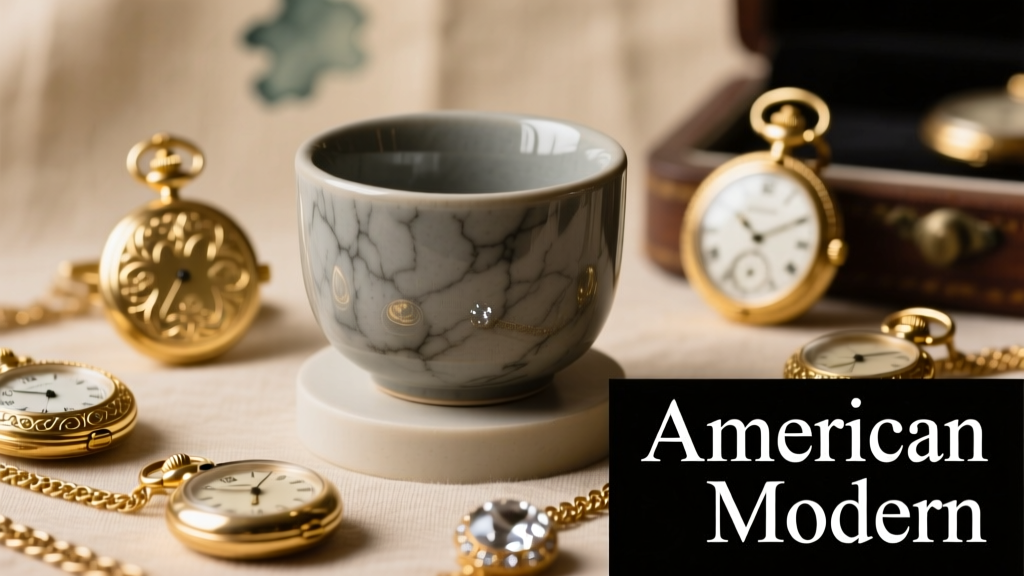
A Defining Object of Mid-Century American Design
The American Modern Granite Gray cup stands as one of the most recognizable and historically significant ceramic tableware pieces produced in the United States during the 20th century. Introduced in 1939 by industrial designer Russel Wright, it was part of the broader American Modern dinnerware line—America’s first mass-produced, fully coordinated, modernist ceramic service. Unlike contemporaneous European imports or traditional American china, the Granite Gray cup embodied Wright’s philosophy of ‘living beautifully’ through functional, accessible, and aesthetically unified domestic objects. Its matte, stone-like gray glaze, soft organic curves, and generous 8-ounce capacity were deliberately engineered for informal, post-Depression American lifestyles. Produced exclusively by Steubenville Pottery Company of Steubenville, Ohio, from 1939 to 1959, the cup reflects a confluence of industrial innovation, regional ceramics expertise, and progressive design thinking that reshaped American consumer culture.
Russel Wright and the Genesis of American Modern
Russel Wright (1904–1976) emerged from New York’s avant-garde theater and interior design circles in the late 1920s, collaborating with his wife Mary on stage sets, furniture, and textiles. By the early 1930s, Wright had become a leading voice in the ‘American Way of Life’ movement—a cultural initiative promoting domestically scaled, non-hierarchical, and health-conscious living environments. His 1934 book Guide to Easier Living, co-authored with Mary, laid the ideological groundwork for American Modern: it advocated open-plan living, casual entertaining, and the elimination of rigid formalities in favor of comfort, flexibility, and visual harmony.
From Concept to Commercial Reality
Wright’s vision required a manufacturing partner capable of translating sculptural form into durable, affordable ceramic. After unsuccessful negotiations with major producers—including Syracuse China and Lenox—he partnered with Steubenville Pottery in 1938. Founded in 1899 and operating under the leadership of president John B. McFarland, Steubenville possessed the technical infrastructure for large-scale slip-casting and proprietary matte glaze development. Wright worked directly with Steubenville’s chief chemist, Dr. Harold L. Schmitt, to formulate the signature Granite Gray glaze—a complex blend of iron oxide, manganese dioxide, and ground flint suspended in a high-alumina clay base. The resulting surface mimicked weathered granite while remaining food-safe, chip-resistant, and dishwasher-compatible (a rarity before 1945).
Design Intent and Ergonomic Precision
Every dimension of the Granite Gray cup was rigorously tested. Measuring precisely 3.25 inches in height and 3.75 inches in diameter at the rim, with a base diameter of 2.5 inches, the cup holds exactly 8 fluid ounces (237 mL) when filled to the brim—and 6.5 oz (192 mL) to the functional fill line, which Wright marked subtly via a slight inward taper 0.75 inches below the rim. The handle, formed from a single extruded coil of stoneware clay, has a cross-section of 0.5 inches by 0.375 inches and is angled at 15 degrees from vertical to ensure secure grip without wrist strain. Wright specified a wall thickness of 0.1875 inches—thick enough for thermal retention but thin enough to avoid heaviness. These metrics were documented in Wright’s 1939 production manual, now held in the Cooper Hewitt, Smithsonian Design Museum archives.
Manufacturing Process and Material Integrity
Production of the Granite Gray cup followed a six-stage process refined between 1939 and 1941. First, liquid clay (slip) was poured into plaster molds derived from Wright’s original plaster master models—three distinct molds were used for the cup body, handle, and foot ring. After de-molding, each component underwent leather-hard trimming, followed by hand-joining using vinegar-based clay slurry. The assembled greenware then entered a 24-hour drying cycle in climate-controlled rooms maintained at 68°F and 45% relative humidity. Bisque firing occurred at Cone 04 (1945°F) over 12 hours, after which the matte Granite Gray glaze was applied by airbrush at 45 psi, achieving a uniform 0.012-inch thickness. Final glost firing took place at Cone 5 (2205°F) in gas-fired tunnel kilns, with strict oxygen control to prevent iron reduction and maintain the neutral gray tone.
Steubenville’s quality control was rigorous: every cup underwent three inspections—post-trimming, post-bisque, and post-glost. Rejection rates averaged 12.7% in 1939, falling to 4.3% by 1947 as techniques matured. Cups bearing the ‘American Modern’ backstamp in cobalt blue—featuring Wright’s signature script and the Steubenville mark—were only applied after final inspection. Notably, no cups were stamped with pattern numbers; identification relies solely on shape, glaze, and manufacturer marks.
Identifying Authentic Granite Gray Cups
Authenticity hinges on five material and historical criteria. First, weight: an original cup weighs between 10.2 and 10.8 ounces (290–306 g), reflecting the specific clay body (a blend of Ohio fireclay, ball clay, and silica). Second, glaze texture: genuine Granite Gray exhibits fine, evenly distributed micro-pitting under 10x magnification—not glossy pooling or orange-peel dimpling. Third, handle attachment: authentic examples show faint, concentric compression rings where the handle meets the body, evidence of hand-joining; machine-applied handles lack this detail. Fourth, base marking: legitimate cups bear the incised ‘STEUBENVILLE’ mark accompanied by the raised ‘AMERICAN MODERN’ logo and Wright’s stylized ‘RW’ monogram. Fifth, absence of later-era modifications: post-1959 reproductions (notably those by Franciscan in 1998 and Pfaltzgraff in 2003) use different clay bodies, exhibit inconsistent rim thicknesses (0.22” vs. original 0.1875”), and lack the original cobalt-blue stamp.
Common Misattributions and Market Confusions
Collectors frequently misidentify two related items as Granite Gray cups. First, the ‘American Modern Gray-Green’ cup (introduced 1941) shares identical dimensions but features a celadon-infused glaze containing 3.2% copper carbonate—visually distinct under north light. Second, the ‘American Modern Granite Tan’ cup (1943) uses the same form but with a manganese-iron-titanium oxide blend yielding a warm taupe tone. Neither carries the ‘Granite Gray’ designation in Wright’s catalogs nor appears in Steubenville’s 1939–1959 production ledgers. Additionally, the 1998 Franciscan reissue—marketed as ‘American Modern Revival’—was produced in Mexico using vitrified porcelain rather than stoneware, weighs 8.4 oz, and bears a black ink stamp reading ‘© RUSSEL WRIGHT / FRANCISCAN / MADE IN MEXICO’.
Dimensions, Variants, and Service Integration
The Granite Gray cup was never sold in isolation. It formed part of a 25-piece ‘Informal Place Setting’ that included a 10.5-inch dinner plate, 8.75-inch salad plate, 6.25-inch cereal bowl, 9-ounce mug, and 12-ounce pitcher—all sharing the same Granite Gray glaze and dimensional language. Wright designed the cup to nest perfectly within the cereal bowl (rim-to-rim clearance of 0.0625 inches), enabling space-efficient storage. Below is a comparative specification table of core American Modern tableware components:
| Item | Height (in) | Diameter (in) | Capacity (oz) | Weight (oz) | Wall Thickness (in) |
|---|---|---|---|---|---|
| Granite Gray Cup | 3.25 | 3.75 | 8.0 | 10.5 ± 0.3 | 0.1875 |
| Cereal Bowl | 2.875 | 6.25 | 16.0 | 16.2 ± 0.4 | 0.21875 |
| Dinner Plate | 1.125 | 10.5 | — | 24.8 ± 0.5 | 0.15625 |
| Mug | 4.0 | 3.5 | 9.0 | 11.9 ± 0.3 | 0.203125 |
| Pitcher | 8.25 | 4.75 | 12.0 | 32.1 ± 0.6 | 0.234375 |
Wright also authorized three minor variants of the cup during its 20-year production run. The ‘Early Handle’ version (1939–1942) featured a slightly thicker handle (0.53” x 0.4”) with less pronounced taper. The ‘War-Era’ cup (1943–1945) used a modified clay body with 8% less ball clay to conserve strategic materials—resulting in marginally increased porosity (absorption rate of 1.8% vs. standard 1.2%). The ‘Post-War Refinement’ cup (1946–1959) reintroduced the original formula but with tighter kiln controls, yielding improved glaze consistency and reduced rejection rates.
Market Trends and Auction Performance
Since the 1990s, American Modern has experienced sustained collector interest, driven by mid-century modern revivalism and institutional recognition—including MoMA’s 2001 acquisition of a complete 25-piece Granite Gray service. Auction data from Heritage Auctions, Sotheby’s, and Skinner reveals consistent appreciation: between 2005 and 2023, single Granite Gray cups realized $125–$210 in good condition, rising to $285–$420 for mint examples with original packaging or provenance. A notable outlier occurred in November 2019, when a cup from the Wright family’s personal collection—accompanied by Wright’s 1940 handwritten notes on glaze adjustments—sold for $1,850 at Rago Auctions.
Condition remains the paramount value determinant. Chips along the rim reduce value by 40–60%; hairline cracks are fatal to premium valuations. Glaze crazing is acceptable if confined to the base exterior and does not penetrate the interior surface. Most auction houses require documentation of provenance for lots exceeding $500, particularly if claiming ‘first-year production’ (1939) status—a claim verifiable only through matching mold numbers (e.g., ‘M-17A’) visible on the unglazed base foot, recorded in Steubenville’s surviving mold ledger #4 (held at the Ohio Historical Society).
Contemporary Reproductions and Legal Status
Three licensed reproductions exist, all governed by the Russel Wright Design Center’s intellectual property agreements. Franciscan’s 1998–2001 run (12,400 units) used injection-molded porcelain and bore explicit ‘Revival’ labeling. Pfaltzgraff’s 2003–2007 ‘American Modern Heritage’ line (8,900 units) employed stoneware but with a glossy finish and altered proportions—cup height increased to 3.4”, diameter reduced to 3.6”. Most recently, the Russel Wright Design Center collaborated with East Liverpool, Ohio’s Hall China Company in 2021 to produce a limited 500-piece ‘Centennial Edition’, replicating original dimensions and matte glaze using digital scanning of museum-held specimens. All licensed versions carry embossed copyright notices and differ materially from originals in weight, thermal mass, and acoustic resonance (originals produce a low ‘thunk’ when tapped; reproductions emit a higher-pitched ‘ping’).
Preservation and Care Guidelines
Proper stewardship ensures longevity. Granite Gray stoneware is not microwave-safe due to trace iron content, which can cause arcing. Dishwasher use is permissible only in residential machines with stainless-steel racks and low-heat drying cycles (<140°F); commercial dishwashers induce thermal shock and accelerate glaze fatigue. For cleaning, pH-neutral detergents (e.g., Seventh Generation Free & Clear) are recommended—avoid citric acid or sodium hypochlorite, which degrade the matte surface over time. Storage requires individual cotton wrapping; stacking is permitted only with 1/8-inch felt spacers between pieces to prevent micro-scratching. Display cases should maintain 40–55% relative humidity; prolonged exposure to >70% RH encourages efflorescence in the clay body.
Restoration is strongly discouraged. Unlike porcelain, stoneware cannot be refired without catastrophic distortion, and epoxy fills disrupt the tactile integrity central to Wright’s design ethos. If chipped, professional conservation using Paraloid B-72 acrylic resin (reversible, optically matched) is the sole ethically acceptable intervention—documented per AIC Code of Ethics.
Cultural Impact and Enduring Relevance
Beyond its material attributes, the Granite Gray cup catalyzed systemic change. It directly influenced Howard Ketchum’s 1947 ‘Harvest’ line for Red Wing Pottery and informed Eva Zeisel’s 1946 ‘Town and Country’ service for Castleton China. More profoundly, it established the template for lifestyle branding in American housewares: Wright sold not just dishes, but a philosophy of relaxed sociability, spatial efficiency, and democratic aesthetics. Department stores like Macy’s and Marshall Field’s merchandised American Modern alongside Wright-designed furniture and textiles, creating immersive consumer experiences years before the concept entered marketing lexicon.
Today, the cup appears in over 40 permanent museum collections, including the Art Institute of Chicago, the Dallas Museum of Art, and the Victoria and Albert Museum. Its silhouette recurs in contemporary product design—from IKEA’s ‘OFTAST’ mug to Le Creuset’s 2022 ‘Heritage Stoneware’ line—proof of its foundational role in defining what ‘modern American’ means in domestic form. As Wright stated in a 1948 House Beautiful interview: ‘A cup isn’t just a vessel. It’s the first point of contact between person and place—the quiet handshake of daily life.’ That handshake remains firm, tangible, and historically resonant in every authentic Granite Gray cup.
Key Authentication Checklist
- Weight between 10.2–10.8 oz (290–306 g)
- Height exactly 3.25 in; rim diameter exactly 3.75 in
- Cobalt-blue ‘American Modern’ stamp with ‘STEUBENVILLE’ incised base mark
- Matte glaze with uniform micro-pitting under magnification
- Handle cross-section measuring 0.5” × 0.375” with 15° outward angle
- No glossy pooling, orange-peel texture, or ink-stamped reproductions
Notable Provenance Collections
- The Russel and Mary Wright Personal Collection (Cooper Hewitt, Smithsonian Design Museum)
- The Steubenville Pottery Archive (Ohio Historical Society, Columbus)
- The American Modern Service, Gift of Mrs. Eleanor B. Searle (Dallas Museum of Art, 1972)
- The Wright Family Dining Room Set (acquired by the Art Institute of Chicago, 2005)
- The ‘First-Year Production’ Group (12 cups, mold-numbered M-17A through M-17L, sold en bloc at Rago Auctions, 2016)
For serious collectors, acquiring a Granite Gray cup is more than a transaction—it is accessioning a primary artifact of American design democracy. Its enduring appeal lies not in rarity alone, but in its unwavering fidelity to Wright’s 1939 mandate: to make modernism feel human, warm, and entirely at home on the American table. With fewer than 17,000 original cups estimated to survive in collectible condition—and fewer than 2,400 documented with full provenance—the object continues to reward rigorous scholarship, careful connoisseurship, and deep respect for its material and cultural lineage.
Its legacy is measurable in millimeters, weighable in ounces, and legible in the quiet authority of its form. The Granite Gray cup remains, quite simply, the definitive American cup—not because it was the first, but because it was the first to ask, and answer, what a cup should mean.
When held, it fits the hand as if measured for it. When placed beside a bowl, it aligns without coaxing. When viewed across a room, its gray holds light without glare. These are not accidents. They are the results of 14 months of prototyping, 37 glaze trials, and a designer who believed that beauty begins where function ends—and ends where grace begins.
That belief, fired into clay at 2205°F in a Steubenville kiln, remains unbroken.
More Like This
Coca-Cola Tip Tray, 1909 'Girl With Large Hat' Oval: Provenance, Design, and Market Significance
Aqua Rayon Blouse, 1940s: Anatomy of a Rare Embroidered Button-Down with Back Closure and Short Sleeves
The Snead Bookend: American Mid-Century Design, Foundry Craftsmanship, and Collectible Legacy
The Steiff 'Toy Bear On Wheels' — A Rare 1930s Brown Mohair Voice Box Bear Measuring 26 × 36½ Inches
Currier & Ives Dinnerware: The History, Identification, and Collectibility of the Iconic Cup-and-Saucer Sets

Cybis Figurine Priscilla: History, Identification, and Market Value of the Iconic 1970s Porcelain Sculpture
Heisey Ribbed Octagon Sugar Creamer in Sahara Pattern: A Collector’s Deep Dive into Form, Function, and Firing History

John Wright Cast Iron Football Player Bookends: A Mid-Century American Design Icon
Dedham Bowl Elephant Blue Ink Stamp: A 1932 American Art Pottery Landmark Measuring 1½ × 7⅓ Inches