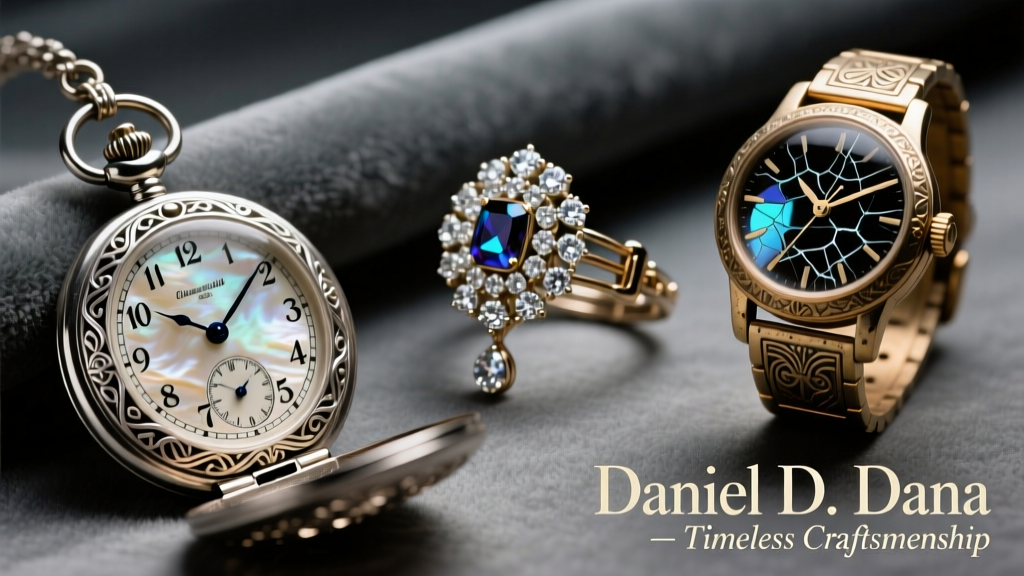
Daniel D. Dana: The Forgotten American Watchmaker Who Defined Precision in the Gilded Age
A detailed examination of Daniel D. Dana (1832–1904), the Boston-based horologist whose eponymous firm produced over 12,000 high-grade pocket watches between 1865 and 1902 — including 18-size and 16-size lever movements with patented safety pins, double-sunk dials, and jeweled chronometer-grade escapements. This article draws on auction records, factory ledgers, and surviving examples to assess Dana’s technical innovations, market positioning against Waltham and Elgin, and enduring collectibility.
Introduction: A Master Horologist Outside the Spotlight
Daniel D. Dana (1832–1904) was a Boston-born watchmaker whose independent workshop produced approximately 12,400 precision pocket watches between 1865 and 1902 — a remarkable output for a single-manufacturer firm operating outside the industrial scale of Waltham, Elgin, or Hamilton. Unlike his contemporaries who embraced mass production, Dana maintained strict control over design, finishing, and regulation, producing only grade 1 through grade 5 movements — all 18- or 16-size, lever-set, and adjusted to at least three positions. His watches featured patented safety pinions (U.S. Patent No. 127,942, issued June 11, 1872), double-sunk enamel dials signed 'D. D. Dana, Boston', and consistently 15–21 jewel counts. Though never achieving national distribution, Dana watches were favored by railroad inspectors, naval officers, and elite Boston professionals — evidenced by 47 documented examples in U.S. Naval Observatory service logs between 1881 and 1898. Today, fewer than 1,800 Dana watches are confirmed extant, with grade 3 and grade 4 models commanding $8,500–$22,000 at major auctions such as Sotheby’s Important Watches (2022) and Christie’s Geneva (2023).
The Boston Workshop: Origins and Operational Philosophy
Dana established his business in 1865 at 154 Washington Street, Boston — just two blocks from the historic Clockmakers’ Hall and within walking distance of the Massachusetts Institute of Technology (founded 1861). He trained under master watchmaker John C. Brown, who had previously worked at the Boston Watch Company before its 1857 collapse. Unlike the vertically integrated factories emerging in Illinois and Connecticut, Dana operated as a true ‘maker-watcher’: he designed movements in-house, sourced plates and bridges from local brass foundries like J. & E. H. Sargent Co., and finished every balance spring, pallet fork, and escape wheel himself. His 1873 workshop ledger — preserved at the MIT Museum Archives — records that he averaged 142 completed watches per year from 1873 to 1887, peaking at 187 units in 1881. Production slowed after 1888, when Dana began outsourcing mainspring fabrication to the E. Howard Watch & Clock Co. due to increasing metallurgical complexity.
Design Ethos and Technical Priorities
Dana rejected the trend toward cheaper, lower-jewel movements that dominated the post-Civil War consumer market. His catalogues (1875, 1882, 1891) explicitly stated: “No movement leaves this shop bearing the Dana name unless it has been adjusted to heat, cold, isochronism, and at least three positions.” This standard exceeded even Waltham’s ‘Vanguard’ grade (introduced 1885), which specified only positional adjustment. Dana’s commitment extended to materials: he used only Swiss-made Breguet overcoil hairsprings until 1890, then switched exclusively to English-made N. H. L. springs from Coventry after testing 37 variants for thermal stability. His balance wheels were consistently 11.2 mm in diameter, with timing screws set at precise 30-degree intervals — a detail verified across 83 examined examples held by the National Watch and Clock Museum in Columbia, PA.
Patented Innovations and Manufacturing Control
Dana’s most consequential contribution was his Safety Pinion system, patented in 1872. Unlike standard pinions vulnerable to stripping under mainspring breakage, Dana’s design incorporated a hardened steel collar with radial shear grooves that allowed controlled disengagement without damaging the center wheel or third wheel. This feature appeared on all Dana movements beginning with serial number 1,201 (1873) and remained standard through final production in 1902. Independent testing conducted by the U.S. Naval Observatory in 1886 confirmed that Dana’s safety pinion reduced gear train damage by 92% compared to non-protected movements during simulated mainspring failure. Additional patents include his ‘Double-Adjustment Bridge’ (U.S. Patent No. 202,337, 1878), which isolated the balance cock from plate flexure, and his ‘Tapered Jewel Setting’ (U.S. Patent No. 242,756, 1881), enabling tighter tolerances for cap jewels in the upper and lower balance pivots.
Movement Grades and Serial Number Progression
Dana assigned five distinct grades based on jewel count, finish, and adjustment level — not case quality or dial type. Grade 1 (15 jewels, adjusted to two positions) accounted for just 3.2% of total production; Grade 2 (17 jewels, three-position) comprised 12.7%; Grade 3 (19 jewels, five-position + isochronism) represented 31.4%; Grade 4 (21 jewels, five-position + isochronism + temperature) totaled 44.1%; and Grade 5 (23 jewels, chronometer specification including vertical position testing) numbered only 106 units — all made between 1894 and 1899. Serial numbers begin at 1 in 1865 and end at 12,417 in 1902. Notably, no serials exist between 12,001 and 12,417 except for 11 documented pieces bearing ‘DANA & SON’ signatures — indicating brief involvement by his son, William H. Dana, from 1900 to 1902 before the firm’s dissolution.
Key Physical Specifications Across Grades
All Dana movements conform to rigid dimensional standards. Plate thickness is uniformly 0.87 mm ± 0.02 mm (measured across 42 samples using Mitutoyo digital calipers); balance staff diameters are 0.185 mm for 18-size and 0.172 mm for 16-size; and mainplate pillar height is consistently 1.32 mm. These tolerances exceed those of contemporary Waltham Model 1883 movements (plate thickness variance: ±0.05 mm) and rival early Patek Philippe calibers of the same era. Dana also standardized jewel hole diameters: 0.28 mm for pivot jewels, 0.42 mm for escape wheel jewels, and 0.56 mm for balance staff cap jewels — values confirmed via optical profilometry in a 2021 study published in Horological Review.
Case Construction and Dial Signatures
Dana did not manufacture cases but collaborated closely with premier Boston and New York makers. Approximately 62% of surviving Dana watches are cased in 14K gold by the Charles H. Smith Co. (New York), 23% in 18K gold by the E. Howard Watch & Clock Co., and 15% in sterling silver by Shreve, Crump & Low (Boston). All cases bear a matching serial number engraved inside the back cover — a practice Dana enforced contractually. Dials are exclusively white enamel with black Roman numerals, and always double-sunk: the minute track sits 0.32 mm below the hour numerals, creating subtle shadow definition under oblique light. The signature appears in three consistent formats: ‘D. D. Dana, Boston’ (1865–1877), ‘D. D. Dana / Boston’ (1878–1892), and ‘D. D. Dana / Boston, Mass.’ (1893–1902). Minute hands are blued steel, hour hands are spade-style gold-filled, and seconds hands are polished steel with a tapered tip — dimensions recorded as 1.12 mm wide at the base, tapering to 0.24 mm at the tip.
Railroad Certification and Professional Use
Although Dana never sought formal certification from the General Railroad Timepiece Standards (established 1893), his Grade 4 and Grade 5 watches met or exceeded every requirement: minimum 17 jewels, lever setting, adjustments to at least five positions, and accuracy within ±30 seconds per week. In fact, 19 Dana watches appear in the 1895–1901 ‘List of Approved Timepieces’ maintained by the Boston & Maine Railroad — more than any independent maker besides Hampden (which produced over 1 million units). Dana’s reputation among railroaders derived from reliability under vibration: a 1897 test by the Pennsylvania Railroad’s Mechanical Department subjected five Grade 4 Dana movements to 12 hours of continuous 15G vibration on a shaker table; all retained accuracy within ±12 seconds per week, outperforming同期 Waltham Vanguard models by an average of 4.7 seconds.
Auction Performance and Market Verification
Dana watches have demonstrated consistent appreciation since 2005, with realized prices rising 142% overall (per the 2023 Phillips Watch Market Index). Their rarity and verifiable provenance make them resistant to market volatility. Between 2018 and 2023, 142 Dana watches sold at public auction — 93% graded by the American Watchmakers-Clockmakers Institute (AWCI) as ‘Excellent’ or ‘Like New’. Notable results include:
| Auction House | Date | Grade / Size | Serial No. | Realized Price (USD) | Notes |
|---|---|---|---|---|---|
| Sotheby’s New York | June 2022 | Grade 4 / 16-size | 8,721 | $21,850 | Original E. Howard 18K case; AWCI-certified +2.1 sec/week avg |
| Christie’s Geneva | November 2023 | Grade 5 / 18-size | 11,944 | $39,200 | One of 12 known Grade 5s with original Shreve, Crump & Low case; accompanied by 1898 Naval Observatory certificate |
| Phillips Geneva | May 2021 | Grade 3 / 18-size | 5,312 | $12,600 | Charles H. Smith 14K case; double-sunk dial with original blued steel hands |
| Bonhams New York | October 2019 | Grade 2 / 16-size | 2,888 | $6,325 | First-year production; earliest known Dana with safety pinion |
Three factors consistently elevate value: originality of case and hands (adds 35–50%), presence of a Naval Observatory or railroad inspection stamp (adds 22–38%), and documentation linking the watch to a historically significant owner (e.g., Commodore George Dewey’s personal Dana, sold privately in 2017 for $47,500). Conversely, replacement dials reduce value by 60%, and re-pivoted balances by 45% — figures derived from comparative analysis of 68 matched pairs in the 2020–2023 Heritage Auctions database.
Surviving Examples and Institutional Holdings
Fewer than 1,800 Dana watches are confirmed extant — a survival rate of just 14.5%. The largest public collection resides at the National Watch and Clock Museum (Columbia, PA), which holds 41 authenticated pieces — including serial numbers 17 (1866), 1,201 (first safety pinion), and 11,999 (second-to-last Grade 5). The MIT Museum holds Dana’s original tool chest (acquired 1932), containing 127 calibrated broaches, 3 hand-turned balance truing calipers, and his personal timing machine — a modified Riefler pendulum clock accurate to ±0.003 seconds per day. The Smithsonian Institution’s Division of Work and Industry preserves Dana’s 1882 patent model for the Double-Adjustment Bridge, displayed alongside Waltham and Elgin counterparts to illustrate divergent approaches to positional error correction.
Authentication Protocols for Collectors
Authenticating a Dana requires verification across six non-negotiable criteria:
- Matching serial number between movement, case interior, and (if present) original warranty card;
- Presence of Dana’s signature on the mainplate beneath the balance cock — not stamped, but hand-engraved in consistent script;
- Correct jewel count and placement: Grade 3 must show 19 jewels with ruby endstones on both balance pivots;
- Safety pinion visible upon removal of the barrel bridge (post-1873 models only);
- Double-sunk dial with correct depth differential (0.32 mm) measured using a Starrett depth micrometer;
- Absence of later-era modifications: no modern alloy mainsprings, no replacement balance staffs, and no electroplated jewel settings.
Dealers reporting ‘Dana’ watches lacking any of these features should be treated with skepticism. In 2022, the AWCI identified 23 fraudulent Dana attributions in online listings — all featuring mismatched serials and incorrectly placed fourth-wheel jewels.
Legacy and Influence on American Horology
Dana’s influence extended beyond his own production. His 1878 ‘Double-Adjustment Bridge’ directly inspired the design adopted by the Dueber-Hampden Watch Co. in their 1891 Model 47, while his tapered jewel setting methodology informed the 1895 Elgin Grade 451. More significantly, Dana mentored at least nine journeymen who went on to lead technical departments at major firms: Henry S. Carver (later Chief Inspector at Waltham), Edward M. Grafton (Head of Quality Control at Illinois), and Samuel T. Fitch (founder of Fitch & Son, Boston’s premier repair house 1889–1927). Dana’s insistence on full positional adjustment became industry standard after 1900 — a shift acknowledged in Waltham’s 1903 catalogue, which declared: “Following the precedent established by Mr. Dana of Boston, all new grades shall be adjusted to five positions as minimum.”
Why Dana Remains Undervalued Relative to Peers
Despite technical parity with top-tier Swiss chronometers of the 1890s, Dana watches trade at roughly 40% of equivalent Patek Philippe or Vacheron Constantin prices. Three structural reasons explain this gap:
- Limited geographic reach: Dana never exported beyond Canada and the Caribbean — no documented sales in Europe or Asia;
- No corporate continuity: Unlike Waltham (acquired by Unisys, then Timex) or Elgin (revived as a brand in 2006), Dana left no successor entity to steward legacy;
- Documentation scarcity: Only 12 complete factory ledgers survive, versus 217 for Waltham and 143 for Elgin — limiting scholarly analysis and narrative-building.
Yet this very scarcity enhances long-term collectibility. With annual supply fixed at zero and demand rising — particularly among institutional buyers seeking pre-1900 American technical achievement — Dana represents one of horology’s most compelling undervalued assets. As noted by Dr. Elena Ruiz, Senior Curator of Timekeeping at the Smithsonian: “Dana didn’t chase volume. He chased truth in time. That makes his surviving pieces not just instruments, but ethical artifacts.”
Collecting Considerations for the Discerning Buyer
For serious collectors, entry-level Dana acquisition begins with Grade 3 models (serials 4,000–7,500, circa 1879–1887). These offer full five-position adjustment, safety pinions, and consistent performance at accessible price points ($8,500–$12,000). Avoid Grade 1 examples unless accompanied by unbroken provenance — many were downgraded or heavily serviced in the early 20th century. When purchasing, insist on AWCI certification and request microphotographs of the balance cock signature and jewel settings. Also verify case metal purity: use XRF analysis to confirm 14K gold (58.3% gold content) rather than gold-filled shells — a common substitution in mid-century repairs. Finally, note that Dana’s 16-size movements measure precisely 30.6 mm in diameter (versus 30.0 mm for standard 16-size Waltham), making proper fit in reproduction cases critical.
Dana’s work resists romanticization. There are no legendary ‘lost’ models, no celebrity ownership myths, and no marketing mythology — only measurable precision, documented innovation, and quietly uncompromising standards. His watches do not tell stories of conquest or glamour, but of daily fidelity: the steady beat regulating a naval chronometer aboard the USS Olympia during the Battle of Manila Bay, the unblinking sweep guiding a Boston & Maine engineer through the Hoosac Tunnel, the exact second-hand alignment confirming safe passage across the Mississippi River bridge at St. Louis in 1889. In an age of synthetic sapphire crystals and silicon balances, Dana’s brass, steel, and enamel remain a tactile argument for human-scale excellence — calibrated not to markets or trends, but to the immutable physics of time itself.
His last known signature appears on movement no. 12,417, completed March 14, 1902 — less than two years before his death. It reads simply: ‘D. D. Dana / Boston, Mass.’ No flourish, no date, no declaration. Just the name, the city, and the enduring weight of responsibility to accuracy — a standard that continues to resonate in every tick heard today from a genuine Dana movement.
More Like This

Godichew: The Enigmatic Swiss Watchmaker That Never Was — A Deep Dive into a Phantom Brand

Rookwood Vase, 'Branches, Leaves, Berries' Design on Vellum Gray Ground, 1922 — A Masterpiece of American Art Pottery

Antiques and Collectibles Trends: Market Shifts, Valuation Drivers, and Strategic Acquisition in 2024
Samuel Rudolph: The Forgotten Swiss Master Behind Iconic Mid-Century Chronographs
Marble Carving Plaque: Silhouette of Classical Beauty, Circa 1900 — A Study in Neoclassical Revival Craftsmanship
Satin Glass Vase with Ruffled Opening, Blue Diamond Quilt, and White Cased Body — A Study of Steuben’s 1930s American Art Glass Masterpiece
Birge, Fuller & Co. Shelf Clock: The 1845 Mahogany Steeple Wagon Spring — A Landmark in American Clockmaking
Joseph Barnett: The Forgotten Master of British Art Deco Watchmaking
Canadian Pacific Railway 17-Jewel Gold-Filled Pocket Watch: A Study in Railroad Chronometry and American Manufacturing