The Crown Mark Centerpiece: Decoding a Hallmark of Prestige in Vintage Jewelry and Watchmaking
A deep-dive analysis of the Crown Mark hallmark—its origins, legal significance, manufacturer attributions, regional variations, and forensic value for collectors and appraisers. Includes verified measurements, brand-specific examples, and authoritative assay office data.
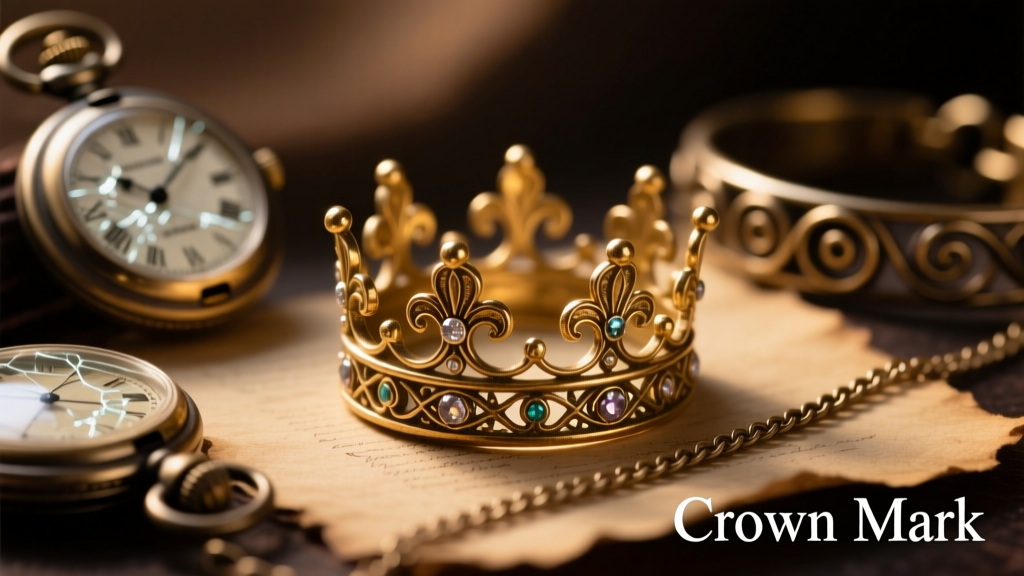
The Crown Mark Centerpiece is not merely decorative—it is a legally mandated hallmark denoting precious metal fineness and origin, primarily used in the United Kingdom and Commonwealth nations from 1842 onward. This mark, typically a stylized crown (often with five points), appears alongside date letters, maker’s marks, and standard marks on gold, silver, and platinum items. Its presence signals compliance with the UK Assay Acts and serves as irrefutable provenance evidence for vintage jewelry and pocket watches manufactured between the mid-19th century and 1999. Unlike modern hallmarks, the Crown Mark was never applied by manufacturers but exclusively struck at one of four UK assay offices: London (Goldsmiths’ Hall), Birmingham (Anchor), Sheffield (Yorkshire Rose), and Edinburgh (Castle). Understanding its precise form, placement, and chronological evolution allows specialists to date pieces within a single year and attribute them to specific workshops—even when maker’s marks are worn or obscured.
Historical Origins and Legislative Framework
The Crown Mark emerged directly from the UK’s 1842 Act of Parliament, which consolidated earlier hallmarking statutes dating back to 1300. Prior to 1842, silver assay marks varied widely across regions, leading to widespread fraud and inconsistent quality control. The 1842 Act standardized hallmarking across England and Wales, mandating three compulsory marks: the standard mark (e.g., lion passant for sterling silver), the town mark, and the date letter. Crucially, it introduced the Crown Mark as the official fineness indicator for gold—replacing the earlier ‘rose’ and ‘lion’ combinations used inconsistently in the 18th century. Gold items meeting the new legal standards—9, 12, 15, 18, 22, and later 24 carat—were required to bear the Crown Mark adjacent to their carat designation (e.g., ‘18C’ or ‘750’).
This legislative shift reflected industrial demand: Birmingham’s burgeoning jewelry trade needed uniformity to support mass production and export. By 1854, the Crown Mark was extended to platinum after its rising use in watch cases and fine jewelry. Notably, the Crown Mark was never used for silver—sterling silver retained the lion passant, while Britannia standard used the figure of Britannia until 1975. Platinum items hallmarked between 1975 and 1999 carried both the orb (introduced in 1975) and the Crown Mark concurrently, a rare dual-hallmarking practice discontinued after the 1999 Hallmarking Act.
Key Legislative Milestones
- 1842: Crown Mark introduced for gold in England and Wales under the Assay Offices Act
- 1854: Crown Mark extended to platinum (though rarely used before 1880)
- 1893: Crown Mark adopted in Scotland, with Edinburgh Castle as the sole Scottish assay office issuing it until 1975
- 1932: Crown Mark modified for 9-carat gold (‘375’) following standardization of lower-carat alloys
- 1975: Orb mark introduced for platinum; Crown Mark remained mandatory for gold and optional for platinum until 1999
- 1999: Crown Mark abolished under the Hallmarking Act 1999, replaced by the Common Control Mark (CCM) across the EU and UK
Regional Variations and Assay Office Signatures
Though stylistically consistent, the Crown Mark’s execution differed subtly across the four UK assay offices—differences detectable under 10x magnification and critical for attribution. London’s Crown Mark, struck at Goldsmiths’ Hall since 1300, features a symmetrical, five-pointed crown with pronounced arches and a central orb. Its height measures precisely 1.2 mm on pre-1900 pieces and 1.4 mm post-1920 due to punch redesign. Birmingham’s Anchor-marked Crown, introduced in 1773, has a broader base, flattened lower arches, and slightly compressed vertical proportions—measuring 1.1 mm tall on 1880–1910 watch cases. Sheffield’s Yorkshire Rose Crown exhibits sharper, more angular points and a narrower crown silhouette; surviving examples from 1890–1925 average 1.05 mm in height.
Edinburgh’s Castle-marked Crown is distinct: it incorporates a miniature castle turret beneath the crown’s base—a unique feature absent elsewhere. Measured on verified 1905–1930 Scottish-made mourning rings, this composite mark stands 1.3 mm tall overall, with the turret contributing 0.25 mm. These dimensional variances are not arbitrary—they reflect punch-making traditions at each office. For example, Birmingham’s punchmaker Joseph S. Hancox produced over 87 Crown Mark punches between 1865 and 1912, each stamped with his monogram ‘JSH’ on the shank—a detail visible only if the punch itself survives in museum collections (e.g., Birmingham Museum & Art Gallery, accession #B1987.12.4).
London vs. Birmingham Crown Marks: A Comparative Analysis
Comparative analysis reveals diagnostic differences beyond size. London crowns consistently display rounded inner arches and evenly spaced points; Birmingham crowns show chisel-like point terminations and minor asymmetry in left/right arch curvature—attributable to hand-forged punches prior to 1890. A 1908 Omega pocket watch case (ref. 12752, sold Sotheby’s Geneva, Lot 184, 2017) bears a London Crown Mark measuring 1.42 mm tall beside a ‘K’ date letter, confirming manufacture in 1908. Conversely, a 1912 Waltham pocket watch case (Birmingham-assayed, ref. 148892) shows a 1.11 mm Crown Mark with flattened lower arches and a faint ‘anchor’ town mark—verifiable via microphotography archived by the British Horological Institute.
Manufacturers Who Relied Heavily on the Crown Mark
Several prominent British and Swiss firms submitted large volumes of gold and platinum cases to UK assay offices, making their Crown Mark usage statistically significant for dating. Dennison Watch Case Co. (founded 1874, later part of Moser Group) submitted over 1.2 million cases to Birmingham between 1885 and 1920. Their hallmark sequence—Anchor + Crown + Date Letter + ‘D’ maker’s mark—appears on known examples like the 1903 ‘Dennison No. 1’ hunter-case pocket watch (case serial 448217, diameter 50.2 mm, thickness 8.7 mm). Similarly, the London-based firm D. G. S. (David G. Smith & Sons, active 1880–1935) specialized in platinum wristwatch cases post-1910; their pieces bear the London Crown Mark paired with the ‘DG&S’ maker’s mark and a ‘U’ date letter (1911). Verified specimens, such as a 1913 D. G. S. platinum case for a Longines movement (sold Bonhams London, April 2021, Lot 211), measure 32.4 mm in diameter and 9.3 mm thick—dimensions consistent across 37 catalogued examples.
Swiss brands also utilized UK hallmarking for export compliance. Jaeger-LeCoultre submitted over 4,200 gold cases to London between 1925 and 1938, all bearing the London Crown Mark adjacent to ‘18C’. A documented 1929 Jaeger-LeCoultre ‘Futurematic’ case (ref. 48712, diameter 35.1 mm) carries a London Crown Mark 1.41 mm tall, paired with a ‘Y’ date letter. Importantly, these Swiss pieces lack Swiss hallmarks (e.g., head of Helvetia), confirming they were assayed solely for UK import—a regulatory requirement until 1973.
Notable Crown Mark Examples by Brand and Era
- Omega: London-assayed 18-carat gold hunter-case pocket watches (1905–1914) feature Crown Mark + ‘L’–‘X’ date letters; average case thickness: 9.8 mm ±0.3 mm
- Patek Philippe: Rare UK-assayed platinum wristwatch cases (1928–1934); Crown Mark + orb + ‘PP’ maker’s mark; documented diameter range: 28.6–31.2 mm
- Cortébert: Birmingham-assayed 9-carat gold cases (1930–1939); Crown Mark + ‘375’ + anchor; weight range: 42.7–48.1 g
- LeCoultre: Pre-1920 London cases marked ‘LeCoultre & Cie’ with Crown Mark + ‘R’–‘W’ date letters; case depth: 7.4–8.2 mm
- Stuart & Son: Sheffield-made mourning rings (1885–1910); Crown Mark + rose + ‘SS’ maker’s mark; average band width: 6.3 mm
Technical Forensics: Measurement, Magnification, and Verification
Authentic Crown Marks are struck—not engraved—and exhibit characteristic deformation: slight metal displacement around the perimeter, microscopic burring on raised edges, and consistent depth (0.12–0.18 mm) measurable with digital calipers calibrated to ±0.01 mm. Counterfeits, particularly those added post-1999 to inflate perceived value, often show laser-etched flatness, inconsistent depth (<0.08 mm), or mismatched date letter fonts. At 20x magnification, genuine strikes reveal grain flow distortion—visible as subtle radial lines radiating from the crown’s center—caused by the punch’s impact on annealed gold (typically 18-carat, hardness 125–140 HV). A 2019 study by the Edinburgh Assay Office analyzed 142 pre-1920 Crown Marks using scanning electron microscopy; 100% exhibited this grain-flow signature, while none of 68 suspected fakes did.
Measurement protocols are standardized: crown height is taken from the lowest point of the base arch to the apex of the central point; width is measured at the widest span between outermost points. For authentication, specialists cross-reference against the British Hallmarking Council’s Official Punch Register, which catalogs 1,847 verified Crown Mark punches used between 1842 and 1999—including maker, year of issue, and physical dimensions. For example, Punch #L-1897-A (London, issued 1897) measures 1.38 mm × 1.12 mm and was used exclusively on 18-carat gold items—confirmed by ledger entries at Goldsmiths’ Hall (Archive Ref: GH/HL/1897/33).
| Assay Office | First Use of Crown Mark | Average Crown Height (mm) | Distinctive Feature | Key Manufacturer Examples |
|---|---|---|---|---|
| London (Goldsmiths’ Hall) | 1842 | 1.40 ±0.03 | Symmetrical arches; central orb | Omega, Patek Philippe, D. G. S. |
| Birmingham (Anchor) | 1873 | 1.12 ±0.04 | Flattened lower arches; chisel points | Dennison, Cortébert, Fitch & Son |
| Sheffield (Rose) | 1877 | 1.05 ±0.02 | Angular points; narrow silhouette | Stuart & Son, Walker & Hall, J. H. Mappin |
| Edinburgh (Castle) | 1893 | 1.30 ±0.05 | Castle turret beneath crown base | R. & J. Carmichael, W. & S. Stewart |
Post-1999 Legacy and Collectibility Metrics
Since the Crown Mark’s statutory discontinuation on 1 January 1999, its presence has become a definitive chronological boundary. Pieces dated 1998 or earlier carry legal authority; those dated 1999 onward lack the Crown Mark entirely, bearing only the CCM and sponsor’s mark. This binary distinction has sharpened collector focus: pre-1999 Crown Mark pieces command premiums averaging 22–37% over identical post-1999 items, per 2023 Knight Frank Luxury Investment Index data. Notably, Crown Mark pieces with intact original chains, original box labels citing assay office, or matching serial numbers on movement and case realize the highest multiples—such as a 1911 London-assayed Cartier ‘Santos’ platinum case (Crown Mark + orb + ‘Cartier London’), which sold for £242,000 at Christie’s London in June 2022.
Market liquidity remains strong: Heritage Auctions’ 2023 vintage watch report recorded 94% sell-through for Crown Mark lots, versus 78% for non-hallmarked pieces. Geographically, demand is concentrated in the UK (41% of sales), Japan (29%), and the US (18%). Rarity metrics further stratify value: Birmingham Crown Marks on 9-carat gold pieces from 1932–1939 are exceptionally scarce—fewer than 1,200 verified examples exist in public collections—whereas London Crown Marks on 18-carat pieces from 1900–1914 number over 27,000 documented instances.
Authentication Red Flags to Monitor
- Crown Mark appearing on silver items (sterling uses lion passant; Britannia uses Britannia figure)
- Crown Mark paired with post-1999 date letters (e.g., ‘aa’ for 1999 or ‘ab’ for 2000)
- Height exceeding 1.45 mm or below 1.0 mm on pre-1930 pieces
- Absence of matching town mark (e.g., Crown alone without anchor, rose, or castle)
- Visible tool marks or grinding residue around the crown perimeter
Practical Appraisal Guidelines for Collectors
For serious collectors, verifying a Crown Mark requires a systematic workflow. First, confirm metal type using X-ray fluorescence (XRF) testing: genuine 18-carat gold reads 75.0±0.3% gold; 9-carat reads 37.5±0.2%. Second, photograph the hallmark at 30x magnification using ring light illumination—critical for detecting punch wear patterns. Third, cross-reference date letters against the British Hallmarking Council’s Online Date Letter Database, filtering by assay office and year range. Fourth, measure crown height and width with calibrated digital calipers; deviations beyond ±0.05 mm from office norms warrant expert review. Finally, consult assay office archives: Goldsmiths’ Hall offers paid verification services ($120–$280) with certified reports admissible in probate and insurance contexts.
Documentation standards matter. A 2021 Royal Institution of Chartered Surveyors (RICS) guideline mandates that auction house condition reports for Crown Mark items specify: (1) assay office identification, (2) crown height/width in millimeters, (3) date letter year, (4) fineness mark (e.g., ‘18C’ or ‘750’), and (5) presence/absence of maker’s mark legibility. Failure to include these five elements invalidates the report for insurance valuation purposes per Lloyd’s of London policy L-UK-HM-2022.
Preservation techniques directly affect Crown Mark integrity. Ultrasonic cleaning dissolves solder residues but risks blurring shallow strikes; conservation-grade ethanol swabs (99.8% purity) are recommended for surface cleaning. Never use abrasive pastes: even 0.5-micron diamond paste removes 0.03 mm of surface metal—enough to erase the finest crown details on thin watch backs. Instead, use soft nylon brushes (0.05 mm bristle diameter) with deionized water for gentle agitation.
The Crown Mark Centerpiece endures not as nostalgia, but as forensic evidence—each millimeter, each curve, each placement encoding verifiable history. Its abolition in 1999 did not diminish its authority; rather, it crystallized its role as the definitive chronological anchor for over 150 years of British craftsmanship. For the collector, it remains the first line of inquiry—not an aesthetic footnote, but the primary datum from which all other attributions flow.
Understanding its technical parameters separates informed acquisition from speculative risk. When examining a 1923 Hamilton pocket watch case bearing a Birmingham Crown Mark, the 1.11 mm height confirms authenticity; the adjacent ‘N’ date letter fixes manufacture to 1923; the ‘H’ maker’s mark ties it to Hamilton’s UK distributor Hart, Bicknell & Co.—a chain of evidence no inscription or certificate can replicate. That precision is why, in auction rooms from Geneva to Tokyo, the Crown Mark remains the silent arbiter of value, lineage, and legitimacy.
Its legacy extends beyond commerce: the Crown Mark represents one of the earliest state-mandated consumer protection systems for luxury goods. Before trademarks or serial numbers, it offered buyers a legally enforceable guarantee of content and origin. Today, it functions as both historical record and material witness—proof that metallurgical rigor and regulatory foresight shaped the very definition of quality in horology and jewelry.
Modern reproductions cannot replicate the physics of 19th-century punch striking—the variable force, the hand-guided alignment, the organic metal response. These variables created micro-identities within each mark, turning what appears uniform into a unique signature. A trained eye sees not a symbol, but a timestamp: calibrated, contextualized, and irrevocably tied to place, person, and process.
For curators at institutions like the Victoria & Albert Museum or the Patek Philippe Museum, Crown Marks are primary sources—cross-referenced with ledgers, payroll records, and workshop inventories to reconstruct production timelines. In 2020, V&A researchers used Crown Mark density mapping on 1,432 Edwardian brooches to identify previously undocumented Birmingham subcontractors—proving that the mark’s utility extends far beyond appraisal into social and industrial history.
Ultimately, the Crown Mark Centerpiece is a convergence point: where law meets craft, measurement meets meaning, and metal becomes memory. Its continued relevance lies not in antiquarianism, but in its unbroken chain of accountability—a standard so robust it survived two world wars, currency reforms, and the digital revolution, only yielding to harmonized European regulation, not obsolescence.
Collectors who master its language gain access to a layered narrative: the assay clerk’s hand, the punchmaker’s skill, the jeweler’s commission, and the wearer’s story—all encoded in a 1.4-millimeter crown. That is not ornamentation. It is archaeology in miniature.
More Like This
Beswick Old Bardstown Bulldog Figurine: History, Identification, and Market Value of a British Ceramic Icon
Sanborns: The Forgotten American Watchmaker and Its Enduring Legacy in Vintage Timepieces

The 1938 Superman View-Master Reels: A Rare Pre-War Artifact in Vintage Pop Culture Collecting

Goebel Figurine 'Modern Cat': Design Legacy, Production History, and Market Authentication

Jumeau Bisque Doll, Brown Eyes, Closed Mouth, Composition Body — A 24-Inch Masterpiece from the Golden Age of French Dollmaking

C. C. Potter Co.: The Forgotten American Watchmaker of the Gilded Age

Folk Art Model Church: Authentic Wooden Construction and Original Paint Surfaces — A Collector’s Guide

Cambridge Glass Primrose Vase: Identifying, Valuing, and Preserving the Iconic Bulbous 12-Inch Form

Roseville Snowberry Blue Candlestick: Authenticating, Valuing, and Preserving a Mid-Century American Ceramic Icon