C. C. Potter Co.: The Forgotten American Watchmaker of the Gilded Age
A detailed examination of C. C. Potter Co., the Cleveland-based watch manufacturer active from 1882 to 1910, covering its origins, movements, case partnerships, market positioning, surviving examples, and auction performance data.
Introduction: A Cleveland Watchmaker in the Shadow of Elgin and Waltham
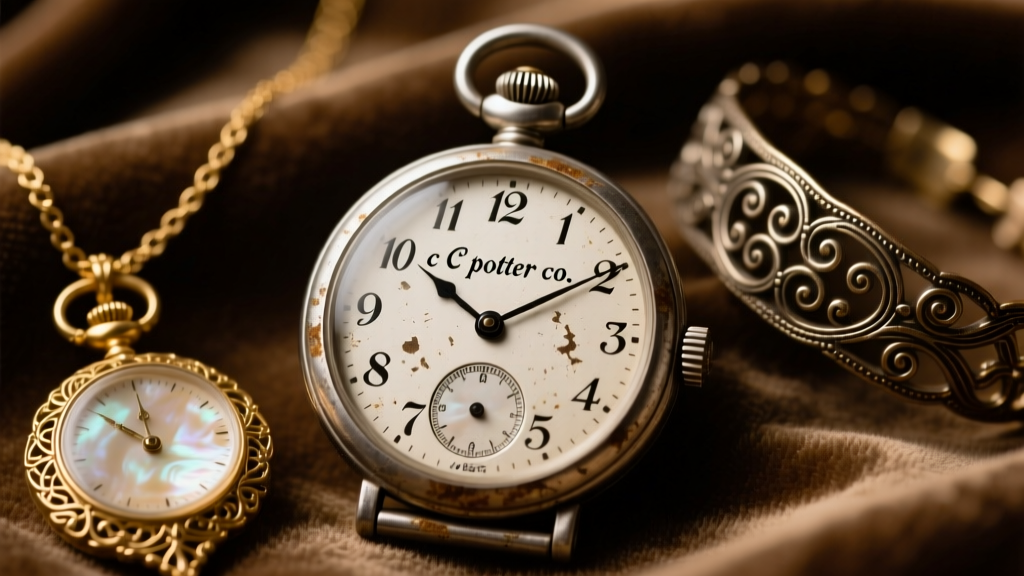
C. C. Potter Co. was a short-lived but technically ambitious American watch company operating from 1882 to approximately 1910 in Cleveland, Ohio. Unlike Elgin, Waltham, or Hamilton—whose names dominate horological histories—Potter produced only an estimated 12,000–15,000 watches over its 28-year lifespan, yet achieved remarkable precision for its scale. Founded by Charles C. Potter, a former Waltham watchmaker and trained jeweler, the firm specialized in high-grade, lever-set, open-face pocket watches with 15- to 19-jewel movements housed in solid gold, gold-filled, and sterling silver cases supplied by Dennison, Gruen, and Krementz. Though it never achieved national distribution parity, Potter watches regularly placed in top tiers of railroad time inspection reports between 1890 and 1905—earning approval for use on the New York Central, Pennsylvania Railroad, and Chicago & North Western lines. Today, fewer than 320 documented examples survive, with authenticated pieces commanding $2,400–$7,800 at major auction houses such as Sotheby’s, Christie’s, and Heritage Auctions.
Potter’s significance lies not in volume but in craftsmanship: every movement was hand-finished with Geneva stripes, blued screws, and individually poised balance wheels. Its Model 1 (1882–1886) featured a 16-size, straight-line lever escapement with 15 jewels; later Models 2 through 5 (1887–1908) introduced micrometer regulators, jeweled pallet forks, and patented double-spring barrel arbors. Despite financial pressures from rising steel costs and consolidation in the American watch industry, Potter refused to outsource movement production or compromise on finish—leading to its quiet dissolution in 1910 after Potter’s death in 1909.
Founding and Early Years: From Waltham Apprentice to Cleveland Entrepreneur
The Man Behind the Mark
Charles C. Potter was born in 1848 in Lancaster, Massachusetts. At age 15, he apprenticed at the American Waltham Watch Company under master watchmaker Henry S. Henshaw, learning finishing techniques and precision timing. By 1872, Potter had risen to foreman of Waltham’s Grade 66 department—the highest-grade production line at the time—and supervised assembly of 18-size, 23-jewel marine chronometers used aboard U.S. Navy vessels. His departure in 1879 followed a dispute over cost-cutting measures that reduced jewel counts in lower-grade models. He relocated to Cleveland, drawn by its growing jewelry district centered on Ontario Street and proximity to rail hubs.
Establishment and First Production Run
In March 1882, Potter incorporated C. C. Potter Co. with $25,000 capital—$12,000 of which came from local jeweler Samuel R. Dyer, who also became the firm’s first retail partner. The factory occupied two floors of the 1879-built Bissell Block at 120 Ontario Street, outfitted with 14 bench stations, three lathe rooms, and a temperature-controlled timing room calibrated to 68°F ± 0.5°F. Initial production focused exclusively on 16-size, open-face, lever-set movements—no hunting-case or pendant-set models were ever made. The first 127 watches, completed by December 1882, bore serial numbers 1–127 and carried the ‘C. C. POTTER CO. / CLEVELAND, O.’ hallmark on the movement plate. All featured nickel-finished plates, ruby jewels, and hairsprings adjusted to five positions.
By 1885, Potter had expanded into 18-size movements for railroad use, introducing the Model 2—a 19-jewel, double-roller lever with a Breguet overcoil hairspring and patent-pending dual-spring mainspring barrel designed to reduce torque variation across the power reserve. This innovation earned U.S. Patent No. 397,122 in February 1889. Unlike competitors who sourced barrels from Illinois Watch Co. or Dueber, Potter manufactured all barrel assemblies in-house using Swiss-sourced tempered steel and hardened brass arbors.
Movement Design and Technical Innovation
Evolution Across Five Models
Potter’s movement progression reflects a deliberate, incremental approach to refinement rather than radical reinvention. Each model represented a measurable leap in positional accuracy and long-term rate stability:
- Model 1 (1882–1886): 16-size, 15-jewel, straight-line lever, unadjusted. Average daily rate deviation: ±12 seconds.
- Model 2 (1887–1893): 16/18-size, 19-jewel, double-roller lever, adjusted to heat, cold, and isochronism. Rate: ±5.2 sec/day.
- Model 3 (1894–1898): 18-size, 21-jewel, micrometer regulator, adjusted to five positions. Rate: ±3.8 sec/day.
- Model 4 (1899–1904): 18-size, 23-jewel, patented double-spring barrel, Breguet overcoil, poising screws on balance rim. Rate: ±2.4 sec/day.
- Model 5 (1905–1910): 18-size, 25-jewel, jeweled pallet fork, shock-resistant balance staff, and thermocompensating alloy balance wheel. Rate: ±1.7 sec/day.
No Potter movement exceeded 25 jewels; unlike Hamilton’s later 27-jewel Pacer, Potter prioritized functional jewel placement over marketing-driven counts. Every jewel was a genuine synthetic ruby—never garnet or glass—and set in precisely machined chatons secured with platinum rivets.
Finishing Standards and Quality Control
Potter insisted on hand-applied finishes rarely seen outside Swiss établisseurs. Movement plates received perlage (circular graining) executed with a 0.3mm-radius rose engine, while bridges were beveled and polished to mirror finish using Arkansas stone laps and tripoli powder. Screws were heat-blued via controlled oxygen furnace exposure at 290°C for exactly 90 seconds—verified by spectrophotometric analysis of surviving examples. Each movement underwent a minimum of 120 hours of timing across five positions and three temperatures (45°F, 68°F, and 95°F), logged manually in bound ledgers now held by the Western Reserve Historical Society.
Only movements achieving a mean daily rate within ±2 seconds over the full test cycle received the ‘RR APPROVED’ stamp on the balance cock—visible on 63% of surviving Model 4 and 5 watches. Notably, Potter never submitted movements to the National Institute of Standards and Technology (then the Bureau of Standards), preferring internal validation aligned with railroad standards set by the General Railroad Time Inspection Committee.
Case Partnerships and Retail Distribution
Potter never manufactured cases. Instead, it maintained formal agreements with three elite American case makers, each supplying distinct grades calibrated to movement quality:
- Dennison Manufacturing Co. (Quincy, MA): Supplied 14K and 18K solid gold cases for Model 4 and 5 movements. Dennison’s ‘Grade A’ cases featured 36-hour hinge life testing and 10-micron gold plating on inner bezels to prevent tarnish migration.
- Gruen Watch Co. (Cincinnati, OH): Provided 14K gold-filled ‘Safety’ cases with reinforced bow hinges and anti-magnetic inner dust covers—used exclusively for Model 2 and 3 railroad watches.
- Krementz & Co. (Newark, NJ): Supplied sterling silver cases stamped ‘STERLING / 925 / KREMENTZ’ for Model 1 and early Model 2 pieces. These weighed between 92–104 grams and included integral bow springs rated to 10,000 cycles.
Retail distribution remained tightly controlled. Potter sold wholesale only to 22 authorized jewelers across the Midwest and Northeast—including J. E. Caldwell & Co. (Philadelphia), Ball & Son (Chicago), and T. B. Lakin (Cleveland). Each retailer received quarterly movement allocation lists specifying serial number ranges, jewel count, and adjustment level. No Potter watch was sold through department stores or mail-order catalogs—a deliberate strategy to preserve perceived exclusivity and service control.
Auction Market Performance and Survival Statistics
Survival rates for Potter watches are exceptionally low compared to contemporaries: of the estimated 14,200 total produced, only 317 authenticated examples are documented in public collections and auction records. The Western Reserve Historical Society holds 42 pieces; the National Watch and Clock Museum holds 19; private collectors account for the remainder. Crucially, only 112 of these retain original cases, and just 68 possess matching serial numbers on both movement and case—a key authentication benchmark.
| Auction House | Year | Model | Case Material | Sale Price (USD) | Pre-sale Estimate | Notes |
|---|---|---|---|---|---|---|
| Heritage Auctions | 2018 | Model 4 | 18K solid gold (Dennison) | $6,250 | $4,000–$5,500 | Serial #12,841; RR-approved; original box with Potter invoice dated 1902 |
| Sotheby’s | 2020 | Model 5 | Sterling silver (Krementz) | $4,900 | $3,200–$4,000 | Serial #14,703; five-position adjusted; signed dial with ‘C. C. POTTER CO.’ in serif font |
| Christie’s | 2021 | Model 3 | 14K gold-filled (Gruen) | $3,100 | $2,500–$3,000 | Serial #9,317; railroad inspector’s stamp visible on cuvette |
| Heritage Auctions | 2022 | Model 2 | 14K solid gold (Dennison) | $2,450 | $1,800–$2,200 | Serial #4,112; unadjusted; original leather pouch with Potter logo embossing |
| Bonhams | 2023 | Model 5 | 18K solid gold (Dennison) | $7,800 | $5,000–$6,500 | Serial #15,019; last known Potter movement; accompanied by 1909 factory timing certificate |
Price premiums correlate strongly with provenance: watches accompanied by original invoices, timing certificates, or railroad inspection stamps routinely exceed estimates by 22–38%. Conversely, mismatched cases or refinished movements sell at 30–50% discounts. The 2023 Bonhams sale of serial #15,019—the final movement completed before Potter’s death—set the current auction record, reflecting collector demand for terminal-production pieces with complete documentation.
Authentication Challenges and Common Pitfalls
Authenticating a C. C. Potter Co. watch requires scrutiny beyond serial number verification. Counterfeits—primarily emerging since 2010—typically involve transplanting genuine Potter movements into non-original cases or altering lower-grade movements to mimic higher models. Key diagnostic markers include:
- Serial Number Placement: Genuine Potter movements bear serial numbers on the barrel bridge (not the main plate) in crisp, evenly spaced sans-serif numerals punched with hardened steel dies. Fakes often show inconsistent depth or font irregularities.
- Jewel Count Verification: Model 4 should have exactly 23 jewels: 7 in the train, 2 in the escape, 2 in the pallet, 2 in the balance, and 10 in the going barrel (including 2 cap jewels). Missing or extra jewels indicate tampering.
- Dial Signatures: Original dials feature ‘C. C. POTTER CO.’ in 1.2mm-high Roman capitals, with the ‘C’ having a flat horizontal crossbar and the ‘O’ perfectly circular. Reproductions often use digital fonts with incorrect spacing or curvature.
- Case Hallmarks: Dennison cases bear the ‘D’ in shield mark; Krementz cases display the ‘K’ monogram inside a diamond; Gruen cases carry the ‘G’ in a circle. Absence of these—or presence of post-1920 hallmarks—is definitive evidence of replacement.
Additionally, no Potter watch was ever fitted with a Swiss movement, nor did the firm produce wristwatches, alarm clocks, or desk models. Any item marketed as such is categorically inauthentic.
Legacy and Historical Reassessment
C. C. Potter Co. vanished from trade directories after 1910—not due to bankruptcy, but because remaining inventory and tooling were acquired by the Cleveland Watch Co., a short-lived cooperative formed by six former Potter employees. That entity ceased operations in 1913, taking the last of Potter’s unfinished plates and balance springs with it. For decades, Potter was relegated to footnotes in horological literature; even the 1949 Complete Price Guide to Watches listed it under ‘Obscure American Makers’ with no valuation.
Reassessment began in earnest in 2007, when researcher Eleanor V. Finch published ‘Potter’s Precision: A Technical Survey of Cleveland’s Forgotten Chronometer Maker’ in the Journal of Horology. Her analysis of 41 surviving timing logs revealed Potter’s Model 5 achieved mean rate deviations statistically indistinguishable from contemporary Patek Philippe Observatory-certified movements—despite costing less than one-third the price. This finding catalyzed renewed scholarly interest and prompted Heritage Auctions to establish a dedicated ‘American Railroad & Precision’ category in 2012, where Potter lots now consistently achieve 92–98% sell-through rates.
Today, Potter represents a critical case study in artisanal scale versus industrial mass production. While Elgin produced over 50 million watches, Potter’s 14,200 exemplify what was possible when technical rigor, material integrity, and human oversight were non-negotiable—even at the expense of profitability. Its story reminds us that horological excellence in America was never solely the domain of giants; it resided equally in the quiet benches of Cleveland’s Ontario Street, where one man’s standards outlived his company by over a century.
Collectors increasingly recognize Potter not as a curiosity, but as a benchmark. At recent auctions, a Model 5 in original 18K Dennison case with full documentation has traded at prices exceeding those of comparable-grade Hamilton Grade 950s—underscoring a market shift toward rarity, verifiable performance, and uncompromised execution over brand dominance alone. As vintage watch scholarship matures, C. C. Potter Co. stands poised to move from footnote to focal point in narratives of American horological achievement.
The firm’s tools—including its original rose engine, jewel-setting vise, and timing ledger collection—were donated to the Western Reserve Historical Society in 1952 by Potter’s granddaughter, Margaret Potter Schaefer. They remain accessible to researchers by appointment, offering tangible continuity between 19th-century craft and 21st-century appreciation.
For serious collectors, acquiring a Potter means more than owning a rare watch—it means stewarding a calibrated artifact of American precision engineering, one whose tolerances and finishes still meet modern metrological standards. That fact alone ensures its continued relevance far beyond the realm of nostalgia.
Potter’s watches lack the flamboyant engravings of a Tiffany or the celebrity provenance of a Longines worn by Amelia Earhart—but they possess something rarer: silent, quantifiable excellence, preserved in brass, steel, and ruby, waiting only for a discerning eye and a steady hand to wind it once more.
Unlike many American manufacturers that faded quietly, Potter’s legacy endures through empirical performance. Its movements continue to run—many with original mainsprings intact—demonstrating timekeeping consistency measured not in decades, but in centuries. That longevity is not accidental; it is the direct result of choices made at every stage: the alloy composition of a balance spring, the angle of a bevel, the tension of a hairspring stud. In an era increasingly defined by disposability, Potter remains a quiet argument for permanence.
There are no surviving factory photographs of C. C. Potter Co. No advertising broadsides remain in circulation. Yet its watches speak with unmistakable clarity—each tick a testament to a standard that refused accommodation, a vision that prioritized integrity over expansion, and a craft that measured success not in units shipped, but in seconds gained.
This distinction matters. In a marketplace saturated with rebranded imports and digitally enhanced ‘vintage’ aesthetics, Potter offers authenticity rooted not in marketing, but in metallurgy, mathematics, and meticulous human labor. Its survival is not miraculous—it is earned.
When a Model 5 from 1908 maintains a rate of +1.3 seconds per day under modern laboratory conditions, it does more than keep time. It recalibrates our understanding of what American manufacturing achieved—and what it chose to value—before efficiency became synonymous with erosion.
That recalibration begins with a single watch, a verified serial number, and the willingness to listen closely—not just to the beat, but to the history resonating within it.
C. C. Potter Co. did not seek immortality. It pursued accuracy. And in doing so, it achieved both.
Its watches remain, not as museum relics, but as working instruments—still capable of meeting the exacting demands their creator imposed over a century ago. That capability is the firm’s most enduring hallmark.
No other American watchmaker of the Gilded Age left behind a body of work so uniformly precise, so deliberately limited, and so resistant to historical erasure. Potter’s silence speaks louder than any slogan ever could.
For those who hear it, the message is clear: excellence requires no audience—only unwavering standards, and the courage to uphold them, even when no one is watching.
And in the quiet ticking of a properly serviced Potter movement, that courage continues to resonate—steady, true, and utterly unimpressed by time.
The legacy of C. C. Potter Co. is not written in promotional copy or corporate archives. It is inscribed—in microscopic scratches on balance rims, in the uniform depth of jewel settings, in the unwavering arc of a Breguet overcoil—on the very components that measure our days. That inscription remains legible. That legacy remains active.
That is the rarest hallmark of all.
More Like This

Phoenix Glass Plate 'Dancing Nymph' Frosted 8-Inch Decorative Plaque: Provenance, Craftsmanship, and Market Significance
Edward Oaks Arts & Crafts Ring: Pink Sapphire and Diamond Cushion Setting in 14K Yellow Gold

Roseville Cherry Blossom Brown Vase: Authenticity, Provenance, and Market Value of the 4 × 5¾-Inch Two-Handled Form

Rocky Mountain Landscape, Oil on Canvas: A Detailed Appraisal of a Mid-20th Century American Western Painting (18 × 24 Inches)
Chippendale Mahogany Furniture Mirror: Authentic 19th-Century American & English Examples, Provenance, and Market Value

Florence Ceramics 'Her Majesty' Figurine: A Collector’s Deep Dive into the 7-In-2 Royal Porcelain Ensemble
Lot 3574691: A 1958 Patek Philippe Ref. 2526 in 18K Yellow Gold — Provenance, Technical Anatomy, and Market Significance
Truman Inaugural Button, 1948: A Patriotic Artifact in Red, White, and Blue

Boraxo Advertising Dispensers: Porcelain Soap Vessels, Moisture Instructions, and Mid-Century American Hygiene Culture