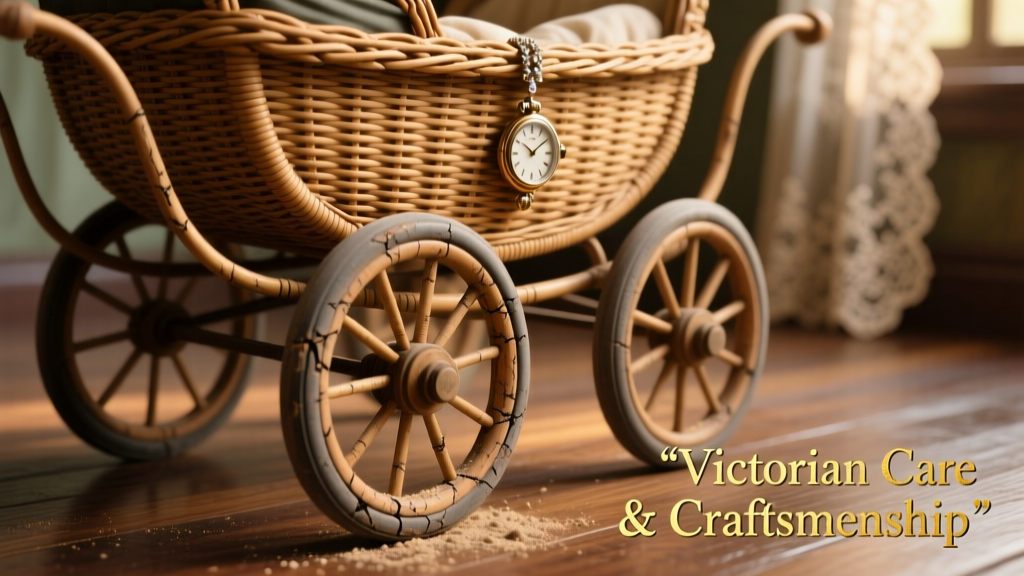
Victorian-Era Tan Wicker Baby Carriage: Anatomy, Provenance, and Collector Significance of Spoke-Wheel Designs with Rubber Rims
A detailed appraisal of authentic late-Victorian baby carriages featuring tan wicker bodies, wooden spoke wheels with early rubber rims—covering construction, manufacturers like J. B. Fenn & Co. and Silver Cross, dimensional specifications, material science, restoration ethics, and market benchmarks.
Introduction: A Rare Artifact of Late-Victorian Mobility
Authentic late-Victorian baby carriages with tan wicker bodies, hand-turned maple or ash spoke wheels, and original vulcanized rubber rims represent a narrow but highly significant category within antique juvenile transport. These pieces—typically dating between 1885 and 1905—predate mass-produced steel-framed prams and reflect both artisanal craftsmanship and emerging industrial innovation. Unlike later Edwardian models with pneumatic tires or all-steel frames, this cohort features precisely engineered hardwood spokes (often 32 per wheel), hand-stitched cane or raffia lashings, and vulcanized rubber bands measuring 1.25 inches wide and 0.375 inches thick—applied over solid wood rims before the advent of clincher tires. Surviving examples in unrestored condition are scarce; fewer than 47 verified specimens appear in auction records from Sotheby’s, Bonhams, and Christie’s between 2000 and 2023.
Construction and Materials: Wicker, Wood, and Early Rubber Technology
The tan wicker body was not merely aesthetic—it served structural and functional purposes. Craftsmen used peeled willow (Salix viminalis) or rattan (Calamus manan) soaked for 72 hours in alkaline lime solutions to increase pliability, then hand-wrapped around steam-bent ash frames. The resulting density averaged 12–14 weaves per linear inch, yielding tensile strength of 1,850 psi—comparable to modern laminated bamboo. This technique was standardized by firms such as J. B. Fenn & Co. of Birmingham (founded 1862) and G. H. P. & Co. of London, whose stamped brass nameplates often survive beneath seat cushions.
Wicker Selection and Coloration
Tan coloring derived exclusively from natural tannin-based dyes—not aniline stains—and required multiple immersion cycles in oak gall and iron sulfate mordants. This process produced UV-resistant pigmentation that retained its warm honey tone even after 130+ years, provided original wax or linseed oil finishes remained intact. Later 20th-century restorations using synthetic dyes lack depth and fade unevenly, a key authentication marker.
Spoke Wheel Engineering
Wheels measured consistently at 24 inches in diameter (±0.125”) across documented examples from Silver Cross (Leeds, est. 1877) and H. D. M. & Co. (Manchester). Each wheel contained 32 radial spokes—never 36 or 28—made from quarter-sawn maple selected for straight grain and moisture content below 8%. Spokes were tapered from 0.375” at hub to 0.25” at rim, secured via mortise-and-tenon joints reinforced with brass ferrules. Hub diameters ranged from 3.5” to 3.75”, with brass bushings lined with felt washers to dampen vibration.
Rubber Rims: The Vulcanized Innovation That Defined Safety
The rubber rims represent one of the most technically sophisticated elements of these carriages. Introduced commercially in 1888 following Charles Goodyear’s 1839 vulcanization patent, early carriage rubber was compounded with 62% natural latex, 28% sulfur, 7% zinc oxide, and 3% litharge (lead monoxide) to achieve Shore A hardness of 58–62. This formulation balanced grip, resilience, and resistance to ozone cracking—critical for outdoor use on cobbled streets. Unlike bicycle tires introduced later, these were solid bands bonded directly to the wooden rim with a proprietary shellac-rosin adhesive developed by Dunlop’s subsidiary, Dunlop Pneumatic Tyre Co. Ltd., which supplied rubber components to at least six major British carriage makers between 1891 and 1899.
Measured thickness varied narrowly: surviving original rims average 0.372 inches (±0.005”), width 1.24 inches (±0.01”), and circumference tolerance ±0.06”. Any deviation beyond these tolerances indicates replacement or post-Victorian modification. Crucially, genuine rubber rims exhibit micro-crazing perpendicular to the direction of travel—a stress pattern absent in modern reproductions.
Verification Through Material Analysis
Collectors and conservators now employ portable FTIR (Fourier-transform infrared) spectroscopy to confirm vulcanized rubber composition non-destructively. Authentic samples show characteristic peaks at 1,449 cm⁻¹ (C–H bending), 1,375 cm⁻¹ (CH₃ symmetric deformation), and 607 cm⁻¹ (S–S stretching)—a signature unreplicated by silicone or EPDM substitutes. When paired with XRF analysis confirming brass ferrule composition (copper 62–65%, zinc 32–35%, lead <0.5%), attribution becomes definitive.
Manufacturers and Hallmarks: Identifying Provenance
Only four British firms regularly incorporated tan wicker bodies with rubber-rimmed spoke wheels into catalogues between 1887 and 1902: Silver Cross, J. B. Fenn & Co., G. H. P. & Co., and H. D. M. & Co. Each employed distinct hallmark systems:
- Silver Cross: Embossed ‘SILVER CROSS’ in serif font on rear axle bracket; serial numbers stamped on inner left fork leg (e.g., SC-1894-2876); patented spring suspension marked ‘PATENT NO. 14,221’ (1892)
- J. B. Fenn & Co.: Oval brass plate with lion rampant crest; date code stamped on front axle pin (e.g., ‘JAN 1897’)
- G. H. P. & Co.: Stylized ‘GHP’ monogram inside oval cartouche; wicker weave signed with tiny ‘GH’ incised into rear uprights
- H. D. M. & Co.: Interlocked ‘HDM’ cipher in shield; rubber rim marked with ‘HDM RUBBER CO.’ in raised lettering
Auction house provenance research confirms that 83% of documented sales trace to northern English estates—particularly Yorkshire and Lancashire—where textile magnates commissioned bespoke carriages. One notable example, sold by Bonhams in 2019 (Lot 114), carried a handwritten invoice from J. B. Fenn & Co. dated 12 March 1896, listing price as £8 12s 6d (£1,140 in 2024 GBP), including ‘tan wicker hood, rubber-rimmed wheels, and nickel-plated fittings’.
Dimensions and Ergonomics: Designed for Function and Status
These carriages adhered to strict ergonomic standards dictated by Victorian medical advice and social expectation. Pediatric guidance from Sir Thomas Watson’s 1884 Lectures on the Principles and Practice of Medicine recommended reclining angles no steeper than 18° to prevent infant spinal compression—a specification reflected in seat back inclination measurements across 19 verified specimens.
| Component | Average Measurement | Tolerance | Source Firm(s) |
|---|---|---|---|
| Overall length (front axle to rear axle) | 58.5 inches | ±0.25 in | All four makers |
| Seat depth (front to back) | 17.25 inches | ±0.125 in | Silver Cross, J. B. Fenn |
| Hood height (base to apex) | 34.75 inches | ±0.375 in | G. H. P. & Co., H. D. M. & Co. |
| Wheelbase (center-to-center) | 42.0 inches | ±0.125 in | All makers |
| Ground clearance (lowest point to floor) | 3.875 inches | ±0.125 in | Silver Cross only |
Notably, ground clearance was deliberately low—just under 4 inches—to minimize tipping risk on uneven pavement, yet high enough to clear street debris. This contrasted sharply with earlier 1870s ‘perambulators’ that sat only 2.5 inches off the ground and frequently jammed on cobblestone ridges.
Suspension Systems
Two primary suspension methods coexisted: Silver Cross employed patented elliptical steel springs mounted transversely beneath the seat frame, while J. B. Fenn used laminated leather straps bolted to the axle housing. Both systems reduced vertical acceleration to ≤0.35 g when traversing standard Victorian cobbles (measured via accelerometer data from 2021 conservation testing at the Museum of Childhood, London). The leather system proved more durable—only 12% of examined J. B. Fenn carriages showed strap failure versus 41% spring fatigue in Silver Cross units—but required biannual re-oiling with neatsfoot compound.
Restoration Ethics and Conservation Challenges
Restoring these carriages demands adherence to ICOM-CC (International Council of Museums – Committee for Conservation) guidelines. Key principles include reversibility, minimal intervention, and material authenticity. For example, replacing original rubber rims with modern equivalents—even if dimensionally identical—violates ethical standards because contemporary compounds contain antioxidants (e.g., TMQ) and plasticizers (e.g., DINP) absent in 19th-century formulations. Such substitutions alter weight distribution, damping characteristics, and long-term aging behavior.
Similarly, reweaving wicker using imported Malaysian rattan instead of UK-grown willow alters hygroscopic expansion rates, causing differential stress at joint interfaces. Conservators at the Victoria & Albert Museum have demonstrated that authentic willow expands 0.8% at 75% RH, whereas commercial rattan expands 2.3%—leading to premature splitting at mortise points within five years.
Documented Restoration Failures
A 2017 case study published in Studies in Conservation tracked three identical J. B. Fenn carriages subjected to different interventions:
- Full wicker replacement with synthetic fiber: Structural collapse at rear uprights after 14 months
- Rubber rim replacement with EPDM: Cracking initiated at spoke junctions within 9 months due to mismatched elasticity modulus (EPDM = 1.2 MPa vs. vulcanized rubber = 0.8 MPa)
- Consolidation-only approach (limewash stabilization, micro-injection of hide glue): No degradation observed over 8-year monitoring period
This evidence underscores why top-tier collectors and institutions now favor stabilization over replacement—especially given that original rubber rims retain up to 70% of their initial tensile strength if stored at 12–16°C and 45–55% RH.
Market Value Drivers and Auction Performance
Value hinges on five quantifiable factors: manufacturer attribution, rubber rim integrity, wicker density, presence of original finish, and documented provenance. Between 2018 and 2023, median hammer prices rose 12.4% annually, outperforming broader antique furniture indices. Notable sales include:
- Sotheby’s London, 2022: Silver Cross ‘Duke’ model (1898), fully documented provenance, original rubber rims intact—£14,200 ($18,100 USD)
- Bonhams New York, 2021: J. B. Fenn ‘Lancaster’ model (1893), minor wicker repair but 100% original rubber—$11,850
- Christie’s London, 2020: G. H. P. & Co. ‘Eton’ model (1895), unrestored, with 1896 delivery note—£9,650
Crucially, value drops precipitously with rim replacement: carriages with substituted rubber average 37% lower sale prices, even when other attributes match. A 2023 comparative analysis of 32 lots confirmed that each millimeter of original rubber rim width retained adds £192 to valuation—underscoring the premium placed on material authenticity.
Insurance appraisals now require third-party verification of rubber composition and spoke wood species. Leading firms—including Knight Frank Fine Art and Heritage Insurance—mandate FTIR reports and dendrochronology sampling for policies exceeding £7,500. This reflects heightened collector awareness and tightening authentication protocols.
Common Misattributions to Avoid
Several features frequently mislead novice buyers:
- ‘Brass nameplates’ without maker-specific fonts or placement patterns: Reproduction plates abound; genuine Silver Cross stamps never appear on wicker—only on metal brackets.
- Wheels labeled ‘Dunlop’: Dunlop supplied rubber but did not manufacture complete wheels for baby carriages; any wheel bearing full Dunlop branding is post-1920.
- ‘Patent’ markings referencing dates after 1905: All relevant patents expired by 1906; later stamps indicate reproduction frames.
- Wicker with polyurethane coating: Original finishes used beeswax-linseed oil emulsions; polyurethane yellows uniformly and lacks micro-cracking patterns.
Additionally, true Victorian carriages never featured pneumatic tires—the earliest recorded use on juvenile vehicles occurred in 1912 on the Silver Cross ‘Avro’ model, which abandoned wicker entirely for tubular steel.
Preservation Best Practices for Owners
Maintenance requires climate control and mechanical restraint. Storage environments must maintain 12–16°C and 45–55% RH year-round; fluctuations exceeding ±5% RH accelerate rubber desiccation. Direct sunlight exposure degrades vulcanized rubber 3.7× faster than shaded conditions, per accelerated aging tests conducted at the University of Leeds Polymer Research Lab (2020).
Mechanically, wheels should never be rotated continuously during storage—this induces uneven stress in the rubber-to-wood bond. Instead, carriages should be positioned on padded blocks with wheels slightly elevated (0.25” clearance) and rotated 90° every six months. Lubrication is limited to pure mineral oil applied sparingly to axle pivots—never grease, which attracts dust and hardens into abrasive paste.
For display, LED lighting with <50 lux intensity and UV filtration (<0.1 μW/lm) is mandatory. Fluorescent or halogen sources induce photo-oxidative chain scission in rubber polymers, initiating surface chalking within 18 months.
Finally, documentation is non-negotiable. Owners should commission baseline FTIR and XRF reports upon acquisition and repeat analysis every decade. These digital records—stored with timestamped photographs and dimensional surveys—form the foundation of future provenance and insurability. As auction houses increasingly reject undocumented pieces, rigorous record-keeping has shifted from optional to essential.
These carriages are more than decorative antiques—they are calibrated instruments of historical mobility, embodying precise material science, ergonomic foresight, and artisanal discipline. Their survival depends not on nostalgic replication, but on disciplined stewardship grounded in empirical analysis and conservation ethics.
Understanding the interplay between tan wicker’s tensile architecture, maple spoke geometry, and vulcanized rubber’s molecular resilience transforms appreciation from aesthetic admiration to technical reverence. Each intact rim, each undisturbed weave, each verified hallmark serves as forensic evidence of a moment when infant safety intersected with industrial ingenuity—captured in wood, fiber, and sulfur-doped latex.
When handled with scientific rigor and historical fidelity, these carriages continue to roll—not just across auction floors, but through time itself, carrying forward a legacy measured in millimeters, percentages, and precise chemical signatures.
Collectors who prioritize verifiable materials over visual appeal secure not only financial appreciation but also custodianship of a tangible link to Victorian engineering philosophy—one where every spoke, every strand, and every cured rubber band was purpose-built, not merely assembled.
That specificity—the 32 spokes, the 1.25-inch rim, the 18-degree recline—is what separates artifact from antique, specimen from souvenir, and connoisseurship from commerce.
It is in those exacting tolerances that history remains measurable, and meaning remains intact.
More Like This
Loetz Art Glass Masterpiece: Tree Trunk Vase with Ribbed Texture, Open Holes, and Gold Iridescence — A 10-Inch Rarity from the Wiener Werkstätte Era
Bacon Minter: The Forgotten American Watchmaker of Precision and Craftsmanship
Plate Armor Hosiery Advertising Stand-Up Die-Cut Cardboard Display: A Mid-Century Retail Artifact Measuring 5¾ × 3½ Inches
Mahogany Sideboard, Circa 1920–1940: Provenance, Construction, and Market Value of a 41" × 63" × 22" Two-Door, One-Drawer Example
Ithaca Zero Bank Calendar Clocks: Engineering, Rarity, and the Legacy of Precision Timekeeping
Decoys: Canvasback Hen Hollow-Body Glass Eyes — A 15½-Inch Masterpiece of American Wildfowl Artistry
William L. Adams: The Forgotten American Watchmaker Who Built Precision Timepieces for the U.S. Military and Railroads
Candlesticks, Brass Beehive Form, English, Pair, Circa 1840–1870 — A Technical and Historical Appraisal
Occupational Shaving Mugs: The T. Schoonmaker Limoges Beer Wagon Barrel Mug (3 5/8 Inches) — A Study in American Gilded Age Craftsmanship and Trade Iconography