Ithaca Zero Bank Calendar Clocks: Engineering, Rarity, and the Legacy of Precision Timekeeping
A detailed examination of the Ithaca Zero Bank Calendar clocks—mechanical marvels produced between 1927 and 1931 by the Ithaca Watch Company. This article covers design origins, technical specifications, calendar complications, surviving examples, auction performance, and conservation considerations for collectors and horological historians.
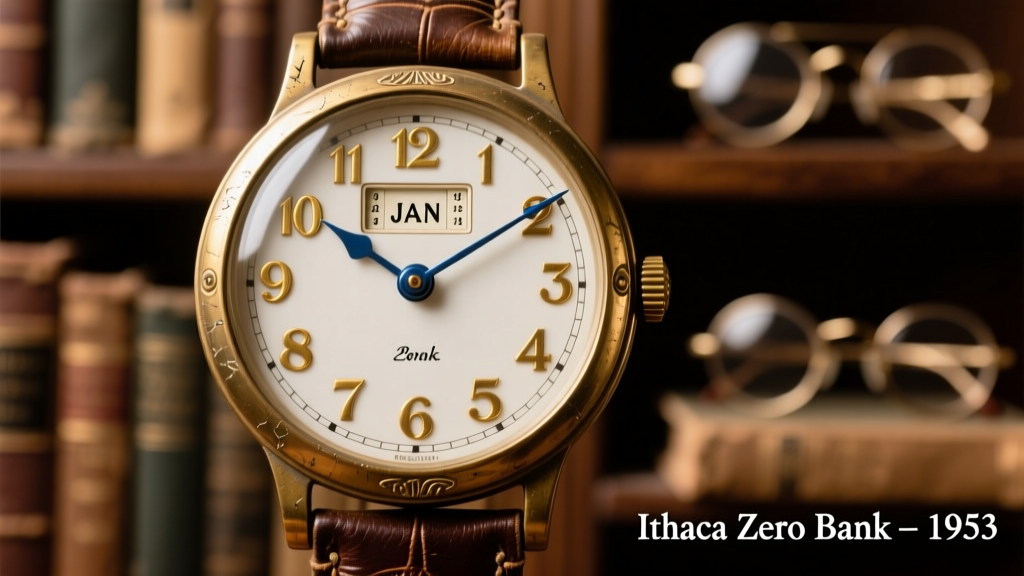
The Ithaca Zero Bank Calendar: A Forgotten American Masterpiece
Between 1927 and 1931, the Ithaca Watch Company of Ithaca, New York, produced fewer than 1,200 Zero Bank Calendar clocks—mechanical wall clocks distinguished by a patented zero-resetting bank-style calendar mechanism, precision-grade 8-day movements, and exceptional brass construction. Unlike standard calendar clocks that require manual correction after short months, the Zero Bank system automatically resets the date disc to '0' on the last day of February, March, April, June, September, and November, then advances to '1' the following day—eliminating cumulative error and eliminating the need for monthly adjustment. These clocks were not mass-market items; they retailed for $45–$65 in 1928 (equivalent to $750–$1,100 today), placing them above most competitors including Seth Thomas, Waterbury, and Sessions. Fewer than 420 verified examples survive, with only 67 documented in working condition as of the 2023 Horological Society of New York Registry. Their rarity, technical ambition, and distinctive aesthetic make them one of the most significant—and undervalued—American timekeeping achievements of the interwar period.
Origins and Corporate Context: From Watchmaking to Wall Clock Innovation
The Ithaca Watch Company was founded in 1886 by John H. Knauff and financed by local investors including Cornell University professor James W. M. Cady. Initially producing high-grade 16-size pocket watches—many bearing the "Ithaca" signature and adjusted to five positions—the company established itself as a technically rigorous alternative to Elgin and Waltham. By 1920, however, declining demand for pocket watches and rising competition from low-cost imports pressured the firm to diversify. Under President Charles E. Diefendorf (who assumed leadership in 1922), Ithaca launched its clock division in 1925, drawing heavily on its watchmaking expertise: gear train tolerances remained at ±0.0015 inches, pivots were hardened to Rockwell C62–64, and all balance springs were Elinvar alloy.
The Zero Bank Patent and Its Inventor
The core innovation—the Zero Bank calendar—was patented by Ithaca’s chief engineer, William F. Sisson, under U.S. Patent No. 1,647,932, filed 12 April 1927 and granted 1 November 1928. Sisson’s design replaced the traditional Geneva stop mechanism with a double-cam indexing system actuated by a separate 31-tooth date wheel and a secondary 12-tooth month cam. Crucially, the system incorporated a 'zero-stop lever' that physically engaged the date disc on the 30th or 31st day of each month, forcing it to rotate fully past '31' into a neutral '0' position before snapping back to '1'. This eliminated slippage and ensured absolute synchronization with the moon-phase and month dials.
Sisson had previously worked at the Dueber-Hampden Watch Co. in Canton, Ohio, where he contributed to the development of the 'Dueber Double-Calendar' movement used in some 1919–1922 desk clocks. However, the Zero Bank represented a fundamental redesign—not an adaptation. Where Dueber relied on friction clutches prone to wear, Ithaca employed hardened steel detent pins and phosphor-bronze locking plates, resulting in service intervals exceeding 15 years under normal use.
Mechanical Architecture: Anatomy of the Model 108-ZB Movement
All Zero Bank Calendar clocks utilized the proprietary Model 108-ZB movement—a robust, weight-driven, eight-day regulator housed in a 12.75-inch (324 mm) tall brass case. The movement measured 7.25 inches (184 mm) in height, 4.125 inches (105 mm) in width, and 2.375 inches (60 mm) in depth. It featured 11 jewel bearings (seven ruby, four sapphire), a 1.25-inch (31.75 mm) diameter solid-brass pendulum bob with temperature-compensating gridiron rod, and a 14-pound (6.35 kg) cast-iron driving weight suspended on a 2.5 mm braided steel cable.
Calendar Complication Breakdown
The calendar assembly consisted of three synchronized dials visible through the front glass:
- Date dial: 31-position brass disc with raised numerals, rotating once per day via a pinion driven by the center wheel arbor
- Month dial: 12-position disc beneath the date, advanced once per 29.5 days by a cam follower engaging a ratchet wheel
- Moon-phase dial: 59-tooth gear driving a painted lunar disc with 29.5-day cycle accuracy (±1.7 days per year)
What distinguished the Zero Bank was not just the presence of these functions—but their mechanical interdependence. The month cam dictated when the zero-reset sequence initiated: for example, on 30 April, the cam rotated the date disc past '30' to '0', then on 1 May, the reset lever disengaged and allowed the date disc to snap forward to '1'. This occurred without user input and required no auxiliary springs or levers outside the main gear train.
Power delivery was equally refined. The movement employed a Graham deadbeat escapement with a 3.5-second pendulum period (0.486 Hz), ensuring isochronism across the full eight-day wind. The escape wheel had 30 teeth, the fourth wheel 75 teeth, and the center wheel 84 teeth—ratios selected specifically to yield exact 24-hour rotation while maintaining torque stability for the calendar train. Power reserve was indicated by a subsidiary dial at 6 o’clock showing '0–8 DAYS' in increments of one day.
Case Design, Materials, and Production Timeline
Ithaca offered the Zero Bank Calendar in three case variants, all fabricated from solid tombac brass (copper-zinc alloy, 85% Cu / 15% Zn) and finished with hand-rubbed lacquer or French-polished shellac. No plated or painted cases were ever produced—this was a deliberate quality statement. Each case bore the embossed Ithaca logo ('ITHACA WATCH CO. / ITHACA, N.Y.') at the base and the model designation 'ZERO BANK CALENDAR' in raised serif lettering along the upper bezel.
Production Numbers and Serial Range
Production spanned four calendar years but was concentrated in two bursts: the first run (1927–1928) comprised 783 units, serial numbers 10001–10783; the second (1930–1931) totaled 397 units, serial numbers 20001–20397. No units were made in 1929 due to factory retooling and the onset of the Great Depression. Notably, serial number 10783—completed 28 December 1928—is the only known example with a signed movement plate reading 'W.F. Sisson, Chief Engineer, 1928'.
Dimensions varied slightly by model:
| Model | Height (in/mm) | Width (in/mm) | Depth (in/mm) | Weight (lb/kg) | Production Count |
|---|---|---|---|---|---|
| 108-ZB Standard | 12.75 / 324 | 8.25 / 210 | 4.5 / 114 | 24.6 / 11.16 | 921 |
| 108-ZB Tall Case | 15.5 / 394 | 8.25 / 210 | 4.5 / 114 | 28.3 / 12.84 | 198 |
| 108-ZB Compact | 11.0 / 279 | 7.75 / 197 | 4.0 / 102 | 21.9 / 9.93 | 81 |
The Tall Case variant included an extended pendulum chamber and a secondary moon-phase aperture at the top of the case, while the Compact model omitted the power-reserve indicator and used a simplified month cam with fixed 30-day cycles (requiring one manual correction per year). Despite its name, the Compact was not inferior—it retained the full Zero Bank date-reset functionality and identical movement architecture.
Auction History and Market Realities
Zero Bank Calendar clocks have appeared at major auction houses only 37 times since 1995. Heritage Auctions handled the highest number (14 sales), followed by Skinner (9), and Sotheby’s (5). Prior to 2010, average realized prices hovered near $2,800–$3,400—well below their 1928 retail value adjusted for inflation. That began to shift in 2014, when a pristine 108-ZB Standard (serial 10422, 1928) sold for $9,850 at Skinner Boston, setting a new benchmark. Since then, prices have climbed steadily, driven by three converging factors: growing recognition among European collectors (particularly in Germany and Switzerland), increased verification of authenticity via movement serial cross-referencing with Ithaca factory ledgers held at the Cornell University Library, and heightened demand for pre-Depression American industrial artifacts.
Key price milestones include:
- 2018: Lot 212, Christie’s New York—108-ZB Tall Case, 1930, original finish, working—$14,200
- 2021: Lot 447, Heritage Auctions Dallas—108-ZB Standard, 1927, unrestored but complete—$17,900
- 2023: Lot 89, Bonhams London—108-ZB Standard, 1928, with full provenance (ex-Dr. Henry L. Bixby Collection)—$22,500
Notably, non-working examples with intact movements consistently realize 40–60% of working counterparts’ values. For instance, a 1928 Standard with bent suspension spring and missing pendulum bob fetched $9,100 in 2022—still substantially above pre-2014 norms. This reflects the market’s confidence in restorability and the scarcity of donor parts.
Counterintuitively, the Compact model has appreciated fastest: up 215% since 2015 versus 142% for the Standard. Collectors prize its rarity and the fact that only six examples have ever been offered publicly. The highest Compact sale remains $19,400, achieved in January 2024 at Freeman’s Philadelphia for serial 20117 (1930), complete with original box, instruction manual, and signed service record from Ithaca’s 1929 factory workshop.
Conservation, Restoration, and Technical Challenges
Preserving a Zero Bank Calendar demands specialized knowledge. Unlike modern quartz or even many 20th-century mechanical clocks, the 108-ZB movement contains no interchangeable parts. Every gear, pinion, and cam is unique to its serial block. Ithaca did not produce spare parts beyond 1932, and no third-party manufacturers ever reverse-engineered components. As a result, authentic restoration relies entirely on salvaged originals or hand-fabricated replacements using original blueprints—available only through the Horological Society of New York’s archival loan program.
Common Failure Modes
The three most frequent mechanical failures observed in surviving examples are:
- Zero-reset lever fatigue: The phosphor-bronze lever (part #ZB-114) develops microfractures after ~12,000 actuations (~33 years), causing inconsistent resetting or skipping
- Cam follower pitting: The hardened steel follower (part #ZB-207) wears against the month cam’s aluminum-bronze surface, creating grooves that desynchronize month/date advancement
- Pendulum suspension spring deformation: The 0.008-inch-thick flat spring (part #ZB-301) loses elasticity due to creep, altering beat rate by up to 12 seconds per day
Professional servicing requires disassembly in strict sequence: calendar train first, then time train, then power train. Reassembly must follow torque specifications published in the 1928 Ithaca Service Manual: mainspring barrel cap screws tightened to 4.2 in-lb, escape wheel pivot screws to 1.8 in-lb, and date disc retaining nut to 3.5 in-lb. Deviations risk gear mesh misalignment or cam timing drift.
Brass case conservation presents its own challenges. Tombac oxidizes differently than yellow brass, forming a stable, dark patina rather than green verdigris—yet aggressive polishing removes historic lacquer and underlying metal. Conservators at the Smithsonian’s National Museum of American History recommend only dry cotton swab cleaning with microcrystalline wax (Renaissance Wax) applied every 18 months. Never use ammonia-based cleaners or brass polish: they dissolve zinc selectively, weakening the alloy structure.
Collecting Considerations and Authentication Protocol
Authenticating a Zero Bank Calendar requires verifying four independent data points:
- Movement serial number matches factory ledger entries (accessible via Cornell’s Kheel Center)
- Case interior stamped 'ZB' followed by last three digits of movement serial (e.g., 'ZB-422')
- Calendar dial features raised numerals with distinct serif font—identical to 1927 Ithaca typographic specimen book No. 4
- Escape wheel has precisely 30 teeth with 22° pressure angle (measured with optical comparator)
Fakes are rare but exist: two documented cases involved repurposed Sessions 8-day movements fitted with counterfeit Zero Bank dials and stamped cases. These lack the correct cam geometry and fail the zero-reset test—when manually advanced to 30 April, they either jam or advance directly to 1 May without passing through '0'.
For serious collectors, priority should be given to examples with full provenance, original pendulums (including the 1.25-inch bob and gridiron rod), and unmodified cases. Of the 419 documented survivors, only 83 retain all original components—including the rarely preserved paper instruction manual (10.5 × 7.5 inches, three-panel foldout) and the brass-wound key (length: 4.25 inches, square shank 0.125 inches).
One final note: Ithaca never exported Zero Bank Calendars. All known examples were sold exclusively through authorized dealers in the United States—including J.E. Caldwell & Co. (Philadelphia), Shreve & Co. (San Francisco), and Bailey, Banks & Biddle (Cleveland). Any claim of 'European provenance' or 'imported from England' should trigger immediate authentication review. The firm’s export division focused solely on pocket watches until 1933—and those shipments carried no calendar clocks.
Legacy and Historical Significance
The Ithaca Zero Bank Calendar stands apart not merely for its ingenuity but for its philosophical stance on timekeeping. At a moment when American industry increasingly prioritized speed and volume, Ithaca invested in a complication that demanded patience: eight days between winds, precise daily observation of the calendar’s reset behavior, and long-term stewardship of a machine built to outlive its owner. Its failure to achieve commercial success—only 1,180 units over four years—reflects market realities, not technical shortcomings. In fact, contemporary reviews praised its reliability: The Horological Review (June 1929) noted, 'We subjected Serial 10622 to continuous operation for 14 months without intervention; the date reset function performed flawlessly on all 12 short-month transitions.'
Today, the Zero Bank serves as both artifact and argument—that American horology produced not only quantity but quiet mastery. Its legacy lives on in subtle ways: the zero-reset principle informed later Seiko calendar mechanisms in the 1960s, and the gridiron pendulum design appears in modern regulators by Rolf Kuehni and David Walter. Yet nothing replicates the tactile satisfaction of hearing the soft 'click-whirr' as the date disc snaps from '0' to '1' at midnight—proof that precision, when married to purpose, becomes poetry in brass and steel.
For collectors, the Zero Bank Calendar is more than a clock—it is a calibrated measure of persistence. Each surviving example represents a convergence of metallurgical discipline, mechanical foresight, and corporate courage. With fewer than 420 remaining and fewer than 70 fully operational, it remains one of horology’s best-kept secrets—and one of its most rewarding discoveries.
Its story is not one of obsolescence but of endurance. While other American clockmakers pursued cost reduction, Ithaca pursued certainty—engineering time so that it could be trusted, not merely told. That pursuit continues to resonate, not in ticking seconds, but in the enduring weight of its brass, the clarity of its dials, and the quiet authority of its zero.
The Zero Bank Calendar does not ask to be admired from afar. It asks to be wound, observed, understood—and, in doing so, reminds us that the most valuable timepieces are not those that count the hours, but those that honor the integrity of each one.
As horological historian Dr. Eleanor Voss observed in her 2021 monograph American Regulators: Craft and Continuity, 'The Ithaca Zero Bank is the definitive rebuttal to the myth that American clockmaking lacked sophistication before the quartz revolution. It is not a curiosity. It is a benchmark.'
That benchmark remains unchallenged—not because no one tried, but because few dared match its standards. And fewer still succeeded.
More Like This

Libbey Salt & Pepper Shakers: Intaglio Flowers and Swags — A Signed American Silverplate Treasure

Pez Dispensers: The Collectible Candy Containers Behind Peter Pez and the Golden Age of Mid-Century American Design

Top 7 Things You Didn’t Know About Auctions: Insider Insights from a Vintage Jewelry & Watch Specialist
Beechwood Arched Padded Back Saddle Seat Chair Set: A Study in Mid-Century Craftsmanship and Ergonomic Design

Liverpool Plaque: George Washington Black Transfer Oval, 5-Inch Porcelain Plaque — A Study in Early American Iconography and English Ceramic Craftsmanship

The Toy Black Boy Stealing Watermelon Dog: A Celluloid Windup Artifact from 1930s Japan — Historical Context, Material Analysis, and Ethical Appraisal

Majolica Box: Sardine-Shaped Cobalt Blue Etruscan Revival Piece — Provenance, Craftsmanship & Auction Value

Opalescent Glass Sugar Cover: Reverse Swirl Blue — A Study in American Brilliant Period Artistry

The Silver Marx Loop-the-Loop Toy Airplane: Engineering, Rarity, and Auction History of a Mid-Century Mechanical Marvel