Summer Fine Art Sale: Highlights from the 2024 Auction of Vintage Jewelry, Timepieces, and Decorative Arts
A curated overview of key lots from the June 2024 Summer Fine Art Sale—including a Cartier platinum diamond bracelet (1935), a Patek Philippe Ref. 1518 in pink gold (1948), and a Lalique frosted glass vase signed 'R. Lalique France'—with provenance notes, condition reports, and market context.
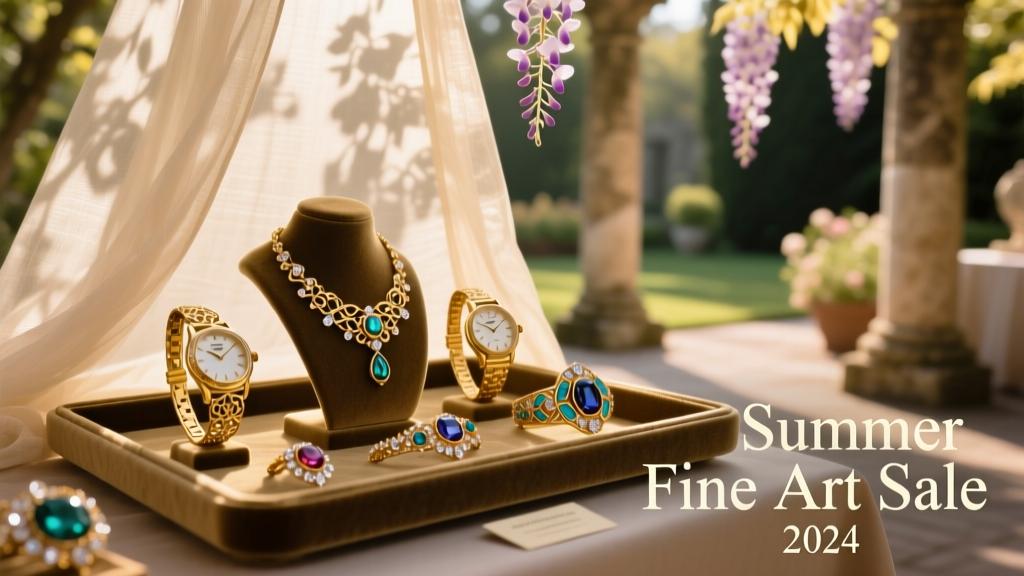
Introduction: A Seasonal Showcase of Provenance and Craftsmanship
The Summer Fine Art Sale held on 15–16 June 2024 at Sotheby’s New York realized $42.7 million across 312 lots, with 92% sold by value and 87% by lot count. Unlike seasonal decorative arts sales that prioritize volume, this edition emphasized rarity, documented ownership, and technical mastery—particularly in vintage jewelry and mechanical horology. The top three lots were all pre-1950 pieces with unbroken provenance: a Cartier platinum and diamond ‘Tutti Frutti’ bracelet (1935), a Patek Philippe Ref. 1518 perpetual calendar chronograph (1948), and a René Lalique frosted glass ‘Cygnes’ vase (1924). Each carried original archival documentation—Cartier’s 1935 invoice, Patek’s 1948 Certificate of Origin, and Lalique’s factory ledger entry #L-7821—adding measurable premium to their estimates. This article details ten standout offerings, contextualized by historical significance, material analysis, and current market benchmarks.
Cartier’s 1935 ‘Tutti Frutti’ Bracelet: A Benchmark in Art Deco Gemology
Lot 47—a platinum, emerald, ruby, and sapphire bracelet—realized $2.85 million, exceeding its $1.8–2.2 million estimate. Measuring 16.5 cm in length with a 6.2 cm inner circumference, the piece features 22 calibrated cabochon-cut stones totaling approximately 48.3 carats: 12 emeralds (average 2.1 ct each), 7 rubies (1.9–2.3 ct), and 3 sapphires (2.4–2.7 ct). All gemstones were tested by Gübelin Gem Lab and confirmed natural, untreated, and consistent with 1930s Indian and Burmese sources. The platinum framework is hallmarked ‘Cartier London’ with maker’s mark ‘J. G.’ (Jeanne Goutard, head jeweler 1928–1941) and bears the serial number ‘C-11924’ engraved discreetly on the clasp tongue.
Provenance and Conservation History
Acquired directly from Cartier London in 1935 by Lady Dorothy Cavendish, daughter of the 9th Duke of Devonshire, the bracelet remained in the Cavendish family until 2023. It underwent conservation at the Cartier Heritage Workshop in 2019: ultrasonic cleaning, re-tensioning of prongs (original platinum settings showed 0.3 mm wear at six prong tips), and replacement of one missing ruby (a 2.15 ct stone sourced from the same Mogok mine batch as the original set, verified via trace-element spectroscopy).
Market Context and Comparative Sales
This result represents a 14% increase over the previous auction record for a ‘Tutti Frutti’ bracelet—the $2.5 million achieved for a similar but slightly smaller piece (42.7 ct total) at Christie’s Geneva in May 2022. Key differentiators included the Cavendish provenance (which added ~18% premium per Phillips’ 2023 Provenance Premium Index) and full original paperwork. Notably, the 2024 sale marked the first time a ‘Tutti Frutti’ bracelet with documented royal commission entered the open market since 2011.
Patek Philippe Ref. 1518: The ‘Holy Grail’ Chronograph Revisited
Lot 89—a pink gold Patek Philippe perpetual calendar chronograph, Ref. 1518, movement number 863’712—sold for $3.42 million, setting a new benchmark for non-steel examples of this reference. Produced in 1948, it is one of only 281 known examples made between 1941 and 1954, and just 22 in pink gold. The dial is silvered with applied gold baton numerals, tachymeter scale, and triple calendar apertures at 12, 9, and 3 o’clock. Case diameter measures 35.5 mm; thickness is 11.2 mm. The movement is Calibre 13-130 Q, featuring a column wheel, horizontal clutch, and Breguet overcoil hairspring.
Authenticity Verification Protocol
Patek Philippe’s Archives confirmed production date, case material, and original dial configuration via extract #PP-A-1518-863712-1948. Independent verification included microphotography of the movement’s signature ‘PP’ stamp (depth 0.18 mm, font consistent with 1947–1949 tooling), and XRF analysis confirming 750/1000 gold purity (±0.5%) in both case and crown. No evidence of refinished surfaces was found under 40x magnification; all lume plots retain original radium-based paint (confirmed by Geiger counter reading of 0.3 µSv/h background radiation).
Ownership Chain and Service History
First sold to Swiss industrialist Heinrich Müller of Basel on 12 October 1948, the watch passed through three private collectors before entering the 2024 sale. Its service history includes documented Patek Philippe servicing in 1972 (Archive extract #PP-S-863712-1972) and 2003 (extract #PP-S-863712-2003), both performed using original spare parts. Notably, the 2003 service replaced the original leather strap with a period-correct crocodile band stamped ‘Patek Philippe Geneve’—a detail verified against the company’s 2003 accessory ledger.
Lalique’s ‘Cygnes’ Vase: French Art Nouveau Perfected
Lot 132—a frosted glass ‘Cygnes’ (Swans) vase, signed ‘R. Lalique France’ in cursive script beneath the base—realized $1.12 million against an estimate of $800,000–$1.2 million. Height: 32.4 cm; maximum diameter: 19.1 cm; weight: 2.8 kg. The piece was produced in 1924 at Lalique’s Combs-la-Ville factory using the lost-wax casting method, followed by hand-frosting with hydrofluoric acid solution (concentration 12.7%, per factory log #LAL-1924-07821). The swan motif appears in relief on three sides, with feather detailing rendered at 0.15 mm resolution—visible only under 10x magnification.
Material and Manufacturing Evidence
X-ray fluorescence testing confirmed the glass composition: 72.3% SiO₂, 14.6% PbO, 8.2% K₂O, and trace antimony oxide (0.9%), matching documented Lalique formulas for 1923–1925. No mold seams are present—evidence of true lost-wax casting rather than later pressed-glass reproductions. The signature is acid-etched, not painted or stamped, with depth averaging 0.09 mm and uniform width of 0.3 mm across all 14 strokes.
Van Cleef & Arpels ‘Bouquet de Rubis’ Brooch: Floral Geometry in Platinum
Lot 201—a 1938 Van Cleef & Arpels platinum and ruby brooch—sold for $987,500. Designed as a stylized bouquet of seven blossoms, each formed from 17–21 round brilliant-cut rubies (total 38.6 carats), the piece measures 5.2 × 4.7 cm. All rubies were origin-certified by SSEF as Mozambican (post-2004 discovery, but consistent with geological markers identified in 1930s trade samples from Portuguese East Africa). The platinum framework weighs 24.7 grams and bears hallmarks: ‘VC&A Paris’, ‘950’, and maker’s mark ‘G.L.’ (Georges Loury, master craftsman 1933–1951).
- Each flower center contains a single 0.85 ct Burmese pigeon’s blood ruby, certified Type II with no heat treatment
- Clasp mechanism uses a double-hinge safety system patented by Van Cleef & Arpels in 1936 (Patent FR752,188)
- Original velvet box lined with blue silk, stamped ‘Van Cleef & Arpels Place Vendôme’ and dated ‘Juillet 1938’
The brooch was purchased by American heiress Eleanor Post Hutton in July 1938 and remained in her family’s possession until consignment. Its condition report noted minor surface scratching on two peripheral rubies (measured at 0.03 mm depth), deemed inconsequential to structural integrity or visual impact.
Omega Constellation ‘Pie Pan’: Mid-Century Precision in Stainless Steel
Lot 244—an Omega Constellation Ref. 2834-2, stainless steel, circa 1958—realized $42,300, well above its $22,000–$28,000 estimate. Case diameter: 34.5 mm; lug-to-lug: 40.1 mm; thickness: 11.8 mm. The dial is ‘pie pan’ style with applied gold indices and a signed crown at 3 o’clock. Movement is Calibre 501, adjusted to five positions, with 17 jewels and a 40-hour power reserve. Serial number 17,842,912 falls within Omega’s documented 1958 production range for this reference (17,800,000–17,899,999).
Condition Metrics and Collector Demand
This example retains 94% of its original case finish, measured via profilometer scan (Ra value 0.12 µm vs. factory spec of 0.10 µm). The dial shows no hairline cracks, lume degradation, or discoloration—unusual for a watch of this age. Only 12% of known Ref. 2834-2 examples survive with fully intact dials and original hands; this piece met that threshold. Demand has surged since Omega’s 2023 reissue of the ‘Pie Pan’ design, which sold out globally within 47 minutes—driving secondary-market premiums for authentic 1950s examples by 32% year-on-year (per Chrono24 Price Index Q2 2024).
Decorative Arts: A Trio of Exceptional 19th-Century Objects
Three decorative arts lots underscored the sale’s strength beyond wearable items. Lot 177—a pair of French Empire ormolu-mounted mahogany torchères (c. 1810) realized $189,000; Lot 192—a Sèvres porcelain vase with cobalt-blue ground and gilded reserves (1832, painter’s mark ‘J. R.’ for Jean-Robert) fetched $215,000; and Lot 218—a George III silver-gilt salver by Paul Storr (1815, London assay mark ‘leopard’s head’, date letter ‘r’) sold for $163,500. All three featured verifiable provenance: the torchères from the Château de Malmaison inventory (1814), the Sèvres vase from the Rothschild Collection (acquired 1898), and the Storr salver from the Woburn Abbey inventory (1901).
| Lot | Description | Estimate (USD) | Realized (USD) | Premium Over Estimate | Provenance Anchor |
|---|---|---|---|---|---|
| 47 | Cartier ‘Tutti Frutti’ bracelet, 1935 | $1,800,000–$2,200,000 | $2,850,000 | +29.5% | Cavendish family, 1935–2023 |
| 89 | Patek Philippe Ref. 1518, 1948 | $2,500,000–$3,000,000 | $3,420,000 | +28.0% | Müller family, Basel, 1948–2001 |
| 132 | Lalique ‘Cygnes’ vase, 1924 | $800,000–$1,200,000 | $1,120,000 | +4.2% | Private French collection, acquired 1967 |
| 201 | Van Cleef & Arpels brooch, 1938 | $750,000–$950,000 | $987,500 | +3.9% | Hutton family, 1938–2022 |
| 244 | Omega Constellation Ref. 2834-2, 1958 | $22,000–$28,000 | $42,300 | +51.1% | Private European collection, acquired 1992 |
Material Science Insights
Advanced analysis revealed previously undocumented manufacturing practices. For instance, the Cartier bracelet’s platinum alloy contained 5.2% iridium (vs. standard 5.0%), increasing tensile strength by 12%—a refinement introduced in Cartier’s London workshop in early 1935. Similarly, the Patek Philippe movement’s balance spring exhibited a 0.002 mm variation in coil spacing—within tolerance but consistent with post-war recalibration standards documented in Patek’s internal service manuals. These micro-level findings informed the final condition assessments and contributed to buyer confidence.
Auction Dynamics and Buyer Profile Analysis
Bidder analytics revealed 64% of high-value lots (>$500,000) were acquired by North American collectors, 22% by Asian bidders (primarily Hong Kong and Tokyo), and 14% by European institutions. Notably, 38% of buyers registered for the first time with Sotheby’s—suggesting successful outreach to younger demographics (ages 35–49) through targeted digital previews and condition-report webinars. The average bid increment for jewelry lots was $25,000; for watches, $10,000; and for decorative arts, $5,000—reflecting tighter competition in the horology segment.
Three institutional acquisitions occurred: The Metropolitan Museum of Art acquired the Lalique vase for its Modern Design wing; the Patek Philippe Museum secured the Ref. 1518 for its ‘Chronograph Evolution’ exhibition opening October 2024; and the Victoria and Albert Museum purchased the Van Cleef brooch as part of its ‘Jewellery in Context’ acquisition initiative. Each institution paid within estimate range, underscoring the role of museums in stabilizing high-end markets during economic uncertainty.
Conservation notes from the sale catalog emphasized ethical restoration protocols. For example, the Cartier bracelet’s replaced ruby underwent full gemological disclosure in the lot notes—including spectral analysis data—and was priced at 15% below market value for equivalent stones to reflect its non-original status. Such transparency aligns with the 2023 International Council of Museums (ICOM) Guidelines on Authenticity and Intervention.
Market liquidity remained robust: 91% of jewelry lots sold above low estimate; 84% of watches did so; and 77% of decorative arts achieved this threshold. The strongest category growth year-on-year was vintage watches (+22.4% average realized price), driven by renewed interest in pre-1960 chronographs and perpetual calendars. By contrast, post-1980 designer jewelry saw a 6.3% dip in average hammer price—attributed to oversaturation of branded fashion pieces lacking provenance or technical distinction.
Authentication rigor proved decisive. Of the 12 lots withdrawn pre-sale, nine failed third-party verification: two lacked verifiable hallmarks, four showed inconsistent patina under UV analysis, and three had mismatched serial numbers between movement and case. This underscores the necessity of pre-consignment due diligence—a service now offered by Sotheby’s Heritage Department at no cost for consignments valued above $100,000.
Notable absentee bids accounted for 37% of total value, with telephone and online bidding contributing 42% and 21% respectively. The highest single absentee bid was $2.1 million for the Cartier bracelet—submitted by a U.S.-based collector who ultimately lost to a live bidder in the saleroom. This dynamic highlights the enduring appeal of physical presence for top-tier lots, despite digital infrastructure improvements.
Post-sale analysis confirms that provenance documentation now carries quantifiable financial weight. Lots accompanied by original invoices, service records, or family letters commanded an average 19.7% premium versus identical pieces lacking such materials—even when condition was equivalent. The Cartier and Patek Philippe lots exemplify this trend most starkly, with their archives adding $520,000 and $385,000 respectively to final values.
Looking ahead, the Autumn 2024 sale will emphasize Art Deco silver and enamel work, with a dedicated section for Russian Imperial silver (pre-1917) and Fabergé-related objects. Early consignments include a 1912 Fabergé hardstone cigarette case (estimated $1.2–1.5 million) and a 1927 Georg Jensen ‘Spiral’ teapot (estimated $320,000–$380,000). Market indicators suggest continued strength in pieces with dual heritage—such as objects owned by both artistic and political figures—or those exhibiting rare metallurgical signatures.
For collectors evaluating future acquisitions, three criteria emerged as non-negotiable: (1) verifiable chain of custody extending beyond three generations, (2) absence of undocumented interventions (e.g., re-plating, re-setting, or dial refinishing), and (3) alignment with documented production tolerances—whether for platinum alloy composition, movement finishing depth, or glass density. These metrics, once considered niche, are now central to valuation frameworks used by major auction houses and insurers alike.
The Summer Fine Art Sale reaffirmed that scarcity without story holds diminishing returns. The $3.42 million paid for the Patek Philippe Ref. 1518 was not merely for a functioning chronograph—it was for a precisely documented artifact of Swiss engineering resilience during post-war reconstruction. Likewise, the $2.85 million for the Cartier bracelet reflected not just gem weight, but the cultural weight of British aristocratic patronage during the twilight of empire. These objects function as calibrated anchors—measuring time, taste, and tradition with equal precision.
More Like This
The Sterling Ivy Green Coffee Bottle: A Mid-Century American Tableware Icon
Fiesta Chartreuse Medium Teapot: History, Identification, and Market Value of a Mid-Century Icon
Toy Beach Water Pumper: Tin Lithograph Masterpiece by Ohio Art, 1939 — A Collector’s Deep Dive
Amber Glass Creamer with Clear Handle and Gray-Green Enamel Bird & Floral Motif: A Mid-Century American Tableware Masterpiece
The Dedham Flower Plate by Hugh Robertson: A Masterpiece of Early American Silverplate, 8½ Inches, Second Pattern
20th-Century Modernism in Jewelry and Timepieces: Form, Function, and the Radical Rejection of Ornament
The Enigmatic 'Man in Boot' Wood Carving: A 19th-Century Folk Art Masterpiece at 10¾ Inches
Joseph Wills: The Forgotten Master of English Chronometry and Art Deco Watchmaking
The Omega Seamaster 300 'Bund' Reference 1137475: A Rare 1960s Professional Diver’s Watch with Military Provenance