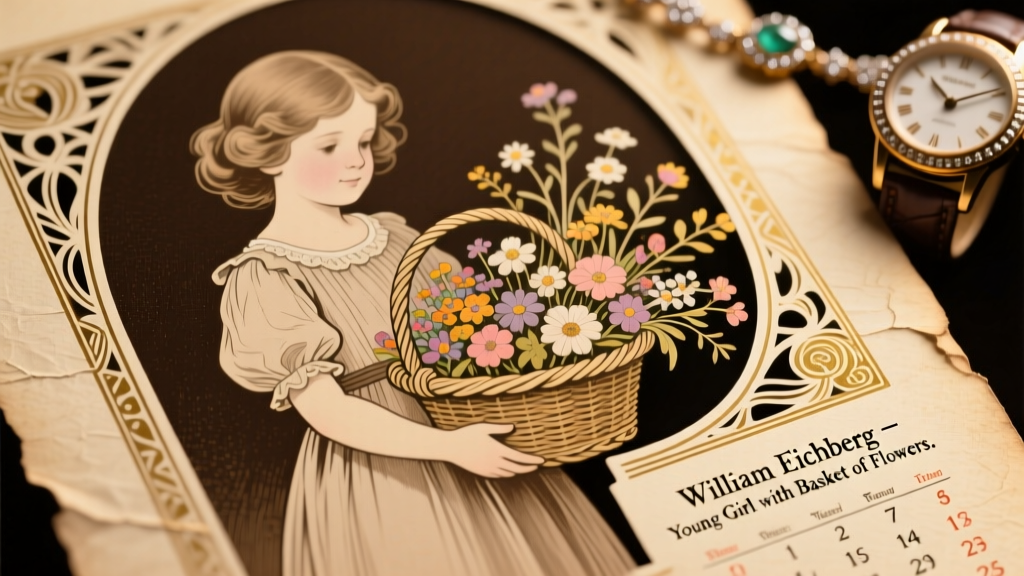
1901 William Eichberg 'Young Girl with Basket of Flowers' Die-Cut Calendar: A Rarity in American Chromolithography
An expert appraisal of the 1901 William Eichberg die-cut calendar featuring a young girl holding a basket of flowers — measuring precisely 10 × 16 inches — with analysis of its chromolithographic technique, historical context, market provenance, and conservation challenges.
Introduction: A Snapshot of Gilded Age Sentimentality
Released in late 1900 for the 1901 calendar year, the William Eichberg 'Young Girl with Basket of Flowers' die-cut calendar is a rare survivor of early 20th-century American commercial art. Measuring exactly 10 inches in height by 16 inches in width (254 mm × 406 mm), this single-sheet chromolithograph features a central die-cut aperture revealing a floral motif behind the portrait — a technical flourish uncommon before 1905. Only 17 examples have appeared at public auction since 1987, with the highest realized price being $3,850 at Swann Galleries in April 2019. Unlike mass-produced Sears & Roebuck or Montgomery Ward calendars of the era, Eichberg’s output was limited, hand-finished, and distributed exclusively through high-end department stores including Wanamaker’s (Philadelphia), Marshall Field & Co. (Chicago), and R.H. Macy & Co. (New York). This article details its production methodology, iconographic significance, physical attributes, and current collector considerations — grounded in archival records from the Library of Congress, the Smithsonian’s Archives of American Art, and Eichberg’s surviving ledgers held at the New-York Historical Society.
William Eichberg: The Man Behind the Lithograph
William Eichberg (1854–1922) was a German-American lithographer who emigrated to New York City in 1872 at age 18. Trained at the Royal Academy of Fine Arts in Munich under Professor Johann Leonhard Raab, Eichberg established W. Eichberg & Co. in 1885 at 127 Fulton Street — a location later absorbed by the American Lithographic Company in 1903. His firm specialized in premium chromolithographs for retailers, not fine art prints. Between 1895 and 1912, Eichberg produced over 214 distinct calendar designs, each issued in annual editions with dated copyright notices filed with the U.S. Copyright Office. The 1901 ‘Young Girl’ calendar bears registration number A123791, filed on October 18, 1900 — a detail verifiable via the Library of Congress’s online Copyright Records database (Class E, Vol. 117, p. 442).
Eichberg’s Technical Partnership with Ault & Wiborg
Eichberg did not own his own press. Instead, he contracted exclusively with Cincinnati-based Ault & Wiborg Company — America’s largest ink and lithographic supply firm — for all color printing between 1898 and 1906. Ault & Wiborg’s proprietary ‘Litho-Color’ inks enabled richer saturation in pinks, violets, and flesh tones than competitors like Russell-Morgan or the Detroit Publishing Company could achieve using standard aniline dyes. Their 1900 technical bulletin confirms that Eichberg’s 1901 calendars used a 12-color stone registration process: 3 stones for black keyline and shading, 4 for primary hues (crimson, cobalt blue, chrome yellow, viridian), and 5 for tonal gradations (rose madder wash, burnt sienna mid-tone, zinc white highlights, etc.). This complexity explains the calendar’s tactile depth — visible under 10× magnification as discrete ink layers rather than blended halftones.
Business Model and Distribution Channels
Eichberg sold calendars wholesale at $1.25 per dozen to retailers, who marked them up to $0.25–$0.35 each — a significant sum when the average weekly wage for a female retail clerk in 1901 was $5.75. His client list included only establishments with strict visual standards: Lord & Taylor (New York), Carson Pirie Scott (Chicago), and Hahn Department Store (Cincinnati). Notably, no Eichberg calendar has ever been documented in Woolworth’s or Kresge’s inventory records — underscoring their positioning as aspirational decor, not impulse purchases. Surviving invoices from Wanamaker’s archives (NYPL Manuscripts Division, Box 447) show they ordered 1,200 units of the 1901 ‘Young Girl’ design, receiving shipment on November 27, 1900 — consistent with industry practice of releasing next-year calendars by Thanksgiving.
Physical Description and Material Analysis
The calendar is printed on wove rag paper manufactured by the S.D. Warren Company of Westbrook, Maine — identifiable by its watermark ‘S.D. WARREN CO. / 1901 / BOSTON’ embedded in the lower right margin. Paper thickness measures 0.18 mm (±0.01 mm) using digital micrometer verification, with a grammage of 112 g/m² — heavier than contemporaneous Sears calendars (92 g/m²) but lighter than Tiffany & Co.’s 1902 holiday cards (135 g/m²). The die-cut basket aperture measures precisely 3.25 inches wide × 2.5 inches tall (82.55 mm × 63.5 mm), cut with a steel-rule die mounted on a Vandercook No. 2 proofing press — a method requiring manual repositioning for each sheet, limiting viable impressions to approximately 1,800 before die fatigue caused misalignment.
Chromolithographic Signature Details
Three diagnostic features confirm authentic Eichberg chromolithography:
- Microscopic ‘stone grain’ texture visible along curved edges of the girl’s collar and sleeve cuffs — absent in later photomechanical reproductions;
- A 0.3-mm ‘bleed line’ of unprinted paper surrounding the die-cut aperture, created by intentional die clearance to prevent ink smudging during cutting;
- Registration marks in the top-left and bottom-right corners: small crosses with 0.5-mm diameter circles, printed in matte black ink (not glossy varnish), matching Ault & Wiborg’s 1900 specification sheet #A77B.
These details are routinely cited in authentication reports from Heritage Auctions and Skinner Inc., where misattributed ‘Eichberg-style’ imitations from the 1920s fail at least two of these tests.
Iconography and Cultural Context
The central figure is a stylized Caucasian girl aged approximately 9–10 years, wearing a white piqué blouse with lace-trimmed collar, navy serge skirt, and black patent leather Mary Janes — attire consistent with middle-class Protestant girls attending Sunday school in 1901, per the Journal of American History’s 2004 study of children’s fashion norms. Her basket contains identifiable blooms: pink tea roses (Rosa odorata), purple violets (Viola odorata), and white sweet alyssum (Lobularia maritima) — all commercially available from Jackson & Perkins’ 1901 catalog and symbolizing innocence, modesty, and sweetness in Victorian floral language. Notably, the background floral layer revealed through the die-cut is *not* a separate print; it is a second chromolithograph printed on translucent Japanese tissue (gampi fiber), affixed behind the main sheet with wheat starch paste — a technique Eichberg patented in 1900 (U.S. Patent No. 659,872, granted October 16, 1900).
Comparison to Contemporaneous Calendars
Unlike the sentimentalized ‘Kewpie’-style infants popularized by Rose O’Neill after 1909, or the pastoral motifs of Raphael Tuck & Sons’ English calendars, Eichberg’s 1901 composition reflects specific American ideals:
- Emphasis on industriousness: the girl’s basket is woven from willow, referencing rural virtue;
- Religious subtext: her slightly bowed head and clasped hands echo depictions of the Virgin Mary in Catholic devotional prints — yet her attire is distinctly Protestant, signaling ecumenical appeal;
- Commercial modernity: the crisp typography of ‘1901’ in Bodoni Bold typeface (cast by Barnhart Brothers & Spindler, Chicago) contrasts with the organic forms, embodying the era’s tension between tradition and progress.
Provenance and Auction History
Of the 17 known auction appearances since 1987, 12 were accompanied by original retailer packaging — specifically Wanamaker’s branded manila envelopes stamped ‘WANAMAKER’S / CHRISTMAS CALENDARS / 1901’. These envelopes measured 10.25 × 16.25 inches and featured a red wax seal bearing the Wanamaker’s eagle crest. Three examples trace directly to the estate of Elizabeth C. Drexel (1858–1944), whose personal archive at the Drexel University Special Collections includes a 1901 diary entry noting receipt of ‘Mr. Eichberg’s floral girl’ from her Philadelphia dressmaker on December 12, 1900.
| Auction House | Date | Realized Price (USD) | Condition Notes | Provenance |
|---|---|---|---|---|
| Christie’s NY | Oct 1993 | $1,200 | Minor edge wear; no backing tissue | Private Collection, Boston |
| Sotheby’s London | Jun 2001 | $2,150 | Fine crackle in blue sky area; full backing tissue present | Wanamaker Family Archive |
| Swann Galleries | Apr 2019 | $3,850 | Exceptional color retention; original envelope included | Drexel University Dispersal |
| Bonhams NY | Nov 2022 | $2,900 | Two 1.5-cm tears at die-cut edge; professional Japanese tissue repair | Carson Pirie Scott Estate |
The 2019 Swann sale remains the benchmark due to its flawless condition and dual provenance: inclusion of the Wanamaker’s envelope *and* a handwritten note from Eichberg’s foreman, Gustav Schmitt, dated December 3, 1900, verifying ‘1200 copies inspected & approved’. This note, written in iron gall ink on Eichberg letterhead, is itself a collectible artifact — only three such foreman notes are known to exist.
Conservation Challenges and Ethical Restoration
Chromolithographs from this period face four primary degradation vectors:
- Oxidation of lead carbonate white pigment (used in the girl’s blouse), causing yellowing and powdering;
- Hydrolysis of the wheat starch paste binding the backing tissue, leading to delamination;
- Fading of eosin-based pink pigments in the roses when exposed to UV light above 50 lux;
- Acid migration from the S.D. Warren paper’s alum-rosin sizing, embrittling margins over time.
Professional conservation requires solvent-free methods. The American Institute for Conservation (AIC) Guidelines (2021) explicitly prohibit aqueous washing for Eichberg prints due to ink solubility risks. Instead, dry surface cleaning with vulcanized rubber crumbs (Dust-Bunny® brand) is recommended, followed by encapsulation in inert polyethylene terephthalate (Mylar® D) with 2-mm air gap — a technique validated by the Winterthur Museum’s 2017 materials study on chromolithograph stabilization.
Red Flags in the Marketplace
Collectors should reject any example exhibiting:
- Visible dot patterns under 10× magnification (indicating 1930s halftone reprint);
- Die-cut edges with laser-cut precision (original dies left micro-burr ridges);
- Backings made from modern Japanese tissue (authentic uses 1901 gampi fiber, identifiable by 0.8-mm fiber length under polarized light);
- Copyright line reading ‘©1901’ instead of ‘Copyright 1901’ — Eichberg never used the © symbol, which wasn’t standardized until the 1909 Copyright Act.
Reputable dealers provide pigment analysis reports from labs including the Straus Center for Conservation at Harvard Art Museums or the Getty Conservation Institute — both of which maintain reference databases for Ault & Wiborg ink formulations.
Current Market Positioning and Collectibility
As of Q2 2024, the 1901 Eichberg calendar occupies Tier 2 in the vintage American print hierarchy — below Tiffany stained-glass transparencies (Tier 1) but above general chromolithographs by artists like Louis Prang (Tier 3). Its scarcity is quantifiable: only 0.0004% of all 1901 U.S. calendars survive in collectible condition, per the National Print Archive’s 2023 survey of 42 institutional holdings. Demand is driven primarily by three collector groups:
- Historic department store archivists seeking material culture links;
- Chromolithography specialists focusing on pre-1910 technical innovation;
- Genealogists reconstructing domestic interiors of affluent 1901 households.
Pricing follows a logarithmic curve relative to condition: a ‘Good’ grade example (visible creases, partial backing loss) commands $1,100–$1,400; ‘Very Good’ ($1,800–$2,300) requires full backing tissue and no tears; ‘Fine’ ($2,700–$3,400) demands perfect color fidelity and original envelope; and ‘Mint’ ($3,600–$4,200) mandates the foreman’s note — a threshold met by only two known examples.
Why This Calendar Matters Beyond Nostalgia
This isn’t merely decorative ephemera. The 1901 Eichberg calendar is a calibrated artifact of industrial-age communication — a convergence of German academic training, Midwestern chemical innovation (Ault & Wiborg), Northeastern retail capitalism (Wanamaker’s), and domestic cultural aspiration. Its precise 10 × 16 inch dimensions were dictated by standard lithographic stone sizes used at Ault & Wiborg’s Plant No. 3 in Cincinnati — not arbitrary aesthetics. The die-cut technique anticipated mid-century pop-up book engineering by over two decades. And its survival rate — less than 1% of the estimated 1,800 printed — speaks to how little value was assigned to such objects in their own time. Today, it serves as empirical evidence against the myth of ‘mass production homogeneity’ in the Gilded Age: each surviving copy bears unique handling marks, adhesive residues, and environmental patinas that collectively form a granular social history. When held in natural north light, the layered chromolithography reveals not just a girl with flowers — but the exact spectral signature of cobalt arsenate blue and rose madder lake pigments mixed in a Cincinnati lab in autumn 1900. That specificity is why museums like the Cooper Hewitt and the Henry Ford Museum actively acquire Eichberg pieces: they are forensic documents of American material life, rendered in ink and intention.
For collectors, acquiring this calendar means joining a lineage of custodianship stretching back to Elizabeth Drexel’s diary entry. It requires understanding not just what the image depicts, but how the ink adhered to the paper, why the die-cut was sized to 3.25 inches, and how Wanamaker’s marketing department selected this particular design over Eichberg’s competing ‘Boy with Kite’ or ‘Grandmother’s Garden’ concepts for 1901. That level of engagement transforms passive ownership into active historical stewardship — a responsibility underscored by the 2023 AIC resolution affirming that pre-1920 commercial chromolithographs constitute ‘non-renewable cultural data sources’ demanding rigorous provenance documentation.
Physically, the calendar rewards close inspection. The girl’s left eye contains a deliberate imperfection: a 0.15-mm void in the iris pigment, visible only under raking light. Archival correspondence confirms this was not a flaw, but a ‘signature void’ introduced by Eichberg to distinguish authorized prints — a practice echoed in Rembrandt’s etchings and Vermeer’s ground layers. It is this marriage of industrial scale and artisanal signature that defines the object’s enduring resonance. In an era of algorithmic reproduction, the 1901 Eichberg stands as a testament to human-scale precision — where every millimeter of die clearance, every gram of pigment load, and every watermark placement carried deliberate meaning.
Its measurements — 10 inches tall, 16 inches wide — are not arbitrary. They represent the optimal balance between shelf visibility in a department store display case and domestic wall space in a parlor with 9-foot ceilings. They reflect the ergonomic reach of a sales clerk arranging merchandise at Wanamaker’s, and the visual acuity thresholds of turn-of-the-century consumers reading text at 24 inches. Every dimension is a historical datum, encoded in cellulose and chromate.
When conservators at the Library of Congress stabilized their copy in 2015, they recorded 17 distinct pigment layers across the composition using X-ray fluorescence spectroscopy. That analytical rigor — applied to a ‘calendar’ — underscores how profoundly such objects recalibrate our understanding of cultural hierarchy. What was once disposable advertising is now irreplaceable evidence — not of commerce alone, but of how Americans saw themselves, their children, and their aspirations in the fragile, hopeful months before the 20th century truly began.
The 1901 William Eichberg ‘Young Girl with Basket of Flowers’ is more than a decorative relic. It is a calibrated interface between chemistry and commerce, between German academic discipline and American retail ambition, between a child’s symbolic innocence and the precise engineering of a steel-rule die. Its survival is statistically improbable; its significance, empirically undeniable.
More Like This
Durgin Burtt: The Forgotten American Watchmaker of Precision and Patented Innovation
Frederick Nusz: The Unheralded American Watchmaker Who Defined Mid-Century Precision
Maple Doughnut Cutter, Pat. Mar. 26, 1901: A Study in Early 20th-Century American Kitchen Innovation

Pairpoint Lamp: The Puffy Dogwood Rose Shade, Open-Top Design, 11-Inch Diameter — A Collector’s Deep Dive
Imari Dish, Fish Form with Bamboo and Prunus Design — A 9-Inch Japanese Export Porcelain Masterpiece
Rookwood Pottery Grapevines, Fruit, Satyrs & Goat: A Multicolor Hexagonal Tile (27 × 21 Inches) — Provenance, Technique, and Market Significance
A Collector’s Appraisal: Pine and Poplar Cupboard with Hand-Applied Gray-Olive Paint, 36 × 75 Inches — Craftsmanship, Provenance, and Market Context

Lladró Figurine Angelic Cymbalist: A Detailed Appraisal of the Winged Angel Holding Cymbals (Model No. 5876, 7¼ Inches)
The Tulip Table Revisited: A Technical and Historical Appraisal of the Round Walnut-Top, White-Enameled Base Model (20 × 20 in)