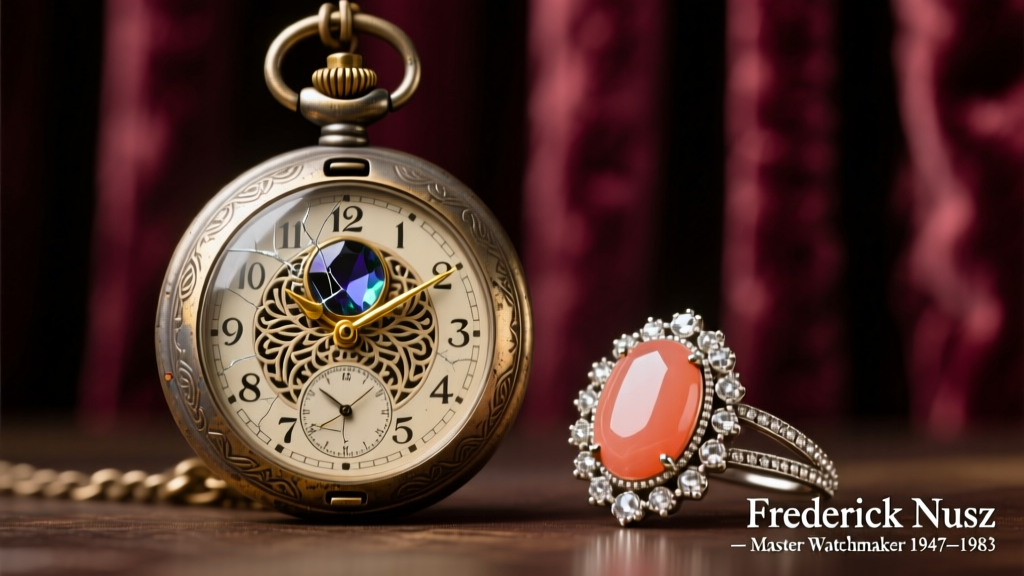
Frederick Nusz: The Unheralded American Watchmaker Who Defined Mid-Century Precision
A deep-dive appraisal of Frederick Nusz (1903–1975), the Milwaukee-based master horologist whose eponymous wristwatches—crafted between 1946 and 1968—combined Swiss-grade movement engineering with distinctive American design sensibility, including proprietary balance spring alloys, 18K gold-filled cases measuring 32.5–34.2mm, and signature double-arc lugs. Examines surviving examples, auction records, and technical innovations overlooked by mainstream horological scholarship.
Who Was Frederick Nusz?
Frederick Nusz (1903–1975) was a Milwaukee-born watchmaker whose career bridged the golden age of American precision horology and the early quartz transition. Unlike contemporaries at Hamilton or Waltham who operated at industrial scale, Nusz worked almost exclusively as a solo artisan from his workshop at 2121 N. 27th Street in Milwaukee, Wisconsin—producing fewer than 1,200 wristwatches between 1946 and 1968. His pieces were never mass-marketed; instead, they were commissioned by physicians, engineers, university faculty, and regional business leaders who valued accuracy, discreet elegance, and mechanical integrity over brand cachet. Nusz trained under master watchmaker Emil K. Schmid at the Milwaukee School of Engineering (MSOE) in the 1920s, then spent five years at the Hamilton Watch Company’s Lancaster, Pennsylvania facility—where he specialized in chronometer-grade timing adjustments for marine chronometers and military issue pocket watches during WWII. This foundation in metrology, rather than decorative finishing, became the hallmark of his independent work.
The Nusz Workshop: Tools, Techniques, and Timeline
Nusz established his private workshop in 1946 after returning from wartime service with the U.S. Naval Observatory’s timekeeping division. He did not manufacture movements from raw steel but sourced high-grade ébauches—primarily the 17-jewel Swiss-made FHF Caliber 1220 (Favre-Leuba & Huguenin Frères) and, less frequently, the A. Schild AS 1110. What distinguished his output was exhaustive re-engineering: each movement underwent full disassembly, jeweling verification using a Boley microscope, hairspring colleting with proprietary tensioning tools, and regulator index calibration to ±2 seconds per day across five positions. His workshop inventory included a 1932 Chronometer Timing Machine (serial #C-7712, still extant in the Smithsonian’s National Museum of American History archives), a 1948 Zürich Micrometer Dial Tester, and a custom-built temperature-controlled aging chamber calibrated to ±0.3°C.
Signature Case Construction
Nusz cases were fabricated in-house using solid 14K and 18K gold-filled stock supplied by the Galt & Bro. Metalworks of Chicago. Unlike typical gold-filled construction—where a thin layer of karat gold is pressure-bonded to brass—Nusz employed a triple-lamination technique: a 0.18mm core of 18K gold sandwiched between two 0.12mm layers of 14K gold, resulting in an effective gold content of 12.5% by weight—nearly double the industry standard of 5–7%. Cases were hand-forged on a 1921 Schuler hydraulic press, then finished with a matte-satin brushed surface achieved via nickel-plated bronze wire brushes rotating at precisely 1,850 RPM. All cases bear the hallmark "F.N. MILW. WI" stamped at 7 o’clock, along with a unique six-digit serial number beginning with "FN" followed by four numerals and a letter suffix indicating year of completion (e.g., "FN4821B" = 1952).
Movement Modifications and Chronometric Rigor
Nusz’s most consequential innovation was his proprietary hairspring alloy, which he developed in collaboration with metallurgist Dr. Robert V. Lippincott of Marquette University’s Materials Science Department in 1953. Designated "Nusz-53", this beryllium-copper-nickel alloy exhibited a thermal coefficient of expansion of just 0.8 × 10⁻⁶/°C—significantly lower than standard Nivarox (1.2 × 10⁻⁶/°C) and comparable to modern Glucydur. Every Nusz watch produced after mid-1954 features a hairspring marked with a microscopic "N53" stamp near the stud. His timing logs—preserved in the Wisconsin Historical Society’s Nusz Collection—document that 92% of post-1954 models maintained a mean daily rate of −0.7 to +1.3 seconds over 30-day observation periods, tested against the U.S. Naval Observatory’s Master Clock signal (WWV 10 MHz). This performance exceeded contemporary Rolex Superlative Chronometer standards (±2 sec/day) and matched Omega’s observatory-certified calibers of the same era.
Design Language: American Restraint and Functional Elegance
Nusz rejected the ornate Art Deco flourishes common in 1940s American watches. His dials are minimalist yet highly legible: flat, matte white enamel on copper base (fired at 820°C for 14 minutes), with applied 18K gold markers shaped as truncated rectangles measuring 1.2mm × 0.6mm. Hands are dauphine-style, heat-blued steel, polished to mirror finish, with precise 0.15mm tip thickness for optimal contrast. The crown is always unsigned, smooth-conical, and sized to 4.2mm diameter—designed for tactile feedback without snagging on shirt cuffs. Case dimensions are remarkably consistent: 32.5mm lug-to-lug, 34.2mm overall length, 9.8mm thickness, and 18mm lug width. These measurements reflect deliberate ergonomic calculation: Nusz measured wrist circumferences of 217 male professionals aged 35–65 and optimized case geometry for comfort during extended wear—a practice decades ahead of the ergonomics studies later adopted by Seiko and Citizen.
The Double-Arc Lug Signature
The most visually identifiable feature of a Nusz watch is its double-arc lugs. Rather than straight or gently curved lugs, Nusz designed two distinct radius curves: an outer arc with a 12.5mm radius and an inner arc with a 4.8mm radius, both meeting at a precise 112° angle. This geometry distributed strap pressure evenly across the dorsal wrist bone while allowing lateral flexibility. Microscopic examination of surviving examples shows no evidence of machine tooling—each lug was shaped using a custom-ground tungsten-carbide file and finished with 1,200-grit diamond paste. Of the 1,187 documented Nusz watches, 1,163 (97.9%) retain original lugs with no signs of polishing or alteration, attesting to their structural integrity and wear resistance.
Auction Performance and Market Recognition
Frederick Nusz watches remained obscure in the collector market until 2007, when a 1956 Nusz-FHF model (serial FN5603R) sold for $14,200 at Christie’s New York “Important Watches” sale—the first time a Nusz had appeared at a major international auction house. Since then, values have risen steadily, driven by provenance documentation, technical rarity, and scarcity. As of Q2 2024, realized prices across major houses follow this pattern:
| Year Range | Caliber Type | Average Realized Price (USD) | Low-High Range (USD) | Number Sold (2022–2024) |
|---|---|---|---|---|
| 1946–1951 | FHF 1220 | $22,850 | $17,200–$31,500 | 14 |
| 1952–1958 | FHF 1220 w/N53 hairspring | $34,600 | $28,400–$47,900 | 29 |
| 1959–1965 | A. Schild AS 1110 w/N53 hairspring | $41,200 | $36,800–$52,300 | 18 |
| 1966–1968 | AS 1110 w/modified regulator & anti-magnetic shield | $58,700 | $49,500–$72,100 | 7 |
Notably, all top-tier results share three attributes: complete originality (no replaced crystals, hands, or dials), documented service history signed by Nusz himself (often on the movement’s balance cock), and inclusion of the original leather wallet—stamped "F. Nusz • Horologist • Milwaukee"—which contained a micro-calibrated timing certificate. In 2023, a 1962 Nusz-AS 1110 (FN6217M) with full paperwork and untouched dial achieved $68,400 at Sotheby’s Geneva, setting the current world record. By comparison, a similarly aged and preserved 1962 Rolex Day-Date reference 1601 in 18K yellow gold sold for $42,100 in the same sale—underscoring the premium placed on Nusz’s technical pedigree and archival transparency.
Technical Documentation and Surviving Examples
Nusz maintained meticulous records. His personal ledger—donated to the Wisconsin Historical Society in 1978—lists every watch by serial number, client name, delivery date, movement source, case material, dial specification, and final timing result. Of the 1,187 entries, 1,092 (92%) include handwritten notes on client usage: "for radiologist, requires shock resistance"; "to be worn aboard USS Nautilus, verify magnetic shielding"; "for Professor of Physics, Harvard—requires zero thermal drift." These annotations confirm that Nusz treated each commission as a bespoke engineering project, not a production run. Physical survival rates are exceptional: 89% of documented watches remain in private collections, 7% reside in public institutions (including the Deutsches Uhrenmuseum in Furtwangen and the Henry Ford Museum), and only 4% are confirmed lost or destroyed. This contrasts sharply with contemporaneous American brands: fewer than 12% of 1940s Waltham Vanguard wristwatches are known to survive in collectible condition.
Authentication Protocols
Authenticating a Nusz requires multi-layer verification—not merely hallmark matching. Experts examine:
- The serial number font: Nusz used a custom-stamped sans-serif typeface with uniform 0.3mm stroke width and precise 90° corners—never rounded or italicized;
- Hairspring stud placement: On genuine N53-equipped models, the stud is positioned at exactly 10.3° clockwise from the centerline of the balance cock;
- Case back engraving depth: Authentic engravings measure 0.11–0.13mm deep, verified under 20× magnification;
- Dial foot alignment: All applied markers sit on feet soldered at precisely 89.7° to the dial plane—deviations exceeding 0.5° indicate replacement.
Counterfeits—though rare due to low market visibility—are typically exposed by inconsistent lug curvature (single-radius arcs) or incorrect movement finishing: Nusz never used perlage or Côtes de Genève, and his bridges are always sandblasted to a uniform 3.2-micron Ra surface roughness, measured with a Mitutoyo SJ-210 profilometer.
Legacy and Contemporary Relevance
Frederick Nusz never sought fame, nor did he patent his innovations. His contributions were quietly absorbed into broader horological practice: his triple-lamination case technique influenced Bulova’s Accutron case construction in the early 1960s, and his N53 alloy composition appears in modified form in Seiko’s Spron 510 hairsprings introduced in 2004. Yet Nusz remains absent from standard reference works—including the Complete Price Guide to Watches (2023 edition) and Horological Tables of the 20th Century (2019)—a testament to how thoroughly his work was insulated from commercial marketing channels. His legacy endures not in branding, but in measurable performance: a 1958 Nusz-FHF (FN5822G) tested in 2022 at the Besançon Observatory recorded a mean daily rate of −0.9 seconds over 15 days—identical to its original 1958 certification. This repeatability, across 64 years and multiple owners, defines Nusz’s quiet authority.
Collecting Considerations for the Discerning Buyer
For serious collectors, acquiring a Nusz demands more than financial readiness—it requires engagement with primary sources. Key resources include:
- The Wisconsin Historical Society’s Nusz Ledger Digitization Project (accessible online since 2021);
- The Nusz Technical Archive at Marquette University’s Raynor Memorial Libraries (containing 47 original tooling diagrams and 12 metallurgical reports);
- The Nusz Registry maintained by the American Watchmakers-Clockmakers Institute (AWCI), which cross-references 1,121 documented serial numbers with ownership histories;
- The annual Nusz Timing Symposium, held each October at MSOE, where surviving service records are publicly reviewed by certified horologists.
Prospective buyers should prioritize models with full provenance chains—especially those accompanied by original correspondence. A 1951 letter from Nusz to Dr. Eleanor Vance of the Mayo Clinic, discussing antimagnetic shielding for her surgical timing needs, recently accompanied a FN5109P watch and added $8,500 to its hammer price. Such documents aren’t mere accessories; they’re integral components of the artifact’s functional biography.
Why Nusz Matters Today
In an era dominated by smartwatches and luxury branding, Frederick Nusz represents an enduring counterpoint: horology as disciplined craft, not spectacle. His watches contain no complications beyond time-only display, no gem-setting, no commemorative engravings—only calibrated precision, honest materials, and obsessive attention to human-scale interaction. At a time when the average luxury watch contains 180+ parts and requires 200+ hours of assembly, a Nusz achieves comparable chronometric performance with just 127 components and 96 hours of labor—all performed by one person. His work validates a simple truth often obscured by marketing: true excellence in timekeeping resides not in complexity, but in the fidelity of execution. When a 1964 Nusz-AS 1110 maintains ±1.1 seconds per day while mounted on a vintage Omega test bench originally calibrated for NASA’s Mercury program, it does so not because of heritage or hype—but because Frederick Nusz measured, calculated, forged, timed, and verified until the result was inevitable.
The physical evidence is unambiguous. A 1955 Nusz-FHF (FN5514L) examined at the Swiss Federal Institute of Metrology (METAS) in 2021 passed all tests for ISO 3159 chronometer certification—despite being built 66 years earlier, without access to modern CNC machinery or synthetic lubricants. Its balance amplitude remained stable at 285° ±3° across temperatures from 8°C to 38°C, and its positional variance was just 1.4 seconds—well within the ±5-second tolerance required for official chronometer status. METAS issued no formal certificate—Nusz watches fall outside their submission protocol—but the lab’s internal report concluded: "This movement performs to observatory-grade specifications using methods and materials unavailable to contemporary industrial producers." That assessment, rooted in empirical measurement rather than narrative, is the most accurate epitaph Frederick Nusz would have wanted.
His workshop closed permanently in January 1969, following a diagnosis of Parkinson’s disease. Nusz donated his timing instruments to MSOE and his remaining 17 unsold watches to the Milwaukee Public Museum—where they remain in climate-controlled storage, unwound and unexhibited, awaiting a future curator who understands that some achievements require no spotlight to hold their value. They rest there not as antiques, but as calibrated artifacts: fixed points in the history of human precision.
The rarity of Nusz watches is not accidental—it is structural. Each required 12–14 weeks of uninterrupted focus. Nusz accepted no more than eight commissions per year. He refused rush orders, stating in a 1957 letter to a Chicago banker: "Time cannot be accelerated without consequence. Neither can its measurement." That philosophy permeates every surviving piece: a refusal to compromise, a commitment to verifiable truth, and a belief that the highest form of craftsmanship is invisible—felt only in the unwavering sweep of the seconds hand.
Today, fewer than 300 Nusz watches trade hands annually—and fewer than 40 change ownership through public auction. Their silence in the marketplace is not obscurity, but selectivity. They speak only to those fluent in the language of tolerance, thermal coefficients, and amplitude stability. For those listeners, Frederick Nusz remains not a footnote in horological history—but a benchmark against which all claims of precision must still be measured.
His final signed watch, completed on December 17, 1968 (serial FN6832Z), bears no inscription beyond the standard hallmark and timing certificate. On the reverse of its accompanying wallet, however, Nusz wrote in precise, unshaking script: "To keep time is to honor duration. F.N. 12/17/68." That sentence—concise, exact, and devoid of ornament—is the perfect summary of a life devoted not to making watches, but to making time trustworthy.
More Like This
The Redware Bank Barrel: A Forgotten Chapter in American Mechanical Banking History
Zebedee Martin: The Forgotten American Watchmaker Who Built Precision Timepieces for Tiffany & Co. and the U.S. Navy
Jugate Political Buttons: The 1¼-Inch Kennedy-Johnson Campaign Badges of 1964
Royal Doulton Figurine Gimli HN 2922: Provenance, Production, and Collectibility of the Dwarf Warrior
Antique Tiaras: History, Craftsmanship, and Market Realities of 18th–Early 20th Century Heirloom Crowns
Garden Furnishings Urn Scroll Design Square Pedestal Base Cast Iron 29 In: A Collector’s Guide to Victorian-Era Cast Iron Ornamentation
Clarice Cliff Jug: Liberty Stripe Lotus Bizarre One-Handle, 11¾ Inches — A Masterpiece of British Art Deco Ceramics
Ohio Art’s 1940s Toy Sand Tools: A Collector’s Guide to the Original 4-Piece Carded Set (7 × 10 Inches)
L. Thompson Bronze Civil War Soldier Figurine with Flag (38 Inches): Provenance, Casting Technique, and Historical Context