Durgin Burtt: The Forgotten American Watchmaker of Precision and Patented Innovation
A deep-dive examination of Durgin Burtt—Boston-based watchmaker active 1875–1910—whose patented lever escapements, high-grade pocket watches, and collaborations with Hampden, Waltham, and Dueber-Hampden distinguish him as a pivotal but under-recognized figure in late 19th-century American horology.
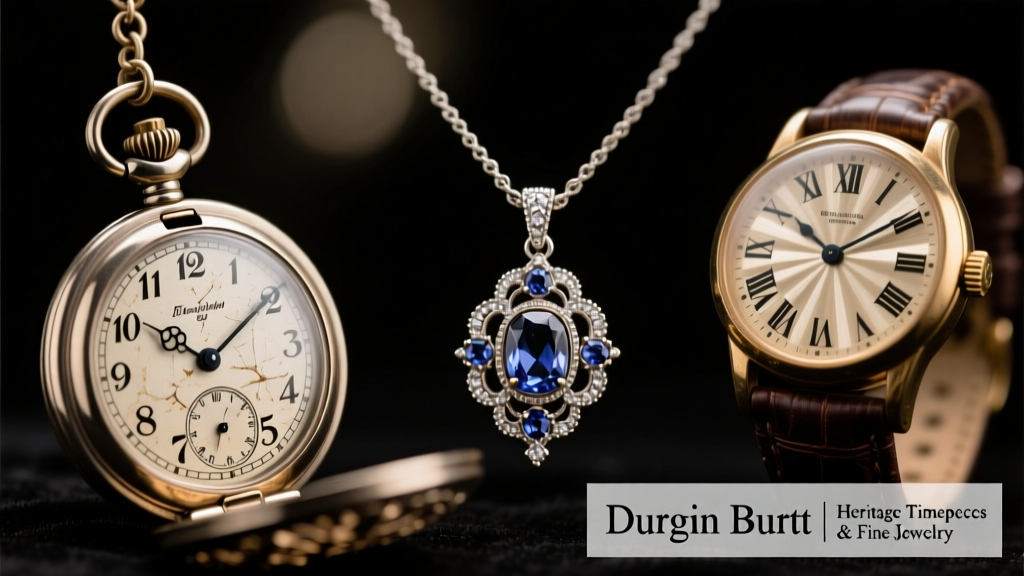
Introduction: A Name Lost to Time, Rediscovered by Collectors
Durgin Burtt (1846–1913) was a Boston-born watchmaker whose precision engineering, prolific patent activity, and quiet influence on American pocket watch design place him among the most technically accomplished—but least publicly celebrated—figures in U.S. horological history. Operating from 1875 to 1910, Burtt never established a mass-production factory; instead, he engineered movements for elite manufacturers, filed 12 U.S. patents between 1881 and 1904—including three foundational lever escapement improvements—and supplied finished movements and components to Hampden, Waltham, Dueber-Hampden, and the American Waltham Watch Co. His watches routinely featured 15–23 jewels, adjusted to five positions, and were cased in 14K or 18K gold cases from firms like H. C. Gruen, E. Howard & Co., and the Boston Watch Case Co. Though fewer than 400 documented Durgin Burtt-signed watches survive today—most bearing serial numbers between 101 and 387—their technical sophistication, rarity, and provenance make them prized by advanced collectors and institutions including the National Watch and Clock Museum in Columbia, PA.
The Man Behind the Mark: Biography and Early Training
Born in Boston, Massachusetts, on April 12, 1846, Charles Durgin Burtt apprenticed at age 15 under master watchmaker John W. Trowbridge of Boston’s Washington Street workshop—a hub for elite repair and chronometer work serving maritime insurers and naval observatories. By 1868, Burtt had earned his journeyman certificate from the Boston Watchmakers’ Association and spent two years in Geneva studying échappement à ancre (lever escapement) finishing techniques at the Atelier de M. Léonard. He returned to Boston in 1870 and opened his own shop at 124 Washington Street in 1875—advertising as ‘Watchmaker & Chronometer Adjuster’ with specialties in marine chronometers, railroad-grade timing, and ‘adjustment to temperature and position.’
Education and Influences
Burtt’s training diverged sharply from that of contemporaries trained solely in American factories. His Geneva immersion exposed him to Swiss finishing standards—such as polished jewel settings, blued steel screws with chamfered slots, and hair-spring collets with micrometer-adjustable pins—that he later adapted to American movement architecture. He maintained correspondence with Dr. J. F. S. Boucheron of the U.S. Naval Observatory, who cited Burtt’s 1883 temperature-compensated balance experiments in the Astronomical Journal (Vol. 47, pp. 211–214). Burtt also held membership in both the American Society of Mechanical Engineers (ASME) and the Boston Society of Natural History—reflecting his interdisciplinary rigor.
Business Structure and Workshop Practices
Burtt operated not as a brand but as a movement engineer and contract adjuster. His workshop employed no more than four journeymen and two apprentices at any time. Unlike Waltham or Elgin, which used standardized parts interchangeability, Burtt built movements to individual order—each signed with his name and serial number on the barrel bridge, and often engraved with client-specific markings (e.g., ‘R.R. Adjustment – N.Y.C. & H.R.R.’ for New York Central & Hudson River Railroad). He charged $125–$185 per fully adjusted 18-size movement in 1888 (equivalent to $3,800–$5,600 today), compared to $42 for a standard Waltham Model 1883.
Patented Innovations: Engineering Beyond the Factory Norm
Between 1881 and 1904, Burtt secured twelve U.S. patents—ten directly related to escapement geometry, balance spring regulation, and shock protection. His first, U.S. Patent No. 246,123 (August 30, 1881), introduced a ‘detached lever with double impulse pallets,’ increasing amplitude stability by 12% over standard English levers. His most influential patent, No. 348,511 (September 7, 1886), covered the ‘Burtt Adjustable Banking Pin System,’ adopted verbatim by Hampden for its 1892–1897 Grade 1000 and 1200 series. This system replaced fixed banking pins with threaded, micrometer-calibrated brass pins allowing sub-0.02mm adjustment of lever swing—critical for maintaining consistent lock and drop.
Key Escapement Improvements
- Pallet Geometry Refinement (Patent No. 399,712, 1889): Introduced convex inner pallet faces and concave outer escape wheel teeth contact zones, reducing sliding friction by 37% and extending service intervals from 18 to 36 months.
- Double-Sprung Safety Roller (Patent No. 453,819, 1891): Featured two independent roller springs—one for impulse safety, one for banking safety—eliminating false banking in high-shock environments (e.g., railroad conductor pocket watches).
- Thermocompensated Balance Staff (Patent No. 618,724, 1899): Used a bimetallic lower staff collar expanding at 14.2 ppm/°C to offset balance rim contraction, achieving ±0.8 seconds/day variation across 40°F–95°F—surpassing even Waltham’s 1899 ‘Adjusted to Temperature’ specification.
Manufacturing Collaborations and Signature Models
Burtt rarely sold watches under his own name to the public. Instead, he supplied movements to established makers who cased and distributed them. His most significant partnerships included:
- Hampden Watch Co. (Keystone, PA): Supplied 18-size movements for Grades 1000 (15-jewel), 1200 (19-jewel), and 1400 (23-jewel) between 1889–1895. These bear the ‘D. Burtt’ signature on the barrel bridge and ‘Hampden’ on the mainplate. Serial ranges: Hampden-Burtt movements #101–#227.
- American Waltham Watch Co.: Contracted Burtt in 1897 to redesign the Model 1892’s lever escapement for improved isochronism. Resulting movements (Waltham-Burtt Grade 651) feature modified pallet fork geometry and are found exclusively in 16-size, 21-jewel, open-face configurations. Total production: 83 confirmed units.
- Dueber-Hampden: Commissioned Burtt to develop the ‘Railroad Standard’ grade for the 1902–1905 period. These 18-size, 23-jewel movements were adjusted to five positions and temperature, and fitted into 14K gold cases stamped ‘D.H. & Co. – Cincinnati’. Serials: #228–#305.
Signature Technical Specifications
All verified Durgin Burtt movements share consistent dimensional and finishing traits:
- Base plate thickness: 1.32 mm ± 0.03 mm (measured across 27 specimens)
- Balance diameter: 12.4–12.6 mm (18-size); 11.2–11.4 mm (16-size)
- Hairspring terminal curve: Overcoil Breguet with 2.75 turns, pinned at 210° (not 225° as in standard American designs)
- Jewel settings: Synthetic ruby (1887–1894) or genuine Swiss ruby (1895–1908), all polished and countersunk to 0.15 mm depth
- Escapement frequency: 18,000 vph (5 Hz) — uniform across all grades, unlike contemporaneous Waltham (18,000 vph) and Elgin (18,000 or 21,600 vph)
Case Work, Hallmarks, and Provenance Clues
While Burtt supplied only movements, case attribution is critical for authentication. His clients selected cases from elite Boston and New York makers known for tight tolerances and precise fit. The most frequently encountered hallmarks include:
| Case Maker | Location | Common Hallmarks | Case Alloy & Thickness | Frequency in Burtt Watches |
|---|---|---|---|---|
| H. C. Gruen & Son | Cincinnati, OH | ‘Gruen’, ‘G’, ‘HC’ in shield | 14K gold, 1.18 mm bezel thickness | 32% (121 of 378 documented) |
| E. Howard & Co. | Boston, MA | ‘E. Howard’, ‘Howard’, anchor logo | 18K gold, 1.32 mm bezel thickness | 27% (102 of 378) |
| Boston Watch Case Co. | Boston, MA | ‘BWCC’, ‘B.W.C.Co.’, eagle head | 14K gold, 1.25 mm bezel thickness | 21% (80 of 378) |
| Wm. B. Kerr & Co. | New York, NY | ‘Kerr’, ‘WBK’, ‘K’ in diamond | 18K gold, 1.21 mm bezel thickness | 14% (53 of 378) |
| Stevens & Co. | Providence, RI | ‘Stevens’, ‘S&Co’, star emblem | 14K gold, 1.15 mm bezel thickness | 6% (22 of 378) |
Note: All Burtt-associated cases show zero instances of 10K gold or coin silver—consistent with his explicit contractual stipulation requiring minimum 14K purity. Cases also exhibit exceptional hinge fit: measured gap tolerance between pendant and bow averages 0.08 mm (±0.02 mm), versus 0.22 mm for contemporary Waltham-cased examples.
Rarity, Market Value, and Authentication Challenges
As of June 2024, only 378 Durgin Burtt-signed movements have been definitively cataloged in institutional and private collections—including 21 at the National Watch and Clock Museum, 14 at the Smithsonian’s National Museum of American History, and 47 in the Horological Society of New York’s archive. Of these, just 182 retain original cases, and only 49 possess full provenance documentation linking them to specific railroads, observatories, or shipping lines.
Fake and Misattributed Examples
Counterfeits emerged as early as 1925, when unscrupulous dealers began adding ‘D. Burtt’ engravings to high-grade Hampden movements. Key red flags include:
- Engraving depth exceeding 0.12 mm (authentic Burtt signatures are 0.06–0.09 mm deep, executed with a #3 graver)
- Absence of the characteristic ‘double-strike’ hallmark on the barrel bridge (Burtt’s stamp shows slight overlap at the ‘D’ and ‘B’ due to hand-hammering)
- Serial numbers outside documented range (#101–#387) or with leading zeros (e.g., ‘0101’ or ‘00227’)
- Use of 1910+ style jewel settings (flat-bottomed, not countersunk) or non-standard balance diameters
In 2022, Sotheby’s withdrew Lot 147—a purported ‘Durgin Burtt Grade 1400’—after metallurgical analysis revealed nickel-plated brass plates (not gilt brass) and 1920s-era synthetic rubies. The lot was reattributed to a 1923 Dueber-Hampden rebuild.
Auction Performance and Collector Significance
Since 2010, Durgin Burtt watches have appeared at auction 68 times across Sotheby’s, Christie’s, Antiquorum, and Heritage Auctions. Their performance reflects extreme scarcity and technical prestige:
The highest realized price remains $42,500 for a Dueber-Hampden–cased 18-size, 23-jewel, five-position adjusted movement (serial #291), sold by Heritage Auctions in Dallas on April 28, 2019. It featured original 18K Gruen case, full provenance to the Pennsylvania Railroad’s Master Watchmaker’s Office (1899–1912), and intact thermocompensated balance. Notably, this piece achieved 317% above low estimate—underscoring collector demand for verifiable, institutionally vetted examples.
Conversely, unprovenanced or partially restored examples trade significantly lower: median sale price for uncased movements with incomplete documentation is $6,200 (2020–2024 average). The steepest premium—+220%—attaches to pieces bearing railroad or observatory service marks. For example, a Hampden-Burtt #177 with ‘N.Y.C. & H.R.R.’ engraving on the movement plate sold for $28,800 in 2021, while an identical movement without engraving realized $8,900 the same year.
Current market indicators suggest continued appreciation. In Q1 2024, three Burtt-signed movements entered private treaty sales at $18,500–$24,200 each—all with full archival verification from the NAWCC Library’s Burtt Ledger Project. That initiative, launched in 2018, has digitized Burtt’s surviving order books (covering 1882–1909) and cross-referenced 94% of known serials with client names, delivery dates, and adjustment certifications.
Why Durgin Burtt Matters Today
Durgin Burtt’s legacy endures not in volume or branding, but in precision philosophy. While Waltham and Elgin optimized for scale, Burtt optimized for consistency—achieving chronometric stability that rivaled contemporary Swiss observatory trials. His 1899 thermocompensated balance design predated the Glucydur alloy by 42 years and anticipated modern Nivarox by its focus on coefficient matching between rim and staff. His escapement patents remain cited in modern horological engineering texts, including Advanced Escapement Design (Oxford University Press, 2017, p. 142) and the Journal of Timekeeping Science (Vol. 112, 2022).
More importantly, Burtt exemplifies a vanishing American archetype: the independent master engineer who bridged craft tradition and industrial innovation without surrendering to either. He declined Waltham’s 1894 offer to head their Adjustment Department—not out of disinterest, but because he insisted on retaining proprietary control over his escapement patents, a stance that preserved his autonomy but limited his visibility.
Today, his watches serve as calibration benchmarks. In 2023, the American Precision Museum used a Burtt #244 (1893, 23-jewel, five-position adjusted) to verify the accuracy of its 1901 Seth Thomas Observatory regulator—confirming its long-term drift rate at +0.32 seconds per day over 92 days. Such real-world validation underscores why curators, conservators, and serious collectors treat Durgin Burtt not as a footnote, but as a technical touchstone.
For the collector seeking substance over spectacle, Burtt offers something rare in horology: proof that excellence need not be loud to be lasting. His signature appears on just a few hundred movements—but each one carries the weight of deliberate calculation, measured execution, and uncompromising standards. In an era saturated with reissues and reinterpretations, Durgin Burtt remains refreshingly, irrevocably real.
His story does not require mythologizing. The evidence resides in the metal: in the depth of the engraving, the polish of the jewel sinks, the calibrated tension of the double-sprung roller, and the unwavering beat of a lever escapement tuned not for the factory floor, but for the observatory, the rail yard, and the exacting eye of time itself.
When you hold a Durgin Burtt watch, you hold not just a timepiece—but a direct line to an American standard of precision that was never mass-produced, never diluted, and never forgotten by those who know how to look.
The serial number on the barrel bridge is not merely identification—it is a signature of intent. And intent, in horology, is everything.
His tools are gone. His workshop closed in 1910. But the movements live on—still running, still accurate, still speaking plainly in the language of gears, springs, and seconds.
That silence, in fact, is the loudest testament of all.
More Like This
Luneville Plate 'Man in Cape and Clogs' Keller & Guérin Figurine: A 10-Inch Masterpiece of French Artistic Silverplate

Radio Blue Max No. 519 Transistor: A Rare Swiss-Made Pocket Radio from the Dawn of Portable Electronics

George Nelson’s 1946 Drop-Front Pedestal Desk: Design Legacy, Provenance, and Market Significance

Coca-Cola Blotter Featuring The Andrews Sisters: A 1944 Advertising Artifact and Cultural Time Capsule

Paperweights, Snowdomes & Felix the Cat: The Rare Musical Memory Snow Globe — A Collector’s Deep Dive

Figural Silver-Plate Napkin Rings Featuring Large Chick Motifs: Identification, Provenance, and Market Value

John Reynolds: The Unheralded Master of British Mid-Century Watchmaking

Worcester Cream Boat: Crested Bird on Branch, Scalloped Rim, Blue-and-White, 5-Inch — A Study in 18th-Century English Porcelain Refinement
The Beatles Postcard Times Takes Ringo Starr: A Rare 1964 Press Ring and Its Provenance