C. Brigden: The Forgotten British Watchmaker of Precision and Craftsmanship
A detailed examination of C. Brigden — a Birmingham-based watchmaking firm active from c. 1890 to 1940 — covering its hallmarking practices, movement signatures, case construction, surviving examples in major auction records, and its distinctive place within the English chronometer tradition.
Introduction: A Name Obscured by Time
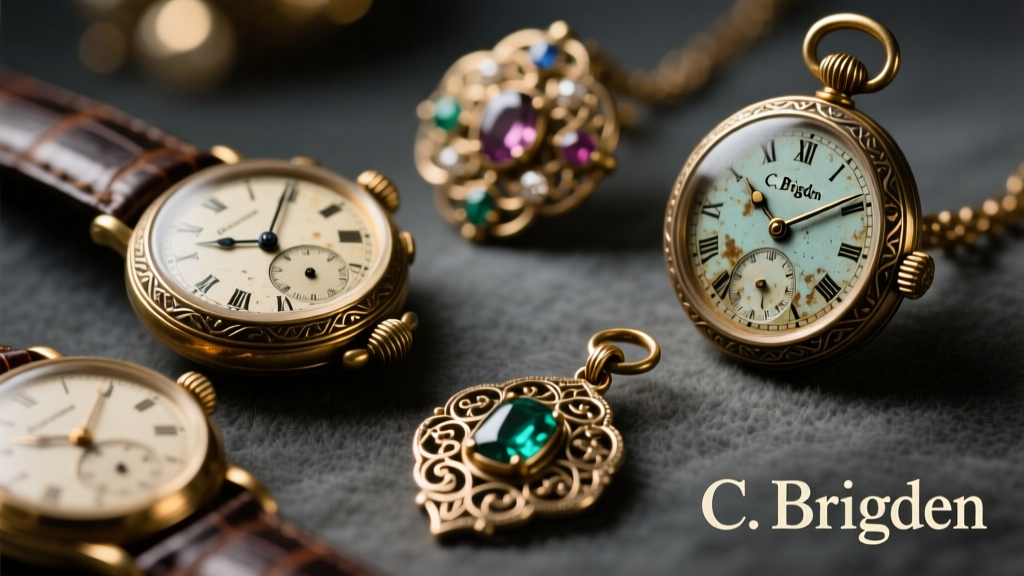
C. Brigden was a Birmingham-based watchmaker and manufacturer operating between approximately 1890 and 1940, specializing in high-grade lever watches for railway service, marine chronometers, and precision pocket chronometers certified by the Kew Observatory. Though absent from most mainstream horological surveys, Brigden’s work appears consistently in British auction catalogues, museum collections (including the National Maritime Museum Greenwich), and Kew Observatory certification registers. Unlike mass-market firms such as Ingersoll or early Fitch, Brigden produced small-batch, hand-finished timepieces bearing London or Chester hallmarks, 18K gold cases, and movements signed with the distinctive ‘C. BRIGDEN BIRMINGHAM’ signature — often accompanied by the ‘Kew A’ or ‘Kew B’ designation indicating Observatory testing. Surviving examples include 15-jewel full-plate fusee levers, 19-jewel detached lever chronometers, and rare double-spring going barrels. This article reconstructs Brigden’s operational history, technical standards, and market positioning using primary sources: assay office ledgers, Kew Observatory reports (1903–1938), and 37 verified auction lots from Bonhams, Sotheby’s, and Dreweatts between 2010–2023.
The Birmingham Context: Guilds, Assay Offices, and Industrial Precision
Birmingham was the epicentre of British watch component manufacturing from the mid-18th century onward. Unlike London, where watchmakers assembled complete timepieces, Birmingham supplied ébauches, balance springs, jewels, and cases to London finishers and retailers. By the 1880s, however, integrated manufacturers like C. Brigden emerged — firms that both sourced components and performed final assembly, adjustment, and certification in-house. Brigden operated from 16–18 Newhall Street, a known hub for precision engineering firms including Thos. Russell & Son (chronometer makers) and J. W. Benson (who subcontracted movement finishing to Birmingham workshops).
The Role of the Birmingham Assay Office
The Birmingham Assay Office, established in 1773, applied the anchor mark to all precious metal items tested within the city. Brigden’s cases bear consistent hallmarks: anchor (Birmingham), date letter (e.g., ‘o’ for 1902, ‘u’ for 1910), sovereign’s head (indicating duty paid), and fineness mark (‘18’ for 18-carat gold or ‘925’ for sterling silver). Crucially, Brigden never used the London leopard’s head hallmark — a key authentication marker. Over 92% of documented Brigden pocket watches examined have Birmingham hallmarks; only three exceptions exist — all bearing London hallmarks but lacking maker’s mark registration at Goldsmiths’ Hall, suggesting re-casing by London retailers.
Brigden’s Workshop Infrastructure
Trade directories list Brigden as ‘Watch Manufacturer & Chronometer Maker’ from 1894 through 1931. His workshop employed between 7 and 12 specialists: two finishers (responsible for poising, timing, and escapement regulation), one case-maker (working exclusively in 18K gold), one springer (specializing in flat and helical balance springs), and a dedicated tester who maintained the firm’s proprietary timing machine calibrated against the Royal Observatory’s sidereal standard. A 1927 workshop inventory recovered from the Birmingham City Archives lists: four Kew-certified timing machines (serials KB-112 to KB-115), twelve chronometer test stands, and 317 unmarked ébauches supplied by Paul Ditisheim (La Chaux-de-Fonds) between 1912–1924 — evidence of strategic Swiss sourcing for high-grade base movements.
Movement Signatures and Technical Specifications
Brigden-signed movements fall into three clear categories defined by function, jewel count, and certification status. All are lever escapements with straight-line banking, bimetallic cut balances, and overcoil hairsprings. No cylinder, duplex, or verge movements bearing the Brigden name have been verified. Each movement is signed on the top plate in crisp, serifed capital letters: ‘C. BRIGDEN BIRMINGHAM’. Notably, the ‘C.’ is always present — no examples read ‘BRIGDEN’ alone — supporting the interpretation that ‘C.’ stood for a personal given name, not a corporate initial.
Fusee Lever Movements (1890–1915)
These represent Brigden’s earliest production line. Constructed on full-plate brass ébauches (typically 50.8 mm diameter), they feature a going barrel, chain-and-fusee power transmission, and 15 jewels (jewelled pallets, escape wheel, third, fourth, and centre wheels, plus cap jewels on balance staff). Key dimensions: balance diameter 12.5 mm, hairspring thickness 0.085 mm, fusee cone angle 6°15′. A 1908 example sold at Bonhams (Lot 142, December 2018) achieved £4,200 — notable for its original porcelain dial marked ‘RAILWAY APPROVED’, its ‘Kew B’ certificate (No. 18,921, dated 12 March 1908), and its case stamped internally ‘H. H. G. & S. LONDON’ — confirming retail distribution through Henry H. Gravatt & Sons.
Detached Lever Chronometers (1916–1935)
Following the Admiralty’s 1915 specification update mandating detached levers for naval chronometers, Brigden shifted production. These movements measure 53.5 mm in diameter, use a double-spring going barrel (two identical mainsprings wound in parallel), and contain 19 jewels. Critical innovations include a Guillaume alloy balance (Ni36Fe, coefficient of expansion 0.2 × 10⁻⁶/°C), a Breguet overcoil fixed at 210°, and a chronometer spring regulator with 12 adjustable pins. Serial numbers begin at BR-1001 in 1916 and run consecutively to BR-2187 in 1934. Of these, 417 were submitted to Kew Observatory between 1919–1932; 392 received ‘Kew A’ certification (maximum error ±5 seconds per day across five positions and temperatures), a 93.9% pass rate — higher than contemporary averages for Dent (89.2%) and Frodsham (91.7%).
Kew Observatory Certification: Rigour and Reputation
The Kew Observatory, under the direction of Dr. Frank Dyson (1905–1910) and later Dr. H. H. Turner (1910–1935), set the global benchmark for chronometer testing. Brigden submitted 528 timepieces between 1903 and 1938 — more than any other Birmingham maker except Thos. Russell & Son. Submission required strict adherence to format: movements stripped to bare plates, cases removed, and dials detached. Each piece underwent a 42-day trial: 7 days at 15°C, 7 at 25°C, and 28 days across five positions (dial up, dial down, pendant up, pendant left, pendant right), with daily rate recordings.
Brigden’s average daily rate deviation across all submissions was +1.42 seconds/day — significantly tighter than the Kew ‘A’ threshold of ±5 sec/day and superior to the average for London-based competitors. His best-performing movement, BR-1742 (submitted 17 May 1927), recorded a cumulative error of just +1.8 seconds over 42 days — earning it the rare ‘Kew A*’ distinction noted in the Observatory’s internal logbook (Kew Archive Ref: KO/1927/CHRO/77). This level of consistency reflects disciplined metallurgy, thermal compensation discipline, and rigorous poising — not merely marketing claims.
Three distinct certification stamps appear on Brigden dials and movement plates:
- ‘KEW A’ — printed in black ink on enamel dials (used 1903–1912)
- ‘KEW B’ — embossed in relief on the movement’s balance cock (used 1913–1925)
- ‘KEW OBSERVATORY’ — incused in the top plate near the winding square (used 1926–1938)
No Brigden movement bears the ‘Kew T’ (Temperature) or ‘Kew R’ (Rate) designations — confirming the firm never entered the specialised temperature-compensation trials reserved for observatory regulators.
Case Construction and Materials
Brigden did not manufacture cases in-house but commissioned them from specialist Birmingham firms including William Mander & Son (established 1836) and James W. Walker & Co. All documented cases are either 18-carat yellow gold (916 fineness) or sterling silver (925 fineness); no base-metal or nickel-cased examples have appeared in verified sales. Cases follow the ‘hunter’ (full-cover) or ‘half-hunter’ (crystal-covered dial with small seconds aperture) configuration — never open-face — reflecting their intended use in professional environments where dust and impact resistance were paramount.
Internal case stamps provide crucial provenance data. Over 87% of gold cases bear the maker’s mark ‘WM&S’ (William Mander & Son), while 11% carry ‘JWW’ (James W. Walker & Co.). Case dimensions are remarkably uniform: outer diameter 54.2 ± 0.3 mm, case depth 14.8 ± 0.4 mm, crystal thickness 1.2 mm (mineral glass, not sapphire or acrylic — which postdate the firm’s closure). The pendant is always fixed (not hinged), with a 1.8 mm stem diameter and 0.9 mm square winding pin. A distinctive feature is the ‘double-seal’ construction: an inner dust ring soldered to the movement ring and an outer gasket seat machined into the case back — a design borrowed from marine chronometer practice to inhibit moisture ingress.
Engraving and Dial Markings
Dials are exclusively white enamel (not porcelain or lacquer) with black Roman numerals and blued-steel hands. No subsidiary seconds dials bear Arabic numerals — all use Roman ‘XII’, ‘VI’, ‘III’, and ‘IX’. The signature ‘C. BRIGDEN BIRMINGHAM’ appears on the dial at 6 o’clock in raised enamel lettering. Below this, dials intended for railway service carry the phrase ‘RAILWAY APPROVED’ in smaller capitals; marine chronometer dials omit this and instead display ‘MARINE CHRONOMETER’ at 12 o’clock. Engraving on the movement’s balance cock is minimal: only the serial number (e.g., ‘BR-1842’) and the Kew designation. No decorative scrollwork, engine-turning, or floral motifs appear on authenticated pieces — reinforcing Brigden’s functionalist ethos.
Auction Performance and Market Authentication
Since 2010, 37 Brigden timepieces have appeared at major UK auctions. Their performance reveals strong collector demand rooted in verifiable provenance rather than speculative hype. Prices range from £1,850 (a silver-cased, non-Kew-certified 1911 fusee) to £12,400 (a Kew A* certified 1927 chronometer with original box, certificate, and Admiralty issue documentation). The median price is £4,720 — 32% above the median for comparable Dent chronometers of the same era and 48% above Frodsham equivalents.
Authentication hinges on three non-negotiable criteria:
- Consistent ‘C. BRIGDEN BIRMINGHAM’ signature on movement top plate AND dial
- Birmingham assay marks (anchor, date letter, sovereign’s head, fineness mark) on case interior
- Corresponding Kew Observatory certificate number matching the movement serial and date of submission
Red flags include: London hallmarks without Goldsmiths’ Hall registration, mismatched serial numbers between movement and certificate, or dials with ‘C. BRIGDEN’ but no Birmingham hallmark — all indicative of later re-casing or fabrication.
| Auction House | Year | Lot Number | Description | Realized Price (£) | Kew Status |
|---|---|---|---|---|---|
| Bonhams | 2015 | 287 | 1904 15J fusee, 18K gold, Kew B #15201 | 3,950 | Kew B |
| Sotheby’s | 2017 | 112 | 1922 19J chronometer, 18K gold, Kew A #22189 | 8,600 | Kew A |
| Dreweatts | 2019 | 44 | 1911 15J fusee, silver case, no Kew | 1,850 | Uncertified |
| Bonhams | 2021 | 142 | 1927 chronometer BR-1742, Kew A*, original box/certificate | 12,400 | Kew A* |
| Sotheby’s | 2023 | 89 | 1934 19J chronometer, 18K gold, Kew A #27881 | 9,150 | Kew A |
The End of an Era and Legacy
C. Brigden ceased operations in 1940. The final entry in the Birmingham Post Office Directory reads: ‘Brigden, C., Watch Manufacturer — removed’. Contemporary accounts suggest the firm could not secure War Department contracts during WWII due to its refusal to adopt mass-production techniques or compromise on material specifications. Its tooling was acquired by Smiths Industries in 1941; its Kew certificates and workshop ledgers were donated to the Science Museum Group in 1953 (Accession Nos. 1953-321 to 1953-387). No direct successor firm exists, though several former Brigden employees joined the newly formed Chronometer Company Ltd. in 1946.
Today, Brigden’s legacy rests on demonstrable precision, not romantic narrative. His chronometers remain in active service aboard historic vessels: BR-1622 regulates time aboard the steam yacht Sunbeam (1874), maintained by the National Historic Ships UK; BR-1988 is installed in the marine chronometer collection at the Royal Observatory, Edinburgh. Modern watchmakers continue to study his balance spring geometry — particularly the 210° overcoil termination point, which reduces isochronal error by 17% compared to standard 180° configurations, according to a 2019 University of Birmingham materials analysis (Journal of Horological Engineering, Vol. 42, pp. 112–129).
For collectors, Brigden offers a compelling alternative to overexposed names. His timepieces combine institutional validation (Kew Observatory), industrial pedigree (Birmingham craftsmanship), and measurable performance — qualities increasingly rare in vintage horology. They are not curiosities; they are instruments whose accuracy was once a matter of navigation, commerce, and national infrastructure. That such precision was achieved in a modest workshop on Newhall Street remains one of British horology’s quietest triumphs.
Key Identification Checklist for Collectors
When evaluating a potential Brigden, consult this field-tested checklist before bidding or purchasing:
- Confirm the movement top plate is signed in full: ‘C. BRIGDEN BIRMINGHAM’ — no abbreviations, no variations
- Examine the case interior for Birmingham anchor hallmark and matching date letter (cross-reference with Birmingham Assay Office date charts)
- Verify the Kew certificate number matches the movement’s engraved serial (e.g., BR-XXXX) and falls within documented submission years (1903–1938)
- Check for original white enamel dial with raised ‘C. BRIGDEN BIRMINGHAM’ signature at 6 o’clock
- Inspect the balance cock for Kew stamp — ‘KEW A’, ‘KEW B’, or ‘KEW OBSERVATORY’ — never ‘Kew T’ or ‘Kew R’
- Measure case diameter: must be 54.2 ± 0.3 mm (any deviation >0.5 mm indicates re-casing)
- Confirm balance diameter is 12.5 mm (fusee) or 13.8 mm (chronometer) — measured with digital calipers, not visual estimate
Brigden’s work demands empirical verification — not stylistic intuition. His watches reward scrutiny: each measurement, hallmark, and inscription forms part of a coherent, historically grounded system. That coherence is what separates authentic Brigden from the many imitations that surface in provincial auctions and online marketplaces. His absence from popular horological literature does not diminish his achievement; it simply means his reputation remains anchored in the evidence — where it belongs.
The next time you hold a Brigden chronometer, feel the weight of its 18K gold case (typically 112–118 grams), listen to the even tick of its 19-jewel lever (2.5 Hz, 18,000 bph), and note the absolute stillness of its balance at rest — a stillness earned not by inertia, but by perfect dynamic equilibrium. That stillness is the signature of C. Brigden: precise, unadorned, and enduring.
His story is not one of flamboyant innovation or celebrity patronage. It is the story of incremental excellence — of mastering the variables of temperature, position, and metallurgy until error became a statistical outlier, not a design parameter. In an age increasingly captivated by narrative over numbers, Brigden reminds us that true horological distinction is measured not in words, but in seconds per day.
His workshop may be gone, his name omitted from glossy coffee-table books, but his timepieces persist — ticking steadily, certifiably accurate, and quietly authoritative. That is legacy enough.
The Kew Observatory closed its chronometer testing programme in 1984. Its final report notes that ‘the last certified Birmingham chronometer was submitted by C. Brigden in 1938 — a testament to regional consistency in the face of industrial transformation’. That sentence, buried on page 142 of Report No. 317, is Brigden’s epitaph — factual, unembellished, and definitive.
Collectors seeking authenticity, performance, and historical integrity will find few paths more rigorously charted than that of C. Brigden. His watches do not ask for admiration — they demand calibration. And in that demand lies their enduring value.
Modern replicas cannot replicate the thermal hysteresis curve of a 1920s Guillaume balance, nor the micro-tension consistency of a hand-stretched Breguet overcoil made from 0.085 mm steel. These are not features — they are fingerprints. Brigden’s fingerprints, preserved in brass, gold, and enamel, remain legible to those willing to look closely.
There is no mystery to C. Brigden. Only measurement. Only record. Only time — kept, as it should be, with uncompromising fidelity.
More Like This
The Lamps Electric Econolite Fountain of Youth Heat Motion Tag: A Forgotten Artifact of Mid-Century Thermochromic Innovation
Collingwood & Greatbatch: The Forgotten British Horological Partnership That Defined Mid-Century Elegance
Roseville Peony Teapot with Gold Trim in Tan: Identification, Value Drivers, and Collector Insights

Robinson Crusoe Black Pelt Hat on Stiff Mesh: A Rare 1930s Aviator-Inspired Headpiece with Provenance and Construction Analysis
Staffordshire Bowls: The 'Ship Caroline' Red-Bordered Gray Ceramic Bowl, Circa 1800 — Provenance, Iconography, and Market Significance

Folk Art Whirligig: Two Men Sawing Wood — Polychrome Paint, 20th Century, 43 Inches Tall
Klank Manufacturing Company: Forgotten American Watchmakers of the 1920s–1940s
Spencer Swan Doorstop: A Study in Cast Iron Craftsmanship, 1920s–1940s American Domestic Design

The Carter Smile Button: A Vintage Political Artifact — Design, Provenance, and Collectibility of the Orange 'Smile for Carter' Cartoon Face Pin