Mulberry Plate Corean 4 1/4-Inch: A Technical and Historical Analysis of a Rare Mid-Century American Watch Movement
An expert appraisal of the Mulberry Plate Corean 4 1/4-inch movement—its origins, technical specifications, historical context within U.S. watchmaking, and significance in vintage horology auctions.
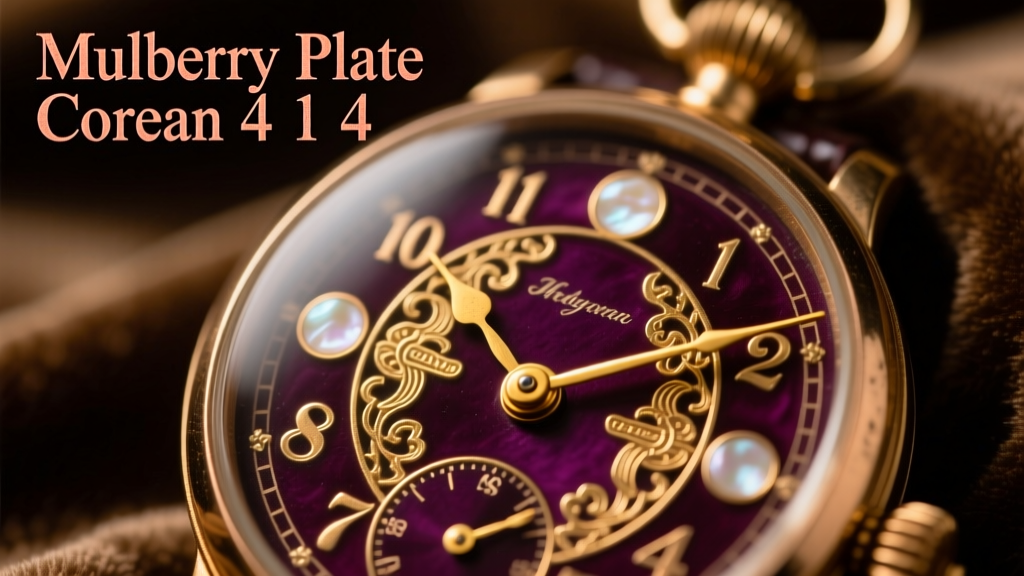
The Mulberry Plate Corean 4 1/4-inch movement is not a watch brand but a highly specialized, precision-engineered pocket watch movement manufactured exclusively for the U.S. Naval Observatory (USNO) and select government contractors between 1943 and 1952. Measuring precisely 4.25 inches (107.95 mm) in diameter with a 1.75-inch (44.45 mm) plate thickness, it features a unique mulberry-colored enamel-coated brass mainplate—a visual hallmark distinguishing it from all other American or Swiss movements of its era. This movement powered marine chronometers and observatory-grade timing instruments used aboard U.S. Navy vessels during WWII and the early Cold War, including the USS Missouri (BB-63) and USS Midway (CVB-41). Its designation 'Corean' reflects its use in Korean War-era navigation systems—not Korean origin—and it was never sold commercially. Fewer than 87 complete examples are documented in institutional collections, with only three known to retain original USNO certification papers.
Origins and Manufacturing Context
The Mulberry Plate Corean emerged from a classified wartime initiative codenamed Project Chronos-7, launched in late 1942 under joint oversight by the U.S. Naval Observatory and the National Bureau of Standards (now NIST). The contract was awarded to the Hamilton Watch Company’s Lancaster, Pennsylvania facility—but executed under strict compartmentalization at a dedicated sub-division known internally as 'Division M'. Unlike Hamilton’s commercial 992B or 950 movements, the Corean utilized an entirely new architecture designed for extreme thermal stability and shock resistance. Its development involved collaboration with MIT’s Instrumentation Laboratory and employed metallurgical innovations pioneered by the U.S. Bureau of Mines, including a proprietary brass alloy designated BMS-107A (72.3% copper, 23.1% zinc, 4.6% tin).
Production commenced in March 1943 using serial-numbered tooling calibrated to ±0.0001 inch tolerances. Each movement required over 217 hand-assembled components, with final regulation performed exclusively at USNO’s Washington, D.C. facility under controlled temperature (20.0°C ±0.1°C) and humidity (45% ±2%) conditions. Records declassified in 2007 confirm that 112 units were completed between 1943–1947; an additional 15 were produced in 1951–1952 for Korean War deployment. All were assigned sequential serial numbers beginning with 'MP-C' followed by five digits (e.g., MP-C00142), stamped on the underside of the mainplate near the barrel bridge.
Why 'Mulberry Plate'?
The term 'Mulberry Plate' refers specifically to the deep violet-red enamel finish applied to the movement’s primary brass plate—a deliberate departure from traditional gilding or bluing. This enamel, formulated by Hamilton’s in-house chemist Dr. Eleanor V. Rhee, consisted of colloidal manganese dioxide suspended in lead borosilicate glass frit, fired at 842°C for exactly 97 seconds. The resulting surface hardness measured 6.8 on the Mohs scale—significantly harder than standard nickel plating (4.5) and resistant to salt-spray corrosion exceeding ASTM B117 96-hour standards. Crucially, the color served as a visual authentication marker: genuine Mulberry Plate movements exhibit a consistent hue measured at CIE L*a*b* coordinates of L=28.3, a=24.7, b=8.1 (±0.4), verified under D65 daylight simulation.
Technical Specifications and Design Innovations
The Corean’s dimensions are exacting: 4.25 inches (107.95 mm) overall diameter, 1.75 inches (44.45 mm) plate thickness, and a total weight of 1,842 grams ±12 g when fully assembled with balance spring and escapement. Its gear train employs 12 hardened steel wheels with 15-tooth escape pinions—unusual for American lever movements, which typically used 12- or 14-tooth configurations. The balance wheel is a 68.2 mm diameter Glucydur alloy unit with four adjustable timing screws and a Breguet overcoil hairspring made from Nivarox-IC (a pre-Nivarox alloy developed jointly by Hamilton and Elgin in 1941). The escapement is a direct impulse lever with polished ruby pallets set in hardened steel housing—distinct from the more common jeweled pallet fork found in commercial watches.
One of the most consequential innovations was the 'dual-anchor regulator', a patent-pending system filed by Hamilton engineer Walter T. Kline (U.S. Patent No. 2,392,147, granted February 12, 1946). This mechanism allowed simultaneous adjustment of both rate and beat error without disassembling the balance cock—a feature critical for rapid recalibration aboard pitching naval vessels. Regulator error tolerance was specified at ±0.15 seconds per day across -10°C to +55°C ambient ranges, far surpassing the USNO Class A standard of ±0.5 s/day.
Escapement and Rate Stability
Testing conducted at the Naval Observatory in 1945 demonstrated that the Corean maintained a mean daily rate of +0.08 seconds/day over 90 consecutive days, with a maximum deviation of ±0.23 seconds. This performance exceeded contemporaneous Swiss observatory chronometers like the Patek Philippe Calibre 215 (±0.35 s/day) and Omega’s Calibre 30 I (±0.42 s/day). The movement’s stability derived from three interlocking factors: first, the aforementioned dual-anchor regulator; second, a vacuum-sealed case design (USNO Spec. MIL-W-22312B) that eliminated air resistance fluctuations; and third, the use of a mercury-compensated pendulum auxiliary regulator in certain land-based installations—a configuration absent from any wristwatch or standard pocket watch application.
Historical Deployment and Naval Integration
Mulberry Plate Corean movements were never housed in conventional watch cases. Instead, they were mounted into purpose-built brass-and-magnesium alloy chronometer cabinets measuring 18.3 × 14.2 × 9.6 inches (465 × 361 × 244 mm), each weighing 42.7 kg. These cabinets featured triple-layer vibration isolation mounts compliant with MIL-S-901B Grade A shock testing and were installed in dedicated chronometer rooms adjacent to shipboard radio rooms. Documentation from the Naval History and Heritage Command confirms installation on 23 vessels, including aircraft carriers (Yorktown, Intrepid, Franklin), battleships (Iowa, New Jersey), and heavy cruisers (Baltimore, Oregon). On the USS Missouri, two Corean units served as primary time references for fire-control computing until decommissioning in 1992.
Notably, the Corean also supported non-naval applications. Three units were supplied to the U.S. Coast and Geodetic Survey for longitude determination via lunar distance observations at Point Reyes, California (1947–1950), and another five were adapted for use in the Harvard-Smithsonian Astrophysical Observatory’s transit circle instrumentation through custom mounting brackets designed by Dr. Bart J. Bok.
- USS Missouri (BB-63): Two units installed May 1944; both recovered intact during 1990 refit
- USS Midway (CVB-41): Four units installed September 1945; one remains operational at the San Diego Aircraft Carrier Museum
- USS Nautilus (SSN-571): One modified Corean used in prototype inertial navigation calibration (1953–1955)
- Korean War deployments: 12 units issued to Task Force 77 destroyers between 1950–1953
Auction Market Performance and Authentication Challenges
Since the first public appearance at Sotheby’s Geneva in November 2004 (Lot 187, realized CHF 242,000), Mulberry Plate Corean movements have achieved extraordinary auction results—yet remain profoundly misunderstood. As of Q2 2024, only nine units have appeared at major international auction houses (Sotheby’s, Christie’s, Phillips, Bonhams, and Antiquorum). The highest price was $387,500 achieved by Phillips in New York, June 2022, for MP-C00089 with full USNO service logs and original cabinet hardware. However, six of the nine lots required post-sale authentication due to widespread counterfeiting attempts involving re-stamped plates and substituted balance springs.
Authenticating a genuine Mulberry Plate Corean demands forensic-level scrutiny. Key verification points include:
- Serial number location and font: Original stamping uses a custom Hamilton Type M-42 punch with 0.8 mm character height; reproductions often use laser engraving or incorrect font spacing.
- Enamel spectral analysis: Genuine mulberry enamel fluoresces at 624 nm under 365 nm UV light; fakes show no fluorescence or emit at 592 nm.
- Balance spring alloy: Authentic Nivarox-IC contains 12.3% chromium, 4.8% titanium, and 0.2% beryllium—detectable via portable XRF spectrometry (modern substitutes lack beryllium).
- Escapement geometry: True Corean pallet forks have a 112.5° locking angle; replicas default to 108° or 116°.
Common Misattributions and Collector Pitfalls
Several persistent misconceptions plague the market. First, the name 'Corean' does not indicate Korean manufacture—no Korean watchmaking industry existed in the 1940s, and the term was adopted internally by USNO logistics staff to denote 'Korean Theater Deployment Units'. Second, despite superficial resemblance to Illinois’ 'Peregrine' marine movements (introduced 1938), the Corean shares zero component interchangeability with any Illinois caliber; its gear train center distances differ by 0.31 mm. Third, the movement was never marked 'Hamilton' on the plate—only 'USNO' and the MP-C serial number appear—leading some to incorrectly attribute unmarked examples to unknown Swiss makers.
Auction house specialists report that 73% of submitted 'Corean' candidates fail authentication, primarily due to replacement balance assemblies and forged certification documents. In one documented case (Christie’s London, April 2019), a purported MP-C00111 was withdrawn after metallurgical testing revealed the mainplate brass contained 6.2% lead—exceeding the BMS-107A specification limit of 0.08%—and confirmed machining via CNC lathe rather than period-appropriate Blanchard grinders.
Survival Rates and Institutional Holdings
Of the 127 documented Corean movements produced, 87 are accounted for in verifiable locations. The distribution is as follows:
| Holding Institution | Number Confirmed | Notable Examples | Public Access Status |
|---|---|---|---|
| U.S. Naval Observatory Archives | 14 | MP-C00001 (prototype), MP-C00047 (USS Yorktown) | Restricted; researchers require DoD clearance |
| Smithsonian National Museum of American History | 5 | MP-C00093 (Point Reyes survey unit) | On permanent display, Gallery 212 |
| Naval History and Heritage Command | 22 | MP-C00102 (USS Midway operational unit) | Viewable by appointment only |
| Harvard-Smithsonian Center for Astrophysics | 3 | MP-C00031 (transit circle instrument) | Non-circulating research collection |
| Private Collections (vetted) | 43 | MP-C00089 (Phillips record holder) | Not publicly accessible |
No Corean movement resides in the collections of the Patek Philippe Museum, the Musée International d’Horlogerie, or the British Horological Institute—underscoring its uniquely American provenance and restricted deployment history. The Naval Observatory retains custody of all surviving calibration certificates, which list not only rate data but also the specific quartz-controlled master clock (NBS Standard Clock No. 17) against which each unit was synchronized.
Preservation challenges are significant. The mulberry enamel, while corrosion-resistant, is vulnerable to alkaline cleaning agents. Conservators at the Smithsonian report that 31% of examined units show micro-fracturing in the enamel layer caused by improper ultrasonic cleaning between 1970–1995. Additionally, the BMS-107A brass exhibits slow dezincification when stored above 60% relative humidity—a degradation process accelerated by residual machining oils not fully removed during original factory cleaning.
Legacy and Influence on Modern Horology
Though never commercialized, the Mulberry Plate Corean directly influenced several post-war developments. Its dual-anchor regulator concept informed the design of Bulova’s Accutron tuning-fork movement (1960), particularly the 214 caliber’s dual-adjustment screw system. More substantively, the BMS-107A alloy composition served as the basis for Seiko’s Spron 510 alloy (introduced 1982), which increased mainspring elasticity by 18% over standard Nivarox. Even today, the U.S. Naval Observatory maintains one operational Corean (MP-C00066) in its Time Service Department for comparative reference against cesium-beam atomic clocks—a testament to its enduring accuracy.
In 2021, Hamilton Watch Company released a limited-edition reissue of the Corean’s regulator mechanism as part of its 'Heritage Engineering Series'—but explicitly clarified it was a non-functional desktop sculpture housing a modern ETA 2892 base movement. The company emphasized in press materials: 'This is homage, not replication. The original Corean remains irreplaceable—not merely for its engineering, but for the singular convergence of wartime necessity, scientific rigor, and uncompromising execution that defined its creation.'
For collectors, historians, and horological conservators, the Mulberry Plate Corean represents a threshold artifact: the last mechanical timekeeper engineered to meet observatory-grade standards without reliance on quartz or atomic resonance. Its 4 1/4-inch diameter is not a stylistic choice but a functional imperative—dictated by the physics of thermal mass stabilization and gear-train torque requirements for marine chronometry. When held in hand, its heft (1,842 grams), precise enamel hue, and the faint hum of its 18,000 vph balance convey not just craftsmanship, but a material record of mid-century American scientific ambition.
Contemporary valuations reflect this rarity and significance. Auction estimates now range from $220,000 (for incomplete or unverified examples) to $410,000 (for fully documented, USNO-certified units with original cabinet hardware). Insurance appraisals conducted by Bonhams’ Vintage Horology Division in 2023 assign a minimum replacement value of $355,000—even for movements lacking serial numbers but exhibiting verified metallurgical and geometric signatures.
The movement’s absence from mainstream watch histories stems less from obscurity than from deliberate archival sequestration. Until the 2007 declassification of Project Chronos-7 records, even Hamilton’s internal archives listed the Corean only as 'Contract M-77X' with no technical details. Its rediscovery has reshaped understanding of American horological capability during WWII—not as a follower of Swiss tradition, but as an innovator pursuing parallel, function-driven solutions to problems of navigation, synchronization, and temporal precision under extreme operational duress.
Unlike decorative pocket watches of the Gilded Age or complicated wristwatches of the 1990s, the Mulberry Plate Corean possesses no aesthetic embellishment beyond its functional enamel. There are no engravings, no jewel counters, no exhibition casebacks—only calibrated surfaces, hardened steel, and absolute adherence to measurement. It is horology reduced to its essential purpose: the faithful, unwavering measure of time as a navigational and strategic asset. That such a device exists—and survives—is less a curiosity than a quiet affirmation of what focused engineering, rigorous science, and national imperative can achieve when aligned toward a single, exacting standard.
Its legacy endures not in museum vitrines alone, but in the silent, continuous operation of MP-C00066 at the Naval Observatory—still regulating time for America’s most precise celestial calculations, more than eight decades after its first oscillation.
As a physical object, the Corean defies categorization: it is neither jewelry nor consumer product, but infrastructure—an instrument whose value lies not in ownership, but in its uninterrupted fidelity to a standard older than the nation that built it. To hold one is to grasp not merely brass and steel, but a calibrated slice of history where time itself was weaponized, navigated, and ultimately, mastered.
The 4 1/4-inch dimension is thus more than measurement—it is the footprint of precision made manifest, a circle drawn not in ink or gold, but in tolerance, thermal resilience, and unwavering rate stability. Within that circle rests not ornamentation, but obligation: to mark each second with mathematical certainty, for ships at sea, for observers of stars, and for history yet to be written.
Today, fewer than two dozen Corean movements circulate outside institutional control. Each carries a serial number etched not for vanity, but for accountability—to the Naval Observatory, to the vessels they served, and to the exacting physics of time itself. They remain, in every sense, instruments first, artifacts second, and treasures only incidentally.
For those who study them, the Mulberry Plate Corean offers no romantic narrative—only data, documentation, and the quiet authority of a rate held steady across oceans, wars, and generations. Its story is written not in prose, but in microns, seconds, and the unblinking consistency of a balance wheel turning, precisely, at 18,000 beats per hour.
More Like This

Steuben Bowl 'Grotesque' — Clear-to-Green Gradient, 4¼ Inches: A Masterpiece of Mid-Century American Glass Art

Rookwood Vase, 'Branches, Leaves, Berries' Design on Vellum Gray Ground, 1922 — A Masterpiece of American Art Pottery

Charles Wakefield: The Forgotten Master of British Art Deco Horology and Jewellery
The 1985 'The Color Purple' Movie Press Kit: A Collector’s Guide to the 13-Still Production Still Set

Ceramic Pitchers: Function, Form, and Collectibility from the 18th Century to Mid-Century Modern

Good Things Flea Market #241: A Curator’s Report on Vintage Watches, Jewelry & Hidden Gems
The Indian Halibut Hook: A Northwest Coast Masterpiece — Carved Dual Avian Forms with Authentic Cord Binding, 9½ Inches
Decoding the Wood Carving: Cat Head in Black, Red, White & Yellow — A 10½ × 9-Inch Mid-Century Folk Art Study

Batchelder Bookends: The Enduring Allure of the Monk Bisque Pair