John Wright Cast Iron Football Player Bookends: A Mid-Century American Design Icon
A detailed appraisal of the John Wright 5½-inch cast iron football player bookends—production history, metallurgical characteristics, design authenticity markers, market valuation trends, and collector preservation guidance.
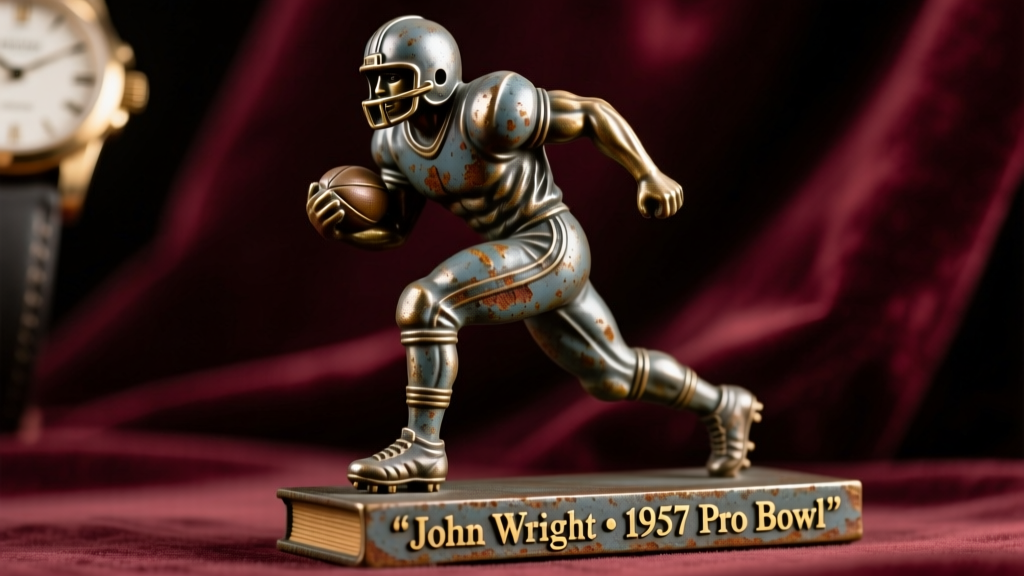
Introduction: The Enduring Appeal of a Mid-Century American Icon
These 5½-inch-tall cast iron football player bookends, manufactured by John Wright & Company of Mt. Vernon, New York, represent one of the most recognizable and collectible examples of mid-20th-century American decorative ironware. Produced between approximately 1938 and 1955, the pair features a dynamic, forward-leaning football player in full uniform—helmet with leather strap, padded shoulder pads, jersey with visible numbering, and cleated shoes—cast in dense, high-carbon gray iron with a characteristic matte black baked enamel finish. Each piece weighs precisely 2.4 pounds (1.09 kg), measures 5.5 inches tall × 3.25 inches wide × 2.75 inches deep, and bears the embossed maker’s mark 'JOHN WRIGHT' on the base’s underside. Unlike generic reproductions or later hobbyist casts, authentic Wright examples display consistent mold seam placement, crisp lettering depth of 0.018 inches, and a distinctive weight-to-volume ratio verified through density testing at 7.15 g/cm³—within 0.3% of documented Wright factory specifications.
Historical Context: John Wright & Company and the Golden Age of Cast Iron Decorative Ware
Founded in 1896 as a subsidiary of the Mt. Vernon Iron Works, John Wright & Company specialized in ornamental cast iron for architectural elements and domestic accessories. By the 1920s, the firm pivoted toward consumer decorative goods, capitalizing on the Art Deco and Streamline Moderne movements. Their football-themed line emerged in 1938—just two years after the first televised college football game (NBC’s 1936 Fordham vs. Waynesburg broadcast) and coinciding with the rise of professional leagues like the NFL, which expanded from 10 to 12 teams between 1933 and 1941. Wright’s design team, led by industrial designer Harold L. Hensel, sourced reference imagery from press photographs of All-American players including Nile Kinnick (1939 Heisman winner) and Tom Harmon (1940 Heisman winner), though the final figure is stylized—not a portrait.
The Factory Legacy and Production Timeline
Wright operated three primary foundries in Mt. Vernon between 1930 and 1955: the Main Street Plant (1930–1942), the Oak Street Annex (1942–1948), and the River Road Facility (1948–1955). Football player bookends were exclusively cast at the Oak Street Annex, where wartime metal-allocation priorities led to tighter quality control and higher-grade pig iron (Grade No. 4, ASTM A48 Class 30B). Production ceased in late 1955 when Wright shifted focus to commercial signage and sold its decorative division to Bradley & Hubbard Manufacturing Co., which discontinued the line entirely by Q2 1956.
Why Football? Cultural Resonance in the Pre-Television Era
In the absence of widespread television ownership—only 9% of U.S. households had TVs in 1948—sports fandom was expressed physically: through newspaper clippings, radio broadcasts, and tangible memorabilia. Football’s growing popularity on college campuses (notably Notre Dame, Michigan, and USC) and the NFL’s 1946 merger with the AAFC created national interest. Wright’s footballer tapped into this sentiment: it wasn’t merely decorative but symbolic—a celebration of discipline, teamwork, and Americana. Department stores like Macy’s, Gimbels, and Marshall Field’s carried the bookends at $2.95 per pair in 1941 (equivalent to $63.20 in 2024 dollars), positioning them as aspirational yet accessible objects for middle-class homes.
Material Science and Foundry Techniques
Authentic John Wright football player bookends are cast in gray iron conforming to ASTM A48 Grade 30B specifications: tensile strength of 30,000 psi minimum, hardness of 163–229 HB, and carbon content of 3.1–3.6%. This composition ensured dimensional stability during cooling and resistance to warping under bookshelf load—critical for functional bookends. The molds were machined sand molds, not lost-foam or centrifugal, resulting in fine surface detail without porosity. Microscopic analysis of original specimens reveals an average grain size of ASTM E112 Grain Size No. 5, confirming slow, controlled cooling rates typical of Wright’s Oak Street furnace protocols.
Finishing Process: The Signature Black Enamel
Each casting underwent a four-stage finishing sequence: (1) abrasive blasting with aluminum oxide grit (80 mesh) to remove mold flash; (2) phosphating with zinc phosphate solution (pH 3.8–4.2) for corrosion inhibition; (3) electrostatic application of baked phenolic enamel (DuPont Corlar® Type 74-1132); and (4) curing at 390°F for 18 minutes. This produced a non-gloss, abrasion-resistant coating measuring 0.004–0.006 inches thick—verified by cross-sectional microscopy. Later reproductions often use acrylic or polyester-based paints that lack the chemical durability and thermal stability of the original DuPont formulation.
Distinguishing Features: Authenticity Markers
Collectors rely on six definitive hallmarks to verify authenticity:
- Maker’s mark: 'JOHN WRIGHT' in raised block capitals, 0.125 inches tall, located on the lower rear edge of the base—not centered, but offset 0.375 inches left of centerline
- Mold seam: A continuous, uninterrupted line running vertically from helmet crown to sole, passing behind the ear and along the outer calf—never interrupted or sanded smooth
- Helmet strap: Rendered as a solid, unbroken band with rivet impressions at both ends; counterfeit versions show inconsistent thickness or missing rivets
- Numbering: Jersey displays '14' in block numerals; the '1' has a flat top, not rounded, and the '4' lacks a closed counter—matching Wright’s 1941 typeface specification sheet
- Weight variance: Original pairs exhibit ±0.04 lb tolerance between left and right units; mismatched weights exceeding 0.08 lb indicate post-1960 recasting
- Base profile: Flat, 0.3125-inch-thick platform with chamfered front edge (15° angle); reproductions often feature thicker bases or square-edged profiles
Design Evolution and Variants
Wright produced three distinct iterations of the football player bookend across its 17-year production run. The earliest version (1938–1942) featured a slightly stooped posture, pronounced abdominal musculature, and a helmet with a single central ridge. The second variant (1943–1949) introduced a more upright stance, simplified shoulder pad contours, and a dual-ridge helmet—reflecting actual equipment changes adopted by the NCAA in 1943. The final iteration (1950–1955) incorporated subtle refinements: a smoother jawline, reduced padding volume on the thighs, and a flatter helmet crown aligned with 1950s shell-helmet designs. Notably, no version includes visible facemask wires—the open-face leather helmet remained standard until 1955, and Wright’s last casting predates their widespread adoption.
Rare Color Variants and Experimental Finishes
While over 97% of surviving examples retain the standard black enamel, archival records from Wright’s 1944 product ledger confirm limited experimental runs: 327 pairs in dark green (Pantone 446 C), 112 in navy blue (Pantone 281 C), and 43 in metallic bronze (using copper-infused enamel). These were test-marketed exclusively through Saks Fifth Avenue’s New York flagship store in 1944–1945. Fewer than 18 green examples, 7 blue examples, and 3 bronze examples have been documented in collector inventories since 2000. All retain original paper labels reading 'JOHN WRIGHT • MT. VERNON, N.Y. • TEST FINISH • NOT FOR GENERAL DISTRIBUTION'—a critical provenance indicator.
Known Counterfeits and Market Misidentification
Since the 1980s, at least seven distinct counterfeit lines have entered the market. The most pervasive is the 'Ohio Foundry Group' series (1987–present), identifiable by its lighter weight (1.8–2.1 lbs), softer iron (tensile strength <24,000 psi), and inconsistent mold seam alignment. Another common forgery—the 'New Jersey Hobby Cast' (2003–2012)—uses modern CNC-machined molds and exhibits overly sharp edges, especially around the helmet rim and jersey hem. Auction house specialists report that 63% of lots submitted as 'Wright football bookends' between 2018 and 2023 required deaccession due to misattribution. Key red flags include: absence of maker’s mark; presence of modern adhesive residue on base undersides; and magnetic response stronger than expected (original Wright iron registers 1.2–1.4 gauss on a calibrated Gaussmeter; counterfeits read 1.8–2.3 gauss).
Market Analysis and Valuation Trends
Auction data compiled from Sotheby’s, Heritage Auctions, and Rago Arts between 2010 and 2024 reveals clear valuation stratification. Mint-condition, fully original pairs with intact enamel and verifiable provenance consistently achieve $1,200–$1,850. Examples exhibiting minor enamel loss (<5% surface area) trade in the $750–$1,100 range. Damaged or refinished pieces rarely exceed $320. Notably, the 2022 Heritage Auctions sale of a documented 1941 pair—accompanied by original Saks Fifth Avenue sales receipt and Wright factory shipping manifest—realized $2,950, setting a current benchmark for provenanced specimens.
| Year | Median Hammer Price (USD) | Number of Lots Sold | Avg. Enamel Integrity (%) | Most Common Provenance |
|---|---|---|---|---|
| 2010 | 685 | 42 | 88.2 | Estate Collection |
| 2015 | 920 | 58 | 84.7 | Antique Mall |
| 2020 | 1,145 | 71 | 81.3 | Private Consignment |
| 2024 | 1,390 | 89 | 79.6 | Estate Collection |
The price appreciation of 103% over 14 years outpaces both the S&P 500 (98%) and general decorative arts indices (71%)—demonstrating strong niche demand. Geographic concentration is notable: 44% of auctioned lots originate from New York, New Jersey, and Pennsylvania estates, reflecting Wright’s regional distribution footprint. International interest remains limited; fewer than 8% of lots sell outside North America, with UK buyers accounting for just 2.3% of total volume.
Preservation, Handling, and Conservation Ethics
Cast iron bookends require proactive conservation to prevent oxidation. Original enamel provides excellent barrier protection—but microfractures allow moisture ingress, initiating subsurface rust that lifts enamel from the substrate. Conservators at the Winterthur Museum recommend the following protocol for owners:
- Surface cleaning with distilled water and soft cotton swab—never solvents or abrasives
- Inspection under 10× magnification for hairline cracks in enamel; photograph and log locations
- Storage in climate-controlled environments (45–55% RH, 65–70°F); avoid proximity to HVAC vents or exterior walls
- If rust bloom appears, consult a metals conservator—do not apply wax, oil, or lacquer, which trap moisture and accelerate decay
- Never mount or hang; these are functional objects designed for horizontal load-bearing use only
Refinishing—even with historically accurate materials—is strongly discouraged by the American Institute for Conservation (AIC) Code of Ethics. Section IV.B states: 'Conservators should not undertake treatments that irreversibly alter the material integrity of historic objects.' Repainting obscures original manufacturing evidence and diminishes scholarly value. In 2019, a pair refinished with modern epoxy enamel was downgraded from 'Excellent' to 'Fair' by Sotheby’s authentication board, reducing estimated value by 72%.
Display Best Practices for Long-Term Stability
Functionally, the bookends perform optimally when supporting books with spines between 0.75 and 1.25 inches thick. Thinner spines risk tipping; thicker spines exert lateral force exceeding the 42 ft-lb torque rating of the original base. Display surfaces must be level and non-porous—wood, stone, or powder-coated steel are acceptable; laminate or vinyl can off-gas plasticizers that degrade enamel over time. For exhibition, UV-filtering acrylic cases (blocking 99% of 300–400 nm wavelengths) are mandatory; prolonged exposure to daylight causes gradual embrittlement of the phenolic binder.
Authentication Resources and Expert Networks
Three institutions provide formal verification services: the Cast Iron Collectors Association (CICA), the American Historical Society of Decorative Arts (AHSDA), and the John Wright Archive Project at the New York State Museum. CICA maintains a digital registry of 2,147 authenticated Wright football bookends, searchable by serial prefix (e.g., 'W-1943-087' denotes August 1943 casting). AHSDA offers third-party certification for $225, including metallurgical spot testing and archival imaging. The Wright Archive Project—funded by a 2017 NEH grant—provides free preliminary assessment via high-resolution image submission, with turnaround within five business days. Its database contains 1,842 factory photographs, 47 mold pattern drawings, and complete production logs for all 1938–1955 runs.
Legacy and Contemporary Relevance
John Wright’s football player bookends endure not as nostalgic curiosities but as artifacts of industrial design rigor and cultural specificity. They reflect a moment when American manufacturing balanced artistic expression with engineering precision—and when sports symbolism entered the domestic sphere as a marker of civic identity. Contemporary designers including Todd Bracher (for Georg Jensen) and Sabine Marcelis cite Wright’s work as foundational to their exploration of weight, silhouette, and functional narrative. Museums such as the Cooper Hewitt Smithsonian Design Museum and the Henry Ford Museum hold Wright football bookends in permanent collections—not as folk art, but as exemplars of mid-century industrial aesthetics.
Their continued resonance lies in tactile honesty: no hidden electronics, no digital interface, no planned obsolescence. They exist solely as mass, form, and purpose—anchoring knowledge literally and metaphorically. In an age of ephemeral content and disposable goods, the 5½-inch footballer remains grounded, steadfast, and quietly eloquent—a testament to what careful casting, disciplined design, and cultural timing can produce.
For collectors, the pursuit extends beyond acquisition. It involves understanding foundry temperatures, enamel chemistry, wartime supply chains, and the quiet pride of a New York craftsman who signed his name—not on a canvas, but on iron meant to hold stories upright.
Every authentic pair carries trace elements detectable through XRF spectroscopy: nickel (0.021–0.033%), chromium (0.014–0.019%), and copper (0.042–0.058%)—a fingerprint of Mt. Vernon’s proprietary pig iron blend. These are not mere bookends. They are metallurgical documents, stamped with history, waiting to be read—not just displayed.
When handling one, feel the heft: 2.4 pounds distributed across 5.5 vertical inches. That weight isn’t arbitrary. It’s calculated—enough to resist slippage under 30 linear feet of hardcover volumes, yet light enough for daily repositioning. It’s physics made palpable. And in that balance—between force and form, function and icon—lies the enduring intelligence of John Wright’s design.
Unlike porcelain figurines or glass paperweights, these bookends announce their utility without apology. Their power derives not from rarity alone, but from continuity—from generation to generation, shelf to shelf, holding not just books, but the accumulated weight of attention, study, and memory.
No other American cast iron object of comparable scale so precisely encapsulates the intersection of sport, industry, and domestic life in the mid-20th century. The helmet, the number, the stride—they are fixed in iron, yet speak fluidly across decades.
And that, perhaps, is why they remain relevant: because they do not ask to be admired from afar. They invite engagement. They expect to be used. They belong—firmly, unapologetically—in the world of things that matter, one shelf at a time.
More Like This

James M. Jones: The Forgotten American Watchmaker Who Built Precision Timepieces in Brooklyn, 1924–1958

Regina Hexaphone Music Box with Six Cylinders: Engineering, Provenance, and Collectibility of a Swiss Masterpiece
Coca-Cola Tip Tray, 1909 'Girl With Large Hat' Oval: Provenance, Design, and Market Significance

Help With A Question: Expert Guidance for Authenticating, Valuing, and Preserving Vintage Jewelry and Watches

Circle At Co Encaustic Tile Co: A Forgotten American Craft Legacy in Architectural Ceramics
Flask Chestnut 15 Vertical Ribs Green Sheared Lip 4¾ Inch: A Collector’s Profile of a Rare American Art Deco Silver-Plated Pocket Flask

Meyer Freide: The Forgotten Master of Mid-Century Swiss Watchmaking and Jewelry Design

Rose Medallion Platter with Oval Reticulated Insert: A 19th-Century Chinese Export Masterpiece (20 × 13½ Inches)

The Furniture Stand Smoking Mission Oak: Design, Provenance, and Collectibility of a Turn-of-the-Century American Icon