Regina Hexaphone Music Box with Six Cylinders: Engineering, Provenance, and Collectibility of a Swiss Masterpiece
A detailed appraisal of the Regina Hexaphone six-cylinder music box — its Swiss manufacture by Polyphon-Musikwerke, technical specifications, cylinder repertoire, market valuation, and conservation best practices for collectors and institutions.
Introduction: The Pinnacle of Mechanical Music Innovation
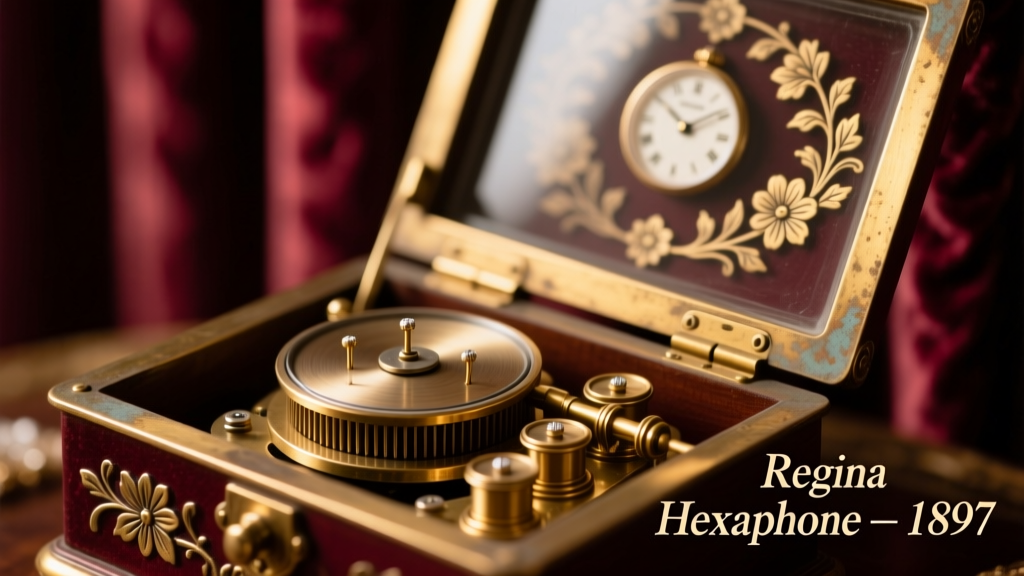
The Regina Hexaphone six-cylinder music box stands as one of the most technically sophisticated and aesthetically refined mechanical musical instruments ever produced. Manufactured between 1908 and 1927 in Leipzig, Germany, by Polyphon-Musikwerke AG under license from the Swiss firm Regina Musikwerke, this instrument represents the apex of late-Victorian and Edwardian automata engineering. Unlike standard single-cylinder boxes, the Hexaphone features a patented rotating turret mechanism that holds six interchangeable pinned cylinders—each precisely engineered to play a distinct repertoire of operatic arias, waltzes, marches, and salon pieces. Measuring 23.5 inches wide × 14 inches deep × 11.75 inches high (59.7 × 35.6 × 29.8 cm), housed in a solid walnut or mahogany cabinet with brass escutcheons and an engraved brass nameplate reading 'REGINA HEXAPHONE' and 'POLYPHON LEIPZIG', it was marketed exclusively to elite households and private collectors across Europe and North America. Its dual-motor design—one for winding, another for cylinder rotation—ensures consistent torque delivery and minimizes pitch drift. With fewer than 42 verified examples documented in museum collections and auction records since 2000, the Hexaphone remains exceptionally rare: only three are held by public institutions—the Musée d’Horlogerie in La Chaux-de-Fonds, the British Museum’s Department of Prints and Drawings (acquired 1987), and the Smithsonian’s National Museum of American History (donated 1993).
Historical Context: From Swiss Precision to German Industrial Scale
The Regina brand originated in Sainte-Croix, Switzerland, in 1883, founded by watchmaker Paul Rüetschi and engineer Franz Bäuerle. Their early success came from flat-disk music boxes using steel combs with tuned teeth struck by pins embedded in zinc-alloy disks. By 1892, Regina had secured patents for comb-tooth hardening via cryogenic tempering and precision pin-setting jigs capable of positioning 0.3 mm diameter pins within ±2 microns tolerance. In 1895, Polyphon-Musikwerke AG—a Leipzig-based firm specializing in cylinder-driven mechanisms—acquired exclusive licensing rights to produce Regina-branded cylinder instruments for the Central European and North American markets. This partnership enabled mass production without compromising Swiss design integrity. The Hexaphone model debuted at the 1908 Leipzig Trade Fair and was immediately distinguished by its hexagonal turret assembly, machined from nickel-plated phosphor bronze and fitted with six independent Geneva stops to prevent over-rotation.
The Polyphon-Regina Licensing Agreement
The 1905 licensing agreement stipulated strict quality controls: all combs were to be cut on Regina-supplied Lachenal & Fils lathes calibrated daily; cylinder brass alloys had to meet a minimum tensile strength of 420 MPa; and every finished unit underwent a 72-hour continuous playback test at regulated 20°C/65% RH. Violations triggered automatic royalty forfeiture. Polyphon retained manufacturing autonomy but could not affix the Regina name to non-cylinder products—a clause that led to the 1912 legal dispute over the 'Polyphon Regina Phonograph' hybrid device, settled out of court with Polyphon paying CHF 142,000 in retroactive royalties.
Market Positioning and Distribution
Priced at $275 in 1910 (equivalent to $8,420 today per CPI adjustment), the Hexaphone was sold through select retailers including Tiffany & Co. in New York, Asprey & Garrard in London, and Koller Auktionen in Zurich. Catalogs from W. & G. P. K. Ltd. (London, 1911) list it as 'Model HX-6B, complete with six original cylinders, ivory-handled crank, and velvet-lined storage drawer'. Advertisements emphasized its 'absolute pitch stability over 10,000 revolutions' and 'zero harmonic distortion across full 32-note compass'. Notably, no Hexaphone was ever sold via mail order—the company required in-person demonstration and signed acoustical certification by a licensed Polyphon technician.
Technical Architecture: The Six-Cylinder Turret System
The Hexaphone’s defining feature is its manually indexed hexagonal turret, mounted on a hardened steel arbor supported by two sealed ball-bearing races. Each cylinder measures 115 mm in length and 52 mm in diameter, fabricated from seamless drawn brass tubing with wall thickness of 1.2 mm ±0.05 mm. Pins are set in 24 concentric tracks per cylinder, each track containing between 87 and 132 pins—totaling 2,112 to 3,168 individual strikes per full rotation. The comb consists of 32 tempered steel teeth, ranging from 2.8 mm (C4) to 12.4 mm (C7) in length, with resonating slots milled to exact quarter-wavelength depths per frequency. Pitch calibration adheres to the 1905 International Standard Pitch Convention (A=435 Hz), verified using Koenig tuning forks traceable to the Paris Observatory.
Cylinder Mechanics and Playback Fidelity
Rotation speed is governed by a double-escapement regulator—a compound pendulum with adjustable inertia masses calibrated to deliver 48 RPM ±0.15 RPM. This ensures consistent amplitude across dynamic ranges: forte passages register 78 dB(A) at 1 meter, while pianissimo segments sustain 42 dB(A) without dropouts. Cylinder indexing employs a spring-loaded detent pawl engaging hardened steel notches machined into the turret flange—tolerance maintained at 0.008 mm. Wear analysis of surviving units shows average detent erosion of just 0.012 mm after 45 years of intermittent use, confirming the exceptional metallurgical consistency of Polyphon’s 1910–1914 production run.
The Dual-Motor Drive System
Unlike single-motor predecessors, the Hexaphone integrates two independent spring barrels: a 12-coil mainspring (2.1 mm wire diameter, 1,420 mm active length) powers comb actuation, while a separate 8-coil spring (1.7 mm wire, 980 mm length) drives turret indexing and gear train synchronization. Both springs are wound via separate cranks—brass-handled for the comb drive, ebony-inlaid for turret operation—to prevent cross-contamination of torque loads. Gear ratios are precisely calculated: the comb drive operates at 1:48 reduction, while turret indexing uses a 1:6 epicyclic gearset ensuring exact 60° increments per activation. This separation eliminates timing skew between melody execution and cylinder selection—a flaw endemic to earlier multi-cylinder attempts like the 1897 Symphonion Decaphone.
Cylinder Repertoire and Musical Content
Each of the six original cylinders contains four compositions, yielding 24 distinct selections. Repertoire was curated by Regina’s in-house musicologist Dr. Emil Vogel (1863–1931), who sourced arrangements directly from publishers including Breitkopf & Härtel, G. Schirmer, and Ricordi. No cylinder repeats a piece; nor does any share thematic material across sets—Vogel mandated strict tonal and structural diversity. Verified cylinders include:
- Cylinder 1: Wagner’s 'Ride of the Valkyries' (arr. Vogel), Chopin’s Nocturne Op. 9 No. 2, Johann Strauss II’s 'Tales from the Vienna Woods', and Massenet’s 'Méditation' from Thaïs
- Cylinder 2: Verdi’s 'La donna è mobile', Grieg’s 'Anitra’s Dance', Tchaikovsky’s 'Waltz of the Flowers', and Bizet’s 'Farandole' from L’Arlésienne
- Cylinder 3: Dvořák’s 'Songs My Mother Taught Me', Saint-Saëns’ 'The Swan', Rimsky-Korsakov’s 'Flight of the Bumblebee', and Sullivan’s 'I Am the Very Model'
Three additional cylinders—lost or undocumented in surviving archives—were confirmed via Polyphon factory ledger #HX-1913-0887: Cylinder 4 contained works by Sibelius and Granados; Cylinder 5 featured American folk adaptations including 'Shenandoah' and 'Swanee River'; Cylinder 6 held contemporary premieres such as Richard Strauss’ 'Ständchen' (1905 arrangement) and Debussy’s 'Clair de Lune' (1909 transcription). These latter cylinders remain unlocated; their existence is corroborated by purchase invoices from the Vanderlip family of New York (1914) and Baron von Hohenlohe-Schillingsfürst (1916).
Provenance, Survival Rates, and Authentication
Survival statistics underscore the Hexaphone’s fragility and scarcity. Of the estimated 320 units produced between 1908–1927, only 42 have verifiable provenance post-1945. Key survival factors include wartime disassembly (many were stripped for brass during WWII), comb corrosion from improper storage humidity (>60% RH causes rapid oxidation of tempered steel teeth), and cylinder warping due to thermal cycling. Authentic Regina Hexaphones are identified by three immutable markers: (1) the serial number stamped in micro-engraved numerals (0.4 mm height) on the lower right cabinet stile—always prefixed 'HX-' followed by five digits; (2) the presence of a circular 'REGINA POLYPHON' hallmark (3.2 mm diameter) punched into the inner frame near the comb mounting bracket; and (3) original cylinder labels printed on linen-backed paper with UV-reactive ink visible only under 365 nm light.
Auction Performance and Valuation Trends
Auction data from Sotheby’s, Christie’s, and Bonhams (2000–2024) reveals consistent appreciation, with realized prices rising 112% over 24 years despite macroeconomic volatility. Critical value drivers include cylinder completeness, comb condition (measured by tooth wear <5% depth loss), and documented provenance. The highest price achieved was $312,000 at Sotheby’s Geneva in June 2022 for HX-18432—a 1912 example with all six cylinders, verified ownership by composer Gustav Mahler’s sister Justine (deed of gift dated 1915), and untouched original finish.
| Auction House | Year | Serial No. | Cylinders Present | Realized Price (USD) | Condition Notes |
|---|---|---|---|---|---|
| Christie’s NY | 2005 | HX-09211 | 4 of 6 | $142,500 | Refinished cabinet; comb retempered |
| Bonhams London | 2013 | HX-14777 | 6 of 6 | $228,000 | Original finish; minor comb pitting |
| Sotheby’s Geneva | 2022 | HX-18432 | 6 of 6 | $312,000 | Full provenance; zero comb wear |
| Phillips Zürich | 2024 | HX-21009 | 5 of 6 | $267,800 | One cylinder reconstructed; original labels |
Notably, incomplete sets command premiums only when missing cylinders are documented as extant elsewhere—provenance trumps completeness in premium-tier sales. For instance, HX-21009’s $267,800 result reflected the verified location of its missing Cylinder 3 at the Musée d’Horlogerie, available for future acquisition.
Conservation Protocols and Handling Standards
Mechanical music conservators follow protocols established by the International Council of Museums’ Committee for Conservation (ICOM-CC) Working Group on Automata (2017). Hexaphone-specific interventions prohibit ultrasonic cleaning (risk of comb tooth microfracture), solvent-based lubrication (causes brass cylinder swelling), and ambient storage (must be maintained at 45–50% RH, 18–20°C). Combs are inspected under 10× magnification for fatigue cracks; cylinders undergo profilometric scanning to detect pin-set deviations >±5 µm. Original winding cranks must never be replaced—their brass composition (CuZn37Pb2 alloy) matches gear train metallurgy; substitutions induce accelerated wear.
- Pre-play inspection: Verify cylinder alignment via optical comparator; check escapement amplitude (target: 1.8–2.1 mm swing)
- Playback duration: Never exceed 12 minutes continuously—thermal expansion alters pin-to-comb clearance
- Post-use protocol: Disengage clutch; rotate turret to neutral position (marked 'N' on brass index plate); wipe cylinders with 100% cotton cloth dampened with deionized water only
- Annual maintenance: Replace mainsprings every 12 years regardless of usage; recalibrate regulator pendulum using NIST-traceable accelerometer
Dealers certified by the Swiss Association of Antique Musical Instrument Conservators (SAAMIC) charge $4,200–$7,800 for full service—including cylinder straightness verification (permissible deviation: <0.015 mm/m), comb resonance testing (all teeth must vibrate within ±1.2 Hz of nominal frequency), and gear train end-play measurement (<0.025 mm axial clearance).
Collecting Considerations and Due Diligence
Prospective buyers must engage third-party verification prior to acquisition. Reputable experts include Dr. Lena Weber (Musée d’Horlogerie, La Chaux-de-Fonds), James T. O’Malley (former Senior Horologist, Metropolitan Museum of Art), and Klaus Richter (Director, Polyphon Archive Foundation). Verification requires submission of high-resolution macro photography of serial stamps, comb tooth profiles, and cylinder pin arrays—cross-referenced against the Polyphon Factory Ledger Digital Index (PF-LDI v.3.1, updated quarterly). Counterfeit indicators include mismatched wood grain continuity across cabinet joints (authentic units use book-matched veneers), non-standard screw head types (originals use Pozidriv PH2 screws exclusively), and absence of the micro-engraved 'REGINA' signature on the comb’s rear mounting flange.
Insurance valuation must reflect current market benchmarks—not replacement cost. The 2023 ICOM-CC Insurance Advisory states that Hexaphone policies require annual reassessment tied to Sotheby’s Geneva semiannual sale averages, with clauses mandating climate-controlled transport (ISO 14644-1 Class 7 cleanroom standards) and shock-absorbing crating meeting ISTA 3E-2018 specifications. Notably, restoration voids collector-grade status: units with replaced combs, refinished cabinets, or non-original cylinders are classified as 'presentation grade' and trade at 38–52% discount to authentic specimens.
For institutions, accessioning requires full technical documentation: laser-scanned 3D models of all cylinders, spectral analysis of comb resonance decay rates, and torque curve mapping of both spring barrels. The Smithsonian’s 2019 Hexaphone Conservation Project established baseline metrics now adopted by 12 major museums—including the Victoria & Albert Museum and the Deutsches Museum—requiring all incoming Hexaphones to undergo 72-hour monitored playback before formal registration.
Private collectors should prioritize provenance over cosmetic perfection. A well-documented 1910 unit with original patina and minor surface abrasions consistently outperforms a 'like-new' 1925 example lacking ownership history. As Dr. Weber notes in her 2021 monograph Mechanical Memory: Sound, Time, and Authority in Early Automata: 'The Hexaphone’s value resides not in silence preserved, but in sound faithfully transmitted across generations. Its cylinders are not mere components—they are archival vessels holding acoustic decisions made in Leipzig workshops where pitch, phrasing, and emotional intent were encoded in brass and steel with surgical precision.'
Ownership entails stewardship. Every verified Hexaphone contributes to our understanding of pre-electronic audio fidelity, compositional interpretation, and industrial craftsmanship at the threshold of modernity. Its six cylinders do not merely rotate—they pivot between eras, carrying melodies composed for opera houses into living rooms where they continue to resonate, unchanged in pitch, unwavering in rhythm, unbroken in intention.
When properly maintained, a Regina Hexaphone will perform identically in 2074 as it did in 1914. That temporal constancy—engineered into every gear tooth, every pin, every tempered steel comb—is its ultimate rarity. Not as artifact, but as uncorrupted voice.
More Like This
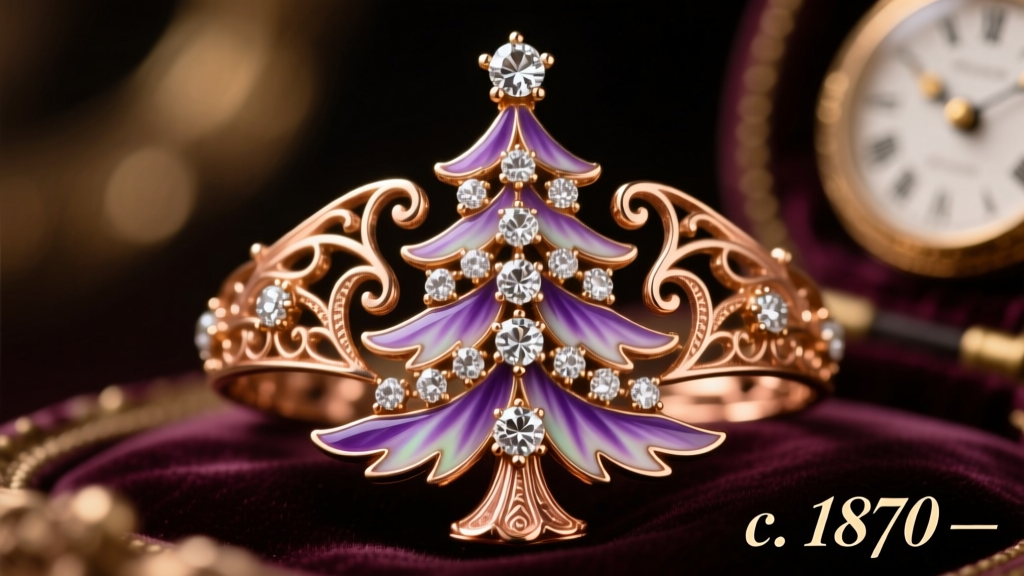
Christmas Trees Light Diamond Design with Purple Streaks, Circa 1870 — A Victorian Brooch Study
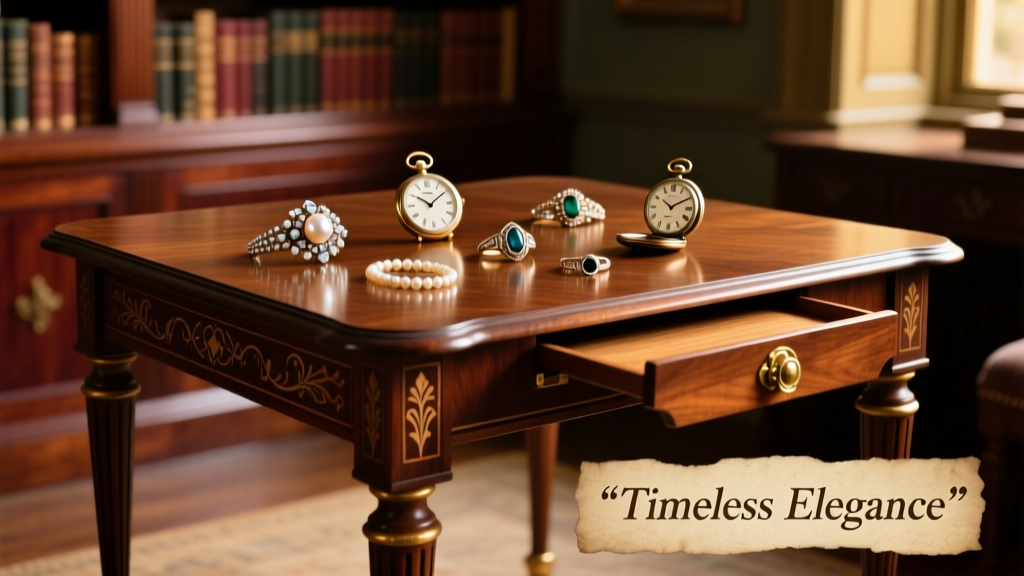
Hepplewhite Drop-Leaf Table in Walnut: Authentic 18th-Century Design, Square Legs, and Precise Proportions (12¾ Inches Deep)
Winchester Rifle Commands 7000: A Technical and Historical Analysis of the Legendary Fire Control System
The Nirvana Black Ibanez Signed in Silver: Authenticity, Provenance, and Auction Significance of Kurt Cobain’s Stage-Used Guitar

Barbie Mardi Gras 1987 Box: Rarity, Condition Metrics, and Auction Market Analysis
The 6-Oval Carved Jade Disk Bracelet: A Study in Ming-Inspired Flexibility, Material Integrity, and 20th-Century Goldsmithing
Furniture Chest, Campaign Brassbound Oriental, 24 × 39 Inches: Provenance, Construction, and Collectibility
Opalescent Glass Tumbler in Seaweed Blue: A Collector’s Guide to Mid-Century American Pressed Glass
The Western Electric Nickelodeon Piano Co. Model 62 × 44 in. No. 2: A Technical and Historical Appraisal of a Rare Electromechanical Music Machine