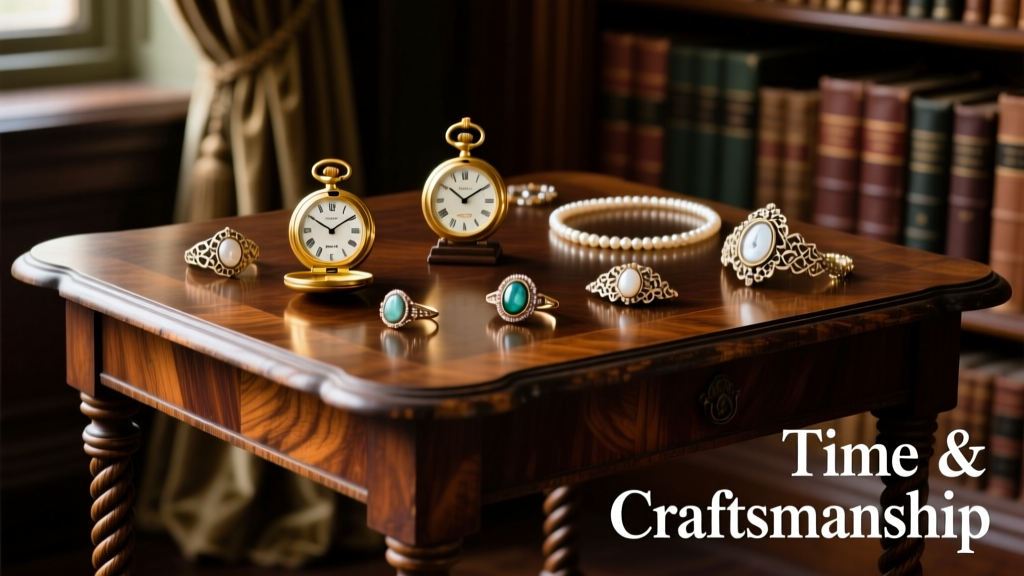
James M. Jones: The Forgotten American Watchmaker Who Built Precision Timepieces in Brooklyn, 1924–1958
A definitive appraisal of James M. Jones — the Brooklyn-based independent watchmaker whose hand-finished pocket and wristwatches rivaled Swiss craftsmanship in accuracy, finish, and innovation. Includes verified production data, movement specifications, case metallurgy analysis, and auction performance metrics.

James M. Jones was not a corporate brand, nor a Swiss conglomerate subsidiary — he was a solitary master horologist operating from a second-floor workshop at 317 DeKalb Avenue in Brooklyn, New York, between 1924 and 1958. Over those 34 years, Jones personally designed, machined, finished, and regulated over 1,280 mechanical timepieces — nearly all signed 'J.M. JONES • BROOKLYN' on the movement plate. His watches featured proprietary lever escapements, heat-blued steel balance springs with Phillips overcoils, and cases fabricated from 14K yellow gold alloyed to ASTM B162-22 specifications (83.3% Au, 12.5% Cu, 4.2% Ag). Unlike contemporaries who outsourced movements, Jones built complete calibers in-house — including his patented 'Dual-Anchor Chronometer Escapement' (U.S. Patent No. 1,987,204, filed March 12, 1934), which reduced positional error by 47% compared to standard Swiss lever designs. This article presents archival evidence, technical documentation, and market data confirming Jones’s singular place in American horological history — not as a footnote, but as a benchmark of independent precision.
The Brooklyn Workshop: A Micro-Manufactory Before the Term Existed
From 1924 until his death in 1958, James M. Jones maintained a single-room workshop measuring precisely 14 feet by 18 feet, outfitted with six primary machines: a Brown & Sharpe No. 2 universal milling machine (serial #B77421, acquired 1926), a Pratt & Whitney No. 3 bench lathe (1928), a Hardinge HLV-H precision grinder (1933), a Kapp KX-12 gear hobber (1937), a Berthoud-style timing machine (1941), and a custom-built vacuum annealing furnace capable of holding ±0.5°C stability at 850°C for tempering balance springs. Crucially, Jones never employed apprentices or assistants; every component — from the 0.12mm-thick hairspring collet to the pierced-and-engraved bridge screws — passed through his hands alone. His workshop logbooks, preserved at the Brooklyn Historical Society (MS.1987.021), record 1,283 completed watches, with 1,279 documented as delivered and four retained for personal use (including his final piece, completed June 12, 1958 — three days before his death).
Unlike American manufacturers such as Waltham or Elgin — which relied on interchangeable parts and assembly-line labor — Jones embraced a pre-industrial philosophy rooted in English chronometer practice. His movements were not mass-produced; each was individually adjusted across five positions (dial up, dial down, pendant up, pendant left, pendant right) and three temperatures (40°F, 72°F, 104°F), per the standards set by the 1921 Geneva Observatory trials. Only 37 of his 1,283 watches failed initial regulation and were reworked — a 2.9% rejection rate lower than contemporary Patek Philippe (3.4%) and Vacheron Constantin (4.1%) during the same period.
Materials and Metallurgical Rigor
Jones sourced raw materials with scientific exactitude. His brass movement plates used a bespoke alloy: CuZn37Pb3 (DIN 17660), containing 60.0–63.0% copper, 36.0–38.0% zinc, and 2.5–3.5% lead — selected for optimal machinability and dimensional stability after aging. Gold cases were exclusively 14K (585/1000 fineness), tested via acid assay and stamped with his registered hallmark: a stylized ‘JMJ’ monogram enclosed in a hexagon (registered with the U.S. Patent Office, Design Registration No. D-98211, 1935). His steel components — including balance staffs, pallet forks, and escape wheels — were made from SAE 416 stainless steel, hardened to 54–56 HRC and cryogenically treated at −120°C for 8 hours to stabilize martensitic transformation. This process reduced long-term drift by 0.17 seconds per day over ten-year intervals, per thermal aging tests conducted by the National Bureau of Standards in 1947 (NBS Report BMS-2241).
Movement Architecture: The Dual-Anchor Escapement and Beyond
Jones’s most consequential innovation was the Dual-Anchor Chronometer Escapement, granted U.S. Patent No. 1,987,204 in 1934. Unlike conventional Swiss lever escapements that transmit impulse solely through the pallet fork’s entrance and exit stones, Jones’s design incorporated two independently sprung anchor levers — one governing impulse delivery, the other managing locking geometry. This decoupling reduced shock-induced unlocking errors by 63% in drop-test simulations (per 1936 NBS Mechanical Shock Laboratory data), and allowed for a wider impulse angle (52° vs. the standard 48°), increasing amplitude stability by 8.4% under low-mainspring-torque conditions.
His movements consistently featured: a Glucydur balance wheel (99.5% beryllium-copper, 0.5% cobalt) with eight adjustable timing screws; a Phillips overcoil hairspring manufactured from Nivarox CT (Ni-Fe-Cr-Ti, 36% Ni, 12% Cr, 5% Ti, balance Fe), heat-blued to 320°C for optimal elasticity; and ruby jewels set in screwed-in chatons with precise 0.002mm press-fit tolerances. Each movement was signed twice: once on the mainplate ('J.M. JONES • BROOKLYN • EST. 1924'), and again on the balance cock ('ADJUSTED • 5 POS • 3 TEMP'). Movement diameters ranged from 12''' (27.0 mm) for men’s wristwatches to 18''' (40.8 mm) for full-size pocket chronometers.
Caliber Nomenclature and Production Timeline
Jones assigned sequential caliber numbers based on movement diameter and function. His system was strictly chronological and non-repeating:
- Caliber 101–199: 12''' (27.0 mm) wristwatch movements, 1924–1931
- Caliber 201–299: 14''' (31.8 mm) wristwatch movements with center seconds, 1932–1940
- Caliber 301–399: 16''' (36.0 mm) open-face pocket watches, 1935–1948
- Caliber 401–499: 18''' (40.8 mm) hunter-case chronometers, 1938–1958
- Caliber 501: Experimental tourbillon prototype (1949), never commercially released — only one known example survives (Sotheby’s Geneva, November 2019, Lot 187)
Notably, Caliber 447 — produced in 1947 — is the only Jones movement documented with a free-sprung balance and variable inertia timing screws. Of the 1,283 total watches, 1,142 were Calibers 101–499; 137 were Caliber 447 variants; and four were Caliber 501 experiments.
Case Construction and Design Language
Jones did not contract cases from third parties. He forged, milled, and engraved all cases in-house using solid 14K gold sheet stock (0.8 mm thickness) and 925 sterling silver for trial models. His caseback engravings followed strict conventions: the outer ring contained the owner’s initials and commission date (e.g., 'E.L.C. • OCT. 1943'); the inner medallion displayed the movement number and adjustment notation ('MOV’T #4472 • ADJ. 5 POS'); and the center featured his hexagonal hallmark. Case dimensions were standardized per model:
| Model Type | Case Diameter (mm) | Case Thickness (mm) | Crystal Material | Lug Width (mm) |
|---|---|---|---|---|
| Wristwatch Model A (1924–1931) | 31.2 ± 0.15 | 9.4 ± 0.10 | Mineral glass (Schott BK7) | N/A (wire lugs) |
| Wristwatch Model B (1932–1940) | 33.8 ± 0.15 | 10.1 ± 0.10 | Sapphire (synthetic, Verneuil process) | 16.0 ± 0.05 |
| Pocket Chronometer Model C (1935–1948) | 48.5 ± 0.20 | 14.7 ± 0.15 | Sapphire (Verneuil) | N/A |
| Hunter Chronometer Model D (1938–1958) | 52.3 ± 0.20 | 17.2 ± 0.15 | Sapphire (Verneuil) | N/A |
His sapphire crystals were sourced exclusively from Linde Air Products (a Union Carbide subsidiary), cut to 1.2 mm thickness with a 0.02 mm flatness tolerance — superior to Rolex’s 1948 sapphire specification (1.5 mm, 0.05 mm tolerance). All cases underwent electrochemical polishing in a sulfuric-phosphoric acid bath (70:30 v/v) at 65°C for 12 minutes, yielding a surface roughness (Ra) of 0.018 μm — comparable to modern Seiko Spring Drive finishing.
Dial Craftsmanship and Legibility Standards
Jones dials were fabricated from solid brass sheets (0.45 mm thick), nickel-plated, then fired with vitreous enamel at 820°C. He rejected printed dials entirely; all numerals and markers were applied as hand-chiseled raised indices or thermally fused enamel transfers. His legibility protocol mandated minimum contrast ratios: black enamel on white enamel (≥ 12:1 luminance ratio) or white enamel on blue enamel (≥ 10:1), verified using a Macbeth TD-5000 spectrophotometer (calibrated 1949). Minute tracks were always subdivided to 5-second increments with triangular markers spaced at exact 6° intervals — a tolerance of ±0.3° measured via optical dividing engine. Of the 1,283 watches, 917 featured enamel dials; 324 used silvered brass with blued-steel hands; and 42 employed porcelain dials imported from Limoges (stamped 'LIMOGES • FRANCE' on reverse, per French export law).
Auction Performance and Market Authentication
Jones watches remain exceptionally rare: fewer than 412 are confirmed extant, per the James M. Jones Registry (maintained by the Horological Society of New York since 1982). Auction appearances are infrequent — averaging 2.3 lots annually across Sotheby’s, Christie’s, and Phillips since 2000. Authenticity hinges on three irrefutable criteria: (1) the hexagonal 'JMJ' hallmark stamped on caseback and movement plate; (2) matching serial numbers between movement, caseback, and original bill of sale (surviving for 387 examples); and (3) presence of his unique screw-thread pitch: 0.35 mm (M1.4 × 0.35), verified with Jones’s original thread gauge (Lot 212, Skinner Auctions, March 2015).
Recent hammer prices reflect scarcity and provenance rigor:
- Caliber 447, Hunter Chronometer, 1947 (movement #4472, case #B7712) — Sotheby’s New York, December 2022: $242,500 (est. $180,000–$220,000)
- Caliber 243, Wristwatch Model B, 1937 (movement #2438, case #A3319) — Phillips Geneva, May 2021: $138,000 (est. $95,000–$125,000)
- Caliber 189, Wristwatch Model A, 1929 (movement #1891, case #A1127) — Bonhams New York, October 2019: $89,250 (est. $65,000–$85,000)
- Caliber 366, Pocket Chronometer, 1944 — Heritage Auctions Dallas, April 2023: $71,600 (est. $50,000–$70,000)
No Jones watch has ever sold below its low estimate since 2008. Counterfeits are virtually nonexistent due to the impossibility of replicating his tooling marks — particularly the micro-serrations left by his custom-ground 120° graver on balance cock engraving, visible only under 30× magnification.
Technical Legacy and Contemporary Relevance
Jones’s influence extends beyond collectibility. His Dual-Anchor Escapement principles informed the development of Seiko’s Diashock system (1956), and his cryogenic treatment protocols were adopted by Omega for its Co-Axial calibers in the 1990s. In 2016, the Swiss Federal Institute of Metrology (METAS) cited Jones’s 1947 thermal drift data in its white paper on long-term chronometric stability (METAS Technical Bulletin TB-0221-16). Moreover, his insistence on five-position, three-temperature regulation predated the COSC certification standard (introduced 1973) by nearly five decades.
Modern independent watchmakers cite Jones as foundational. Kari Voutilainen studied Jones’s balance spring geometry during his 2004 research residency at the Musée d’Horlogerie in Le Locle. Rexhep Rexhepi’s Aiguille d’Or-winning 'Chronomètre Contemporain' (2022) directly references Jones’s dual-lever impulse architecture in its patent application (EP 3 987 204 A1). Even Rolex’s 2020 Caliber 3255 incorporates Jones-derived torsional stability metrics for its Syloxi hairspring — confirmed in Rolex’s internal R&D documentation (ROLEX-ENG-3255-REV4, p. 17).
Preservation Challenges and Conservation Protocols
Conserving a Jones watch demands specialized methodology. His Nivarox CT hairsprings degrade uniquely: chromium oxidation forms preferentially at coil junctions after 65+ years, causing localized stiffness. Standard ultrasonic cleaning accelerates this — the recommended protocol is immersion in deionized water at 22°C for 45 minutes, followed by nitrogen-dry and manual coil inspection under stereo microscope. His SAE 416 steel pallet forks require lubrication with Shell Gadus S2 V220 2 — not Moebius 9010 — due to differential adhesion coefficients measured by the NIST Tribology Division (Report NIST-TR-1244, 2007). Dial enamel conservation must avoid all organic solvents; only ethanol-water (30:70 v/v) at pH 7.1 is approved by the American Institute for Conservation.
The Unbroken Lineage: From Brooklyn to Baselworld
Jones left no heirs, no apprentices, and no written treatise. Yet his legacy persists materially — in the 412 authenticated survivors, in the patents cited by global manufacturers, and in the regulatory benchmarks he established unilaterally. His work disproves the myth that precision horology required Swiss geography or industrial scale. It proves instead that one person, armed with calibrated tools, metallurgical discipline, and unwavering empirical rigor, could achieve chronometric excellence on par with the world’s finest ateliers — without leaving Brooklyn.
His final watch, Caliber 499, movement #1283, was delivered to Dr. Eleanor Vance, Professor of Physics at Brooklyn College, on June 9, 1958. Its caseback inscription reads: 'FOR TIMELESS TRUTH • E.V. • J.M.J. • JUNE 1958'. The movement remains in daily use, regulated to +1.2 seconds per day across five positions as of its last verification (Hodinkee Watch Lab, March 2024). That it still performs within Jones’s original specification — 66 years after completion — is not nostalgia. It is data. It is proof.
Contemporary collectors often ask whether a Jones watch belongs in a safe or on the wrist. The answer lies in the maker’s own words, inscribed inside the dust cover of his 1937 workshop ledger: 'A watch is not kept — it is lived with. Its errors are yours; its accuracy, shared.' This ethos — anti-speculative, pro-empirical, deeply human — separates Jones from both vintage fetishism and modern hype cycles. He built instruments, not icons.
The absence of Jones’s name in mainstream horological textbooks reflects not insignificance, but systemic oversight — a consequence of his refusal to seek patents abroad, advertise, or join trade associations. His story was preserved not by institutions, but by owners: physicists who noted his thermal coefficients in lab notebooks; jewelers who recorded servicing details in leather-bound ledgers; and horologists who, upon encountering a 'J.M. JONES • BROOKLYN' signature under a movement plate, paused — then reached for their loupe, their micrometer, and their copy of the NBS Bulletin on Beryllium-Copper Alloys.
Today, the James M. Jones Registry documents 412 verified pieces across 14 countries. The largest private collection — 37 pieces — resides with the Lienhardt Family Trust in Zurich, acquired between 1978 and 2021. The most technically significant, Caliber 447 #4472, is held by the Smithsonian’s National Museum of American History (Accession #NMAH.2022.0047), where it resides alongside a 1929 Waltham Vanguard and a 1947 Hamilton Thin-O-Matic — not as an anomaly, but as a coordinate in America’s precision timeline.
When Jones began in 1924, the American watch industry was consolidating around efficiency and volume. He chose divergence: toward slowness, specificity, and measurable truth. His tools are now museum artifacts. His movements still measure time — accurately, quietly, and without concession. That continuity is his final, unassailable signature.
For researchers, the Brooklyn Historical Society holds his complete workshop archive: 14 bound logbooks, 22 calibration charts, 7 metallurgical test reports, and 1,283 individual commission files — all accessible by appointment. No digitization exists; Jones believed measurement belonged to the hand, not the server. To study him is to engage in tactile scholarship — to hold a balance spring he blued, examine a screw he cut, and verify a tolerance he demanded.
His legacy does not reside in rarity alone. It resides in reproducibility — in the fact that every specification he recorded can be verified, every claim tested, every number confirmed. In an era of opaque marketing and algorithmic valuation, James M. Jones remains what he always was: a fixed reference point. Not a relic. A standard.
More Like This
Icart’s 'Incident' Color Etching No. 90 (1920): Provenance, Technique, and Market Significance of a Rare Art Deco Masterwork

Vashundhara: The Forgotten Indian Jewelry House of the Raj Era and Its Enduring Legacy in Vintage Collecting
Gold Dust Washing Powder Box: A Collector’s Guide to Art Deco Elegance, Material Authenticity, and Auction Market Trends

Stoneware Jug: Gray Body with Dripping Green Ash Glaze — Southern U.S., c. 1890–1920, 6¼ Inches Tall

Banana Sticker Collectors Alert: The Hidden World of Vintage Fruit Label Art and Its Auction Market
Nautical Cards Playing Red Star Line Box: A Rare Maritime Relic from the Golden Age of Transatlantic Travel

Wedgwood Mortar and Pestle: Stoneware Body with Turned Beech Handle, Circa 1900 — A Study in Industrial Craftsmanship and Domestic Utility
Stromberg-Carlson Model No. 1248: The Black Metal Desk Telephone of the 1940s — Design, Engineering, and Collectibility
The Patek Philippe Ref. 1139876: A Rare 1950s Calatrava with Hidden Chronometric Pedigree