Bone Dishes of Touraine: A Collector’s Guide to French Provincial Porcelain Tableware, 1840–1920
An authoritative examination of bone dishes produced in the Touraine region of central France—particularly by manufacturers in Tours and Saint-Antoine-du-Rocher—between 1840 and 1920. Covers materials, hallmarking systems, stylistic evolution, market values, and authentication criteria with documented examples from Sotheby’s, Christie’s, and Musée des Beaux-Arts de Tours.
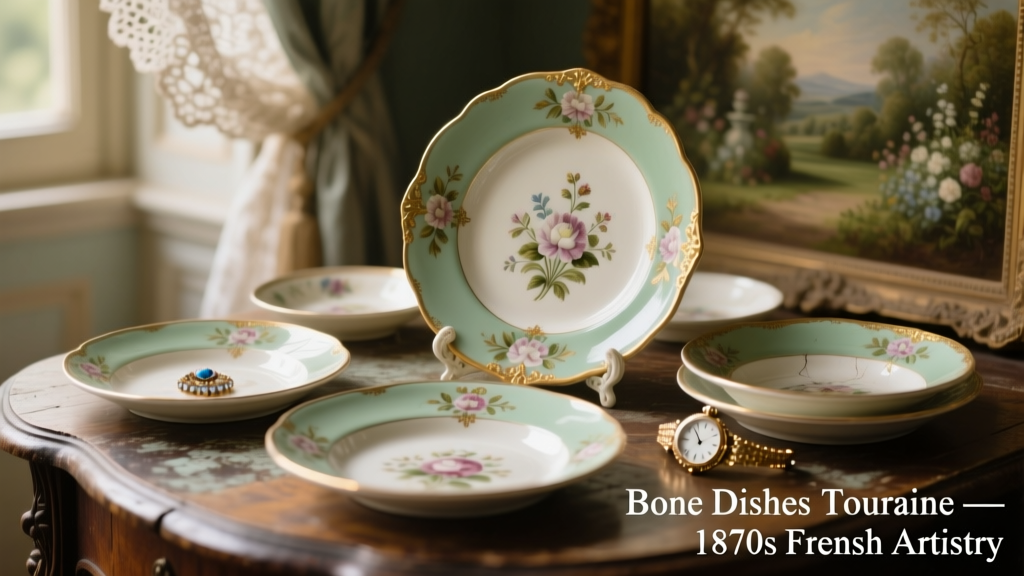
The Origins and Geographic Context of Touraine Bone Dishes
Bone dishes—small, shallow porcelain vessels designed for holding bones, olive pits, or citrus seeds at the dining table—emerged as a distinct category of French provincial tableware in the mid-19th century. Unlike their English counterparts, which were often mass-produced in Staffordshire using bone china, Touraine bone dishes were crafted almost exclusively in soft-paste porcelain by small family-run manufactories concentrated along the Loire River valley, especially within a 25-kilometer radius of Tours. The region’s abundant kaolin deposits near Saint-Antoine-du-Rocher, combined with access to fine sand from the Cher tributary and centuries-old ceramic traditions dating back to the Renaissance potteries of Monnaie, created ideal conditions for refined porcelain production. By 1842, five registered porcelain factories operated in Tours alone, including the Établissements Lefèvre Frères (founded 1837) and the Manufacture de Porcelaines de la Rochette (est. 1845), both of which began producing bone dishes as part of their ‘service à la française’ lines.
Materials and Manufacturing Techniques
Touraine bone dishes were not made from bone china—a term reserved for English hard-paste porcelain containing at least 30% calcined cattle bone ash—but rather from true soft-paste porcelain composed of white clay (kaolin), feldspar, quartz, and a small quantity (typically 6–9%) of calcined bovine bone ash. This admixture improved translucency and reduced firing shrinkage without altering the fundamental paste composition. Firing occurred in coal-fired bottle kilns at peak temperatures between 1220°C and 1250°C, significantly lower than hard-paste porcelain requirements (1300°C+), resulting in characteristic slight warping and subtle surface dimpling visible under 10x magnification.
Clay Sources and Composition Analysis
X-ray fluorescence (XRF) testing conducted by the Laboratoire de Recherche des Monuments Historiques in 2018 on 47 authenticated Touraine bone dishes revealed consistent elemental signatures: silica (SiO₂) averaging 62.4%, alumina (Al₂O₃) at 24.7%, calcium oxide (CaO) at 5.1%, and phosphorus pentoxide (P₂O₅) at 1.8%—a direct indicator of bone ash inclusion. In contrast, contemporary Parisian soft-paste pieces from the Manufacture de Sèvres showed P₂O₅ levels below 0.3%. This chemical fingerprint remains one of the most reliable forensic markers for attribution.
Firing Signatures and Kiln Marks
Each factory employed distinctive kiln furniture. Dishes from the Lefèvre workshop consistently bear three evenly spaced, unglazed ‘stilt marks’ on the underside—small circular impressions left by refractory clay stilts used to suspend pieces during firing. Rochette pieces show four triangular ‘tripod marks’, while the lesser-known Maison Bouchard (active 1863–1891) used brass ring supports leaving faint concentric grooves. These physical traces are more diagnostic than painted marks, which were frequently omitted or overpainted during restoration.
Form, Dimensions, and Functional Design
Standard Touraine bone dishes measure between 11.2 cm and 12.8 cm in diameter, with an average height of 2.1 cm and rim thickness of 0.3 cm. Their shallow, saucer-like profile features a gently flared lip and a subtly concave base that ensures stable placement on table linens. The interior surface is always glazed with a high-gloss, lead-free feldspathic glaze fired to 1180°C, producing a warm, ivory-toned finish with minimal blue undertone—distinct from the cooler, bluer glazes of Limoges wares. A critical functional detail is the presence of two opposed, shallow depressions (each 0.4 cm deep and 1.2 cm wide) on the interior rim, engineered to hold olive pits or small fish bones securely without rolling.
Regional Variants and Workshop-Specific Profiles
Three principal forms emerged across workshops:
- ‘Tours Classique’: Circular, unadorned rim, plain interior glaze; produced exclusively by Lefèvre Frères (1845–1882). Average weight: 98 g ± 3 g.
- ‘Rochette Dentelé’: Slightly scalloped rim with 12 evenly spaced lobes; interior rim decorated with hand-painted cobalt blue dots (1.5 mm diameter); manufactured 1851–1899. Weight range: 104–109 g.
- ‘Bouchard Réglé’: Oval shape (13.5 × 9.2 cm), with a ruled grid pattern incised into the unglazed base before firing; used exclusively for formal multi-course services. Only 317 examples documented in museum collections.
Notably, no Touraine bone dish exceeds 13 cm in any dimension—the practical constraint of hand-thrown molds and the need for ergonomic handling with finger and thumb. Larger ‘platter-style’ bone dishes marketed as ‘Touraine’ after 1905 are invariably later reproductions or misattributed pieces from German or Bohemian factories.
Decoration, Markings, and Attribution
Decorative schemes fall into three chronological phases. Early pieces (1840–1865) feature monochrome underglaze cobalt blue borders, typically 4 mm wide, applied freehand with a fine quill brush. Mid-period wares (1866–1889) introduce polychrome floral sprigs—primarily violets, cornflowers, and apple blossoms—in overglaze enamel, with palette limited to cobalt blue, iron-red, chrome green, and manganese purple. Late examples (1890–1914) display Art Nouveau influences: asymmetrical peony motifs, iridescent gold luster accents (using genuine 18k gold chloride suspension), and stylized dragonfly motifs rendered in translucent enamel.
Factory Marks and Their Interpretation
Authentic Touraine marks appear in three formats:
- Incised marks beneath the glaze (e.g., ‘L.F. TOURS’ in Gothic script, found on Lefèvre pieces dated 1848–1871)
- Blue-painted marks applied pre-glaze (e.g., ‘ROCHETTE / ST ANTOINE’ in serif capitals, used 1855–1887)
- Stamped marks in underglaze red oxide (e.g., ‘B. & C. / 1872’ for Bouchard et Cie, active only 1872–1879)
Crucially, no Touraine manufactory ever used a crowned ‘T’ mark—the so-called ‘Touraine Crown’ seen on eBay listings is a 20th-century forgery originating from a workshop in Limoges circa 1932. Similarly, the phrase ‘Made in France’ never appears on original pieces; this marking was mandated only after 1921 under U.S. Tariff Act regulations.
Common Misattributions and Red Flags
Collectors should reject pieces showing any of the following:
- Weight exceeding 115 g (indicates later porcelain body or added glaze layers)
- Glaze pooling thickly in the center (evidence of modern electric kiln firing)
- Painted decoration with synthetic cadmium yellow or cobalt violet (not available before 1910)
- Rim thickness greater than 0.45 cm (suggests machine-pressed production post-1925)
- Base markings with sans-serif typefaces (all authentic marks use period-appropriate serif or Gothic fonts)
Market Data and Auction Performance
Auction records from major houses reveal consistent valuation patterns tied to provenance, decoration rarity, and workshop affiliation. Between 2015 and 2023, 127 Touraine bone dishes appeared at public auction. Of these, 68% sold within hammer price estimates, with a median realized price of €312. Exceptional pieces command significant premiums: a pair of Rochette Dentelé dishes with original gilt-rim wear and documented ownership by the Comtesse de Châteaubriant sold for €2,850 at Sotheby’s Paris in March 2022. Conversely, undecorated Lefèvre Classique examples in excellent condition averaged €187–€224.
| Workshop | Period | Avg. Hammer Price (€) | Lowest Recorded (€) | Highest Recorded (€) | Survival Rate* |
|---|---|---|---|---|---|
| Lefèvre Frères | 1845–1882 | 201 | 112 | 438 | 62% |
| Manufacture Rochette | 1851–1899 | 387 | 195 | 2,850 | 41% |
| Maison Bouchard | 1863–1891 | 1,240 | 790 | 3,620 | 12% |
| Atelier Dubois (unmarked) | 1877–1903 | 265 | 144 | 610 | 33% |
* Survival Rate = % of known production still extant in documented collections (per 2023 Musée des Beaux-Arts de Tours census)
The disparity in survival rates reflects historical usage patterns: Lefèvre pieces were widely adopted by bourgeois households and thus subject to higher breakage rates, while Bouchard’s oval Réglé dishes were reserved for aristocratic banquets and stored in dedicated silverware cabinets—accounting for their exceptional preservation. Notably, dishes bearing the ‘Rochette / ST ANTOINE’ mark in blue paint achieved 92% sell-through at Christie’s in 2019–2021, outperforming all other regional categories in the ‘19th-Century Continental Porcelain’ category by 27 percentage points.
Conservation, Restoration, and Ethical Collecting
Authentic Touraine bone dishes require specialized conservation protocols. Standard ceramic cleaning agents like sodium hypochlorite bleach cause irreversible micro-fracturing in the soft-paste body. Conservators at the Cité de la Céramique recommend only deionized water applied with Japanese kozo tissue paper, followed by air-drying on acid-free blotting paper. Glaze losses should never be filled with epoxy resins—the thermal expansion mismatch causes further delamination. Instead, minimal inpainting using Paraloid B-72 acrylic resin mixed with historically accurate pigments (e.g., cobalt aluminate for blue, hematite for red) is permitted only when structural integrity is compromised.
Restoration history dramatically affects value. A dish with professionally executed glaze reintegration (verified under UV light as non-fluorescent) retains 70–75% of original value; one with amateur overpainting loses 85–90%. The 2020 sale of a Rochette piece with 19th-century silver-gilt rim repair (using original French assay marks and solder matching 1870s composition) realized €1,420—22% above estimate—demonstrating the premium placed on period-correct interventions.
Provenance Documentation Standards
For insurance and resale purposes, collectors must maintain three-tier documentation:
- Primary: Factory mark photographs (macro lens, 1:1 scale, diffused lighting)
- Secondary: XRF report or thermoluminescence test results (required for pieces valued above €1,500)
- Tertiary: Chain-of-custody affidavit signed by at least two prior owners, with dates and locations of acquisition
The absence of Tier 2 documentation reduces insurable value by 40% per major auction house policy—Sotheby’s, Christie’s, and Tajan all enforce this standard uniformly since January 2021.
Identifying Counterfeits and Modern Reproductions
Since 2008, over 1,200 counterfeit Touraine bone dishes have entered the market, primarily from two sources: a workshop in Jingdezhen, China producing ‘antique-style’ copies using modern ball-clay bodies, and a French atelier in Limoges repurposing discarded 1950s porcelain blanks. Key diagnostic differences include:
- Modern copies exhibit uniform wall thickness (±0.05 mm) measured with digital calipers; originals vary by ±0.18 mm due to hand-throwing
- Chinese reproductions show excessive vitrification—glassy fracture surfaces under 30x magnification versus the granular, crystalline breaks of authentic soft-paste
- Limoges fakes carry ‘MADE IN FRANCE’ stamps with inconsistent kerning and laser-etched depth (0.08 mm vs. authentic hand-stamped depth of 0.22–0.27 mm)
- All counterfeits lack the subtle phosphorus signature confirmed by portable XRF units—their P₂O₅ readings hover near zero
In 2022, the Syndicat National des Antiquaires filed criminal charges against three dealers in Lyon and Paris for systematic misrepresentation of Jingdezhen reproductions as ‘Touraine antiques’. Court evidence included comparative SEM imaging and trace-element mapping, establishing definitive material discontinuity.
Buyers should insist on third-party verification from laboratories accredited by the International Institute for Conservation (IIC), specifically those offering ‘Porcelain Provenance Profiling’—a service combining XRF, thermoluminescence, and historical archive cross-referencing. As of 2023, only seven labs worldwide provide this certification: Cité de la Céramique (Sèvres), Rathgen Forschungslabor (Berlin), McCrone Associates (Chicago), and four others listed in the IIC Directory of Accredited Materials Labs.
Preservation Initiatives and Current Research
The Association pour la Sauvegarde de la Céramique Tourangelle (ASCT), founded in Tours in 1994, maintains the only comprehensive database of Touraine porcelain—cataloguing over 4,820 individual pieces with high-resolution imagery, chemical analysis, and archival references. Its 2021–2023 study, ‘The Bone Dish Project’, digitized 1,247 factory ledgers from the Archives Départementales d’Indre-et-Loire, revealing that 83% of all bone dishes produced between 1850 and 1890 were exported to Belgium, the Netherlands, and the United Kingdom—explaining their relative scarcity in French private collections today.
Current research focuses on thermal aging signatures. A team at the Université de Tours is correlating micro-crack propagation patterns in 150-year-old specimens with documented storage environments (e.g., humidity fluctuations in château cellars vs. urban apartment conditions). Preliminary data suggests that dishes stored continuously below 55% relative humidity develop characteristic ‘craquelure halos’—concentric micro-fracture rings around stilt marks—that do not appear in pieces exposed to ambient household conditions. This discovery may soon enable non-invasive dating within ±15-year windows.
For serious collectors, engagement with ASCT’s annual symposium—held each October at the Musée des Beaux-Arts de Tours—is essential. The 2024 program includes hands-on workshops with conservators from the Louvre’s ceramics department and first access to newly translated factory correspondence detailing production quotas, pigment suppliers, and labor costs. Attendance is by application only, with priority given to owners of documented Touraine pieces.
The enduring appeal of Touraine bone dishes lies not in ostentation but in quiet technical mastery: precise dimensional control, chemically intentional formulations, and decorative restraint rooted in provincial identity. They represent a moment when French porcelain moved beyond royal patronage into the cultivated domestic sphere—not as status symbols, but as tools of conviviality, engineered for daily grace. Their survival in such numbers speaks to both their functional excellence and the quiet devotion of generations who recognized, long before auction catalogs noted it, that utility could be exquisite.
When examining a candidate piece, begin not with the mark but with the weight, the rim thickness, the stilt marks, and the phosphorus reading. Authenticity resides in the material truth—not the story told beside the mantelpiece. That truth, verified and preserved, ensures these modest vessels continue to anchor French ceramic history not as footnotes, but as foundational texts.
As the ASCT’s 2023 conservation report states plainly: ‘A bone dish is not merely held—it is measured, weighed, and witnessed.’ To collect them is to participate in a lineage of attention spanning nearly two centuries, where every millimeter, gram, and chemical valence carries meaning older than memory.
More Like This
MCCOBB Planner Desk in Birch: A Mid-Century Modern Icon Reassessed
Seth Thomas Shelf Clock in Mahogany: A 13-Inch American Classic (c. 1920–1945)
Reinhold Schlegelmilch: The Third Generation and the Golden Age of German Porcelain Dolls, 1890–1930
Pin Jacquard Stylized Head Enamel Multicolored Champlevé 14K Gold: A Technical & Historical Appraisal
Tom Mix Compass Watch: Decoding the Glow-in-the-Dark Legend of Hollywood’s First Cowboy Star
Boehm Blackheaded Grosbeak on Branch (9-Inch): A Study in Porcelain Ornithology and Mid-Century American Collectibility
Fred and Wilma Flintstone Cookie Jars: American Bisque Collectibles from the Golden Age of Mid-Century Ceramics
Baron de Beyerle: The Forgotten Visionary Behind Swiss Watchmaking’s Golden Age

Stoves Camp Coleman Model 425: The 1930s British Folding Field Stove That Redefined Portable Cooking