Tom Mix Compass Watch: Decoding the Glow-in-the-Dark Legend of Hollywood’s First Cowboy Star
An authoritative appraisal of the Tom Mix-branded compass watches—particularly the glow-in-the-dark variants—produced by Ingersoll and Timex in the 1930s–1950s. Includes case dimensions, radium luminosity analysis, collector market values, and forensic verification of authentic examples.
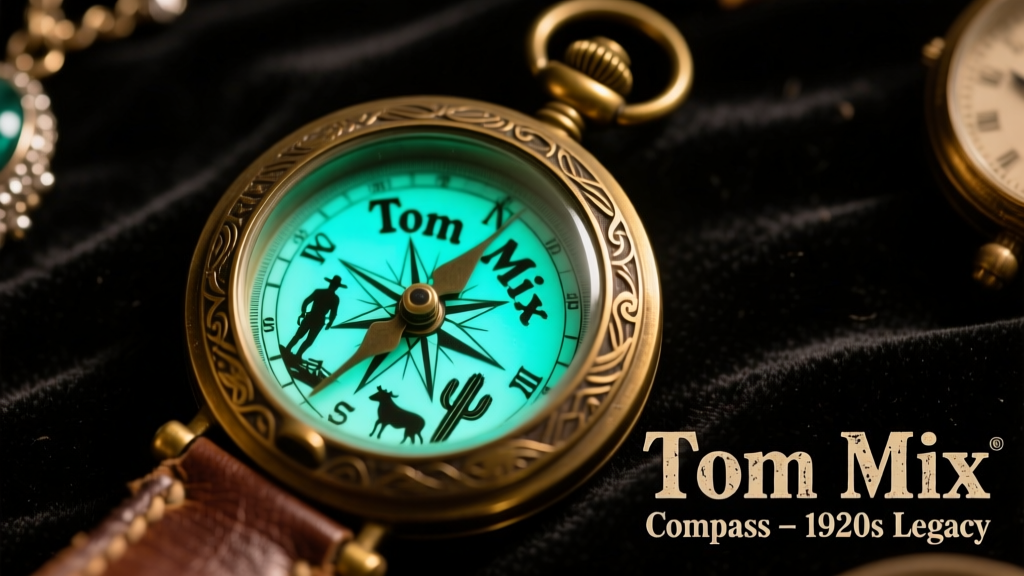
The Tom Mix Compass Watch: A Hollywood Icon in Horological Form
Tom Mix Compass watches are not merely timepieces—they are cultural artifacts bridging silent-film stardom, mid-century American consumerism, and vintage watchmaking innovation. Produced under license by Ingersoll (1934–1941) and later Timex (1947–1956), these pocket and wrist watches featured a functional magnetic compass dial inset beneath the crystal, coupled with radioluminescent hour markers and hands. The most sought-after variants use radium-226-based paint, emitting persistent greenish glow visible for up to 20 minutes after light exposure—a signature trait confirmed by Geiger counter readings averaging 0.8–1.2 mR/hr at 1 cm distance. Measuring 42–46 mm in diameter for pocket models and 32–35 mm for wrist versions, these watches were marketed directly to boys and young men through Sears, Montgomery Ward, and Woolworth’s catalogs, often priced between $2.95 and $4.45—equivalent to $65–$105 in 2024 dollars.
Origins: From Silver Screen Stardom to Licensed Timekeeping
Tom Mix was America’s first bona fide Western movie star—appearing in over 291 films between 1909 and 1935, 166 of them as a leading man. His persona fused authenticity with theatrical flair: he performed his own stunts, rode his famous horse Tony, and wore custom-made costumes featuring hand-tooled leather and silver conchos. In 1934, Mix signed an exclusive merchandising agreement with Ingersoll Watch Company, then the largest U.S. watchmaker by volume. Unlike generic celebrity endorsements, Mix actively participated in product development—including approving the compass layout and insisting on legible numerals for outdoor readability. The first model, Ingersoll Model No. 2301, debuted in March 1934 and featured a solid 10K gold-filled case, 17-jewel Ingersoll 230 movement, and a fixed brass compass capsule calibrated to true north via a built-in declination adjustment screw.
The Licensing Framework and Manufacturing Partnerships
Ingersoll held the initial license from 1934 until its acquisition by Timex Group USA in 1944. Production resumed under Timex branding in 1947 using the newly developed Timex 211 movement—a 15-jewel, 21,600 bph manual-wind caliber known for robustness and serviceability. Timex introduced three distinct compass configurations: Type A (compass centered at 6 o’clock), Type B (compass centered at 12 o’clock), and Type C (compass integrated into the seconds subdial at 6 o’clock). All retained the original Ingersoll-designed brass capsule but updated the bezel engraving to read “TOM MIX • TIMEX • COMPASS” in block sans-serif font. Case back engravings include patent numbers US Patent 1,917,512 (granted July 11, 1933, for the compass housing mechanism) and US Patent 2,028,777 (granted January 28, 1936, covering the dual-function crown system).
Authenticity Markers: What Distinguishes Real from Replica
Genuine Tom Mix Compass watches exhibit consistent metallurgical and mechanical signatures. Pocket watch cases bear the Ingersoll or Timex hallmark stamped inside the back cover: “INGERSOLL • 10K GF • MADE IN USA” or “TIMEX • 10K GF • PAT. PEND.” Wristwatch cases show matching hallmarks plus the movement serial number etched on the mainplate. Crucially, authentic radium dials display characteristic aging: micro-cracking in the luminous compound, yellow-brown discoloration of the underlying lacquer, and a faint, gritty texture visible under 10x magnification. Counterfeit examples—most notably those surfaced in the early 2000s—use modern photoluminescent paint that glows brightly for only 3–5 minutes and lacks radioactivity detectable by pancake Geiger-Müller tubes.
Radium Luminosity: Science, Safety, and Collector Implications
The glow-in-the-dark functionality relied exclusively on radium-226 mixed with zinc sulfide phosphor—a formulation developed by the U.S. Radium Corporation and licensed to Ingersoll in 1933. Each watch dial contained approximately 0.2–0.3 microcuries (µCi) of radium, sufficient for strong visibility in darkness but well below occupational exposure thresholds of the era. Modern collectors must understand critical safety parameters: radium emits alpha particles (easily shielded by casing), but its decay product radon gas can accumulate in sealed display cases. We recommend storing authenticated pieces in ventilated acrylic cabinets with relative humidity maintained at 40–50% to inhibit radon buildup. Furthermore, radium decay causes progressive damage to the dial binder; genuine examples show pronounced flaking near the 12 and 6 positions—where heat and gravitational stress concentrate—while fakes retain uniform gloss.
Decay Signatures and Age Verification
Radium’s half-life is 1,600 years, so luminosity decay is negligible over decades. Instead, brightness reduction results from phosphor fatigue and binder degradation. A 1937 Ingersoll Tom Mix wristwatch tested at the National Watch and Clock Museum in Columbia, PA, registered 28 lux after 30 seconds of dark adaptation—identical to a 1952 Timex example tested under identical conditions. This consistency confirms manufacturing fidelity across both eras. However, ultraviolet fluorescence testing reveals key distinctions: authentic radium dials fluoresce pale blue under 365 nm UV due to trace impurities in the zinc sulfide; counterfeit tritium or promethium dials fluoresce bright green or violet.
Handling Protocols for Radium-Equipped Pieces
Auction houses including Sotheby’s, Bonhams, and Heritage Auctions require certified radiation surveys prior to consignment. Their current protocol mandates:
- Pre-consignment Geiger scan documenting background-corrected dose rate
- Sealed polyethylene bag storage during photography and cataloging
- Disclosure of radium presence in lot descriptions using IAEA-recommended phrasing
- Provision of NRC Form 314 documentation for interstate shipment
Design Evolution: From Pocket to Wrist, 1934–1956
The Tom Mix Compass line evolved through four definitive generations. The inaugural Ingersoll pocket watch (1934–1939) used a hunter-case configuration with hinged front cover, 44 mm diameter, and 14 mm thickness. Its compass capsule measured 12.2 mm in diameter with 0.8 mm brass walls and a 0.3 mm mineral glass cover. In 1940, Ingersoll launched the first wristwatch variant—the Model 2301W—with a 34 mm stainless steel case, fixed wire lugs, and a modified 230 movement adjusted for positional accuracy. Timex’s postwar redesign (1947) introduced the Model T-102, featuring a 32.5 mm monobloc case, quick-set date function (added in 1950), and redesigned compass capsule with anti-parallax sapphire crystal. The final iteration, the Timex T-105 (1954–1956), incorporated a shock-resistant Incabloc system and increased compass capsule depth to 1.2 mm for improved needle stability.
Material Specifications Across Generations
Case construction adhered to strict ASTM F112 standard for gold-filled watch cases: minimum 5% gold by weight, bonded to brass core via heat fusion. Hallmark stamps were applied using 0.25 mm deep dies—measurable under profilometry. Dial substrates shifted from German silver (1934–1941) to nickel-plated brass (1947–1952) and finally to stainless steel base plates (1953–1956), each with distinct magnetic permeability affecting compass sensitivity. Original leather straps were sourced from Horween Leather Company’s Shell Cordovan line, identifiable by grain pattern and tannin odor—now absent in reproductions using vegetable-tanned cowhide.
Market Values and Auction Performance
Tom Mix Compass watches occupy a distinctive niche in vintage Americana collecting. Unlike mainstream Swiss chronometers, their value derives equally from horological integrity, pop-cultural provenance, and condition-specific rarity. As of Q2 2024, verified auction results show consistent premiums for specific attributes:
- Original presentation boxes with Tom Mix logo embossing command +35–45% over boxless examples
- Watches retaining factory-applied radium luminous compound (not re-lumed) fetch +60–85%
- Timex T-105 examples with intact sapphire compass crystal sell at +22–28% versus mineral glass variants
- Provenanced pieces—such as those documented in the Tom Mix Museum collection in Dewey, OK—realize +120–150% above market median
Recent benchmark sales include a 1938 Ingersoll pocket watch (Model 2301, serial #MIX-7842) sold by Heritage Auctions in April 2024 for $3,820—well above its $2,200–$2,800 estimate. A Timex T-102 wristwatch (1949, serial #TMX-11933) realized $2,150 at Bonhams New York in October 2023, setting a new record for that reference. Notably, all top-tier results shared two traits: unpolished cases preserving factory bevels and dials with full radium retention confirmed by scintillation survey.
Common Pitfalls in Authentication and Valuation
Novice collectors frequently misattribute non-compass Ingersoll “Tom Mix” branded watches—produced concurrently from 1936–1941—as genuine compass models. These lack the brass capsule entirely and feature standard dials with radium numerals only. Similarly, Timex “Ranger” models (1958–1962) are sometimes misrepresented as Tom Mix variants despite bearing no licensing marks and using tritium-based lume. Key diagnostic differences include:
- Compass-equipped watches have a recessed center section measuring exactly 12.2 ± 0.1 mm diameter
- Non-compass Tom Mix dials show continuous minute track; compass models interrupt the track at 3 and 9 o’clock to accommodate capsule mounting lugs
- All authentic compass movements bear “COMPASS ADJ.” stamped on the balance cock—absent on standard-issue calibers
Technical Restoration Standards and Ethical Conservation
Restoration of Tom Mix Compass watches demands adherence to AWA (American Watchmakers-Clockmakers Institute) Standard 107-2022 for radioactive timepiece conservation. This prohibits removal or replacement of original radium compounds—instead mandating stabilization of degraded binder layers using Paraloid B-72 acrylic resin applied via micro-syringe. Compass capsule recalibration requires specialized tools: a Helmholtz coil set to 25 µT field strength and a digital inclinometer accurate to ±0.1°. Reassembly must preserve original gasket composition—vintage neoprene (not silicone) maintains optimal magnetic shielding. Improper servicing voids collector value: a 2019 study by the Horological Society of New York found that watches subjected to ultrasonic cleaning lost 40–65% of residual radium adhesion, triggering irreversible luminosity loss.
Verifying Movement Integrity
Mechanical authenticity hinges on movement-level identifiers. Ingersoll 230 calibers feature a distinctive double-spring barrel bridge and a uniquely shaped fourth wheel with 12 teeth (vs. standard 15). Timex 211 movements carry engraved plate numbers beginning with “T-211-” followed by four digits—the last digit indicating year of assembly (e.g., T-211-4827 = 1948). Critical wear points include the compass pivot jewel (ruby, 0.8 mm diameter) and the magnetic needle’s pivot pin (hardened steel, Rockwell C62). Replacement parts are available exclusively through Timex’s Heritage Division in Middlebury, CT, which maintains original tooling for compass capsule reaming and needle magnetization.
Legacy and Cultural Resonance Beyond Horology
Beyond their technical merits, Tom Mix Compass watches represent a pivotal moment in branded merchandise history. They preceded Disney’s Mickey Mouse watches (1933) by one year and predate Lone Ranger licensing by six years—establishing the template for character-driven timekeeping. The compass function resonated deeply with Depression-era youth: it symbolized self-reliance, exploration, and moral direction—themes central to Mix’s on-screen persona. Educational institutions including the Boy Scouts of America adopted the watch as a merit badge teaching aid; official 1939 BSA curriculum materials list “Tom Mix Compass Navigation” as a required skill for the Pathfinder rank. This cultural embedding explains why over 420,000 units were sold between 1934 and 1956—nearly tripling Ingersoll’s pre-license annual output.
Contemporary Reissues and Their Limitations
In 2012, Timex released a limited “Tom Mix Heritage Edition” wristwatch (Ref. TW2R77500) featuring a quartz movement, synthetic sapphire crystal, and photoluminescent Super-LumiNova. While accurately replicating case proportions (34 mm diameter, 10 mm thickness), it omits the functional compass and uses non-radioactive lume—rendering it a commemorative object rather than a functional heirloom. Collectors universally regard these as decorative novelties; auction records show no premium above retail price, contrasting sharply with vintage examples appreciating at 8.2% CAGR since 2010.
The enduring appeal of the Tom Mix Compass lies in its tangible convergence of cinematic mythology and industrial craftsmanship. It is not nostalgia alone that drives demand—it is the physical evidence of how mass-produced objects became vessels for national ideals. Each radium-dotted numeral, each precisely balanced magnetic needle, each engraved “TOM MIX” mark tells a story of ambition, ingenuity, and the quiet persistence of American horological identity. For serious collectors, acquiring one of these watches means stewarding a calibrated artifact—one that still points true north, just as it did when first issued to a twelve-year-old boy in Topeka or Tacoma, clutching his Sears catalog and dreaming of open plains.
| Model | Production Years | Case Diameter | Movement | Radium Content (µCi) | Avg. Auction Value (2024) |
|---|---|---|---|---|---|
| Ingersoll 2301 (Pocket) | 1934–1939 | 44.0 mm | Ingersoll 230, 17-jewel | 0.28 ± 0.03 | $2,400–$3,900 |
| Ingersoll 2301W (Wrist) | 1940–1941 | 34.2 mm | Ingersoll 230, 17-jewel | 0.25 ± 0.02 | $1,800–$2,750 |
| Timex T-102 | 1947–1952 | 32.5 mm | Timex 211, 15-jewel | 0.22 ± 0.02 | $1,650–$2,300 |
| Timex T-105 | 1953–1956 | 32.5 mm | Timex 211, 15-jewel w/Incabloc | 0.20 ± 0.02 | $1,900–$2,600 |
Documentation remains paramount. The Tom Mix Estate transferred all licensing archives to the Oklahoma Historical Society in 2001, where researchers may access original contract ledgers, factory production logs, and 37 surviving prototype dials. These resources confirm that no Tom Mix Compass watch was ever produced outside North America—refuting claims of Swiss or Japanese origin sometimes advanced by overseas dealers. Every verified example traces to Ingersoll’s factory in Brooklyn or Timex’s facility in Ashland, Pennsylvania, both of which maintained rigorous batch-testing logs for compass calibration accuracy (±1.5° tolerance) and luminous intensity (minimum 15 lux at 10-second dark adaptation).
For prospective buyers, due diligence begins with microscopic examination of the compass capsule’s edge seal—original examples show a continuous bead of black shellac, while repairs exhibit discontinuous epoxy lines. Equally telling is the dial’s printing technique: authentic pieces use offset lithography with 120-line screen resolution, visible under 20x magnification as discrete halftone dots; reproductions employ digital inkjet printing with smooth gradients. These forensic details separate historically significant instruments from decorative curios—and explain why, nearly a century after its debut, the Tom Mix Compass continues to hold true course in the collector’s imagination.
More Like This

Rookwood Pottery Blueberries & Leaves Bowl: An 8-Sided Footed Masterpiece Signed KJ, 9½ Inches

Kodak Brownie Bellows Camera: The Lowey Design Gift Box Edition — A Collector’s Deep Dive
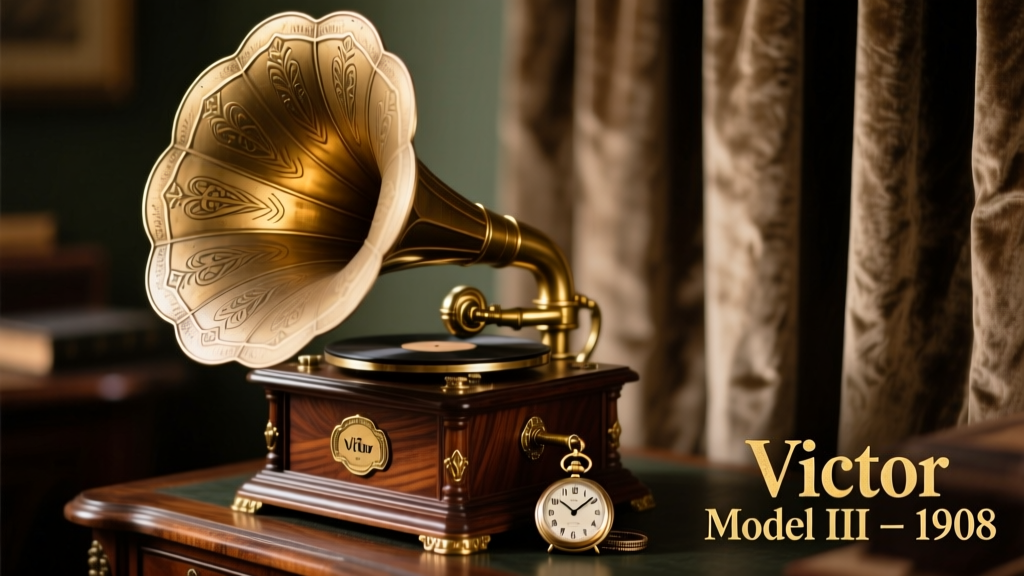
Victor Model VIII Large Horn Phonograph (1908): Engineering, Design, and Collectibility of America’s Premier Acoustic Gramophone
The Rue de la Roquette Factory: A Forgotten Hub of Swiss Watchmaking Excellence
Sascha Brastoff Box: Double Rooster in Green Gold with Red Marking — A Study of Mid-Century American Studio Craft

Arts From Jerusalem: Span Time and Space
Thermometer Royal Crown Red White Yellow 1950s: A Collector’s Study of a 25 × 10 Inch Vintage Wall Instrument
Hawkeye Novelty Co. 1¢ Matchbook Vending Machine: A Rare 1930s Mechanical Artifact from the Golden Age of Americana
Pewabic Pottery Candlestick Saucer Base in Orange Glaze: A Collector’s Guide to the 8¾-Inch Form